
You type a prompt into ChatGPT, get a poem about your cat, and hit send. It feels instant, weightless, almost magical. But behind that digital sparkle sits a physical reality that’s getting heavier by the day. We’re talking about massive server farms humming with heat, guzzling electricity, and drinking up local water supplies. As we move deeper into 2026, Generative AI is no longer just a tech novelty; it has become a major industrial consumer of resources. If you’ve ever wondered what the environmental price tag is for those endless image generations and chatbot conversations, you’re asking the right question.
The core issue isn’t just that AI uses power-it’s how much, and how fast that demand is growing. Traditional computing was efficient. Generative AI is brute force on a scale we haven’t seen before. Training a single large model can take months of continuous operation for thousands of processors. The result? A surge in global energy demand that’s stressing power grids and raising serious questions about whether our current infrastructure can keep up without wrecking the planet.
Key Takeaways
- Energy Intensity: Training clusters for generative AI consume 7-8 times more energy than standard computing workloads.
- Inference Costs: A single query to a tool like ChatGPT uses roughly five times more electricity than a standard web search.
- Water Usage: Data centers require significant water for cooling, creating competition with local communities in dry regions.
- Carbon Footprint: Training one large model can emit as much CO2 as hundreds of cars driving for a year.
- Future Outlook: Without efficiency gains, AI could account for up to 3% of global electricity use by 2030.
The Energy Hunger of Large Models
Let’s look at the numbers, because they are staggering. When researchers from MIT studied the impact of these systems, they found that training clusters for generative AI require seven to eight times more energy than typical computing tasks. This isn’t a small increment; it’s a fundamental shift in power density. Think about GPT-3, which consumed 1,287 megawatt-hours during its training phase. To put that in perspective, that’s enough electricity to power about 120 average U.S. homes for an entire year. And that was just one iteration. Newer models are exponentially larger.
But training is only the beginning. Once a model is live, it enters the "inference" phase-this is when you actually use it. Every time you ask for a recipe or generate an image, servers spin up to process that request. Research indicates that interactions with AI tools can consume ten times more electricity than a standard Google search. Why? Because a search engine mostly retrieves existing text. An AI model calculates probabilities across billions of parameters to create something new from scratch. That calculation costs energy. With millions of users hitting these services daily, the cumulative load is immense.
Global data center consumption reflects this trend. In North America alone, power requirements nearly doubled between 2022 and 2023, largely driven by AI demands. Globally, data centers now sit among the top consumers of electricity, rivaling nations like France. If current trajectories hold, AI infrastructure could push global data center electricity use to 3% of the world total by 2030. That might sound small, but in absolute terms, it’s equivalent to adding another industrial nation to the grid.
Water: The Hidden Cost of Cooling
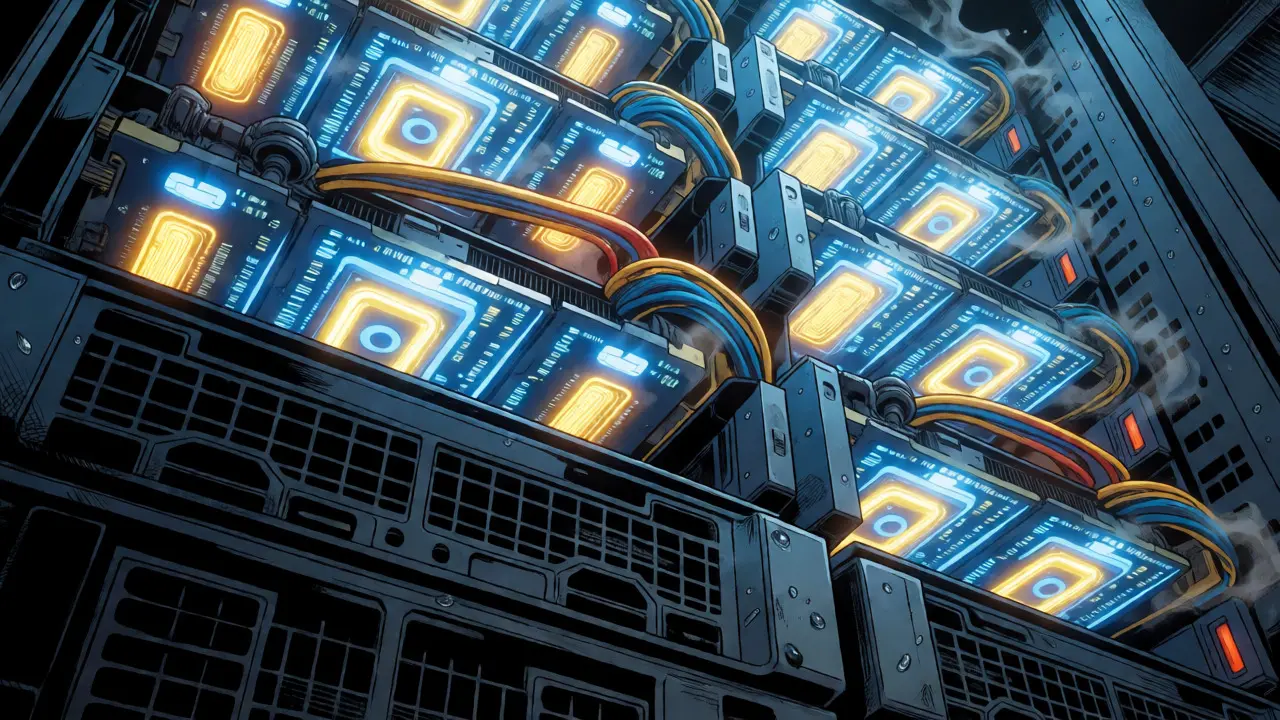
Heat is the enemy of electronics. When thousands of GPUs run at full capacity, they generate intense heat. If they get too hot, they throttle performance or fail. To prevent this, data centers use sophisticated cooling systems. Many rely on evaporative cooling, where water is used to absorb heat and then released as steam. This sounds simple, but it consumes vast amounts of fresh water.
This creates a direct conflict with local environments. In regions already facing water scarcity, such as parts of the American Southwest or Southern Europe, data centers compete with agriculture and residential needs. While exact figures vary by facility design, the demand is rising sharply. Some facilities are moving toward closed-loop liquid cooling to reduce evaporation, but the transition is slow. For communities near these hubs, the sight of white plumes rising from cooling towers is becoming a symbol of AI’s physical footprint. It’s not just about kilowatts anymore; it’s about liters.
Carbon Emissions and Grid Reality
Energy consumption translates directly to carbon emissions, depending on how that electricity is generated. Ideally, we’d power all these servers with wind and solar. In reality, the grid is still heavily reliant on fossil fuels. Noman Bashir, a researcher at MIT, points out a critical bottleneck: the pace of building new data centers outstrips the rollout of renewable infrastructure. Companies need stable, 24/7 power. Solar doesn’t work at night, and wind is intermittent. Until battery storage scales up massively, many new AI facilities will continue to plug into coal or natural gas plants.
| Metric | Standard Web Search | Generative AI Query | Notes |
|---|---|---|---|
| Electricity Use | Low (0.3 Wh) | High (1.5-3.0 Wh) | AI requires complex matrix multiplications. |
| CO2 Emissions | Negligible per query | Significant at scale | Dependent on local grid carbon intensity. |
| Hardware Lifespan | 3-5 years | 2-3 years (GPUs) | Rapid obsolescence drives e-waste. |
| Water Usage | Minimal | High (Cooling) | Evaporative cooling dominates older designs. |
The carbon cost of training itself is also high. Training a model like BLOOM emitted greenhouse gases comparable to what a French citizen generates in a year. Multiply that by the dozens of foundation models being developed annually, and the sector’s contribution to climate change becomes undeniable. Furthermore, the devices we use to access AI-laptops, phones, tablets-account for 25% to 45% of the total carbon footprint of some AI services. So, it’s not just the cloud; it’s the edge too.
E-Waste and Resource Extraction
There’s a third pillar of sustainability often overlooked: hardware lifecycle. Generative AI relies on specialized chips, particularly Graphics Processing Units (GPUs). These components are expensive, powerful, and short-lived. As newer, faster models emerge, older hardware becomes obsolete quickly. This leads to a surge in electronic waste. Disposing of these chips isn’t trivial; they contain rare earth minerals and toxic materials.
Moreover, mining these minerals for new chips causes environmental degradation. Lithium, cobalt, and copper extraction disrupts ecosystems and requires substantial water and energy. The cycle of build-run-discard is accelerating. Unlike a bookshelf that lasts decades, a GPU cluster might be replaced every three years to stay competitive. This rapid turnover puts pressure on supply chains and increases the embodied carbon of AI infrastructure before a single prompt is even processed.
Pathways to Greener AI
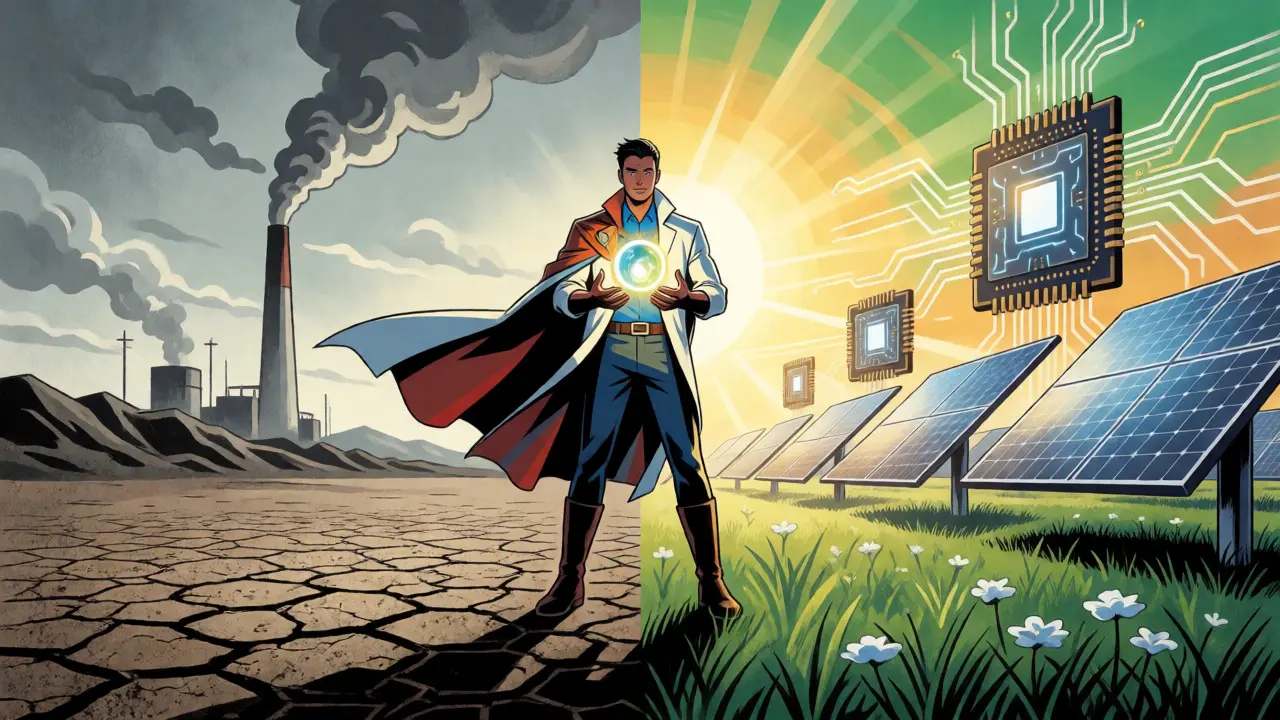
So, is there hope? Yes, but it requires intentional effort. We aren’t stuck with business as usual. Several strategies are emerging to mitigate these impacts.
First, hardware innovation. Researchers are exploring neuromorphic chips and optical processors that mimic the human brain’s efficiency. These technologies promise to perform AI calculations with far less energy than traditional silicon GPUs. While still in early stages, they represent a potential leap forward in efficiency.
Second, software optimization. Not every task needs a trillion-parameter model. Developers are learning to "distill" models-creating smaller, leaner versions that retain most of the capability but use a fraction of the compute. There’s also the concept of "green coding," where algorithms are designed specifically for energy efficiency rather than just speed or accuracy.
Third, renewable integration. Tech giants are signing long-term power purchase agreements for wind and solar. They are also experimenting with colocating data centers near renewable sources. However, as noted earlier, intermittency remains a hurdle. Better battery storage and smart grid management are essential to make this viable at scale.
Finally, user behavior matters. Do you really need a high-resolution image generation for a quick brainstorm? Or would a text summary suffice? Being mindful of how we interact with these tools can reduce unnecessary computational load. The "rebound effect" warns us that as technology gets cheaper and more efficient, we tend to use it more, potentially offsetting gains. Conscious usage is part of the solution.
Frequently Asked Questions
How much energy does one ChatGPT query use?
Research suggests a single query consumes approximately 0.003 kWh, which is roughly five to ten times more than a standard Google search. While small per instance, the volume of queries makes this significant globally.
Why do AI data centers use so much water?
GPUs generate intense heat during operation. Many data centers use evaporative cooling systems, where water absorbs heat and evaporates, requiring constant replenishment. This can strain local water supplies, especially in arid regions.
Is training AI worse than using it for the environment?
Training is energy-intensive but happens once or infrequently. Inference (usage) is less intensive per event but happens continuously for millions of users. Over time, inference often accounts for a larger share of total lifetime energy consumption for deployed models.
Can renewable energy fully power AI data centers?
Not yet reliably. Data centers need stable, baseload power. Renewable sources like wind and solar are intermittent. Until large-scale battery storage or other dispatchable clean energy solutions mature, many data centers still rely on grid mixes that include fossil fuels.
What is the "rebound effect" in AI sustainability?
The rebound effect occurs when improvements in energy efficiency lead to increased usage. For example, if AI models become cheaper to run, companies may deploy them more widely or use them for more complex tasks, potentially negating the energy savings per unit of work.
Next Steps for Responsible AI Users
If you’re building with AI or using it daily, you have agency here. Start by auditing your own usage. Are you generating images repeatedly until you get a perfect match? Consider refining prompts to reduce retries. If you’re a developer, look into model distillation techniques to shrink your deployment footprint. Support companies that publish transparent sustainability reports regarding their data center operations. The future of AI doesn’t have to be a carbon disaster, but it won’t fix itself. It requires engineers, policymakers, and users to treat energy and water as critical constraints, not infinite resources.