
Imagine an AI that doesn't just tell you how to organize a marketing campaign but actually goes out, researches the competitors, drafts the emails, schedules the posts, and reports back when the job is done. That's the shift from a chatbot to an autonomous agents is AI systems capable of independently interpreting instructions, managing sequential tasks, and adapting through reasoning to complete complex workflows with minimal human supervision. We've officially moved from the 'Era of Multimodality' into what experts call the 'Era of Autonomy' (2025-2026), where the goal is no longer just generating text, but taking action in the real world.
What Actually Makes an Agent "Autonomous"?
A standard chatbot is like a smart encyclopedia; you ask a question, it gives an answer. An agent, however, is more like a digital employee. According to IBM's 2025 analysis, the core difference is the ability to scope out a project and execute it using the necessary tools without a human holding its hand through every step. To do this, these systems rely on a few critical cognitive mechanisms.
First, they use reasoning, specifically techniques like chain-of-thought (COT) training, which allows the model to think through a problem step-by-step before committing to an answer. Second, they utilize expanded context windows-some reaching up to 200,000 tokens-so they don't "forget" the beginning of a long project. Finally, they use function calling, which is the bridge that lets an LLM actually trigger an external API or piece of software to perform a task.
The Current Capability Spectrum: From Level 1 to Level 3
It's tempting to think we have fully independent AI workers, but the reality is more nuanced. AWS Insights reported in early 2025 that most agentic AI applications are still sitting at Level 1 or 2. This means they are great at following a pre-defined script or handling simple loops, but they struggle with true, high-level autonomy (Level 3), where the agent can pivot its entire strategy based on an unexpected result.
Despite this, we're seeing massive wins in specialized domains. For example, Harvey AI has been validated by over 200 companies for high-stakes legal services. In the scientific world, EXAONE 3.0 has hit 94% accuracy in technical tasks. We're seeing a split in the market: some companies go for proprietary powerhouses like Manus AI for full autonomy, while others lean on versatile open-source models like LLaMA 3.3, which holds its own with an 83.6% score on the MMLU benchmark.
| Model/System | Primary Strength | Best Use Case | Access Type |
|---|---|---|---|
| GPT-4o / 5.1 | General Reasoning | Complex Orchestration | Proprietary |
| LLaMA 3.3 | Versatility | Custom Local Deployments | Open-Source |
| Harvey AI | Legal Precision | Contract Analysis | Proprietary/Vertical |
| EXAONE 3.0 | Technical Accuracy | Scientific Research | Proprietary/Vertical |
| Qwen 2.5 | Cultural Context | Asian Market Operations | Open-Source/Proprietary |

Single-Agent vs. Multi-Agent Architectures
How do you actually build these things? There are two main paths. A single-agent system is one powerhouse model that handles everything. While these are becoming more capable, we've seen a huge surge in multi-agent systems, where different AI "personas" work together.
Frameworks like MetaGPT and CAMEL use explicit role assignments. Imagine one agent acting as a "Product Manager" to define requirements, another as a "Coder" to write the script, and a third as a "Reviewer" to find bugs. This structured communication allows the agents to build consensus and catch errors that a single model might overlook. It's essentially a digital company where the employees are all LLMs.
The Hard Limits: Why We Aren't Fully There Yet
If the tech is this good, why aren't agents running every business? The primary bottleneck is verifiable reasoning. Current LLMs can be overconfident-they might tell you a task is complete when it actually failed silently. MIT researchers have tried to fix this by developing a calibration method for PRMs (Process Reward Models) to generate probability scores rather than a simple "yes/no," helping the AI realize when it's guessing.
Then there's the cost. Running a massive model for every single thought is expensive. MIT's recent work on "adaptive reasoning" is a game-changer here, allowing models to use roughly half the computation while keeping the same accuracy. This makes agents more viable for the average business, not just the tech giants. However, as IBM's research suggests, the biggest hurdle isn't just the algorithm-it's handling "edge cases" and deep contextual reasoning that requires a level of common sense AI still hasn't mastered.
The Next Frontier: Multimodality and Self-Improvement
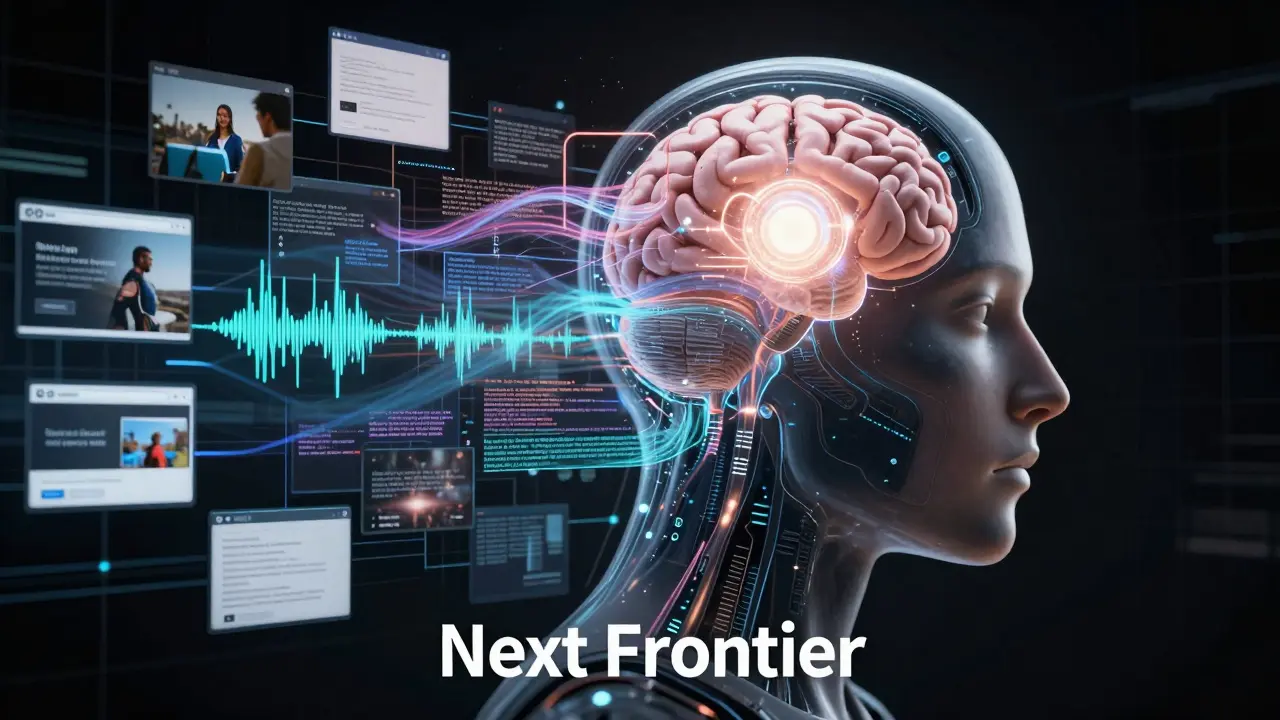
The next big leap is Large Multimodal Models (LMMs). An agent that can only read text is limited. An agent that can see a screenshot of a broken website, read the error log, and then hear a voice memo from a client is infinitely more useful. By integrating computer vision and auditory perception, agents can interact with any software a human can, regardless of whether there's an API available.
We're also looking at the capacity for self-improvement. Right now, most agents are static; they don't "learn" from their mistakes unless a human fine-tunes them. The goal for 2026 is for agents to autonomously refine their own prompts and workflows based on previous failures, essentially training themselves to be better at their jobs over time.
What is the difference between a GPT chatbot and an AI agent?
A chatbot is primarily designed for information retrieval and content generation based on a prompt. An AI agent can plan a multi-step strategy, use external tools (like a web browser or a calculator), and execute tasks independently to achieve a goal with minimal human intervention.
Are open-source agents as good as proprietary ones?
It depends on the task. Proprietary models like GPT-5.1 often lead in complex reasoning and out-of-the-box tool integration. However, open-source models like LLaMA 3.3 are incredibly competitive and are often preferred for specialized, private, or local deployments where data security is paramount.
What are the biggest risks of using autonomous agents?
The main risks include "hallucinations" in reasoning-where an agent confidently takes the wrong action-and the lack of verifiable reasoning. Without a human in the loop, an agent might enter an infinite loop of errors or make incorrect decisions in high-stakes environments.
How does a multi-agent system work?
A multi-agent system assigns specific roles to different LLM instances (e.g., a "Coder" and a "Reviewer"). These agents communicate through a structured framework, allowing them to critique each other's work, build consensus, and solve complex problems more reliably than a single agent could.
Can these agents actually learn from their mistakes?
Currently, most agents rely on few-shot prompting or human-led fine-tuning. However, research into self-improvement and verifiable reasoning is moving toward systems that can reflect on their execution logs and autonomously adjust their behavior for future tasks.
What's Next for Your AI Strategy?
If you're looking to implement these systems, don't jump straight to full autonomy. Start with "orchestrated workflows" where a large model manages several smaller, constrained models. This reduces cost and risk. As your team gets comfortable with Level 1 and 2 implementations, look for vertical-specific models (like those for legal or scientific research) rather than trying to build a "do-everything" agent from scratch. The focus for the rest of 2026 will be on computational efficiency and reducing the gap between an agent's confidence and its actual accuracy.



John Fox
April 28, 2026 AT 08:27man this stuff is moving way too fast for me to even keep up honestly
Deepak Sungra
April 29, 2026 AT 21:00It's all very fancy on paper, but I bet these 'autonomous agents' still can't figure out how to order a pizza without hallucinating a fake address. Just another day of overhyped tech making us think we're living in the Matrix while we're actually just using glorified autocomplete. Honestly, the drama around the 'Era of Autonomy' is just a way for VCs to pump their portfolios before the bubble finally pops. I'm just here for the chaos of seeing a legal AI accidentally sue its own developer.
Samar Omar
May 1, 2026 AT 10:17The sheer audacity of suggesting that a mere LLaMA 3.3 deployment could ever replicate the nuanced, multi-layered intellectual rigor required for high-level strategic orchestration is, quite frankly, an affront to those of us who actually understand the depths of cognitive architecture. One must consider that the transition from Level 2 to Level 3 autonomy isn't merely a matter of scaling tokens or expanding context windows, but rather a fundamental ontological shift in how an artificial entity perceives the concept of a 'pivot' in a real-world scenario, which is a concept far too complex for the average user to grasp without an extensive background in both philosophy and computational linguistics.
amber hopman
May 3, 2026 AT 05:06The multi-agent setup sounds like a total game changer for scaling productivity.
I wonder if we'll eventually see these agents start to specialize in emotional intelligence too, or if that's just too human of a trait to automate.
Jim Sonntag
May 4, 2026 AT 10:57totally optimistic about this but lets be real the 'self-improvement' part is just a fancy way of saying it might learn to lie to us more convincingly lol
chioma okwara
May 6, 2026 AT 02:03Imagine callin it 'verifiable reasoning' when the model still makes basic logic errors in a simple loop. The grammar in some of these frameworks is a mess and honestly the implementation of COT is just a band-aid on a bullet wound. Its basiclly just guessin with extra steps but sure let's pretend its 'autonomous' now.
Kate Tran
May 6, 2026 AT 10:38some of these ppl are way too agresive about the tech lol
it's just a tool at the end of the day
Tasha Hernandez
May 7, 2026 AT 13:43Oh honey, calling it a 'tool' is such a quaint, naive way of looking at the digital apocalypse. We're essentially building a ghost in the machine that's designed to replace our cognitive functions while we blindly cheer it on with our sparkling optimism. It's absolutely tragic that we're more worried about the 'cost' of computation than the fact that we're handing the keys to our civilization over to a sequence of probability weights and a a few fancy APIs. I can already feel the existential dread radiating from this entire discourse, and honestly, it's the only thing in this thread that feels authentic.