
You’re building a customer support bot for a German bank. It works great on your laptop. You deploy it using a popular US-based API. Then the regulator calls. They ask where the prompts go. You say "the cloud." They ask which cloud. You realize you don’t know if that specific server is in Frankfurt or Dublin. That ambiguity costs you millions in fines.
In 2026, this isn't a hypothetical. The EU AI Act is fully in effect as of August 15, 2026. Data residency is no longer just a legal checkbox; it’s an architectural constraint that dictates how you build AI systems. If you choose between hosted APIs and self-hosted open-source LLMs, you aren't just picking a tech stack. You're picking a compliance strategy, a cost model, and a risk profile.
The New Reality of Data Sovereignty
Let's clear up the jargon. Data residency answers one question: In which country does my data physically live? Data localization goes further, demanding that certain data never leave national borders. Data sovereignty covers the broader rights a nation asserts over data within its jurisdiction. These distinctions matter because regulations treat them differently.
The EU AI Act transforms these concepts into technical requirements. High-risk AI systems, like those used in biometric surveillance or critical infrastructure, now require thorough risk assessments. But more importantly, they require transparency about where processing happens. If your LLM processes personal data from EU citizens, that processing must respect GDPR principles regarding transfer and storage. This forces a hard choice: can you trust a third-party API to guarantee geographic isolation, or do you need to control the hardware yourself?
Dr. Elena Rodriguez, Chief Data Officer at InCountry, highlighted a tricky nuance in early 2026: some jurisdictions now view model training itself as a form of processing. This means even if you anonymize data before sending it to an API, the physical location of the training infrastructure might still trigger localization laws. Aggregation doesn't always save you anymore.
API Deployment: Convenience vs. Control
Using a hosted API from providers like OpenAI, Anthropic, or Google Cloud Vertex AI is fast. You get state-of-the-art models without buying GPUs. For many startups, this is the only viable path. However, the 2026 regulatory landscape has made "fast" expensive for regulated industries.
The primary issue with APIs is opacity. While major providers offer regional endpoints (e.g., Azure OpenAI in Europe), verifying that your data stays there requires rigorous auditing. A study by Signzy in January 2026 found that 78% of enterprises had to redesign their disaster recovery plans after discovering failover systems routed data to out-of-region backups. Your primary database might be in Germany, but if your logging service backs up to Virginia, you’ve violated residency rules.
Performance benchmarks show another trade-off. Strictly localized API deployments often incur 15-22% higher latency compared to centralized global models. Why? Because traffic must route through region-specific gateways rather than the nearest edge node. For real-time applications, this lag is noticeable. Yet, according to the same Signzy study, this setup reduces compliance risk by 92%. Is that latency worth the peace of mind? For a bank, yes. For a gaming chatbot, probably not.
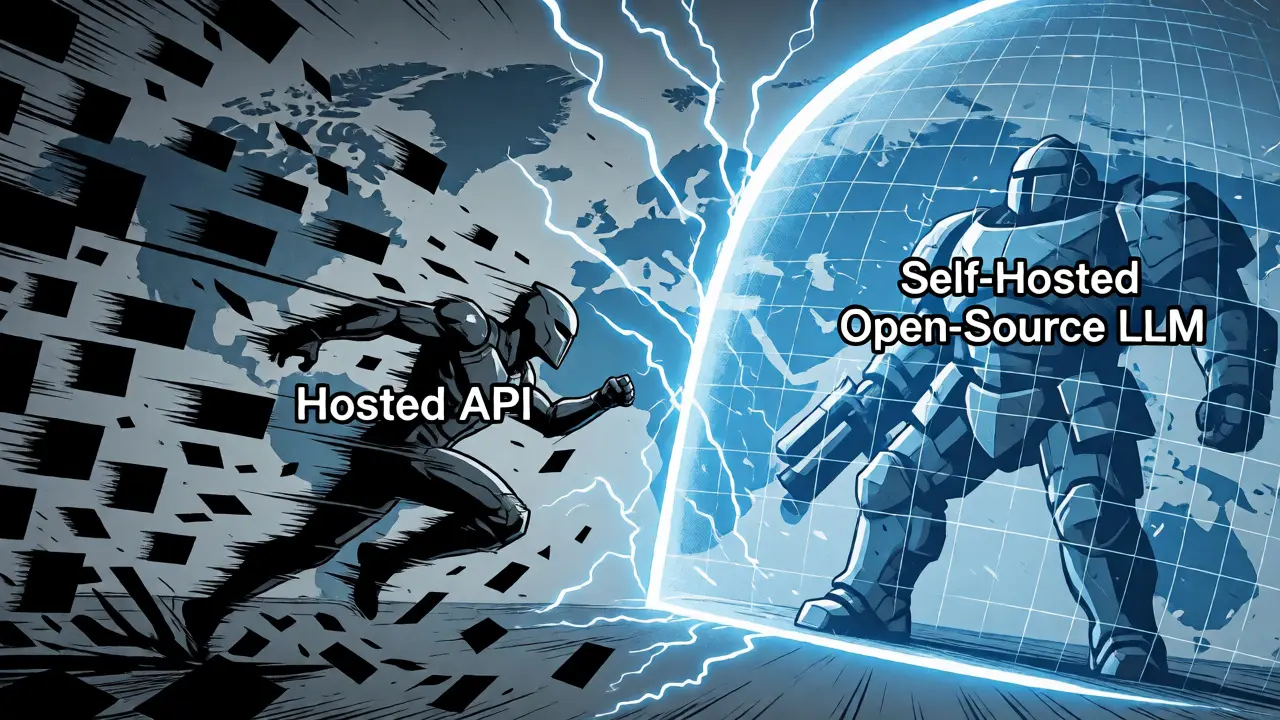
Open-Source LLMs: The On-Premise Shield
If residency is non-negotiable, self-hosting open-source models becomes attractive. Running Llama 3, Mistral, or Mixtral on your own servers gives you absolute control. No data leaves your perimeter unless you explicitly send it somewhere. This satisfies strict localization laws in countries like China, where the Personal Information Protection Law (PIPL) mandates that personal data from Chinese citizens stays within China's borders.
But "self-hosted" doesn't mean "easy." You are now responsible for the entire stack: inference engines, vector databases, monitoring, and security patches. The learning curve is steep. Teams need expertise in jurisdiction-aware infrastructure design, which takes 3-6 months to master. Furthermore, while open-source models have closed the gap with proprietary ones, they often require fine-tuning to match performance on specific tasks. This fine-tuning process itself generates data logs that must also remain local.
A key advantage here is provider flexibility. With an open-source architecture, you can swap models without rewriting your application logic. If a new regulation in Brazil under the LGPD requires different handling, you can adjust your local pipeline without waiting for a vendor to update their API terms.
Comparing the Choices: A Practical Matrix
To help you decide, let's look at the concrete differences. Note that these metrics reflect enterprise deployments in Q4 2026.
| Feature | Hosted API (Regional Endpoint) | Self-Hosted Open-Source LLM |
|---|---|---|
| Data Control | High, but dependent on vendor SLAs and audits. | Total. Data never leaves your infrastructure. |
| Latency | 15-22% higher due to routing constraints. | Low, assuming local network optimization. |
| Compliance Risk | Reduced by ~92% with proper configuration. | Near zero for residency, high for operational security. |
| Initial Setup Time | Days to weeks. | Months (average 4.7 months per Signzy). |
| Operational Cost | Predictable per-token pricing; lower ops overhead. | 30-45% higher total cost of ownership due to specialized staff. |
| Best For | SMEs, low-sensitivity apps, rapid prototyping. | Regulated industries (Finance, Health), strict localization zones. |
Regional Hotspots and Specific Pitfalls
Not all regions play by the same rules. Your deployment strategy must adapt to where your users are.
European Union: The combination of GDPR and the AI Act creates the most comprehensive framework. You need judicial authorization for certain high-risk uses. Encryption everywhere is mandatory, with customer-managed keys ensuring decryption only occurs under your control.
China: PIPL is absolute. There is no "adequacy" loophole like in the EU. If you serve Chinese users, your LLM infrastructure should ideally be domestic. Cross-border transfers require security assessments that can take months to approve.
Australia: Recent reforms require critical infrastructure services to demonstrate data residency down to the physical data hall level. Fines for breaches can hit 28% of annual turnover. This is stricter than the EU's 4% cap.
UAE: Financial institutions must house all customer records on servers physically located within the country. Other sectors can send data to approved destinations, but the list is short.
A common pitfall is ignoring metadata. Professor Kenji Tanaka of Tokyo Institute of Technology warned that derived analytics and model outputs can carry enough identifying information to trigger localization requirements. Even if you strip names, credit risk scoring patterns might uniquely identify individuals. Your residency check must cover logs, embeddings, and intermediate tensors, not just raw input text.

Hybrid Architectures: The Middle Ground
Most large enterprises aren't choosing one or the other exclusively. They are adopting tiered workload classification. High-sensitivity workloads-those involving personal health information or financial records-get routed to local or hybrid configurations using open-source models. Lower-sensitivity workloads, like general content generation or code assistance, use flexible regional APIs.
This approach requires sophisticated gateway solutions. Tools from vendors like TrueFoundry allow jurisdiction-aware routing, directing model calls through region-appropriate APIs automatically. This modular architecture lets you swap providers without rewriting your core application. If a provider loses certification in a specific region, you reroute traffic to a compliant alternative seamlessly.
Gartner predicts that by 2027, 45% of global enterprises will maintain at least three separate LLM deployment environments to comply with regional requirements. Yes, this increases complexity. But it keeps you in business when regulators come knocking.
Frequently Asked Questions
Does using a US-based API violate EU data residency laws?
Not necessarily, but it depends on the configuration. If you use a regional endpoint (e.g., Azure OpenAI in Europe) and ensure that logging, backups, and processing occur within the EU, you can remain compliant. However, you must verify that the provider does not replicate data to the US for redundancy without explicit safeguards. Under the EU AI Act, transparency about these flows is mandatory.
Is open-source LLM deployment cheaper than APIs?
Initially, no. Self-hosting requires significant upfront investment in hardware and skilled personnel. Signzy reports that enterprises face 30-45% higher operational costs with tiered residency models. However, at very high volumes, the per-token cost of APIs can exceed the amortized cost of owned infrastructure. The break-even point varies based on usage spikes and the need for custom fine-tuning.
What happens if my backup system violates data residency?
You are likely in violation. A study found that 78% of enterprises discovered their disaster recovery (DR) plans inadvertently routed data to out-of-region backups. Regulators consider any copy of the data, including backups, subject to residency laws. You must configure DR to stay within the same jurisdiction, which often means higher storage costs and complex replication setups.
Can I train an open-source model on local data without leaving the country?
Yes, provided your training infrastructure is physically located within the required jurisdiction. Some APAC jurisdictions now view training as processing, so the location of the GPUs matters. Using cloud instances in the target region (e.g., AWS Frankfurt for EU data) satisfies this, but you must manage encryption keys locally to ensure full sovereignty.
How long does it take to deploy a compliant LLM solution?
For a first-time compliant deployment, expect an average of 4.7 months. This includes time for jurisdiction-aware infrastructure design, setting up region-specific logging, and configuring encryption key management. Teams typically need 3-5 full-time specialists per major deployment region to handle ongoing maintenance and compliance audits.