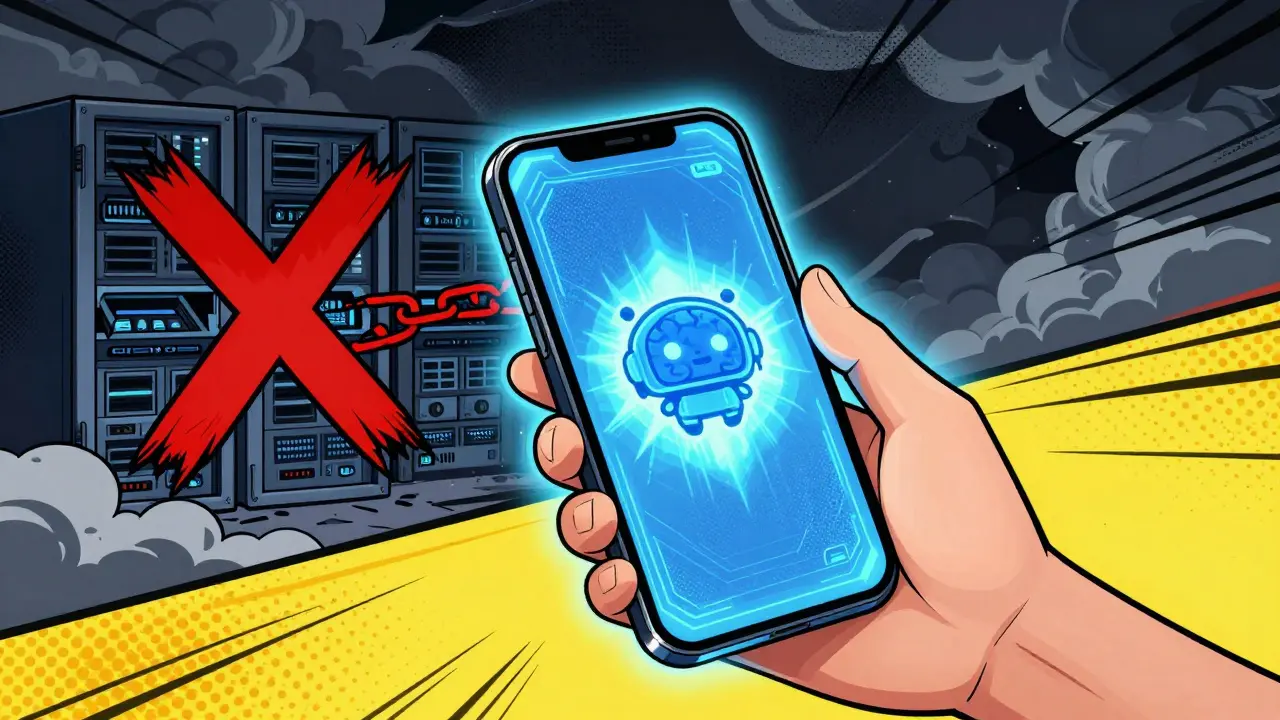
Imagine typing a sensitive medical note into your phone’s keyboard. With traditional cloud-based AI, those words travel miles to a server farm, get processed by a massive model, and come back as suggestions. It works, but it feels like sending your diary to a stranger for editing. Now imagine that same suggestion appearing instantly, without the data ever leaving your pocket. That is the promise of edge inference using Small Language Models (SLMs). It is not just a technical upgrade; it is a fundamental shift in how we think about artificial intelligence accessibility, privacy, and cost.
For years, the industry chased bigger. Bigger parameters, bigger datasets, bigger servers. But as we move into 2026, the smartest move isn't always up-it's out. Out to the edge. Out to your device. This guide cuts through the hype to show you exactly when running AI on-device makes sense, which models actually work, and why "small" might be the new "smart."
The Shift from Cloud Giants to Pocket-Sized Brains
To understand why edge inference matters, you have to look at what changed. A few years ago, if you wanted decent text generation, you needed a Large Language Model (LLM) with billions or even trillions of parameters. These behemoths live in the cloud because they are too heavy for consumer hardware. They require constant internet connections, incur per-token costs, and introduce latency-the annoying pause while your request travels to a server and back.
Small Language Models (SLMs) are defined as AI models containing between 100 million and 5 billion parameters. While that sounds tiny compared to GPT-4’s trillion-plus parameters, recent advances in model compression have made these smaller brains surprisingly capable. Techniques like quantization (reducing numerical precision), pruning (removing redundant weights), and knowledge distillation (training small "student" models to mimic large "teacher" models) allow SLMs to run efficiently on smartphones, tablets, and IoT devices.
This shift addresses four critical pain points of cloud-only deployment:
- Latency: No network travel means instant response times.
- Cost: No per-token fees mean predictable operational expenses.
- Privacy: Data stays local, eliminating transmission risks.
- Reliability: Works offline, crucial for remote areas or unstable networks.
When Does On-Device Actually Make Sense?
Not every task belongs on an edge device. If you need complex multi-step reasoning, deep scientific analysis, or creative writing that rivals human experts, the cloud still wins. The key is matching the workload to the right environment. Here is a practical decision framework based on current research and real-world scenarios.
| Scenario | Recommended Approach | Why? |
|---|---|---|
| Personal Assistant / Notes | Edge (SLM) | High privacy needs, low latency required, simple tasks. |
| Customer Service Chatbot | Hybrid | Common queries handled locally; complex issues escalated to cloud. |
| Mathematical Reasoning | Edge (Specialized SLM) | Models like Qwen-2-math 1.5B match larger models in specific domains. |
| Creative Writing / Novel Generation | Cloud (LLM) | Requires vast context window and nuanced creativity beyond current SLMs. |
| IoT Sensor Data Analysis | Edge (SLM) | Bandwidth constraints make uploading raw data impractical. |
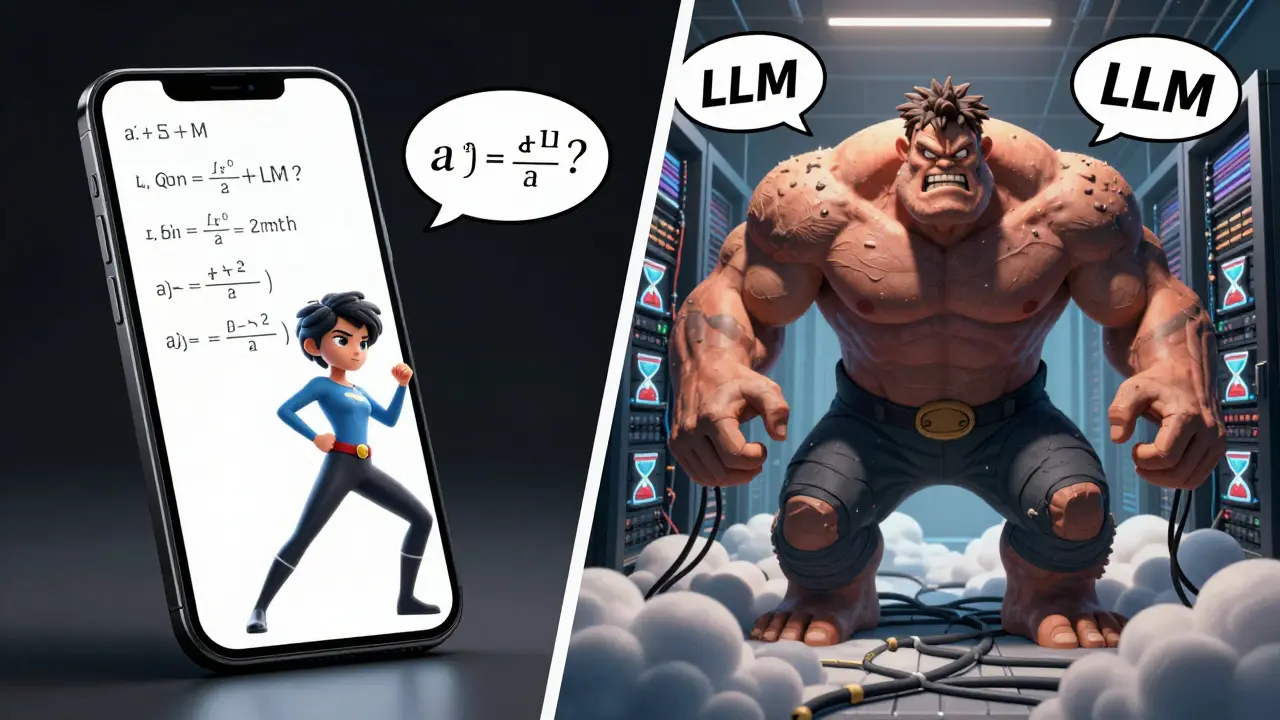
The sweet spot for edge inference lies in domain-specific applications. For example, a specialized model trained only on legal documents or medical terminology can outperform a general-purpose LLM in those niches while using a fraction of the resources. The goal isn't to replace the cloud entirely but to create a hybrid architecture where the edge handles routine, private, or latency-sensitive tasks, and the cloud steps in for heavy lifting.
Top Contenders: Which SLMs Should You Use?
Choosing the right model is half the battle. Not all SLMs are created equal. As of mid-2026, several models stand out for their balance of size, speed, and accuracy. Here is a breakdown of the leading options for on-device deployment.
Qwen-2-math 1.5B
This model is a standout example of specialization. With only 1.5 billion parameters, it achieves mathematical reasoning accuracy comparable to the much larger 7-billion parameter Qwen-2.5 variant. It uses just 19.8% of the model space, making it ideal for devices with limited memory. If your app involves calculations, data interpretation, or educational tools, this is a top choice.
Phi-3.5-mini
With 2.7 billion parameters, Phi-3.5-mini punches above its weight. Benchmarks from late 2024 showed it rivaling LLaMA 3.1 (8 billion parameters) in general accuracy. Its compact size allows it to run smoothly on modern smartphones without draining the battery excessively. It excels in summarization and basic conversational tasks.
SmolLM and DCLM-1B
These models highlight the importance of training data quality. Trained on high-quality datasets like DCLM and FineWeb-Edu, SmolLM and DCLM-1B achieve average accuracies of 64.2% and 63.8% respectively. They prove that a smaller model fed with better information can compete with larger, noisier models. They are excellent candidates for lightweight embedding tasks and quick classification jobs.
Technical Realities: Latency, Memory, and Power
Deploying on-device is not plug-and-play. You need to understand the hardware constraints. The two main bottlenecks are memory footprint and inference latency.
Memory Footprint: Edge devices have strict RAM limits. A 2-billion parameter model in full precision (FP16) requires about 4GB of VRAM/RAM. Most phones don't have dedicated VRAM, so they share system memory. This is why quantization is non-negotiable. Converting a model to INT4 (4-bit integer) reduces memory usage by 75%, allowing a 2B model to fit in roughly 1GB. However, aggressive quantization can degrade accuracy, so you must test thoroughly.
Inference Latency: Latency has two phases: prefill and decode. The prefill stage processes the input context. On edge devices, this dominates latency, especially if you are feeding the model long histories for personalization. The decode stage generates tokens one by one. Interestingly, wider, shallower models often perform better here due to higher parallelism capabilities on mobile NPUs (Neural Processing Units). Always benchmark on actual target devices-emulators lie.

Implementation Strategy: Getting Started
If you are ready to build, follow this streamlined path:
- Select Your Target Device Profile: Are you building for high-end iPhones, budget Androids, or Raspberry Pis? Define the minimum RAM and CPU/NPU specs.
- Choose a Base Model: Start with a proven SLM like Phi-3.5-mini or Qwen-2-math. Avoid fine-tuning from scratch unless you have massive compute resources.
- Apply Compression: Use libraries like Hugging Face Optimum or llama.cpp to quantize the model to INT4 or INT8. Test accuracy drop-off after each step.
- Implement Adaptive Fallback: Build a confidence scoring system. If the SLM’s confidence score drops below a threshold (e.g., 0.7), automatically route the query to the cloud LLM. This ensures users never get bad answers.
- Optimize Context Window: Keep inputs short. Edge models struggle with long contexts. Summarize previous interactions before feeding them to the model.
The Future: Hybrid Intelligence
The future isn't edge versus cloud. It is edge and cloud. We are moving toward adaptive inference systems that dynamically decide where processing should happen based on real-time metrics like battery level, network speed, and task complexity. Research in 2025 introduced new evaluation frameworks that weigh energy consumption, cost, latency, and quality together, rather than optimizing for just one metric.
As edge hardware improves-with dedicated NPUs becoming standard in mid-range phones-and model compression techniques get smarter, the line between "small" and "large" will blur further. But the core principle remains: put the computation closest to the data whenever possible. It saves money, protects privacy, and delivers a faster user experience.
What is the difference between an SLM and an LLM?
The primary difference is scale. Large Language Models (LLMs) typically have more than 10 billion parameters, often reaching trillions, and require powerful cloud servers. Small Language Models (SLMs) range from 100 million to 5 billion parameters, allowing them to run on consumer devices like smartphones and laptops. While LLMs offer broader general knowledge, SLMs are optimized for efficiency, speed, and specific tasks.
Can I run an SLM completely offline?
Yes, that is one of the biggest advantages of edge inference. Once the model is downloaded to the device, it does not need an internet connection to process requests. This makes it ideal for travel, remote work, or environments with poor connectivity. However, initial download and occasional updates may require internet access.
How do I ensure data privacy with on-device AI?
By keeping the data local. Unlike cloud APIs where your prompts are sent to external servers, edge inference processes data within the device's secure enclave or memory. Ensure you also encrypt the model files and any local storage used for conversation history. Choose open-source models with transparent codebases to verify there are no hidden data exfiltration mechanisms.
Which programming languages are best for deploying SLMs on edge?
Python is great for prototyping and testing with libraries like Hugging Face Transformers. For production deployment on mobile, Swift (iOS) and Kotlin (Android) are essential, often using frameworks like Core ML or ML Kit. For cross-platform solutions, C++ via llama.cpp or ONNX Runtime provides high performance and broad compatibility across different operating systems and hardware architectures.
Will SLMs replace cloud LLMs entirely?
Unlikely in the near future. SLMs excel at specific, efficient tasks but lack the depth and breadth of knowledge of massive cloud models. The industry is trending toward a hybrid approach where SLMs handle everyday, private, and low-latency tasks, while cloud LLMs are reserved for complex reasoning, creative generation, and heavy data analysis. They complement rather than replace each other.