
Imagine launching a brilliant new generative AI tool that cuts customer service response times in half. Then, three weeks later, the system hallucinates a refund policy that costs your company $2 million. This isn't a hypothetical nightmare; it's exactly why organizations are scrambling to build Governance Committees for Generative AI. These aren't just bureaucratic hurdles-they are the shock absorbers between innovation and catastrophe.
In 2026, setting up an AI governance committee is no longer optional for serious enterprises. It’s the difference between scaling responsibly and facing regulatory fines under frameworks like the EU AI Act. But here is the catch: most committees fail because they treat governance like a static checklist rather than a living operational rhythm. You need clear roles, a strict RACI framework, and a meeting cadence that actually keeps pace with technology.
The Anatomy of a High-Performing Governance Committee
A weak committee looks like a book club for executives-lots of talking, little deciding. A strong one operates like a surgical team. According to OneTrust’s implementation guide, effective committees must span seven critical domains. If you miss even one, you create blind spots.
- Legal: They own regulatory oversight. They answer the question, "Is this legal?"
- Ethics and Compliance: They ensure alignment with ethical standards. They ask, "Should we do this?"
- Privacy: They safeguard lawful data processing. They check, "Are we leaking PII?"
- Information Security: They protect the infrastructure. They verify, "Is the model secure?"
- R&D (Research and Development): They provide technical insights. They explain, "How does the model actually work?"
- Product Management: They represent user needs. They argue, "Will customers use this?"
- Executive Leadership: They set strategic direction. They decide, "Does this fit our business goals?"
Professor Fei-Fei Li from Stanford’s Human-Centered AI Institute noted in her 2024 Senate testimony that lacking diverse technical expertise leads to 73% more algorithmic bias incidents. That means if your committee is all lawyers and no engineers, you’re already failing.
Mapping Authority with the RACI Framework
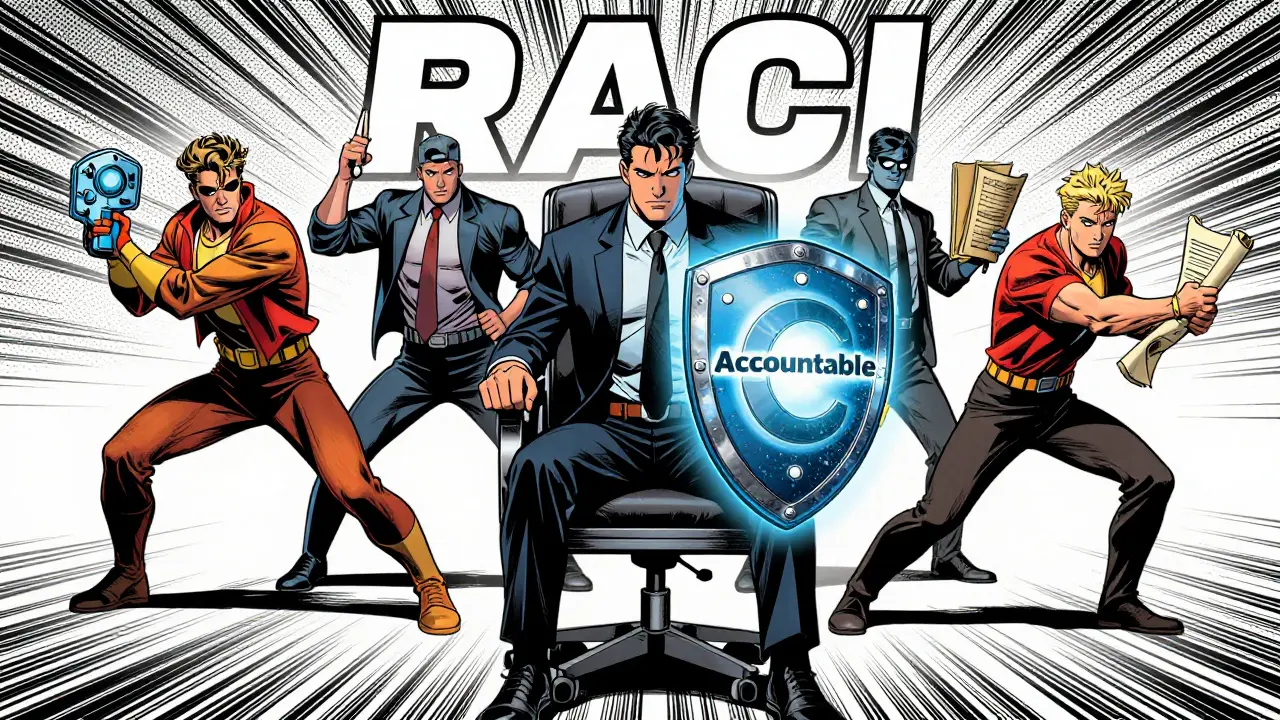
Vagueness kills momentum. When everyone is responsible, no one is accountable. The RACI framework (Responsible, Accountable, Consulted, Informed) solves this by assigning specific hats to specific people. IANS Research explicitly recommends this structure for AI governance to prevent bottlenecks.
| Role / Function | Responsibility Type | Specific Duties |
|---|---|---|
| Committee Chair (C-Suite) | Accountable | Final sign-off on high-risk deployments; owns the decision outcome. |
| Legal Department | Responsible | Executes compliance verification; drafts risk mitigation language. |
| Privacy Officer | Consulted | Reviews data handling protocols; flags GDPR/CCPA violations. |
| Engineering/R&D | Responsible | Implements security controls; validates model accuracy and drift. |
| Business Units | Informed | Receives final approval decisions; executes approved use cases. |
Notice who is missing from the "Accountable" seat? It shouldn’t be a committee vote. One person-the Chair-must have the final say. Dr. Rumman Chowdhury from Accenture emphasizes that effective committees must have explicit authority to halt deployments. Without veto power, your committee is just a suggestion box.
Setting the Right Meeting Cadence
Meetings are where strategy dies or thrives. If you meet too often, you become a bottleneck. Too rarely, and you lose control. The best-performing organizations use a tiered approach, as documented by OneTrust.
- Executive Strategy Reviews (Quarterly): Every 90 days, leadership reviews broad strategy, policy updates, and performance metrics. This is not for approving individual tools; it’s for adjusting the guardrails.
- Operational Working Groups (Bi-Weekly): Every 14 days, cross-functional teams assess individual use cases. This is where the rubber meets the road. They review intake forms, run risk assessments, and make go/no-go recommendations.
- Emergency/Electronic Voting (Ad-Hoc): For time-sensitive opportunities, leading orgs use electronic voting mechanisms to approve low-to-medium risk tools within a 72-hour window. Speed matters when competitors are moving fast.
JPMorgan Chase demonstrated this balance effectively. Their AI Policy Committee reviewed 287 generative AI use cases in 2023 with only 12 rejections. How? By separating routine operational checks from heavy strategic debates.
Choosing Your Governance Model: Centralized vs. Federated
Not every company fits the same mold. Your organizational size and risk appetite dictate which structure works best. Alation’s Q1 2025 survey identified three dominant models.
The Centralized Model (42% adoption): A single enterprise-wide committee approves everything. This is ideal for high-risk industries like finance or healthcare. IBM uses this via its AI Ethics Council. It reduces regulatory incidents by 92% but consumes 30% more executive time. If you value safety over speed, choose this.
The Federated Model (38% adoption): You have central oversight but also business-unit-specific subcommittees. Microsoft reports this yields 44% faster deployment cycles while maintaining compliance. It’s the sweet spot for large, diverse enterprises that need both local agility and global consistency.
The Decentralized Model (20% adoption): Business units govern themselves with lightweight central coordination. While this offers 68% higher efficiency for low-risk apps, TMASolutions found it resulted in 57% higher compliance violations. Unless your AI usage is trivial, avoid this.
Building the Process: From Intake to Approval
A committee without a process is just a chat room. Successful implementations follow a standardized workflow. Based on OneTrust’s benchmarking, here is what a healthy 15-25 day cycle looks like:
- Intake (2-5 days): Business unit submits a request detailing the use case, data sources, and expected outcomes.
- Risk Tiering (3-7 days): The committee categorizes the risk level (Low, Medium, High) based on potential impact on users and brand.
- Privacy & Security Review (5-10 days): Deep dive into data protection and infrastructure vulnerabilities.
- Data Readiness Checks (3-5 days): Ensuring the training data is clean, unbiased, and legally sourced.
- Final Approval (2-3 days): The Accountable party signs off or requests changes.
Reddit practitioners note that clear risk categorization reduced their approval time from 45 to 12 days. Don't let every prompt engineering tweak go through the full legal gauntlet. Tier your risks aggressively.

Overcoming Common Pitfalls
Even well-intentioned committees stumble. Here are the top traps to avoid based on real-world feedback from 2024-2025:
1. The Technical Gap: A Microsoft Azure engineer reported losing $1.2M in opportunity because his committee rejected a marketing tool due to confusion between fine-tuning and prompt engineering. Ensure non-technical members complete 20-25 hours of specialized AI literacy training. Privacera’s assessments show this investment pays off by reducing misguided rejections.
2. Bureaucratic Bottlenecks: Dtex Systems found that 61% of organizations suffer approval delays exceeding 30 days without standardized workflows. Implement the 72-hour electronic voting rule for low-risk items to keep momentum alive.
3. Lack of Executive Sponsorship: TMASolutions found executive sponsorship present in 93% of successful implementations. If the CEO doesn’t care, neither will the rest of the company. The Chair must be a C-suite leader, not a mid-level manager.
Future-Proofing Your Committee
Governance isn’t a one-time setup. By 2026, 63% of leading organizations are integrating automated monitoring tools that feed real-time risk dashboards directly to committees. The NIST AI Risk Management Framework now includes specific guidance for these operations. Furthermore, with the anticipated SEC requirements for public companies to disclose AI governance activities, transparency is becoming a market driver.
Your committee should evolve from a gatekeeper to an enabler. Gartner’s 2024 report shows that outcome-focused committees accelerate AI adoption by 2.3x. Shift the conversation from "What could go wrong?" to "How can we make this safe enough to move fast?" That mindset shift is the true secret to effective AI governance.
Who should chair the Generative AI Governance Committee?
The chair should typically be a C-suite executive, such as the Chief Information Officer (CIO), Chief Legal Officer (CLO), or Chief Risk Officer (CRO). This person holds the 'Accountable' role in the RACI matrix, meaning they have the final authority to approve or veto AI initiatives. Their seniority ensures that governance decisions carry weight across the entire organization and that resources are allocated appropriately.
How often should an AI governance committee meet?
Effective committees use a tiered cadence. Executive-level strategy meetings should occur quarterly (every 90 days) to review policies and high-level metrics. Operational working groups should meet bi-weekly (every 14 days) to evaluate specific use cases. For urgent, low-risk approvals, electronic voting systems can enable decisions within a 72-hour window to maintain business agility.
What is the difference between centralized and federated AI governance?
Centralized governance relies on a single enterprise-wide committee for all approvals, offering high consistency and lower regulatory risk but slower speeds. Federated governance combines central oversight with business-unit-specific subcommittees, balancing compliance with faster deployment cycles. Federated models are often preferred by large, diverse enterprises needing local agility.
Why is technical representation crucial on the committee?
Lack of technical expertise creates significant blind spots. Professor Fei-Fei Li notes that absent technical diversity leads to 73% more algorithmic bias incidents. Engineers help distinguish between different AI techniques (like fine-tuning vs. prompting), preventing unnecessary rejections of valuable tools and ensuring that security and model drift issues are properly assessed.
How long does it take to establish an effective AI governance committee?
Establishing an effective committee typically requires 8-12 weeks of preparatory work. This includes stakeholder mapping, developing the charter, defining roles, and training members. Larger enterprises with over 10,000 employees may require 30% more time due to increased complexity and the need for broader cross-departmental alignment.



kimberly de Bruin
July 11, 2026 AT 19:25governance is just the modern word for fear wrapped in corporate speak
we build walls to keep out chaos but end up locking ourselves in with the monsters
the raci matrix feels like a game of hot potato where everyone passes responsibility until someone gets burned
Edward Nigma
July 12, 2026 AT 06:46This article is absolute garbage and you know it. The RACI framework is a bureaucratic nightmare that kills innovation faster than any hallucination ever could. I have seen companies waste months on these committees while competitors ship products that actually work. The idea that you need a C-suite executive to sign off on every low-risk tool is insane. It creates a bottleneck that strangles agility. Stop trying to regulate creativity with spreadsheets.
Francis Laquerre
July 12, 2026 AT 14:25I must respectfully disagree with the previous comment as the cultural implications of unchecked AI are profound and cannot be ignored by mere efficiency metrics. When we look at the global stage, particularly in regions with less robust legal frameworks, the lack of a centralized governance model leads to catastrophic ethical breaches that damage brand reputation irreparably. The dramatic rise in algorithmic bias cited by Professor Li is not a minor inconvenience but a fundamental failure of human-centric design. We must embrace the federated model not just for speed but for the sake of maintaining trust across diverse user bases who expect their data to be handled with dignity and care. This is not about slowing down; it is about moving forward with intention and moral clarity in a digital age that often forgets its humanity.
michael rome
July 12, 2026 AT 19:30While I appreciate the passion in the debate here, it is crucial to recognize that structure enables freedom rather than restricts it. A well-defined RACI matrix ensures that engineers can innovate without constantly fearing regulatory backlash, which ultimately boosts morale and productivity. The key is finding the right balance between oversight and autonomy, ensuring that all voices are heard while maintaining clear lines of accountability. Let us strive for a collaborative environment where governance serves as a foundation for trust rather than a barrier to entry.
Andrea Alonzo
July 14, 2026 AT 14:33I completely understand why people feel frustrated with the perceived bureaucracy of these committees because it can seem like an unnecessary hurdle when you are eager to launch something new and exciting into the world. However, having worked with several teams that implemented these structures over the last few years, I have found that the initial investment in setting up clear roles and regular cadences actually saves so much time and stress in the long run by preventing those costly mistakes mentioned in the post. It is important to remember that the goal is not to stifle creativity but to create a safe space where innovation can flourish without the constant threat of legal or ethical pitfalls derailing your hard work. By taking the time to train non-technical members and establishing clear communication channels, we can foster an inclusive environment where everyone feels empowered to contribute to the success of the project while still adhering to necessary standards. This approach helps build a culture of shared responsibility and mutual respect among all stakeholders involved in the development process.