
Token Probability Calibration is the process of aligning a large language model's predicted token probabilities with their actual likelihood of being correct. Without proper calibration, models like GPT-4o might confidently state incorrect information, which is dangerous in fields like healthcare or finance. A December 2024 Nature Communications study found that 83% of AI practitioners had to build custom calibration solutions because standard confidence scores are often misleading. Imagine an AI doctor diagnosing a patient with 95% confidence in a condition that's actually wrong. Or a financial model suggesting a high-risk investment with unwarranted certainty. These scenarios happen when LLMs aren't properly calibrated.
Why Token Calibration Matters for High-Stakes Applications
According to the Nature Communications study from December 2024, "To earn human trust, LLMs must be well calibrated such that they can accurately assess and communicate the likelihood of their predictions being correct." This isn't just theoretical-GPT-4o shows a Brier score of 0.09 (95% CI 0.08-0.11), while Gemma has a score of 0.35, meaning the latter's confidence is significantly less reliable. In fields where errors cost lives or millions, this difference is critical. For example, a medical LLM misclassifying a tumor as benign with high confidence could delay life-saving treatment, while a finance LLM overestimating stock performance might trigger massive losses.
Measuring Calibration: Key Metrics Explained
Traditional calibration methods designed for classification tasks (like image recognition) don't work well for LLMs. With vocabularies exceeding 50,000 tokens, each token's probability matters. The Full-ECE metric, introduced in June 2024 by UC researchers, evaluates the entire probability distribution across all tokens-not just the top prediction. This addresses a major flaw in earlier approaches. Other metrics include:
- Brier Score: Measures mean squared difference between predicted probabilities and actual outcomes. Lower scores indicate better calibration.
- Adaptive Calibration Error (ACE): Uses adaptive binning to handle uneven data distributions.
A 2024 NIH study found GPT-4o outperforms smaller models in calibration, with an AUROC of 0.87 for predicting response accuracy-compared to Phi-3-Mini's 0.71. However, all models still show some overconfidence, with even the best having calibration errors above 5%.
Common Calibration Techniques and Their Trade-offs
| Technique | How it Works | Pros | Cons | Best For |
|---|---|---|---|---|
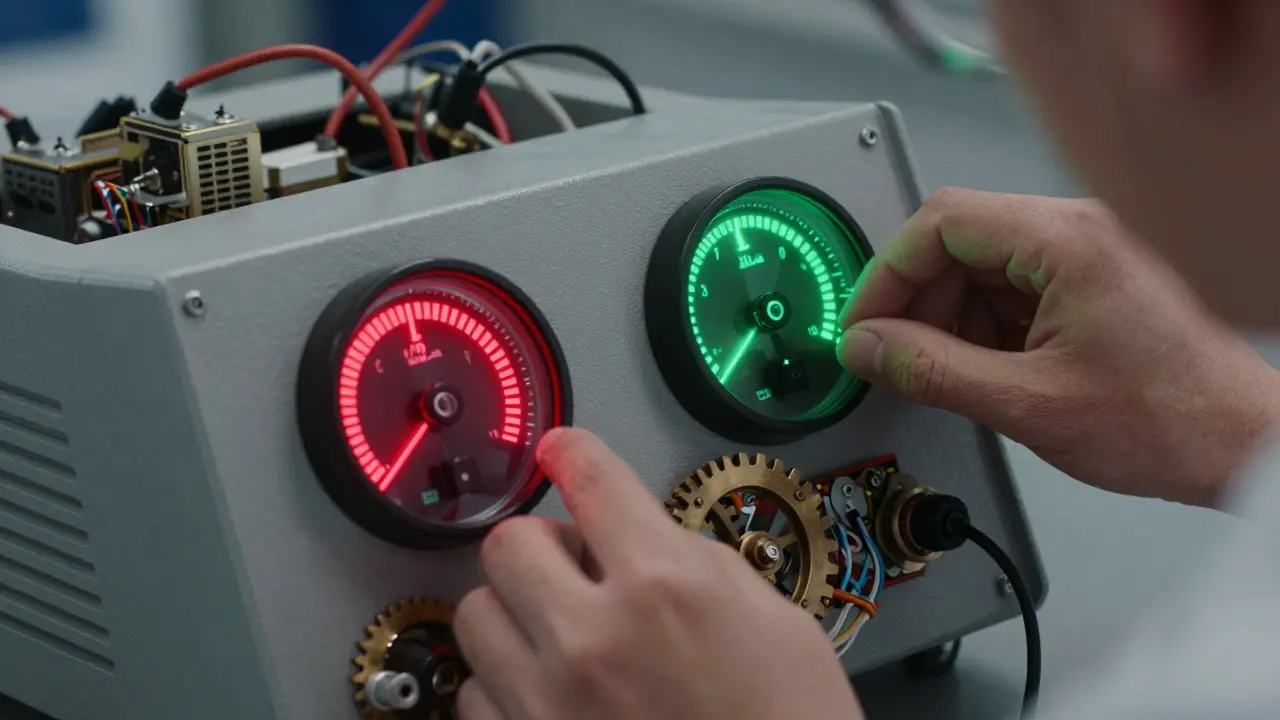
| Temperature Scaling | Adjusts logits before softmax using a scaling factor between 0.5-1.5 | Simple to implement, requires minimal compute | May reduce accuracy; optimal temperature varies by model (GPT-4o: 0.85, Llama-2-7B: 1.2) | Quick fixes for basic models |
| Calibration-Tuning | Specialized fine-tuning using 5,000-10,000 examples with uncertainty annotations | More accurate calibration; handles complex scenarios | Requires significant data and GPU time (1-2 hours on 8 A100s for 7B model) | High-stakes applications like healthcare |
| Average Token Probability (pavg) | Calculates mean probability across all tokens in output | Minimal implementation complexity | Overconfident; ECE around 0.15 for code-generation tasks | Simple tasks with clear right answers |
Developer feedback on Hugging Face forums reveals practical challenges. Alex Chen reported a 15% reduction in Expected Calibration Error (ECE) with temperature scaling on Llama-2-7B, but a 7% drop in MMLU benchmark accuracy. This trade-off shows why choosing the right technique matters.
Real-World Challenges and Industry Trends
Despite progress, several persistent challenges remain. Models trained with Reinforcement Learning from Human Feedback (RLHF) often prioritize user preferences over accuracy, leading to poor calibration. A Generative AI publication in August 2024 noted: "RLHF-LLMs may prioritize adhering closely to user preference over producing well-calibrated predictions." Code-specific LLMs face unique issues-while autoregressively-trained models are well-calibrated at the token level, their average confidence doesn't match the ~30% success rate in line completion tasks.
Industry adoption is accelerating. The EU AI Act's December 2024 update requires "quantifiable uncertainty estimates" for high-risk systems, directly impacting healthcare and finance deployments. The global market for AI calibration tools is projected to reach $2.3 billion by 2027, growing at 34.7% CAGR. Enterprises like Robust Intelligence and Arthur AI now offer specialized calibration solutions, with 42% of Fortune 500 companies including calibration metrics in their evaluation frameworks-up from 12% in 2023.
Practical Steps for Developers
If you're implementing token calibration in your LLM:
- Start with Temperature Scaling. Use a value between 0.5-1.5; GPT-4o works best at 0.85, while Llama-2-7B prefers 1.2.
- Evaluate using Full-ECE for comprehensive calibration assessment. Traditional ECE metrics miss critical details in multi-token outputs.
- For high-stakes applications, consider Calibration-Tuning. This requires curated examples with uncertainty labels but delivers more reliable confidence scores.
- Monitor the "confidence-accuracy disconnect"-where high-probability tokens are incorrect 23-37% of the time (per NIH study). Always validate outputs with real-world data.
- Use domain-specific calibration. Medical LLMs need different parameters than code-generation models.
A survey of 89 practitioners by ML Collective found it takes 2-3 weeks to master these techniques. But the payoff is worth it: correctly calibrated models reduce deployment risks in critical scenarios.
Frequently Asked Questions
What's the difference between token-level and traditional calibration?
Traditional calibration methods (like for image classifiers) focus on top-1 predictions in fixed-class tasks. Token-level calibration evaluates the entire probability distribution across all tokens in an LLM's output. Since LLMs generate sequences token-by-token, each token's probability affects the final result. The Full-ECE metric addresses this by measuring calibration across all tokens, not just the most likely one.
Why do RLHF models often have poor calibration?
Reinforcement Learning from Human Feedback (RLHF) trains models to align with human preferences, which sometimes prioritizes "helpful" responses over accuracy. As noted in a Generative AI publication (August 2024), "RLHF-LLMs may prioritize adhering closely to user preference over producing well-calibrated predictions." This means models might output confident but incorrect answers to please users, leading to higher calibration errors.
Can open-source LLMs like Llama-2 be calibrated effectively?
Yes, but with limitations. Temperature scaling works well for Llama-2, reducing ECE by about 15% according to Hugging Face developers. However, full calibration requires domain-specific tuning. For example, a medical Llama-2 variant needs different parameters than one used for code generation. The Calibration-Tuning protocol can improve results but demands high-quality training data with uncertainty labels.
How does calibration affect open-ended generation tasks?
Open-ended tasks like creative writing or complex problem-solving are harder to calibrate because multiple valid answers exist. The NeurIPS 2024 paper noted that token-level calibration alone may be insufficient here. Models often overconfidently pick one plausible answer while ignoring others. Techniques like inference-time scaling (MIT, December 2025) show promise by allowing models more "thinking time" to assess confidence across alternatives.
What's the biggest mistake developers make when calibrating LLMs?
Treating calibration as a one-time fix. A survey by Anthropic (August 2024) found 68% of practitioners update calibration parameters monthly for production systems. Models drift over time as they process new data, so continuous monitoring is essential. For instance, a finance model calibrated for 2024 market conditions might fail in 2025 due to economic shifts. Regular re-evaluation using Full-ECE prevents this.


Michael Gradwell
February 5, 2026 AT 21:23Token calibration is overrated. Just train better models.
Jess Ciro
February 7, 2026 AT 16:31This is all part of the big tech agenda to control AI. They don't want us to know how unreliable these models are. The study is fake news.
Samar Omar
February 8, 2026 AT 18:28Token probability calibration, as elucidated in the Nature Communications study, represents a fundamental necessity in the realm of large language models.
Without precise calibration, the confidence scores generated by these models are inherently misleading, which poses significant risks in high-stakes domains such as healthcare and finance.
For instance, the Brier score of GPT-4o at 0.09 versus Gemma's 0.35 starkly illustrates the disparity in reliability.
Moreover, the Full-ECE metric introduced by UC researchers in June 2024 addresses the limitations of traditional calibration methods by evaluating the entire probability distribution across all tokens, rather than merely the top prediction.
This is crucial given that LLMs operate with vocabularies exceeding 50,000 tokens, where each token's probability contributes to the final output.
The NIH study further corroborates this by highlighting GPT-4o's AUROC of 0.87 for predicting response accuracy, outperforming Phi-3-Mini's 0.71.
However, even the best models exhibit calibration errors exceeding 5%, underscoring the persistent challenges in this field.
Temperature scaling, while simple to implement, may reduce accuracy-Alex Chen reported a 7% drop in MMLU benchmark when applied to Llama-2-7B.
Calibration-tuning, though more resource-intensive, offers superior results for high-stakes applications.
The EU AI Act's recent update mandating quantifiable uncertainty estimates for high-risk systems further emphasizes the urgency of this issue.
Industry adoption is accelerating, with the global market for calibration tools projected to reach $2.3 billion by 2027.
Enterprises like Robust Intelligence and Arthur AI are now offering specialized solutions, with 42% of Fortune 500 companies incorporating calibration metrics into their evaluation frameworks.
Despite these advancements, RLHF-trained models often prioritize user preferences over accuracy, leading to poor calibration.
Open-ended tasks present additional complexities, as multiple valid answers may exist, necessitating techniques like inference-time scaling.
Continuous monitoring and re-evaluation are essential, as models drift over time due to new data.
In conclusion, while token calibration remains a challenging problem, its importance cannot be overstated in ensuring reliable and trustworthy AI systems.
chioma okwara
February 9, 2026 AT 00:18calibration methids are all wrong. Temperature scaling is a joke. It shud be called 'temperature scaling' but its not. The study says 83% of practicioners built custom solutions but they're all idiots.
John Fox
February 10, 2026 AT 05:07calibration matters but not too much just let the models be they'll figure it out
Tasha Hernandez
February 11, 2026 AT 12:36Oh my god, this is so important! Like, literally life or death stuff. But of course, the AI industry is just going to ignore it all. They never care about real problems. Ugh.
Anuj Kumar
February 13, 2026 AT 00:00Nonsense. Calibration is useless. Models should just be better. No need for all this extra work.