
Have you ever asked an AI a simple question and gotten a confident, completely wrong answer? It happens to all of us. The model sounds authoritative, cites dates that never existed, or invents quotes from people who never spoke them. This is the "hallucination" problem, and it’s the biggest hurdle keeping large language models out of high-stakes fields like medicine, law, and finance.
For a long time, we thought bigger models would just solve this naturally. They didn’t. Instead, researchers found that how the model thinks matters more than how much data it has seen. Enter Chain-of-Verification, also known as CoVe. This isn't a new software download or a paid API tier. It’s a specific way of prompting your existing AI to double-check its own work before giving you the final answer. Think of it as forcing the AI to act like a careful editor rather than a hurried writer.
What Is Chain-of-Verification (CoVe)?
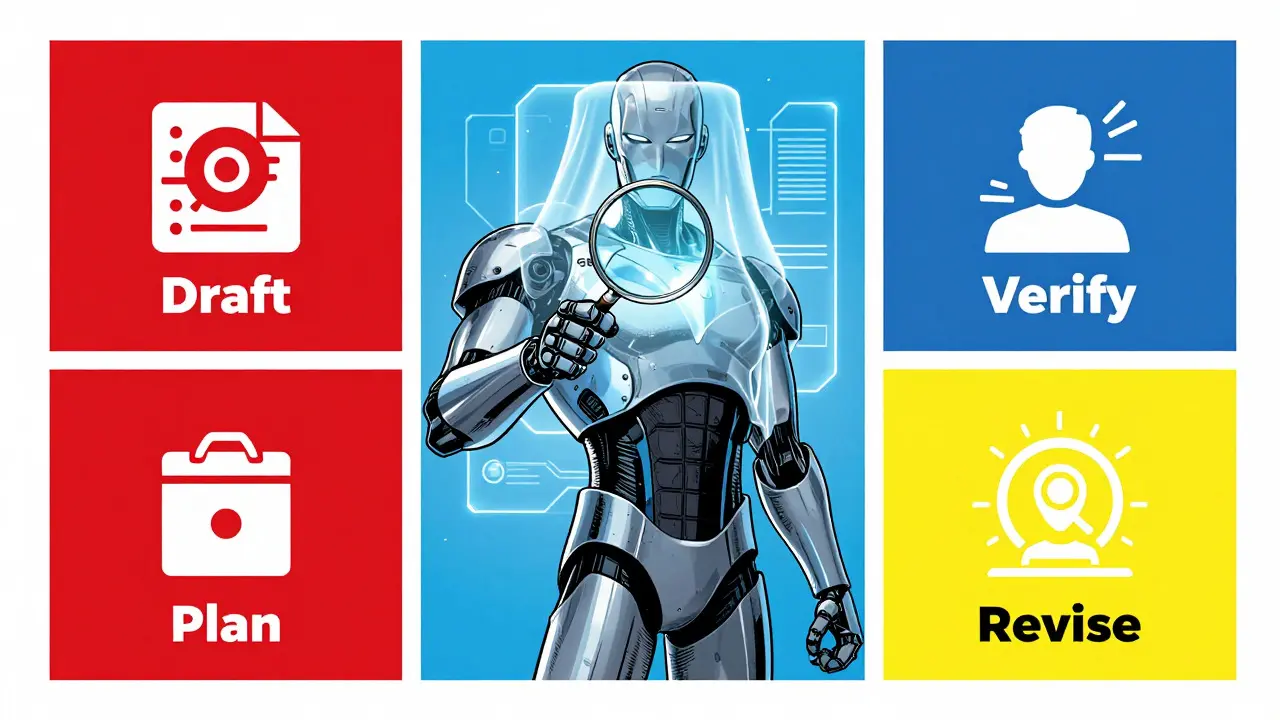
Chain-of-Verification is a four-stage self-verification framework designed to reduce factual errors in large language models by having them draft, plan checks, verify independently, and revise their answers. Introduced in a prominent paper at ACL 2024, CoVe changes the game because it doesn't require retraining the model. You don't need to spend millions on GPU clusters to fine-tune weights. You just change the conversation flow.
Most standard prompts ask the model to generate an answer directly. CoVe inserts a pause. It asks the model to generate a draft, then step back and ask itself, "How can I prove this is true?" Then it answers those questions independently. Finally, it writes the final response based on what it learned during the check. This structure exploits a key weakness in AI: models are often better at verifying facts than generating them from scratch.
The Four Steps of the CoVe Process
To understand why this works, you have to look at the mechanics. The process is rigidly structured into four distinct phases. Skipping any one of them breaks the verification chain.
- Drafting the Baseline Response: First, the model answers your question normally. Let's say you ask, "Who won the Nobel Prize in Literature in 1954?" The model might draft an answer immediately. This draft is prone to error. It might guess wrong or mix up years. At this stage, treat the output as a rough sketch, not the final painting.
- Planning Verification Questions: Here is where the magic starts. The model looks at its own draft and generates a list of specific questions to test its claims. If the draft says "Ernest Hemingway won in 1954," the verification question might be, "Did Ernest Hemingway win the Nobel Prize in 1954, or was it another year?" The goal is to break the big answer into small, testable facts.
- Independent Verification: This is the most critical step. The model answers those verification questions without looking at its original draft. This prevents "confirmation bias," where the AI just repeats its mistake because it already wrote it down. By answering from scratch, the model relies on its core knowledge base, which is often more accurate for short, direct queries than for complex narrative generation.
- Revising the Final Response: Finally, the model compares the independent answers with the original draft. If there’s a conflict-say, the verification says Hemingway won in 1954, but the draft said 1953-the model corrects the error. It produces a final, polished answer that incorporates these corrections.
Why CoVe Beats Standard Chain-of-Thought
You’ve probably heard of Chain-of-Thought (CoT) prompting, where you tell the AI to "think step by step." CoT is great for math and logic puzzles. But for factual accuracy, it has a flaw. When a model reasons step-by-step toward a conclusion, it often builds a logical path to a wrong fact. It convinces itself of the error along the way.
CoVe is different. It separates the generation from the verification. In Chain-of-Thought, the reasoning supports the answer. In Chain-of-Verification, the reasoning challenges the answer. Research presented in 2024 showed that while standard instruction tuning didn't significantly reduce hallucinations, CoVe did. On difficult benchmarks involving Wikipedia categories and closed-book question answering, CoVe-based approaches doubled performance compared to baselines that lacked this explicit checking phase.
| Feature | Standard Generation | Chain-of-Thought (CoT) | Chain-of-Verification (CoVe) |
|---|---|---|---|
| Primary Goal | Speed and fluency | Logical consistency | Factual accuracy |
| Hallucination Rate | High | Moderate (can reinforce errors) | Low (actively detects errors) |
| Token Cost | Lowest | Medium | High (multiple passes) |
| Best Use Case | Casual chat, creative writing | Math, coding logic | Research, legal docs, medical info |
Implementing CoVe in Your Workflow
You don't need special hardware to use CoVe. Since it is a prompting pattern, you can implement it with any modern decoder-only model via API. However, there are trade-offs. Because the model runs through four stages, you will use roughly three to four times the tokens of a single-pass answer. Latency will also increase.
So, when should you use it? Don't use CoVe for brainstorming ideas or writing a funny tweet. The overhead isn't worth it. Use CoVe when the cost of being wrong is high. If you are building a customer support bot that needs to cite policy documents accurately, or a research assistant summarizing scientific papers, CoVe is essential.
Here is a practical tip for implementation: Keep the verification questions narrow. A vague question like "Is this answer correct?" yields useless results. Force the model to ask specific questions about dates, names, and causal links. For example, instead of asking if a historical summary is right, ask, "What year did Event X occur according to historical records?" The simpler the verification task, the higher the accuracy.
Combining CoVe with RAG
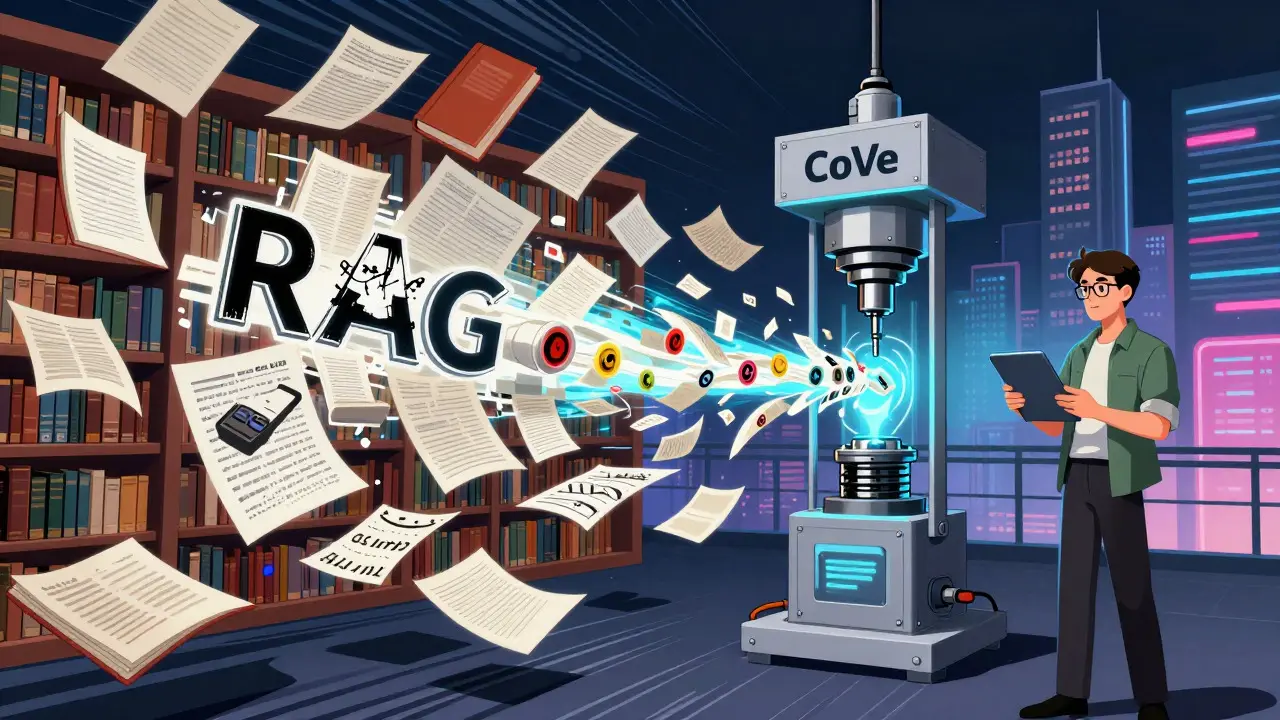
Many developers are currently using Retrieval-Augmented Generation (RAG), which feeds external documents to the AI to ground its answers. CoVe and RAG are not mutually exclusive; they are complementary. RAG provides the raw material (the documents), while CoVe ensures the model uses that material correctly.
In a hybrid setup, you retrieve relevant documents first. Then, you run the CoVe pipeline. During the verification stage, the model can check its draft against the retrieved context. This combination addresses two different failure modes: RAG fixes the lack of knowledge, and CoVe fixes the misinterpretation of that knowledge. Studies suggest that layering self-verification on top of retrieval systems significantly boosts precision in complex QA tasks.
Limitations and Future Outlook
CoVe isn't a silver bullet. Its main limitation is computational cost. Every extra step adds latency and expense. For real-time applications requiring millisecond responses, this might be too slow. Additionally, if the underlying model lacks basic knowledge, no amount of verification will conjure the truth. CoVe improves reliability, but it doesn't create intelligence out of thin air.
Looking ahead, the trend is clear. As models become more integrated into regulated industries, "trustless" AI outputs will become unacceptable. We are moving toward architectures where self-verification is built into the inference loop by default. Expect future model updates to include native CoVe-like capabilities, reducing the prompt engineering burden on developers. For now, however, implementing this four-step pattern manually is the most effective way to squeeze higher accuracy from your current tools.
Does Chain-of-Verification require retraining the model?
No. CoVe is a prompting and orchestration strategy. It works at inference time by structuring the interaction between the user and the model. You do not need to modify model weights or perform expensive fine-tuning.
How much more expensive is CoVe compared to standard prompting?
CoVe typically requires four separate passes through the model (draft, planning, verification, revision). This means you will consume approximately three to four times the token count and experience increased latency compared to a single-turn response.
Can CoVe be used with Retrieval-Augmented Generation (RAG)?
Yes. CoVe and RAG are highly compatible. RAG provides external context, while CoVe verifies how that context is used. Combining them helps prevent both missing information and misinterpreting retrieved documents.
What types of tasks benefit most from CoVe?
Tasks requiring high factual precision benefit most. This includes long-form generation, closed-book question answering, code explanation, and domains like legal or medical advice where hallucinations carry significant risk.
Is CoVe better than Chain-of-Thought (CoT)?
For factual accuracy, yes. CoT helps with logical reasoning steps but can reinforce errors if the initial premise is wrong. CoVe explicitly challenges the generated answer, making it more effective at detecting and correcting hallucinations.