
Imagine trying to read a book where every other word is chopped in half, or where numbers are scrambled into random symbols. That’s essentially what happens when a large language model (LLM) receives poorly tokenized text. Tokenizer design is the process of breaking down raw text into smaller units called tokens that models can process, acting as the critical bridge between human language and machine understanding. It isn’t just a preprocessing step; it’s the lens through which the AI sees the world. Get it wrong, and you waste up to 30% of your model’s capacity on unhelpful splits. Get it right, and you boost information density by 25%. In 2026, with models growing larger and more specialized, choosing the right tokenizer is no longer optional-it’s a core architectural decision.
The Core Algorithms: BPE, WordPiece, and Unigram
Most modern LLMs rely on subword segmentation algorithms. These methods split words into smaller pieces to handle rare terms and out-of-vocabulary (OOV) words without exploding the memory requirements. The three dominant players are Byte-Pair Encoding (BPE), WordPiece, and the Unigram Language Model. Each has a distinct philosophy about how to balance compression and granularity.
BPE is an iterative algorithm that merges the most frequent character pairs until a target vocabulary size is reached. Popularized by OpenAI’s GPT series, BPE is deterministic. If you see "playing" often enough, it might first merge "play" + "ing", then later "un" + "play" if "unplayable" appears frequently. It’s robust, fast, and widely supported, making it the default choice for general-purpose models like GPT-4 (which uses ~50,000 tokens) and Llama 3 (which uses a custom BPE variant with 128,000 tokens).
WordPiece is a probabilistic variant used by Google's BERT that selects merges based on likelihood scores rather than pure frequency. This approach tends to preserve slightly more semantic granularity. BERT uses a vocabulary of 30,522 tokens. Because WordPiece prioritizes probability, it often keeps common suffixes attached to roots longer than BPE does, which can help in tasks requiring detailed token-level information but may increase computational costs by 10-15% due to higher fertility (more tokens per sequence).
Unigram Language Model is an algorithm that starts with a large vocabulary and iteratively removes tokens that minimally affect overall likelihood. Unlike BPE and WordPiece, which build vocabularies from the bottom up, Unigram prunes from the top down. A November 2024 study published on arXiv (2511.03825v1) found that Unigram achieves superior compression efficiency, requiring 12-18% fewer tokens per instruction compared to BPE and WordPiece, especially in structured data like assembly code. This makes it ideal for tasks where context window length is a bottleneck.
| Algorithm | Mechanism | Key Advantage | Typical Use Case |
|---|---|---|---|
| BPE | Frequent pair merging | Balanced performance, wide support | General-purpose LLMs (GPT, Llama) |
| WordPiece | Likelihood-based selection | Higher granularity preservation | Semantic analysis (BERT) |
| Unigram | Iterative pruning | Best compression efficiency | Code analysis, long-context tasks |
Vocabulary Size: The Memory vs. Speed Trade-off
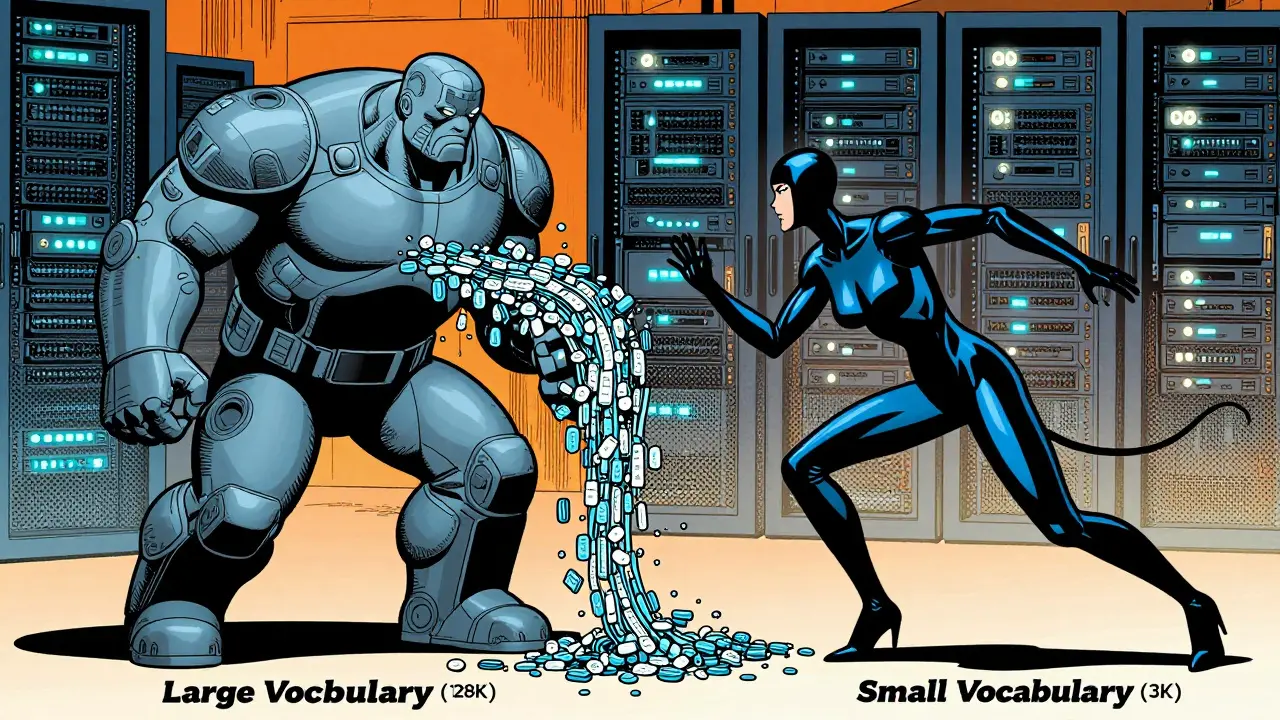
Once you pick an algorithm, the next big lever is vocabulary size. This is not just a technical detail; it directly dictates your model’s memory footprint and inference speed. The trade-off is stark: smaller vocabularies save memory but force the model to process more tokens per sentence, while larger vocabularies reduce sequence length but bloat the embedding layer.
Consider the extremes. A tiny vocabulary of 3,000 tokens can reduce memory overhead by approximately 60%. However, this comes at a steep cost: sequence lengths increase by 25-40%. Why? Because common words get chopped into many small pieces. For example, "understanding" might become ["u", "n", "d", "e", "r", "s", "t", "a", "n", "d", "i", "n", "g"] instead of a single token. This forces the transformer to attend over more positions, slowing down inference and increasing compute costs.
On the flip side, a massive vocabulary of 128,000 tokens (like Llama 3’s) decreases sequence length by 30-45%. Fewer tokens mean faster processing and better context utilization. But the embedding matrix-the table mapping tokens to vectors-becomes huge. This increases memory usage by 75-90%. In 2026, with VRAM still being a premium resource, this is a critical calculation. A Reddit user in r/LocalLLaMA reported in March 2025 that switching from a 32K to a 64K vocabulary improved their code generation accuracy by 9% but doubled their embedding layer memory requirements. For enterprise deployments, this means you might need twice as many GPUs to serve the same traffic.
The sweet spot depends on your domain. General English text often benefits from 30K-50K tokens. Code-heavy or multilingual models push toward 100K+ to capture rare syntax and characters without excessive fragmentation. The arXiv study noted that 35K and 128K vocabularies showed 7-12% higher accuracy in function signature prediction tasks compared to 3K, primarily because they reduced OOV tokens.
The Numerical Representation Problem
Here’s where things get tricky. Most standard tokenizers treat numbers as strings of characters. This creates a fundamental mismatch for mathematical reasoning. If your model sees "123" and "456" as completely unrelated tokens, it struggles to generalize arithmetic rules. This issue was documented in PMC11339515, which highlighted that models struggle with digit-length variability, causing embedding inconsistencies for numbers with different digit counts.
In practice, this leads to embarrassing errors. A GitHub issue (#4321) on the Hugging Face transformers repository detailed how a financial analysis model misinterpreted currency values with a 12.7% error rate because the tokenizer split "$1,000.50" into ["$", "1", ",", "000", ".", "50"]. The model lost the numerical magnitude entirely. According to Stack Overflow data from January 2026, numerical representation challenges account for 27% of all tokenizer-related questions.
To fix this, developers are moving beyond standard subword tokenization. Custom numerical token handlers can improve accuracy by up to 18%, as reported by the LangChain community. Some teams implement regex-based pre-tokenization to keep numbers intact. Others, like researchers at Google DeepMind prototyping in early 2026, are exploring specialized numerical tokenizers that encode numbers as mathematical expressions rather than character sequences. Preliminary tests showed a 28% improvement in numerical reasoning tasks. If your LLM needs to do math, finance, or scientific calculations, don’t rely on the default tokenizer. You’ll need to intervene.
Domain-Specific Optimization and Preprocessing
One size does not fit all. The Nebius blog post from October 2023 warned that poor tokenization can waste up to 30% of model capacity. To avoid this, you must align your tokenizer with your data distribution. This is especially true for low-resource languages, code, and scientific domains.
For code, preprocessing is key. The arXiv study introduced pre-tokenization rules specifically for assembly code, showing 9-14% performance gains in binary code analysis tasks. By treating operators like "==" or "++" as single tokens before the main algorithm runs, you prevent them from being split arbitrarily. Similarly, for multilingual models, token augmentation strategies are essential. The ACL Anthology paper (findings-emnlp.614) found that random token embedding initialization caused 5-8% performance degradation compared to learned embedding strategies. Continued pre-training on domain-specific corpora (e.g., 500 million tokens from mC4 for low-resource languages) improved performance by 17-22%.
Dr. Elena Rodriguez, an NLP researcher at Stanford University, put it bluntly: "The tokenizer isn’t just a preprocessing step-it’s the model’s eyes on the language. A mismatched tokenizer can blind your model to crucial linguistic patterns." If you’re building a medical LLM, train your tokenizer on medical texts so that terms like "cardiovascular" remain whole. If you’re building a coding assistant, ensure your tokenizer captures programming keywords efficiently.

Implementation Strategy for 2026
So, how do you actually choose and implement the right tokenizer? Here’s a practical workflow based on current best practices:
- Collect a Representative Corpus: Gather at least 100 million tokens from your target domain. This ensures the frequency statistics driving BPE or Unigram are accurate. Using generic web text for a specialized model will lead to poor coverage of domain-specific terms.
- Select the Algorithm: Choose BPE for general use and broad compatibility. Pick Unigram if you’re dealing with long sequences or code where compression matters. Opt for WordPiece if you need fine-grained semantic control.
- Determine Vocabulary Size: Start with 32K-50K for balanced performance. Increase to 100K+ only if you have the VRAM budget and a clear need for reduced sequence length (e.g., multilingual or code-heavy loads).
- Handle Numbers Explicitly: Implement custom pre-tokenization rules to keep integers, floats, and currencies intact. Test your model on numerical benchmarks to catch fragmentation issues early.
- Train and Validate: Use the Hugging Face `tokenizers` library, which supports all major algorithms. Train the tokenizer on your corpus, then evaluate its compression ratio and OOV rate on a held-out validation set.
Expect a learning curve. Developers typically require 15-20 hours to become proficient with tokenizer customization. Common pitfalls include underestimating the impact of vocabulary size on memory (cited in 41% of user complaints) and neglecting numerical handling (29% of complaints). Documentation varies; Hugging Face’s library rates 4.3/5 stars on GitHub, while custom implementations often suffer from sparse docs. Lean on community resources like the Tokenization Research Group on Discord for targeted assistance.
Future Trends: Adaptive and Dynamic Tokenization
The field is moving fast. Static vocabularies are showing their limits. The TokSuite research team predicts a shift toward adaptive tokenizers that dynamically adjust vocabulary based on input content. Imagine a model that expands its vocabulary to include rare chemical formulas when processing a biology paper, then shrinks back for casual conversation. This could reduce average sequence length by 25-35% while maintaining semantic fidelity.
Industry analysts predict average vocabulary sizes will grow from the current 30K-50K range to 80K-120K by 2027. This trend reflects the industry’s willingness to trade memory for speed and accuracy, driven by cheaper VRAM and more efficient attention mechanisms. Meanwhile, interoperability remains a challenge. Dr. Kenji Tanaka from RIKEN noted that tokenization inconsistency across models creates significant engineering hurdles, requiring up to 20% additional effort when integrating multiple LLMs. Standardization efforts are underway, but for now, each model ecosystem maintains its own tokenization dialect.
Which tokenizer is best for code generation?
Unigram is often preferred for code generation due to its superior compression efficiency, reducing sequence length by 12-18% compared to BPE. This allows more code to fit into the context window. However, BPE remains popular due to its widespread support in frameworks like Hugging Face and OpenAI. For best results, combine Unigram with custom pre-tokenization rules for operators and keywords.
Does vocabulary size affect inference speed?
Yes, significantly. Larger vocabularies reduce the number of tokens per sequence, speeding up the attention mechanism’s computation. However, they increase the size of the embedding layer, which can slow down memory access. Generally, reducing sequence length provides a net speed gain, but only if your hardware can handle the larger embedding matrix without excessive swapping.
Why do LLMs struggle with numbers?
Standard tokenizers treat numbers as arbitrary character sequences. "123" and "456" share no semantic similarity in the embedding space, even though they are both three-digit integers. This fragmentation prevents the model from learning generalizable arithmetic rules. Custom numerical tokenization or regex-based pre-processing is required to keep numbers intact and enable proper mathematical reasoning.
Should I retrain my tokenizer for a new domain?
If your new domain has specialized terminology (e.g., medical, legal, or proprietary code), yes. Retraining ensures high-frequency domain terms are kept as single tokens, improving accuracy and reducing sequence length. Use at least 100 million tokens from your target corpus to train a robust vocabulary. Failing to do so can degrade performance by 5-8% due to increased out-of-vocabulary errors.
What is the difference between BPE and WordPiece?
Both are subword tokenization algorithms, but they differ in how they select merges. BPE merges the most frequent character pairs deterministically. WordPiece uses a probabilistic approach, selecting merges based on likelihood scores. WordPiece tends to preserve more semantic granularity, making it suitable for tasks like BERT’s masked language modeling, while BPE is more balanced and widely adopted for generative models.



Vishal Bharadwaj
May 27, 2026 AT 23:37typical clickbait sh*t. nobody cares about the "lens" metaphor, just give me the code. and this unigram hype is overblown unless you are literally parsing assembly for a living. most people here are fine with BPE because it works and doesnt break their existing pipelines. also your math on the memory tradeoff ignores quantization which is what actually matters in 2026.
Raji viji
May 28, 2026 AT 20:27Oh look, another tech bro trying to sound smart by using words like 'granularity' and 'semantic fidelity' while clearly not understanding that the real bottleneck is the garbage data you feed these models. You think swapping out BPE for Unigram fixes the hallucination problem? Please. It's like putting a gold-plated nozzle on a sewage pipe. The output is still shit. And don't get me started on the number tokenization nonsense. If your model can't handle "$1,000" as a single concept without a custom regex hack, your architecture is fundamentally broken, not your tokenizer. Stop blaming the messenger for the bad news.
Rajashree Iyer
May 30, 2026 AT 06:29We stand at the precipice of a digital abyss where language itself is being dissected into meaningless fragments, stripped of its soul and reduced to mere statistical probabilities. Is this truly progress, or are we merely building more efficient cages for our own consciousness? The tokenizer does not just process text; it judges us, deciding which parts of our expression are worthy of preservation and which are destined for the void of fragmentation. In this cold, calculated dance of bytes and bits, do we lose the very essence of human connection? Perhaps the true tragedy lies not in the algorithm, but in our willingness to surrender the nuance of our thoughts to machines that cannot comprehend the weight of a single word.
Parth Haz
May 30, 2026 AT 15:47Despite the somewhat dramatic perspectives shared above, I believe this article highlights a genuinely critical aspect of modern AI development that often gets overlooked by practitioners focused solely on model architecture. The distinction between BPE and Unigram is particularly relevant for those working with specialized domains such as legal or medical texts where precision is paramount. While some may dismiss the need for customization, investing time in proper tokenization can yield significant improvements in both efficiency and accuracy. It is encouraging to see more resources becoming available for developers who wish to optimize their models for specific use cases rather than relying on generic defaults.
anoushka singh
June 1, 2026 AT 08:00I mean, why bother reading all this when you can just use the default settings and hope for the best? Honestly, I tried tweaking my tokenizer last week and ended up breaking my entire pipeline so now I just let the cloud providers handle it. Who has time for vocabulary sizes anyway?