
If you're running a basic RAG pipeline, you're likely doing "naive retrieval": user asks a question, you turn it into a vector, and you find the closest matches. But Stanford researchers found that adding a dedicated query understanding layer can boost retrieval accuracy by 35% to 48%. It's the difference between a bot that occasionally helps and one that consistently delivers enterprise-grade results.
The Core Architecture of Query Understanding
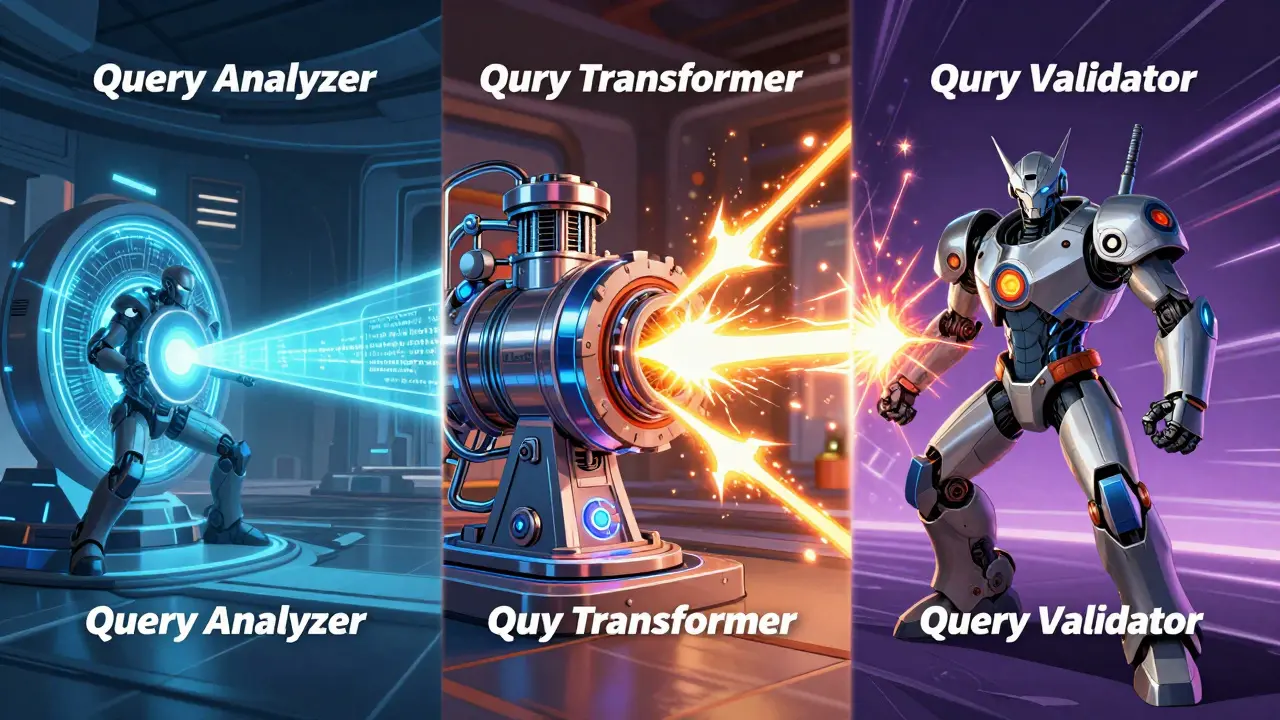
You can't just throw a prompt at an LLM and hope for the best. A production-ready system usually breaks query understanding into three specific stages to keep things fast and accurate.
- The Query Analyzer: This component parses the semantic structure of the input. It figures out if the user is asking a simple fact, a complex multi-part question, or something that requires a specific domain of knowledge.
- The Query Transformer: This is the engine room. It applies specific techniques like Query Reformulation (rewriting the question for clarity) or Query Expansion (adding synonyms and related terms) to cast a wider, more accurate net.
- The Query Validator: Before the final query hits your vector store, the validator ensures the transformation didn't drift too far from the original intent. This prevents "hallucinated" search terms from ruining your results.
The good news? This doesn't require a massive GPU cluster. A lightweight transformer model with around 110 million parameters can handle these transformations on an entry-level NVIDIA T4 GPU, adding only about 150-300ms of latency. For most users, a fraction of a second is a fair trade for a 42% reduction in retrieval failures.
Key Reformulation Techniques That Actually Work
Not all rewriting is created equal. Depending on your use case, you'll want to implement different strategies to handle how users interact with your system.
One of the most effective methods is Multi-Query Rewriting. Instead of relying on one single vector, the system generates three or four variations of the user's question. This accounts for different ways a topic might be phrased in your documents. Research from the University of Washington shows this increases the retrieval of relevant documents by over 37% compared to a single-query approach.
Then there is Step-Back Prompting. This technique asks the LLM to first generate a broader, more conceptual question before tackling the specific one. For example, if a user asks, "Why is the pressure dropping in valve X?", the system first asks, "How does pressure regulation work in this specific system?" By retrieving the general principles first, the LLM can answer the specific problem with 29.8% higher factual accuracy, according to Google AI studies.
For those dealing with messy, heterogeneous data, the RAG Decider Pattern is a powerhouse. It uses routing logic to decide which retrieval strategy to use based on the query type. While it's more complex to maintain, it has been shown to improve relevance by 41.3% in enterprise settings.
| Technique | Primary Goal | Accuracy Boost | Complexity | Best For |
|---|---|---|---|---|
| Multi-Query Rewriting | Overcome phrasing gaps | ~37% more docs | Low | General knowledge bases |
| Step-Back Prompting | Conceptual grounding | ~30% factual gain | Medium | Complex, technical FAQs |
| RAG Decider Pattern | Optimal routing | ~41% relevance | High | Enterprise multi-source data |
Practical Implementation and Trade-offs
Moving from a basic RAG setup to a query-aware one isn't free. You're trading computational overhead and development time for accuracy. Based on surveys from AI engineers, implementing these layers usually adds about 35-50% more development effort. If you're using LangChain, you have a head start-their standardized transformation modules have already shown a 28.7% improvement in Mean Reciprocal Rank (MRR@10).
One thing to watch out for is token consumption. When you use multi-query rewriting, you aren't just sending one request to your LLM; you're sending several. Developers on Reddit have reported that this can increase token usage by nearly 3x. If you're on a tight budget, you'll need to balance the number of expanded queries with your API costs.
Another risk is "expansion drift." As Dr. Emily Bender from the University of Washington pointed out, too much expansion can introduce biases. In legal RAG systems, for instance, expanding queries to find more cases actually amplified historical biases by 19%. The lesson here is simple: don't over-expand. Most developers find that 2-3 variations are the sweet spot.
When to Use (and When to Skip) Query Understanding
You don't always need a sophisticated transformation layer. If your users are asking simple, factual questions-like "What is the company holiday policy?"-basic keyword matching or simple vector search is usually enough. Microsoft Research found that the returns on query understanding diminish significantly for these basic queries.
However, you absolutely need these techniques if you're in a knowledge-intensive field. In healthcare, where a misunderstood term can lead to a dangerous answer, Step-Back Prompting has reduced factual hallucinations by 33.7%. Similarly, in legal or financial tech, where jargon is rampant, query reformulation is the only way to ensure the retriever finds the correct clause in a 100-page contract.
Future Trends: Adaptive and Self-Correcting RAG
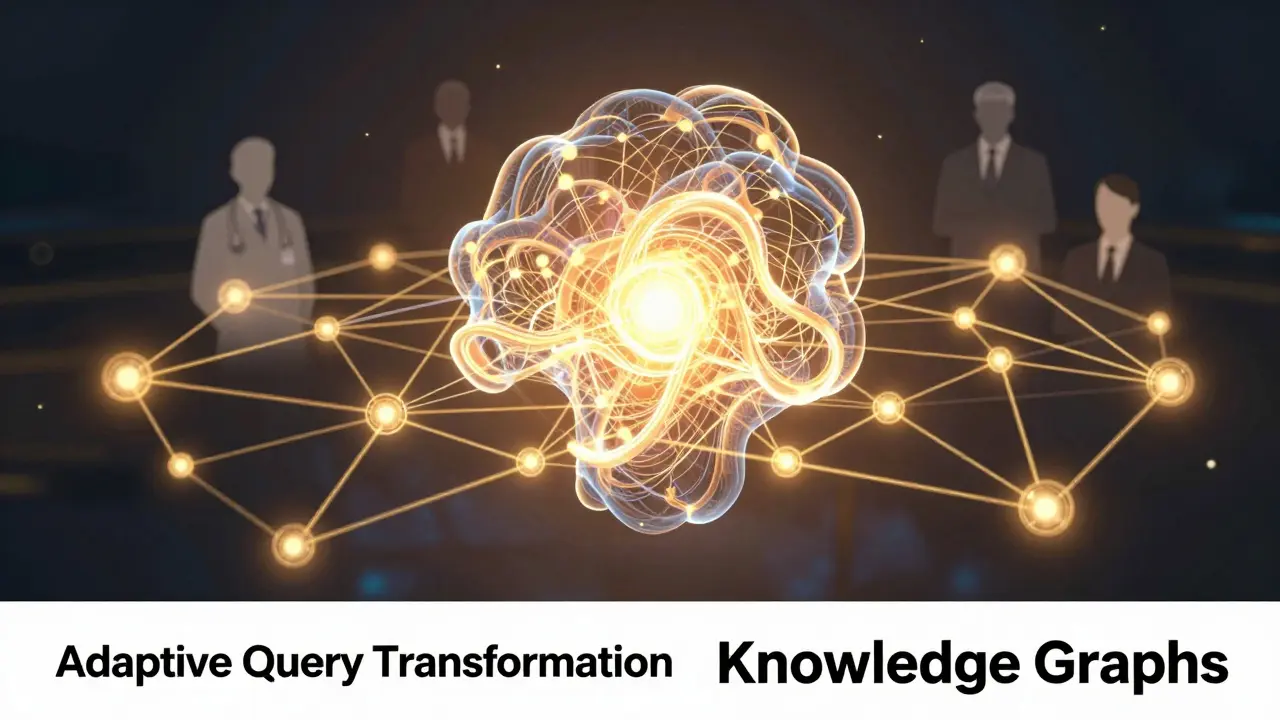
We're moving away from static rewriting. NVIDIA's RAG Stack 2.0 introduced "adaptive query transformation," which doesn't just apply a set of rules but dynamically chooses the best technique based on how complex the query is. This approach has shown an 18.3% improvement over static methods.
Looking ahead to 2025 and 2026, the industry is shifting toward self-correcting systems. LangChain is working on modules that use LLM feedback to iteratively refine a query. If the first retrieval fails to find a good answer, the system doesn't just give up-it analyzes why the retrieval failed and rewrites the query again.
There is also a push to treat query understanding as a graph problem. By modeling query elements as knowledge graphs, recent research from Stanford shows a 41.7% jump in handling truly complex, multi-layered questions. This moves us closer to a system that doesn't just "search" for text, but actually understands the relationship between concepts.
Will query expansion make my RAG system too slow?
It adds some latency, typically between 150ms and 400ms, depending on whether you use a CPU or GPU. However, this is usually negligible compared to the time it takes for the final LLM to generate a long response, and the massive jump in accuracy usually justifies the wait.
How many query variations should I generate for multi-query rewriting?
The consensus among developers is that 2 to 3 variations are optimal. Going beyond that often leads to diminishing returns and significantly increases your token costs without providing a meaningful boost in retrieval quality.
What is the difference between reformulation and expansion?
Reformulation is about changing the structure or phrasing of the original query to make it clearer (e.g., turning a vague question into a specific one). Expansion is about adding related terms, synonyms, or broader concepts to ensure the retriever finds all relevant documents, even if they don't use the exact same words.
Can I implement this without using an LLM for the transformation?
Yes, you can use lightweight transformer models (around 110M parameters) or even rule-based synonym dictionaries for basic expansion. However, for complex tasks like Step-Back prompting or adaptive routing, a small LLM is generally required to understand the semantic intent.
Does query understanding help with hallucinations?
Yes, significantly. Hallucinations often happen because the LLM is trying to answer a question with irrelevant context. By improving the quality of the retrieved documents through better query understanding, you provide the LLM with the correct facts, which reduces its need to "guess" or make things up.
Next Steps for Implementation
If you're ready to upgrade your RAG pipeline, start small. Don't jump straight into adaptive routing. Begin by implementing a basic multi-query rewriting loop using your existing LLM. This will give you an immediate win in retrieval breadth with very little code change.
If you find that your users are asking highly technical or conceptual questions, move toward Step-Back Prompting. This requires a bit more prompt engineering to ensure the "broad" question is actually useful. Finally, if you are managing a massive enterprise dataset with different types of documents (e.g., PDFs, SQL databases, and API docs), invest the time to build a RAG Decider to route queries to the most appropriate source.


Patrick Sieber
April 16, 2026 AT 16:12This is a really solid breakdown of the current state of RAG. I've found that multi-query rewriting is definitely the easiest way to get a quick win without over-engineering the whole pipeline.
Kieran Danagher
April 17, 2026 AT 00:28Sure, it adds a few hundred milliseconds. Absolute tragedy. I'm sure the users will just perish while waiting for their a-plus retrieval quality.
Sheila Alston
April 17, 2026 AT 13:49It's just disappointing that the focus is always on efficiency and speed rather than the ethical implications of how these models are trained in the first place. We should be prioritizing the human cost over a 30% boost in retrieval accuracy, but I suppose that's just how the industry works now.
sampa Karjee
April 17, 2026 AT 19:34The sheer mediocrity of the current implementation standards is staggering. Most of you are just slapping LangChain wrappers on top of things without even understanding the linear algebra behind the vector space. It's frankly embarrassing that we even need a guide for query expansion in 2024. If you actually understood the fundamental mathematics of semantic search, you wouldn't need a 'Decider Pattern' to tell you how to route a basic query. The industry is flooded with 'engineers' who can barely write a clean loop, let alone optimize a retrieval pipeline for enterprise-grade scale. It's a joke. True optimization requires a deep dive into the manifold hypothesis, not just reading a few blog posts and hoping the LLM handles the heavy lifting for you. Honestly, the lack of rigor in modern AI development is why we're seeing so many hallucinations in the first place. You can't fix a broken foundation with a fancy prompt. Stop relying on these high-level abstractions and go back to the basics of information retrieval. It's the only way to actually achieve the 'enterprise-grade results' the post mentions without just burning tokens in a desperate attempt to find a needle in a haystack. The obsession with 'speed' and 'latency' is just a cover for the fact that most people don't know how to build a proper index. Pathetic.
Natasha Madison
April 18, 2026 AT 04:51Who is actually funding these 'Stanford' and 'Google' studies? Probably some shadowy group trying to control what information we can actually retrieve from the web. They want us using 'reformulation' so they can filter out the truth before it even hits the LLM.
OONAGH Ffrench
April 19, 2026 AT 14:34the trade off between precision and recall is fundamentally a philosophical question of intent
one must consider if the system is designed to discover or to verify