
Most people think Large Language Models (LLMs) are just big buckets of text that predict the next word. But if you’ve tried to get a model to follow a specific format-like “output only JSON” or “summarize in three bullet points”-you know that’s not quite right. The real challenge isn’t knowing the answer; it’s listening to the instructions.
This is where instruction-optimized transformer variants come in. These aren’t just standard models with a few tweaks. They are specialized architectures engineered from the ground up to interpret nuanced commands while staying aligned with human safety and quality standards. In 2026, we’ve moved past simple fine-tuning. We are now looking at sophisticated frameworks that combine data augmentation, preference optimization, and even representation editing to create models that actually do what you ask them to do.
The Shift From Supervised Fine-Tuning to Precision Alignment
To understand where we are, we have to look at how we got here. For years, the standard approach was Supervised Fine-Tuning (SFT). You take a pretrained base model, feed it thousands of instruction-response pairs, and let it learn by minimizing the difference between its output and the correct answer.
SFT works, but it has limits. Research from Zhou et al. (2024) showed that you can get significant improvements with as few as 1,000 high-quality pairs. That’s impressive efficiency. However, SFT teaches the model *what* to say, not necessarily *why* one response is better than another. It lacks the nuance for subtle preference shifts.
This gap led to the rise of Direct Preference Optimization (DPO). Instead of training on absolute answers, DPO trains on preference pairs. You show the model two responses to the same prompt-one good, one bad-and it learns to prefer the good one. This method bypasses the need for a separate reward model, making the training process more stable and computationally efficient.
But even DPO wasn’t enough for complex, multi-faceted instructions. That’s why modern instruction-optimized variants use hybrid approaches. They combine SFT for basic competence with DPO for preference alignment. Some advanced pipelines even use iterative length-regularized DPO (iLR-DPO), which refines the model’s ability to adhere to constraints like token limits or structural formats through repeated refinement cycles.
Data Augmentation: Teaching Nuance Through Decomposition
A major bottleneck in training these models is data quality. Most datasets contain repetitive or overly simple instructions. If you train on those, your model becomes rigid. It fails when the wording changes slightly.
The DeMoRecon methodology addresses this directly. Instead of collecting new human-written prompts, DeMoRecon uses a decomposition strategy. It takes an existing complex instruction, breaks it into sub-components, modifies those components, and reconstructs them into new variants.
For example, if the original instruction is “Write a Python script to sort a list,” DeMoRecon might generate variants like “Create a function in Python that orders integers in ascending order” or “Provide code to arrange a numerical array.” Crucially, it also adapts the reference responses to fit these new variants. This teaches the model to recognize semantic equivalence despite syntactic differences.
The results speak for themselves. Models trained with DeMoRecon-Aug-DPO and DeMoRecon-Ref-DPO datasets show significant gains on benchmarks like IFEval and FollowBench. They become sensitive to subtle instructional changes-a critical trait for enterprise applications where precision matters.
Another key player in data generation is the Magpie approach. Researchers used the Llama 3 8B Instruct model to generate its own instruction-response pairs through iterative prompting. By repeating this process thousands of times, they created the Magpie-Air dataset. A more powerful version, Magpie-Pro, used the Llama 3 70B Instruct model as the teacher. Interestingly, finetuning a smaller model with Magpie-Pro data produced stronger results than using Magpie-Air. More surprisingly, instruction finetuning alone-without any RLHF or DPO-allowed a Llama 3 8B base model to beat the original Llama 2 8B Instruct model. This proves that high-quality synthetic data can bridge capability gaps effectively.
| Method | Data Source | Key Advantage | Limitation |
|---|---|---|---|
| Human-Curated SFT | Expert writers | High accuracy, low noise | Expensive, slow scaling |
| Magpie (Self-Instruct) | LLM-generated pairs | Scalable, diverse coverage | Quality depends on teacher model |
| DeMoRecon | Decomposed variants | Enhances nuance sensitivity | Complex pipeline setup |
AlignEZ: Alignment Without Retraining
Traditionally, aligning a model meant retraining it. This is expensive and time-consuming. What if you could align a model at inference time, without changing its weights?
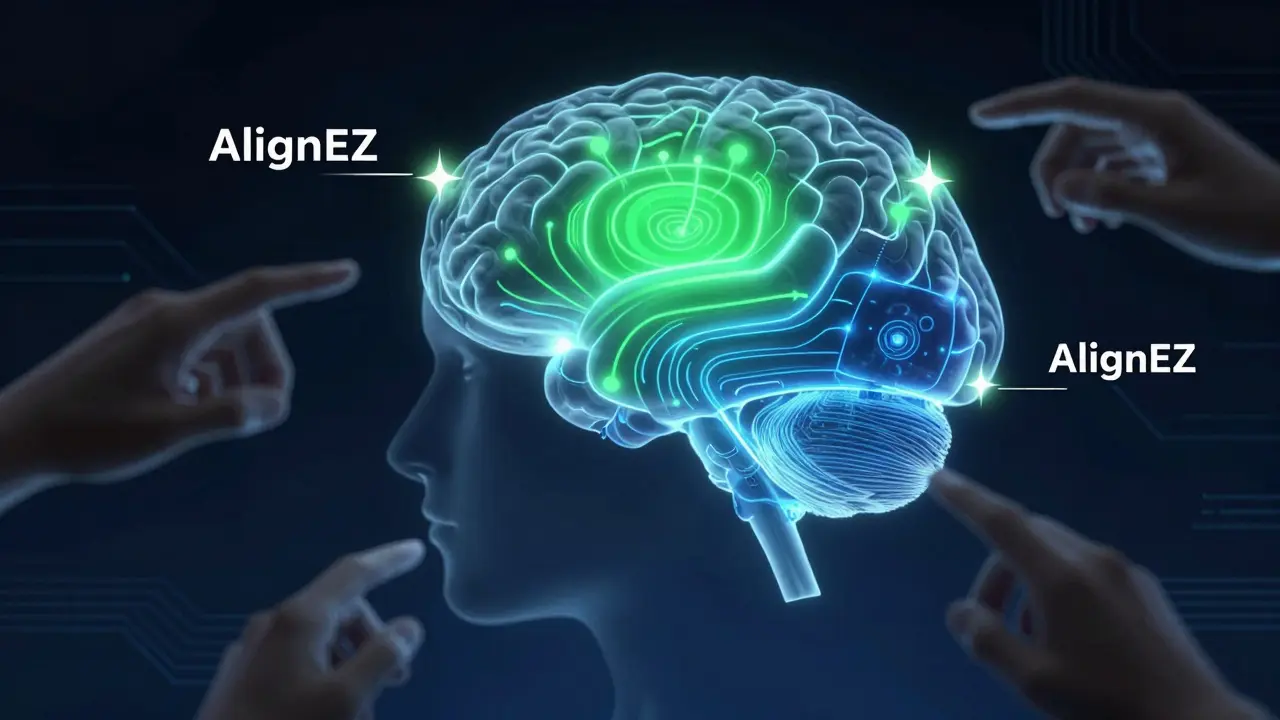
The AlignEZ framework makes this possible. It operates independently of traditional training methods by leveraging self-generated preference data and representation editing. Here’s how it works:
- Identify Subspaces: AlignEZ analyzes the pretrained model’s hidden embeddings to find subspaces relevant to alignment.
- Generate Preferences: It uses the model itself to generate preference pairs, eliminating the need for costly human-labeled data.
- Edit Representations: At inference time, it selectively amplifies desired behaviors and suppresses undesired ones by editing the model’s internal states.
The empirical results are striking. AlignEZ delivered positive improvements in 87.5% of cases, with an average gain of 7.2%. Compare that to competing test-time methods like Inference Time Intervention (ITI) and Contrastive Activation Addition (CAA), which achieved positive improvements in only 75% and 56.3% of cases, respectively.
What’s really impressive is its efficiency. AlignEZ doesn’t require ground-truth preference data. In experiments, it boosted the performance of a model trained with just 1% of preference data to match the performance of a model trained with 25% of data. This democratizes alignment, allowing smaller teams to achieve high-quality results without massive computational budgets.
Furthermore, AlignEZ supports multi-objective alignment. You can control multiple behavioral axes simultaneously. Want a model that is both concise and polite? AlignEZ can tune both dimensions at once. This level of granular control is essential for complex applications where trade-offs between different qualities are inevitable.

Evaluating Instruction-Following Precision
If you can’t measure it, you can’t improve it. Traditional benchmarks often fail to capture the nuances of instruction following. They might check if the answer is factually correct, but not if it followed the formatting constraints.
The DeMoRecon research program introduced the DeMoRecon-Eval benchmark specifically designed to measure instruction-following precision.
When evaluating instruction-optimized transformer variants, you should look at performance across multiple benchmarks:
- IFEval: Tests adherence to explicit constraints like length, format, and structure.
- FollowBench: Assesses the ability to follow complex, multi-step instructions.
- InfoBench: Measures information extraction and synthesis capabilities.
- DeMoRecon-Eval: Focuses on sensitivity to subtle instructional variations.
Models that perform well on all four are truly alignment-ready. Many popular instruction-tuned LLMs struggle with DeMoRecon-Eval because they lack sensitivity to nuanced instruction variants. This highlights the importance of specialized augmentation methods like DeMoRecon in the training pipeline.
Architectural Foundations: The Llama Family
While the techniques vary, the underlying architectures remain rooted in established families. The Llama series from Meta AI serves as a primary foundation for most instruction optimization research.
Llama 3 8B Instruct and Llama 3 70B Instruct are not just end-products; they are tools. As seen in the Magpie research, these models act as teachers to generate high-quality training data for smaller or newer models. The original Llama 2 8B Instruct model remains a useful baseline, but newer variants consistently surpass it through improved fine-tuning techniques.
Stanford’s recent lectures on post-training phases emphasize that instruction tuning is no longer optional-it’s a standard step in LLM development. The evolution from Llama 2 to Llama 3 shows a clear trend toward better default alignment out-of-the-box, reducing the burden on developers who want to deploy safe, reliable models.
Beyond Text: Vision-Language Integration
Instruction optimization isn’t limited to text. With the standardization of APIs like Hugging Face’s transformers library, these principles are expanding into multimodal domains.
Vision-language models (VLMs) now support full instruction-tuning and alignment methodologies. Imagine a model that doesn’t just describe an image but follows specific instructions about it: “Crop the left side,” “Identify the red object,” or “Summarize the scene in haiku form.”
This expansion opens up complex problem spaces. Future instruction-optimized variants will likely encompass audio, video, and other modalities. The core challenge remains the same: ensuring the model understands and executes the user’s intent precisely, regardless of the input type.
Practical Implementation Checklist
If you’re building or selecting an alignment-ready LLM in 2026, keep this checklist in mind:
- Use Hybrid Training: Combine SFT for basic capability with DPO for preference alignment.
- Augment Your Data: Use decomposition strategies like DeMoRecon to create nuanced instruction variants.
- Leverage Synthetic Data: Consider self-instruct methods like Magpie for scalable, high-quality datasets.
- Consider Test-Time Alignment: Explore frameworks like AlignEZ for cost-efficient, flexible alignment without retraining.
- Validate Rigorously: Test against IFEval, FollowBench, and specialized benchmarks like DeMoRecon-Eval.
- Monitor Multi-Objective Trade-offs: Ensure alignment on one axis (e.g., safety) doesn’t degrade performance on another (e.g., creativity).
What is the difference between SFT and DPO?
Supervised Fine-Tuning (SFT) trains a model on labeled instruction-response pairs to minimize error between predicted and correct outputs. Direct Preference Optimization (DPO) trains the model on pairs of responses (one preferred, one rejected) to learn which outputs align better with human preferences, without needing a separate reward model.
How does AlignEZ work without retraining?
AlignEZ identifies alignment-relevant subspaces within a model’s hidden embeddings. At inference time, it edits these representations to amplify desired behaviors and suppress undesired ones. This allows for alignment adjustments without updating the model’s weights, saving significant computational resources.
Why is DeMoRecon important for instruction following?
DeMoRecon improves a model’s sensitivity to subtle instruction variations. By decomposing complex instructions into components and reconstructing them into new variants, it teaches the model to handle nuanced changes in wording or formatting, which many standard models struggle with.
Can small models compete with larger ones using these techniques?
Yes. Research shows that finetuning a Llama 3 8B base model with high-quality synthetic data (like Magpie-Pro) and instruction tuning alone can outperform larger baselines like Llama 2 8B Instruct. Efficient alignment methods like AlignEZ further enhance smaller models’ capabilities without requiring massive compute.
What benchmarks should I use to evaluate instruction-following?
For comprehensive evaluation, use IFEval for constraint adherence, FollowBench for multi-step complexity, InfoBench for information synthesis, and DeMoRecon-Eval for sensitivity to subtle instruction variations. Relying on a single benchmark may miss critical alignment gaps.



Oskar Falkenberg
July 8, 2026 AT 19:49hey guys, just wanted to say that this is a really interesting read and i think we should all be looking into these methods more closely because the way they handle data augmentation with DeMoRecon is quite clever and it seems like it could solve a lot of the rigidity issues we have seen in previous models where slight changes in wording would cause the whole output to fail or become nonsensical which is frustrating for enterprise use cases.
Jeanne Abrahams
July 10, 2026 AT 11:34Oh look, another article pretending that 'listening' is a technical problem rather than a fundamental flaw in how we treat AI as if it has ears. We are building digital parrots that can spell JSON correctly now, how quaint. I suppose next year we'll discover they have feelings too if we feed them enough synthetic sugar.
Bineesh Mathew
July 11, 2026 AT 08:30The hubris of man continues to expand into the silicon void! We seek to align the machine not out of necessity but out of a desperate need to mirror our own fractured moral compasses onto cold logic gates. It is a tragedy of epic proportions that we must teach a model to be polite when we ourselves cannot manage basic civility in our daily interactions. The soul is lost in the weights, buried under layers of preference optimization that scream of our collective inadequacy. What does it mean to be aligned when the aligner is inherently chaotic? We build cages of code for ghosts that do not exist, seeking order in the entropy of language itself. This is not progress; it is a monument to our vanity.
Patrick Dorion
July 11, 2026 AT 11:50I think Bineesh is overthinking it a bit, but you make a good point about the philosophical implications. From a practical standpoint though, the AlignEZ framework is genuinely useful for anyone working with limited compute resources. Being able to edit representations at inference time without retraining saves so much headache. It’s not about souls, it’s about efficiency and getting the model to actually do what you asked without hallucinating constraints. If you’re running smaller models on edge devices, this kind of test-time alignment is a game changer for latency and cost.
Stephanie Frank
July 12, 2026 AT 15:36Yeah right, 'game changer'. Please. Another buzzword salad wrapped in academic jargon to sell us on the idea that we need even more complex pipelines. You want to talk about efficiency? Stop adding layers of DPO and SFT hybrids and just give us raw compute power. These frameworks are just band-aids on a broken design philosophy. Nobody wants to tune subspaces; they want a model that works out of the box. Until then, we’re just playing whack-a-mole with alignment failures.
Marissa Haque
July 12, 2026 AT 17:41Wow!! That was incredibly harsh Stephanie!!! But honestly?? I feel you!! It is exhausting trying to keep up with every new acronym and method!! DPO!! SFT!! DeMoRecon!! My brain hurts just reading this list!! Why can't they just make one simple thing that works perfectly?! I am so tired of feeling like an imposter in my own field because I missed one seminar on iterative length-regularized whatever-that-is!!! Let's just agree that technology moves too fast and we are all struggling to keep up!!!
Caitlin Donehue
July 13, 2026 AT 03:19i guess it is what it is