You built the model. It passed testing. You deployed it to production. And then, three weeks later, a user prompted it to leak customer data, or worse, your system generated advice that violated federal regulations. This is not a hypothetical scenario; it is the daily reality for teams rushing artificial intelligence into live environments without proper boundaries.
The solution isn't just better code. It is production guardrails. These are the technical and procedural controls that act as the final line of defense between your AI systems and your users. They ensure outputs remain safe, compliant, and aligned with organizational values before they ever reach the public eye.
Key Takeaways
- Guardrails operate at inference time: They validate inputs before processing and inspect outputs before delivery, adding only 10-50 milliseconds of latency.
- Compliance is non-negotiable: Frameworks like HIPAA, ISO 42001, and the EU AI Act require specific audit trails and risk assessments that manual reviews cannot sustain.
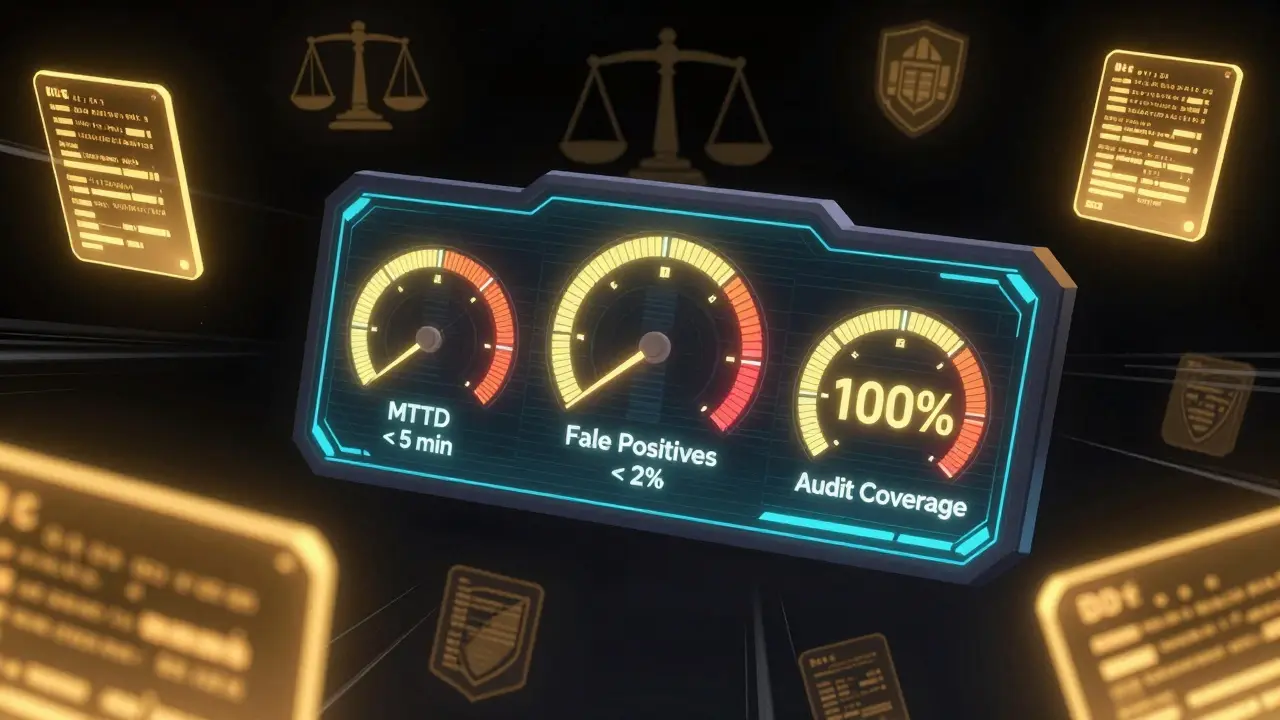
- Metrics matter: Aim for Mean Time to Detect (MTTD) under 5 minutes and False Positive Rates below 2% to balance security with user experience.
- Human-in-the-loop is critical: High-risk actions like financial transactions or data deletion must route to human approval, never autonomous execution.
What Are Production Guardrails?
Think of production guardrails as the traffic laws and speed bumps for your AI agents. In development, you might trust the driver. In production, you cannot. Guardrails are comprehensive safety mechanisms designed to monitor, filter, and govern inputs and outputs. They enforce boundaries so that even if an AI model hallucinates or gets manipulated by a malicious prompt, the system remains contained.
These controls work across two primary stages:
- Pre-execution validation: Inspecting incoming prompts for injection attempts, data exfiltration risks, or policy violations before the model processes them.
- Post-output inspection: Scanning responses for unsafe suggestions, biased language, or formatting errors before they are displayed to the user.
The beauty of modern guardrail frameworks, such as Guardrails AI, is their efficiency. By using asynchronous validation, they add negligible latency-typically just 10 to 50 milliseconds-to the request/response cycle. This means you get enterprise-grade security without sacrificing the real-time performance users expect.
Compliance Gates and Regulatory Frameworks
Security is about preventing harm. Compliance is about proving you prevented harm. In 2026, you cannot separate the two. Production guardrails translate legal obligations into automated enforcement mechanisms. Here is how major frameworks integrate into your pipeline:
| Framework | Primary Requirement | Guardrail Implementation |
|---|---|---|
| HIPAA | Encrypt Protected Health Information (PHI); limit access to minimum necessary. | Input sanitization to strip PHI; output masking for sensitive health data; strict audit logs of all access. |
| ISO 42001 | Establish AI governance structure; conduct ongoing risk assessments. | Automated risk scoring of prompts; continuous monitoring dashboards; documented accountability trails. |
| NIST AI RMF | Govern, Map, Measure, Manage AI-specific risks. | Real-time anomaly detection; bias mitigation filters; transparency logs for decision-making rationale. |
| EU AI Act | Conformity assessments for high-risk systems; transparency for generative AI. | Watermarking outputs; mandatory human review for high-risk categories; detailed provenance tracking. |
For example, under HIPAA, every interaction involving patient data must be logged. Your guardrails should automatically tag requests containing potential PHI, encrypt them in transit, and ensure the response does not expose internal system prompts or unauthorized data. If a vendor’s API is involved, the guardrail checks for active Business Associate Agreements (BAAs) before allowing the call.

Security Reviews and Risk Assessment
A static firewall is useless against dynamic threats. Similarly, guardrails must evolve. The foundation of this evolution is a systematic risk assessment framework. Before deploying any new agent or model, follow these steps:
- Inventory: Catalog every system, model, and agent in your environment. You cannot secure what you do not know exists.
- Classify: Determine the sensitivity level (public, internal, confidential, restricted) and regulatory scope of each component.
- Assess: Identify potential harms. What happens if this model generates toxic content? What if it leaks credentials?
- Prioritize: Rank risks by severity and probability. Focus your highest-fidelity guardrails on high-severity, high-probability scenarios.
- Mitigate: Implement guardrails proportional to the risk. A chatbot answering FAQs needs different controls than an agent executing financial trades.
- Monitor: Track effectiveness continuously. Use metrics like Policy Violation Rate and Agent Audit Coverage.
- Report: Communicate status to stakeholders and regulators. Transparency builds trust.
This process is not a one-time event. As models update and threat landscapes shift, your guardrails must undergo regular security reviews. Red team exercises are essential here. Simulate prompt injection attacks, data exfiltration attempts, and adversarial inputs to find gaps in your coverage. If your red team can bypass your guardrails, so can a bad actor.
Operational Efficiency and Human Oversight
Many organizations fear that guardrails will slow down development. In reality, they accelerate it by removing bottlenecks. Instead of security teams manually reviewing every deployment, pre-approved guardrail templates allow developers to launch projects faster with consistent security controls. Automated testing validates security before production release, reducing back-and-forth between engineering and compliance.
However, automation has limits. For sensitive or high-risk operations, you must implement human-in-the-loop workflows. Production guardrails should route requests to humans for review or approval when:
- Financial transactions exceed a certain threshold.
- Data deletion or privilege changes are requested.
- Anomalous behavior patterns are detected.
- Confidence scores from the AI model fall below a predefined safety margin.
This hybrid approach ensures that while routine tasks flow efficiently, critical decisions retain human accountability. Pre-execution policy checks validate every tool call, confirming user permission and context alignment before action is taken.
Measuring Success: Key Metrics
If you cannot measure it, you cannot manage it. To evaluate the effectiveness of your production guardrails, track these key metrics:
- Mean Time to Detect (MTTD): The average time from a threat occurrence to identification. Target: Less than 5 minutes.
- Mean Time to Respond (MTTR): The average time from detection to containment. Target: Less than 15 minutes.
- False Positive Rate: The percentage of legitimate actions incorrectly flagged. Target: Below 2%. High false positives frustrate users and erode trust.
- Policy Violation Rate: Tracks the frequency of guardrail boundary tests. Sudden spikes may indicate targeted attacks.
- Agent Audit Coverage: The percentage of AI actions with complete audit trails. Target: 100% for regulated industries.
Use these metrics to tune your guardrails. If false positives are high, relax overly strict rules. If MTTD is creeping up, optimize your logging and alerting infrastructure. Continuous improvement is the hallmark of a mature security posture.
Audit Trails and Documentation
In the event of a breach or regulatory inquiry, your audit logs are your evidence. Comprehensive documentation is not optional; it is a requirement for frameworks like ISO 42001 and the EU AI Act. Your guardrails must log:
- User or agent identity for every interaction.
- Input prompts and output responses.
- Policy decisions with allow/deny rationale.
- Data accessed, including what, when, and why.
- Configuration changes to guardrails.
- Anomalies and security events.
These logs enable post-incident forensics and help detect weak points in your setup. Over time, you can analyze denied content lists to refine prompt instructions and expand coverage for emerging edge cases. Remember, audit trails must be immutable and tamper-proof to maintain their integrity.
The Continuous Evolution of Guardrails
Safety measures are not static configurations. They are living systems that must change as your models and threat landscape evolve. New vulnerabilities emerge daily. New regulations pass quarterly. Your guardrails must adapt.
This requires a culture of continuous oversight. Begin with data validation during training, move to prompt tuning in development, and end with live supervision in production. Regularly revisit your risk assessments. Update your red team scripts. Refine your policies based on real-world usage data.
By treating guardrails as an ongoing process rather than a one-time implementation, you build resilience. You protect your users, your reputation, and your bottom line. In the age of AI, security is not a feature. It is the foundation.
What is the difference between input validation and output inspection in production guardrails?
Input validation occurs before the AI model processes a request. It checks for malicious prompts, injection attempts, or data exfiltration risks. Output inspection happens after the model generates a response but before it reaches the user. It scans for harmful content, bias, formatting errors, or policy violations. Both are critical layers of defense.
How much latency do production guardrails add to AI applications?
Modern guardrail frameworks use asynchronous validation to minimize impact. Typically, they add only 10 to 50 milliseconds to the response time. This is negligible for most user experiences while providing significant security benefits.
Which compliance frameworks require production guardrails?
Several major frameworks mandate robust security controls for AI systems. HIPAA requires protection of health data. ISO 42001 focuses on AI management systems. The NIST AI Risk Management Framework provides guidelines for risk assessment. The EU AI Act imposes strict requirements on high-risk AI systems, including conformity assessments and transparency.
When should human-in-the-loop reviews be triggered?
Human reviews should be triggered for high-risk actions. This includes financial transactions above a set threshold, data deletion requests, privilege escalations, or when the AI model's confidence score falls below a safety margin. It also applies when anomalous behavior patterns are detected.
What are the key metrics for measuring guardrail effectiveness?
Key metrics include Mean Time to Detect (MTTD), Mean Time to Respond (MTTR), False Positive Rate, Policy Violation Rate, and Agent Audit Coverage. Targets often include MTTD under 5 minutes, MTTR under 15 minutes, and false positive rates below 2%.
Why are audit trails important for AI compliance?
Audit trails provide evidence of compliance and enable forensic analysis after incidents. They log user identities, inputs, outputs, policy decisions, and data access. Regulations like ISO 42001 and the EU AI Act require comprehensive, immutable logs to demonstrate accountability and transparency.
How often should guardrails be updated?
Guardrails should be treated as living systems. They require continuous updates based on evolving threat landscapes, new regulatory requirements, and feedback from production usage. Regular red team exercises and risk assessments help identify necessary adjustments.
Can production guardrails prevent all AI risks?
No single control prevents all risks. Guardrails significantly reduce exposure to known threats like prompt injection and data leakage. However, they must be part of a broader security strategy that includes secure coding practices, data privacy techniques, and ongoing monitoring.
What is the role of red teaming in guardrail development?
Red teaming simulates adversarial attacks to test guardrail effectiveness. By attempting to bypass controls through prompt injection or other methods, red teams identify coverage gaps. This proactive testing allows developers to refine rules and strengthen defenses before deployment.
How do guardrails improve operational efficiency?
Automated guardrails eliminate manual review bottlenecks for routine tasks. Pre-approved templates enable faster project launches. Consistent security controls reduce friction between development and security teams. This allows security professionals to focus on strategic threats rather than repetitive checks.