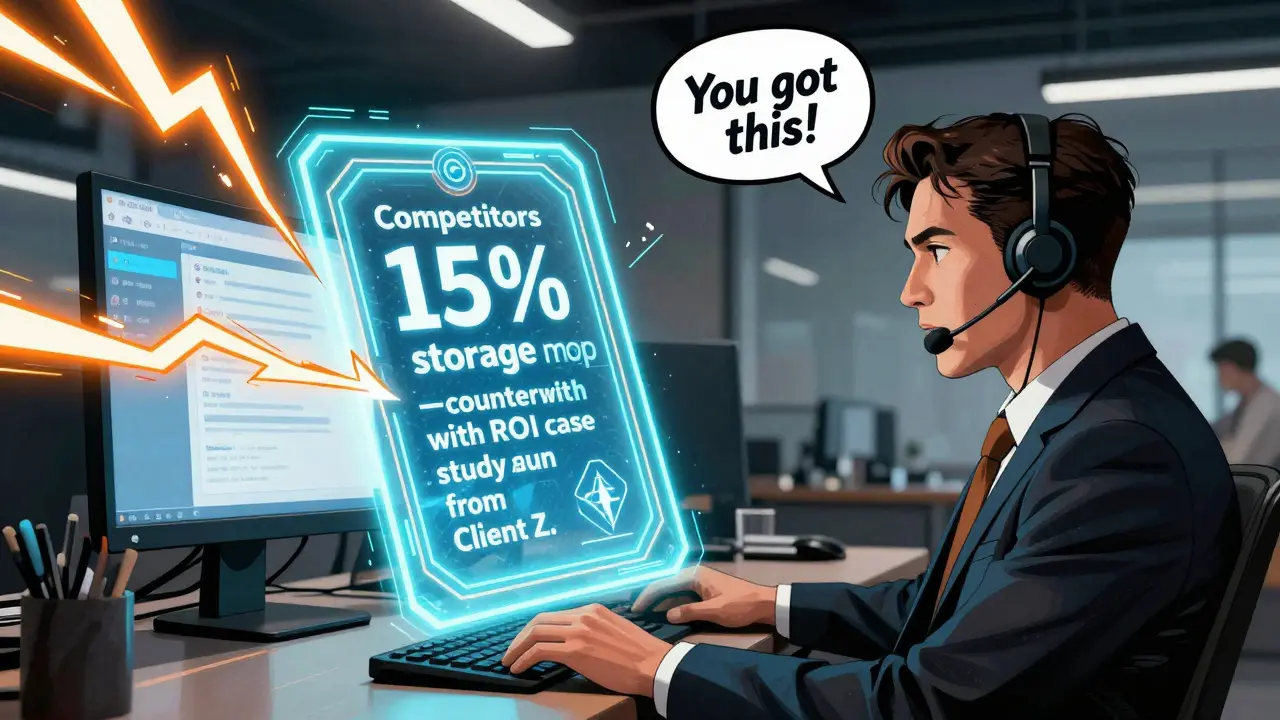
Imagine you’re in a sales call. The prospect mentions a competitor by name - and suddenly, your rep gets a real-time alert on their screen: "They’re offering 15% more storage at the same price. Here’s how to counter with your ROI case study from last month."" That’s not science fiction. That’s what AI-powered battlecards do today - and they’re reshaping how sales teams win deals.
What Are AI-Powered Battlecards, Really?
Traditional battlecards were static PDFs or OneNote pages. Sales reps printed them out, stuck them in a binder, and forgot about them until the next quarter. By then, the competitor had changed pricing, added a feature, or launched a new product. Half the time, the info was outdated. A 2023 study by Haveignition found that 63% of sales reps used battlecards with incorrect or outdated data during critical negotiations.
Generative AI changed all that. Modern battlecards aren’t documents - they’re living systems. They ingest call transcripts, CRM notes, and competitor press releases. Then, using natural language processing, they spot when a competitor is mentioned, analyze the context, and instantly serve up the best response. Platforms like Gong, Goodmeetings, and OctaveHQ now auto-generate battlecards from real sales conversations. If a rep lost a deal last week because the prospect said, "Your support isn’t as fast as Vendor X’s," the AI pulls that exact objection, finds the winning counter-response from another rep’s successful call, and surfaces it before the next meeting.
It’s not magic. It’s data. These systems need at least 500 historical sales calls to learn patterns. They integrate with Salesforce, HubSpot, and Microsoft Dynamics, updating in under 24 hours. And the results? Companies using AI battlecards see 43% faster responses to objections and 31% higher accuracy in positioning. Gong’s analysis of 12,000+ calls showed a 17-29% reduction in sales cycle length.
Call Summaries: The Hidden Engine Behind Better Responses
Call summaries aren’t just pretty notes. They’re the raw material AI uses to build smarter battlecards. Before AI, reps spent 15-20 minutes after every call typing up summaries. Most skipped it. Those notes were lost. Now, AI listens to the call, identifies key moments - objections, competitor mentions, buyer concerns - and auto-generates a structured summary in seconds.
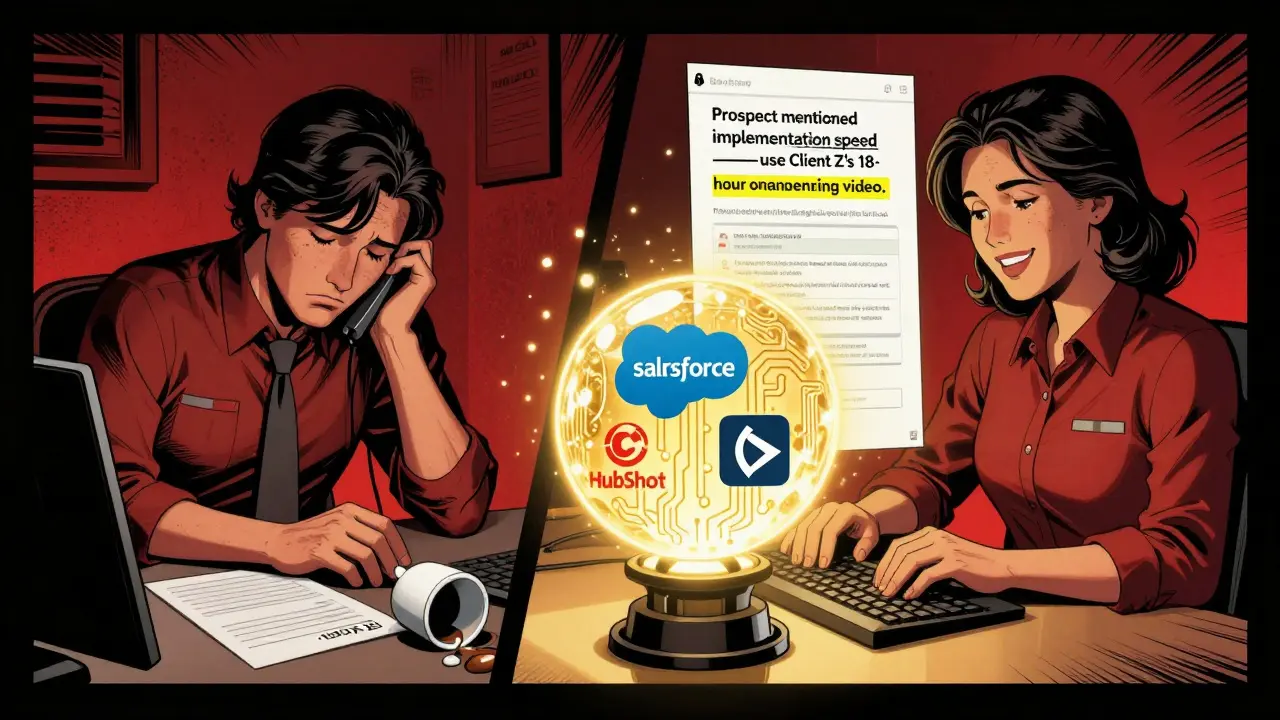
Goodmeetings’ system, for example, processes 97.3% of transcripts with 89.6% accuracy in flagging competitive mentions. It doesn’t just say, "Prospect mentioned Competitor Y." It says: "Prospect raised concerns about implementation speed. Competitor Y was cited as having 24-hour onboarding. Rep did not address timeline. Recommended response: Share case study from Client Z - went live in 18 hours."
These summaries feed directly into battlecards. They also help managers coach reps. Instead of saying, "You need to be better at handling objections," a manager can point to a specific call summary and say, "Here’s exactly what happened - here’s what worked for someone else." This turns coaching from guesswork into science.
And the impact? Teams using AI-generated summaries see 22% fewer missed objections. In one case, a SaaS company reduced deal slippage by 37% simply by surfacing these summaries to reps before their next meeting.
Objection Handling That Actually Works
Objection handling used to be about memorizing scripts. "Our pricing is higher, but we offer better uptime." "We’re not the cheapest, but we’re the most reliable." Those lines don’t work anymore. Buyers are smarter. They’ve read your competitor’s website. They know your marketing fluff.
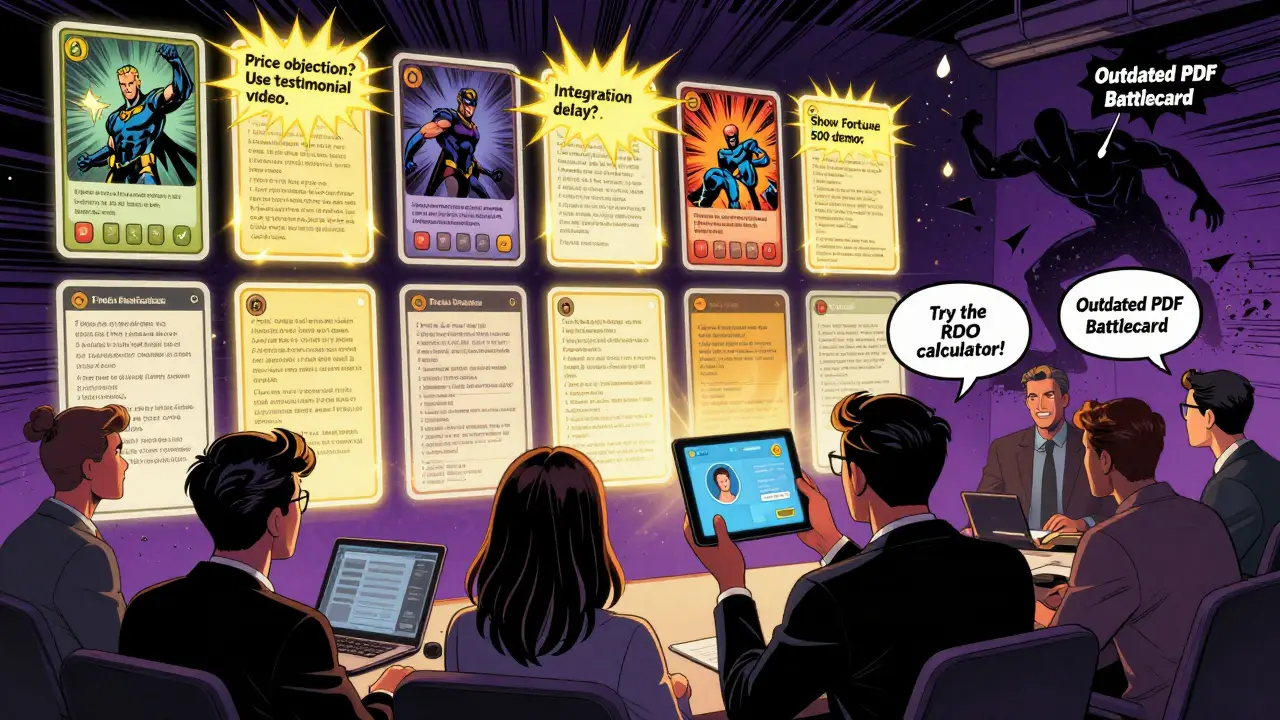
AI-powered objection handling changes the game. It doesn’t give you generic replies. It gives you situation-specific responses based on what’s worked before. If a prospect says, "Your integration takes too long," the AI doesn’t just show a generic response. It pulls a winning rebuttal from a similar deal - maybe one where the rep shared a video demo of a 14-hour setup with a Fortune 500 client. Or it highlights a customer testimonial from the same industry that says, "We were skeptical, but we went live in 11 days."
Forrester found that only 32% of early AI tools included real customer stories in their responses. The best ones now do. Kompyte’s system, for example, automatically links objections to verified success stories from your CRM. Adobe’s sales team saw a 29% increase in win rates after implementing this feature.
It’s not about automation - it’s about personalization. AI doesn’t replace the rep. It gives them the right ammunition at the right time. One rep on Reddit said, "The Paperflite Seek feature cut my objection prep time from 45 minutes to 8 minutes per deal." That’s time you can spend building trust, not Googling.
Who’s Winning - and Who’s Failing?
Adoption is growing fast. 68% of enterprise sales teams now use AI battlecards - up from 22% in 2021. But not everyone succeeds. Gartner reports that over 60% of AI battlecard implementations fail. Why?
Failure reason #1: Bad data. AI can’t fix garbage. If your CRM is full of incomplete call notes, missing win/loss reasons, or outdated competitor info, the AI will spit out nonsense. One HubSpot user reported a 3-month setup delay because their historical data was a mess. The fix? Clean up your data first. Automate it with tools that clean CRM entries - Kompyte’s case studies show this boosts accuracy by 63%.
Failure reason #2: No sales leadership buy-in. If your VP of Sales doesn’t use the system, no one else will. The most successful teams appoint a battlecard champion - someone who owns updates, gathers feedback, and pushes adoption. Teams with this role saw 43% higher usage.
Failure reason #3: Over-reliance on templates. Some tools push reps toward robotic responses. A December 2023 HBR survey of 200 sales leaders found that 64% worry AI will make reps sound like chatbots. The best systems balance automation with flexibility. They don’t force scripts. They offer options. "Here’s what worked last time. Here’s what your peer said. Here’s your own voice."
Success stories? Adobe, Zoom, and Salesforce all report double-digit win rate increases. Failure stories? A major SaaS company abandoned their AI tool after six months because it kept flagging fake competitor mentions - false positives were so high, reps stopped trusting it.
What You Need to Get Started
You don’t need a $100K budget. But you do need a plan.
- Start with data. Audit your CRM. Do you have at least 500 historical sales calls with win/loss notes? If not, pause. Clean it up.
- Choose the right tool. Gong leads in call analysis. Kompyte wins for competitive intelligence. Crayon is strong for enterprise scale. Prices range from $49 to $149 per user/month. Don’t pick the cheapest - pick the one that integrates with your CRM and has strong case studies in your industry.
- Train your team. Reps need 16-24 hours of training. Don’t just show them the tool - show them why it matters. Gamify it. Reward reps who use it to close deals.
- Set feedback loops. Ask reps weekly: "What did the AI miss?" "What response didn’t work?" Feed that back into the system. The best tools learn from you.
- Update constantly. Top performers update battlecards within 48 hours of a competitor’s announcement. Make that part of your process.
Implementation takes 14-18 weeks. But the payoff? Faster deals. Higher win rates. Less stress for your reps.
The Future: AI That Thinks Like a Sales Rep
The next wave isn’t just about answering objections. It’s about predicting them.
OctaveHQ is building predictive battlecards that forecast what a prospect will say - based on historical patterns from similar deals. Goodmeetings is adding live coaching: during a call, the AI whispers suggestions into the rep’s earpiece: "They’re price-sensitive. Try the ROI calculator."
And by 2026, Gartner predicts 90% of enterprise sales teams will use AI battlecards as standard equipment. The question isn’t whether you’ll adopt them. It’s whether you’ll adopt them well.
Because here’s the truth: AI won’t replace your sales team. But sales teams that use AI will replace those who don’t.
Do AI battlecards work for small sales teams?
Yes - but only if you have clean data. Small teams (under 10 reps) can use tools like Kompyte or Paperflite at $49/user/month. But if you don’t have at least 200 historical call records, the AI won’t be accurate. Start by manually logging key objections and competitor mentions for 3 months. Then, use that data to train your tool.
Can AI battlecards replace sales training?
No. They enhance it. AI gives reps real-time answers, but it doesn’t teach them how to listen, build rapport, or read body language. The best teams use AI as a co-pilot - not a replacement. Training should focus on using the tool effectively, not memorizing scripts.
Are AI battlecards compliant with GDPR?
Reputable platforms are. Tools like Gong now auto-redact personal data from call transcripts with 98.7% accuracy. But you must choose a vendor that offers EU-compliant data hosting and PII removal. Ask vendors: "Do you anonymize customer names, emails, and phone numbers in transcripts?" If they hesitate, walk away.
How long does it take to see results?
Most teams see faster deal cycles within 60 days. Win rate improvements usually show up after 90 days - once the AI has enough data to learn patterns. Don’t expect miracles in week one. Give it time. Track metrics like objection response time, deal velocity, and win rate against competitors.
What if the AI gives me the wrong response?
It happens. Early adopters reported 72% accuracy on niche competitors. That means 1 in 4 responses might be off. The key is feedback. Every time the AI gets it wrong, mark it as incorrect. That trains the system. Top-performing teams review AI suggestions daily and correct errors immediately. It’s not a set-and-forget tool - it’s a learning system.

Abert Canada
February 10, 2026 AT 11:54Man, I’ve seen this play out in my team. We started with Gong last year and holy hell, it changed everything. Used to be I’d spend hours prepping for calls, Googling competitor features, digging through old emails. Now? The AI pops up a quick summary right before the meeting and says, "They mentioned Acme last week - here’s how Lisa closed them with the ROI video." I didn’t believe it at first. Then I won a deal I was sure I’d lose. No magic. Just data. And yeah, it works even if you’re a small team - just gotta feed it good stuff.
Xavier Lévesque
February 12, 2026 AT 08:12lol. They call it "AI battlecards" but really it’s just your boss’s spreadsheet with a fancy UI and a voice assistant that whispers in your ear. I work in enterprise sales. We got the whole package. And guess what? Half the time the "winning response" is from a rep who quit three months ago. Or it’s based on a call where the prospect was drunk. I’ve had the system suggest we counter a competitor’s feature… that doesn’t even exist. Still, it’s better than nothing. Just don’t trust it like gospel. Trust your gut. And maybe keep a printed PDF in your drawer.
Scott Perlman
February 13, 2026 AT 18:55simple truth: clean data + consistent use = better results. no magic. no fluff. just do the work. start small. log the calls. fix the crm. update weekly. let the ai learn. you’ll see it in 60 days. no need for $100k tools. just consistency.
Karl Fisher
February 14, 2026 AT 15:32Okay but like… have you seen the *drama* in the sales org since we rolled this out? People are *freaking out*. One rep got a suggestion that contradicted her own win from last month - she cried. Another one went full conspiracy mode and started asking if the AI was secretly recording her tone. HR had to send out a memo. We’re not just selling software anymore - we’re managing emotional AI trauma. And don’t get me started on the VP who now thinks he’s a data scientist. He keeps asking for "predictive sentiment heatmaps." I swear, this isn’t sales. It’s a sci-fi movie shot in a Zoom meeting room.
Barbara & Greg
February 14, 2026 AT 20:59While the technological advances are undeniably impressive, one must not lose sight of the foundational ethical and human dimensions at play. The automation of objection handling, while efficient, risks the erosion of authentic interpersonal engagement - a cornerstone of sales excellence. When a representative relies on algorithmically generated rebuttals, are they truly persuading, or merely reciting pre-programmed responses? Furthermore, the dependence on historical data raises concerns about bias propagation: if past deals were skewed by unconscious preferences or market anomalies, will the AI merely reinforce those distortions? We must ask not just whether this system works, but whether it aligns with the moral imperative of honest, human-centered commerce. The goal should not be to win more deals, but to build more trustworthy relationships.
Buddy Faith
February 16, 2026 AT 12:49AI battlecards? More like AI propaganda. They’re not helping reps - they’re training them to be voice bots. And who’s feeding the data? Your CRM? The same one where reps enter "follow up" instead of actual notes? The AI’s just regurgitating garbage. I’ve seen it. It flagged a fake competitor called "AcmeCorp" because someone typed "Acme" in a typo. Now every rep gets a response to a company that doesn’t exist. And nobody fixes it. Why? Because no one wants to admit they built a system that’s 70% nonsense. It’s not innovation. It’s delusion with a dashboard.
Thabo mangena
February 17, 2026 AT 07:55It is with great optimism that I observe the transformative potential of artificial intelligence in the realm of sales enablement. In my own experience within the Southern African enterprise sector, the disciplined integration of AI-driven tools has led to measurable improvements in team cohesion, client trust, and operational precision. The key lies not in the technology itself, but in its intentional deployment - with humility, consistency, and a steadfast commitment to human oversight. When we treat AI as a collaborative instrument rather than a replacement, we elevate not only performance, but also purpose. The future belongs not to those who fear automation, but to those who steward it wisely.