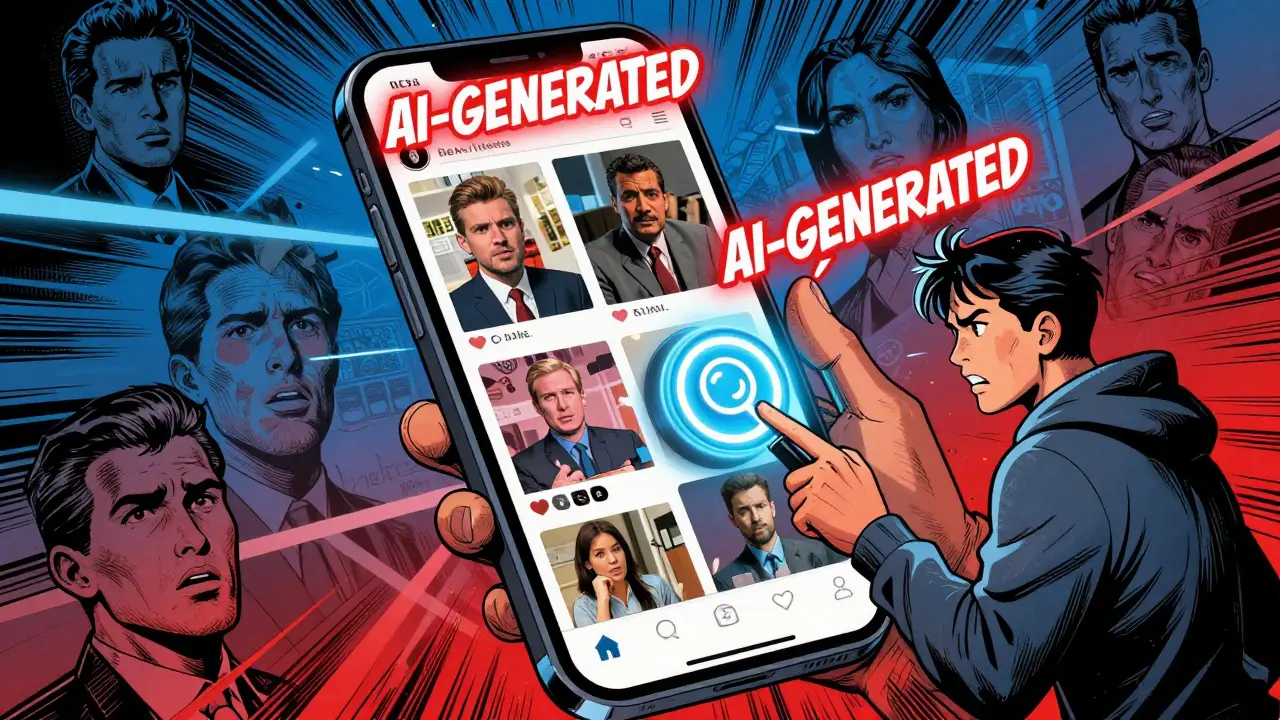
On September 12, 2025, California became the first U.S. state to require generative AI detection tools and mandatory content labels for AI-made media. The new law, Assembly Bill 853 (AB 853), doesn’t just ask companies to be transparent-it forces them to build systems that prove whether a video, image, or audio clip was made by AI. If you’re uploading content to Instagram, YouTube, or TikTok, you might soon see a small tag saying ‘AI-generated’-and you’ll be able to check it yourself.
Who Does This Law Actually Affect?
AB 853 doesn’t apply to everyone. It targets what the law calls ‘covered providers’: companies that run generative AI systems with over 1 million monthly users in California. That means big names like OpenAI, Google, Anthropic, and Meta fall under this rule. Small startups, indie developers, or hobbyists using AI tools for personal projects? They’re out of scope. The law also applies to manufacturers of recording devices-cameras, smartphones, smart doorbells-sold in California. Starting January 1, 2028, these devices must let users optionally add authentication markers to human-created content.Why this two-pronged approach? Because AI content doesn’t just appear out of nowhere. It’s made on one end, then shared on another. AB 853 tries to lock in authenticity at both points: the source and the platform.
What Exactly Must Be Labeled?
The law only covers multimedia: video, audio, and still images. Text generated by AI-like this article-is completely ignored. That’s a major limitation. If you’re worried about AI-written news headlines, fake emails, or AI-generated social media posts, this law won’t help. But if you’re concerned about deepfake videos of politicians, AI-synthesized voices in scams, or manipulated photos used in court cases, this is a big step.Every piece of AI-generated or AI-altered content must carry provenance metadata. That’s just a fancy word for digital fingerprints that show:
- Where the content came from (which AI system made it)
- Whether it was altered after creation
- When and how it was generated
This data is embedded directly into the file-like EXIF data in photos-but more secure. Platforms can’t strip it out. If someone uploads a video from their phone, and it was made with an AI tool, that metadata must stay intact all the way through sharing, compression, and reposting.
Platforms Must Offer Free Detection Tools
Here’s where it gets practical. Covered platforms must give users a free, easy-to-use tool to check if content is AI-generated. You don’t need to download an app. You don’t need to pay. Just click a button on the platform, upload the file, and get a result. The tool must work on common formats: MP4, JPEG, PNG, WAV.But here’s the catch: these tools aren’t perfect. According to Georgetown University’s Center for Security and Emerging Technology, current detection tools have accuracy rates between 65% and 85%. Video detection is the worst-only 68% accurate. That means one in three AI videos might slip through, or one in five real videos might be wrongly flagged.
That’s why the law requires platforms to publicly report their tool’s false positive and false negative rates every quarter. If your photo of a sunset keeps getting labeled ‘AI-generated’ because of the lighting, you’ll know it’s a flaw-not a fact.

Why This Law Is Different From Others
The EU’s AI Act focuses on high-risk AI systems, not content labels. The federal DEEPFAKES Accountability Act, introduced in June 2025, only targets malicious deepfakes used for fraud or harassment. AB 853 goes further: it applies to all AI-made media, even harmless memes or art. And it’s the first law to require detection tools to be built directly into platforms.The most unique part? The recording device requirement. Starting in 2028, Apple, Samsung, and Sony will have to build optional authentication into their cameras and phones. If you record a video of your kid’s soccer game, you’ll be able to toggle on a ‘this is real’ marker. It’s not mandatory-but it’s there. No other state or country has tried this hardware-level approach.
What’s Broken Right Now?
The law sounds good on paper, but real-world tech is messy. Here’s what experts are worried about:- Metadata gets destroyed: Platforms like Instagram and TikTok compress videos to save bandwidth. That often strips out metadata-even the original EXIF data. Keeping provenance intact through multiple uploads and edits is a huge technical challenge. Testing shows 20-30% of metadata degrades across platforms.
- No universal standard: Right now, Adobe’s Content Credentials, Truepic’s verification, and Microsoft’s SynthID all use different formats. Without a single open standard, you might need different tools to check content from different sources.
- False positives hurt creators: Artists using AI to enhance photos, photographers shooting in unusual lighting, or even people with unusual facial features are getting flagged as ‘AI-generated.’ Trustpilot reviews show 62% of negative feedback comes from false positives in landscape photos.
- Cost is high: BIP Consulting estimates compliance will cost platforms $150,000 to $500,000 each. That’s not just software-it’s hiring machine learning engineers, digital forensics experts, and legal teams to handle reporting.
One Reddit user, ‘ContentCreator87,’ summed it up: ‘This will make it harder for indie creators to compete when platforms implement these costly features.’ That’s a real concern. Small creators might get buried under compliance overhead.

What’s Being Done to Fix It?
The California Attorney General formed a GenAI Transparency Task Force in November 2025 to write implementation guidelines. The first draft comes out January 15, 2026. Meanwhile, the Partnership on AI launched the Content Provenance Initiative in October 2025 to push for a single, open metadata standard-like how JPEG or MP3 became universal formats.Big tech is already reacting. Adobe’s Content Credentials tool is being updated to meet AB 853 specs. Apple and Samsung are testing hardware-level authentication in prototype devices. Even though the 2028 deadline is far off, the industry knows this is coming.
How Will This Affect You?
If you’re a regular user: You’ll start seeing ‘AI-generated’ labels on social media. You’ll be able to check them yourself. If you see a video of a politician saying something outrageous, you can verify whether it’s real. That’s powerful.If you’re a content creator: You might get flagged by mistake. Save your original files. Use tools like Adobe’s Content Credentials to prove your work is human-made. Don’t rely on platforms to preserve your metadata-download and archive your originals.
If you’re a business: You’ll need to audit your content pipelines. Are you using AI-generated images in ads? Are you sharing videos that might have been altered? You’ll need to document your processes and train your team on how to handle provenance data.
The Bigger Picture
AB 853 isn’t just about stopping deepfakes. It’s about rebuilding trust in digital media. In 2025, 1.2 billion people used generative AI tools monthly. That number is growing fast. Every day, millions of AI-made images and videos flood the internet. Without labels, we can’t tell what’s real.This law doesn’t solve everything. It won’t stop AI from being used to deceive. It won’t fix the fact that detection tools are still flawed. But it creates a framework. It forces companies to admit when AI is involved. It gives users tools to question what they see.
Other states are watching. Fourteen have introduced similar bills in Q4 2025. Countries like Canada, Australia, and the UK are considering their own versions. California didn’t just pass a law-it started a global movement.
The real test won’t be in 2026, when the law kicks in. It’ll be in 2028, when your phone starts tagging your photos as ‘human-made.’ And in 2030, when we ask: Did this help? Or did it just add another layer of confusion?
Does the California AI Transparency Act apply to text-based AI content like chatbots or AI-written articles?
No. AB 853 only applies to audio, video, and image content generated or altered by AI. Text-based outputs from tools like ChatGPT, Gemini, or Claude are not covered. This is a major limitation, as AI-written misinformation remains a serious problem in news, politics, and advertising. The law focuses on multimedia because visual and audio deepfakes are harder to detect with the human eye and can cause immediate harm, like impersonation or fraud.
What happens if a platform removes or ignores the AI detection labels?
Platforms that violate AB 853 can be fined by the California Attorney General. The law gives the AG authority to investigate and impose penalties for non-compliance, including up to $10,000 per violation. Repeated failures to provide detection tools, strip provenance data, or misrepresent accuracy rates could lead to legal action. The law also requires quarterly public reporting of tool performance, making it easier for watchdogs and journalists to spot violations.
Can I trust the AI detection tools to be accurate?
Not completely. Current detection tools have accuracy rates between 65% and 85%, depending on the content type. Video detection is the least reliable, with accuracy as low as 68%. False positives are common-especially with photos of landscapes, low-light scenes, or artistic styles. The law requires platforms to disclose their tool’s error rates, so you should check those numbers before trusting a label. Think of these tools as a warning sign, not a definitive verdict.
Will this law stop deepfakes from going viral?
It won’t stop them entirely, but it will slow them down. If a deepfake video gets labeled as AI-generated before it spreads, fewer people will share it blindly. Platforms may also reduce its visibility in feeds if it carries a warning. The goal isn’t to eliminate AI content-it’s to make deception harder by forcing transparency. Over time, public awareness of labels may reduce the impact of misleading content, even if the technology to make it keeps improving.
Do I need to do anything as a regular user to comply with this law?
No. As a user, you don’t need to take any action. The law places all responsibility on platforms and device manufacturers. However, you can benefit by using the free detection tools provided by platforms to check content before sharing it. If you’re a creator, keep your original, unedited files to prove your work is human-made if it gets falsely flagged.
Why does the law require recording devices to add authentication markers only in 2028?
The 2028 deadline gives manufacturers time to redesign hardware and software without disrupting the market. Adding authentication features requires changes to camera sensors, firmware, and user interfaces. Major companies like Apple and Samsung have already started testing these features in prototypes. Delaying the requirement until 2028 allows for smoother adoption and avoids forcing consumers to replace devices prematurely.


Priyank Panchal
December 23, 2025 AT 15:44This law is a joke. They’re forcing tech giants to tag AI content but ignoring text-based lies that actually sway elections. You think a tiny label on a deepfake video stops a Russian bot farm? Nah. It just makes indie artists look like frauds when their sunset photos get flagged. Real problem? AI-generated spam emails and fake news articles. But nope, California’s too busy playing god with camera sensors.
Chuck Doland
December 25, 2025 AT 08:54While the intent of AB 853 is commendable, its implementation reveals a fundamental misalignment between regulatory ambition and technological feasibility. The requirement for immutable metadata across compression pipelines is, at present, mathematically untenable. Moreover, the absence of a universal provenance standard-coupled with the lack of interoperability among proprietary systems such as SynthID and Content Credentials-creates a fragmented ecosystem that undermines the very transparency it seeks to promote. Furthermore, the exclusion of text-based generative outputs constitutes a significant epistemic blind spot, as linguistic manipulation remains the most pervasive vector of digital disinformation.
Madeline VanHorn
December 25, 2025 AT 11:24Oh please. You think some little tag is gonna stop people from believing lies? Most folks don’t even know what metadata is. And now we’re gonna make phone companies add magic buttons? Like, wow. So creative. Meanwhile, actual scammers are still spamming DMs with AI-written ‘I’m stuck in Nigeria’ emails and nobody cares. This law is just tech bros feeling smart while real problems burn.
Glenn Celaya
December 27, 2025 AT 06:43lol the idea that anyone actually checks these labels is hilarious. People scroll past them like they’re ad banners. And dont even get me started on false positives. My dog photo got flagged as AI because of the fur texture. Now Im supposed to hire a forensic expert to prove my cat is real? This law is a money pit for lawyers and a nightmare for photographers. And dont even mention the cost. Small creators are gonna get crushed. Its not transparency its tyranny with a UI
Wilda Mcgee
December 28, 2025 AT 01:09Hey everyone-this law is actually kind of brilliant if we stop screaming and start building. Yes, detection tools aren’t perfect-but they’re a starting point. Imagine if every photo you saw on Instagram had a little ‘this might be AI’ badge and you could tap it to see the tool’s accuracy rate? That’s education in action. And the device-level authentication? Genius. If your phone can say ‘this was taken by me, not AI,’ it flips the script. We need more tools like Adobe’s Content Credentials, not less. Let’s push for open standards, not panic. And creators? Keep your RAW files. They’re your armor.
Chris Atkins
December 29, 2025 AT 21:22So my phone will soon say ‘human-made’ on my kid’s birthday video? That’s kinda cool actually. Not gonna lie I was skeptical but this makes sense. If I can prove I didn’t use AI to edit my vacation pics then why not? And the free check tool on YouTube? Yes please. I’ve seen too many fake videos of politicians saying wild stuff. If this helps people pause before sharing then it’s worth it. No need to overcomplicate it. Just tag it and let people decide
Jen Becker
December 30, 2025 AT 03:44Ugh. More tech regulation. Like we need this. Everyone’s already paranoid. Now we’re gonna have AI labels on everything? What’s next? A ‘this was written by a human’ stamp on my grocery list? This law is just a distraction. Real deepfakes don’t need labels-they just go viral before anyone sees the tag. And the cost? Yeah, small creators are gonna get buried. This isn’t protection. It’s performance art for Silicon Valley.
Ryan Toporowski
December 31, 2025 AT 10:20Love the direction this is going 🙌 Seriously though-this is the first time a law actually tries to tackle the *real* problem: trust. Yeah the tools aren't perfect but they're getting better. And the fact that platforms have to report their error rates? HUGE. That’s accountability. To creators: save your originals. To users: use the check tool. To devs: push for open standards. We’re not fixing AI. We’re fixing how we see it. And that matters 💪