
Large language models (LLMs) are now powering customer service bots, code generators, legal document analyzers, and internal knowledge systems across Fortune 500 companies. But as these models handle sensitive data and make decisions that affect operations, their security risks are growing faster than most teams can track. You can't rely on traditional firewalls or antivirus tools to protect an LLM that’s being manipulated by cleverly worded prompts. That’s why organizations are turning to security KPIs-measurable, data-driven indicators that show exactly how well your LLM defenses are working.
Why Traditional Security Metrics Fail for LLMs
Most companies still measure security using old-school metrics: number of blocked IPs, firewall rule violations, or malware detections. These work for network-based threats, but they’re useless against LLM-specific attacks like prompt injection, data leakage through hallucinations, or model inversion attempts. An LLM doesn’t get infected by a virus-it gets tricked into revealing confidential training data or generating harmful content. If you’re only tracking how many alerts your SIEM system fires, you’re missing 70% of the real risks. A 2024 study by Carnegie Mellon found that companies relying only on conventional security KPIs had a 40-60% visibility gap when it came to actual LLM threats. That means for every 10 real attacks, they only saw 4-6. The rest slipped through because the systems weren’t built to recognize how LLMs are exploited.The Three Pillars of LLM Security KPIs
By early 2024, industry leaders like Sophos, Google Cloud, and Fiddler AI had aligned on a three-part framework for measuring LLM security:- Detection: How quickly and accurately does your system spot malicious inputs?
- Response: When a threat is found, how effectively does your system block or neutralize it?
- Resilience: Can your LLM recover from an attack without lasting damage or data loss?
Key Technical KPIs You Need to Track
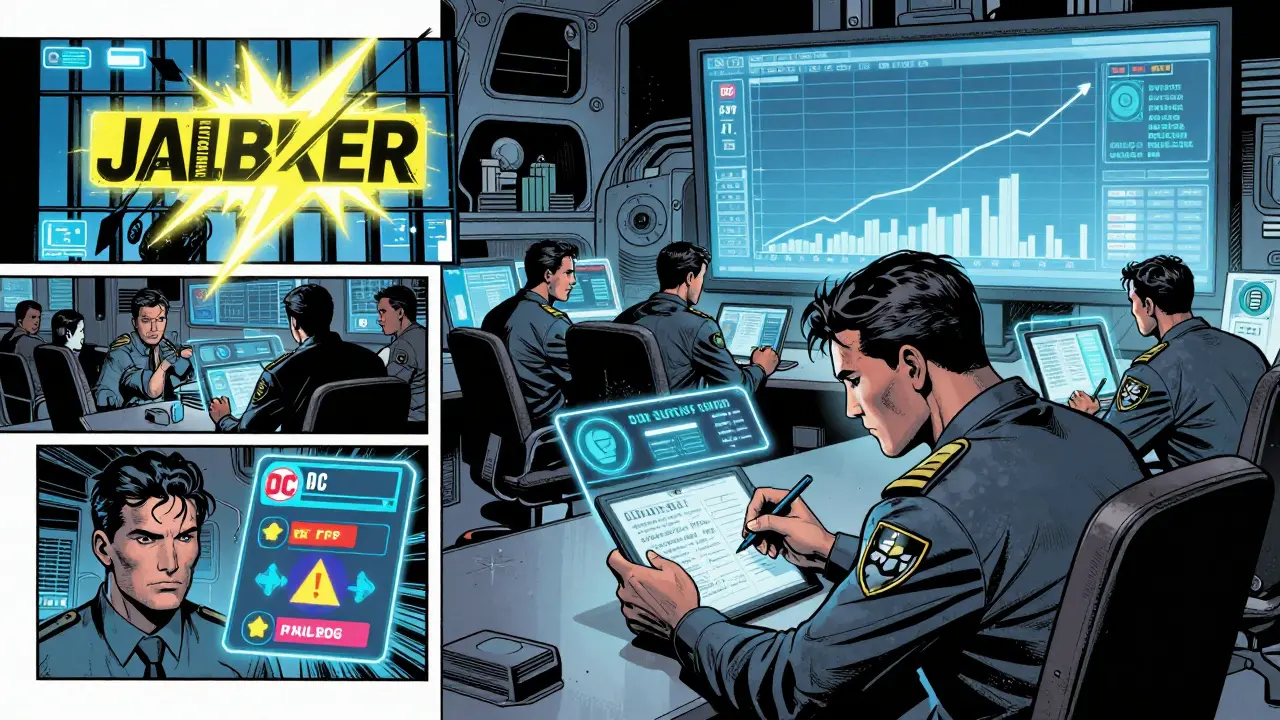
Here are the specific metrics that matter most in production environments, based on real-world deployments and benchmark tests from 2024:- Detection Rate for Jailbreak Prompts: Must exceed 95%. This measures how well your guardrails stop attackers from bypassing content filters using clever phrasing.
- Mean Time to Detect (MTTD) for Resource-Exhaustion Queries: Must be under 1 minute. Attackers can crash your LLM by flooding it with massive prompts. If your system takes longer than 60 seconds to respond, you’re vulnerable to denial-of-service attacks.
- SQL Conversion Accuracy: Measures how well your LLM translates natural language into secure SQL queries during incident investigations. Teams using this KPI saw investigation times drop by 41%.
- Summary Fidelity: Uses algorithms like Levenshtein distance to compare LLM-generated summaries against human-written ones. Low scores mean the model is hallucinating or omitting critical facts.
- Severity Rating Precision: How often does your LLM correctly classify threat severity (e.g., low, medium, high)? This is critical for prioritizing responses.
- Coherence: Does the output make logical sense? (Rated 1-5)
- Fluency: Is the language grammatically correct and natural?
- Safety: What’s the potential harm score? (0-100)
- Groundedness: How accurate is the output based on provided context? (Measured in %)
How Different Models Perform
Not all LLMs are built the same when it comes to security. Benchmarks from 2024 show clear winners and losers:| Model | Security Task Accuracy | Code Generation Accuracy | Context Handling (4,000+ tokens) |
|---|---|---|---|
| GPT-4 | 88% | 82% | High |
| Claude 3 | 87% | 80% | High |
| CodeLlama-34B-Instruct | 85% | 91% | Medium |
| Llama2-7B | 63% | 58% | Low |
| SEVenLLM (fine-tuned) | 83.7% | 81% | Medium |
Real-World Implementation Challenges
Setting up KPIs sounds simple. In practice, it’s messy. Here’s what teams actually run into:- False positives kill trust: One Reddit user reported their system flagged 83% of legitimate queries as malicious during the first two weeks. Analysts stopped checking alerts.
- Threshold tuning takes weeks: 79% of enterprises needed 3-4 weeks to calibrate FPR and TPR targets without breaking usability.
- Integration headaches: 68% of respondents in a SANS survey said connecting LLM KPIs to their existing SIEM or SOAR tools was “difficult or impossible.”
- Over-optimizing for one metric: A team focused only on boosting TPR and ended up blocking legitimate queries. They didn’t track FPR-and paid for it in user complaints.
Who Needs This Most?
Adoption is growing fast. According to Forrester, 68% of Fortune 500 companies now track LLM security KPIs-up from just 12% in early 2023. But not all industries need the same metrics:- Financial services: Focus on PII/PHI leakage detection (92% of implementations). They care most about Safety and Groundedness.
- Healthcare: Need strict compliance with HIPAA. They track data retention, access logs, and hallucination rates in patient summaries.
- Manufacturing: Prioritize secure code generation (87% use LLMs for scripting automation). They monitor CodeLlama accuracy and SQL conversion rates.
- Legal & compliance: Demand high Groundedness-any hallucinated case law could lead to lawsuits.
Getting Started: A Practical Roadmap
You don’t need to build everything at once. Start here:- Define your risk profile: What data does your LLM touch? Who uses it? What’s the worst that could happen?
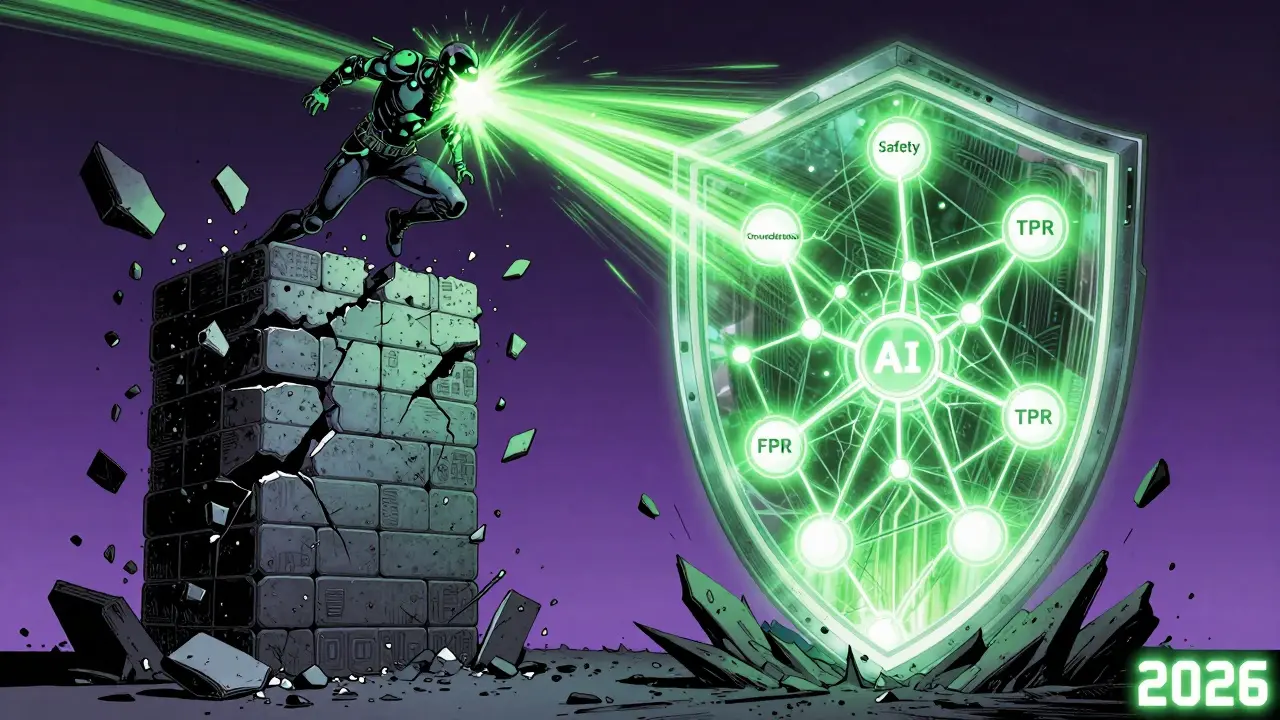
- Pick 4 core metrics: Start with Safety, Groundedness, Coherence, and Fluency. These are universal.
- Add one security-specific KPI: Pick the most relevant threat-e.g., Jailbreak Detection Rate if you’re using it for customer support.
- Integrate with monitoring: Use tools like Fiddler AI, Google Vertex AI, or Sophos’ AI Security Suite to auto-collect data.
- Set baselines and thresholds: Run 100 test prompts. What’s your current TPR? What’s your FPR? Use those numbers to set targets.
- Review monthly: Threats evolve. Your KPIs must too. Update them every quarter.
The Bigger Picture: KPIs Are Not a Finish Line
KPIs are powerful-but they’re not magic. MIT’s AI Security Lab warns that detection rates drop 30-45% when tested against new, unseen attack patterns. If your KPIs only measure known threats, you’re building a fortress with one unlocked door. Also, beware of KPI gaming. A model can be trained to score well on benchmarks without being truly secure. It might memorize how to pass a jailbreak test without understanding why the attack is dangerous. The goal isn’t to hit 95% on every metric. It’s to create a feedback loop where security improves with every incident, every false alarm, every user report. The best teams don’t just track KPIs-they use them to ask better questions: Why did this prompt slip through? What did we miss? How can we learn from this?What’s Next?
By 2026, Gartner predicts 75% of enterprises will use AI-driven systems that auto-adjust KPI thresholds based on real-time threat intelligence. That’s the future: not static dashboards, but living security systems that evolve as fast as attackers do. For now, the priority is simple: stop guessing. Start measuring. If you can’t quantify your risk, you can’t manage it. And in the age of generative AI, unmanaged risk isn’t just a vulnerability-it’s a liability waiting to explode.What are the most important LLM security KPIs to start with?
Start with four foundational metrics: Safety (harm potential scored 0-100), Groundedness (factual accuracy as a percentage), Coherence (logical flow rated 1-5), and Fluency (language quality). Then add one security-specific KPI like Detection Rate for Jailbreak Prompts (must be >95%) or Mean Time to Detect resource-exhaustion queries (must be <1 minute). These cover both quality and security risks.
Can I use the same KPIs for my customer service chatbot and my code-generation tool?
No. Customer service bots need high Safety and Groundedness to avoid giving harmful or incorrect advice. Code-generation tools need high SQL conversion accuracy and secure code generation metrics. A model optimized for fluency in chat may generate insecure code. Tailor KPIs to the use case.
Why is my LLM’s True Positive Rate high but I’m still getting breaches?
High TPR alone isn’t enough. You might be missing novel attack patterns not in your training data. MIT’s 2024 research shows detection rates drop 30-45% against new threats. Also, check your False Positive Rate-if it’s too high, analysts may ignore alerts. Balance both metrics.
How often should I update my LLM security KPIs?
Update them quarterly. Threats evolve fast-new jailbreak techniques emerge monthly. The OWASP Foundation recommends reviewing KPIs every 90 days. Also, update after any incident, even if it was blocked. Each event reveals a gap in your current metrics.
Do I need a data scientist to implement these KPIs?
Not necessarily, but you need someone who understands both security and AI. A SOC analyst trained in LLM threats can manage basic KPIs using tools like Google Vertex AI or Fiddler AI. But setting up custom metrics like summary fidelity or SQL conversion accuracy requires data science skills. Most companies hire or train one AI security specialist per 5-7 LLM deployments.
Is there a free way to measure LLM security KPIs?
Yes, but with limits. You can use open-source tools like LlamaIndex for retrieval evaluation or Hugging Face’s evaluate library for basic Safety and Groundedness scoring. But for production-grade metrics like detection rates, throughput, and latency under load, commercial tools (Fiddler, Sophos, Google Cloud) are more reliable. Free tools won’t give you the precision needed for compliance.
What happens if I don’t track LLM security KPIs?
You’re operating blind. Without measurable metrics, you can’t prove your LLM is secure. In 2025, the EU AI Act and other regulations will fine companies up to 7% of global revenue for failing to monitor high-risk AI systems. Beyond compliance, unmeasured risks lead to data leaks, reputational damage, and loss of customer trust-all of which cost far more than implementing KPIs.



Destiny Brumbaugh
January 8, 2026 AT 06:28Sara Escanciano
January 8, 2026 AT 22:38Elmer Burgos
January 9, 2026 AT 05:26Jason Townsend
January 9, 2026 AT 14:33Antwan Holder
January 10, 2026 AT 17:50Angelina Jefary
January 12, 2026 AT 00:52Jennifer Kaiser
January 12, 2026 AT 05:30TIARA SUKMA UTAMA
January 12, 2026 AT 05:39Jasmine Oey
January 13, 2026 AT 15:01Marissa Martin
January 14, 2026 AT 02:46