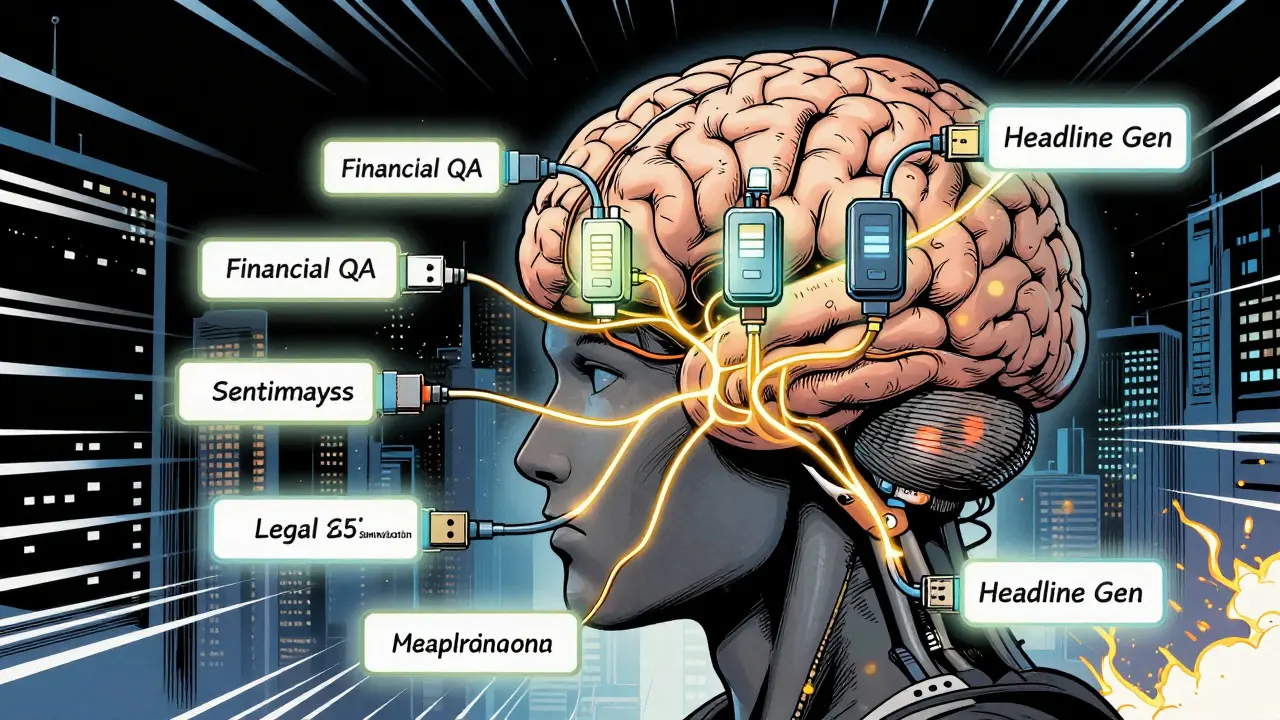
What if you could teach one AI model to write financial reports, analyze customer sentiment, answer legal questions, and summarize research papers-all without building separate models for each job? That’s not science fiction. It’s multi-task fine-tuning, and it’s already changing how companies deploy large language models.
For years, the default approach was simple: train one model for one task. Need a model that understands medical records? Train it on clinical data. Need one that writes marketing copy? Train it again, from scratch. But that’s expensive, slow, and wasteful. Each model needs its own compute, storage, and maintenance. Multi-task fine-tuning flips that script. Instead of many models, you build one smart model that learns many things at once.
How Multi-Task Fine-Tuning Actually Works
At its core, multi-task fine-tuning takes a pre-trained large language model-like Phi-3-Mini or Llama 3-and trains it on several different tasks simultaneously. These tasks aren’t random. They’re carefully chosen to complement each other. For example, training a model on financial question answering, sentiment analysis of earnings calls, and headline generation together helps it learn patterns that none of those tasks could teach alone.
The magic isn’t in training the whole model again. That would take weeks and cost tens of thousands of dollars. Instead, experts use lightweight add-ons called adapters. The most popular method is Low-Rank Adaptation, or LoRA. Think of LoRA like plugging in a USB module to your laptop. The laptop (the base model) stays the same. The USB (the adapter) adds new functionality without rewriting the system.
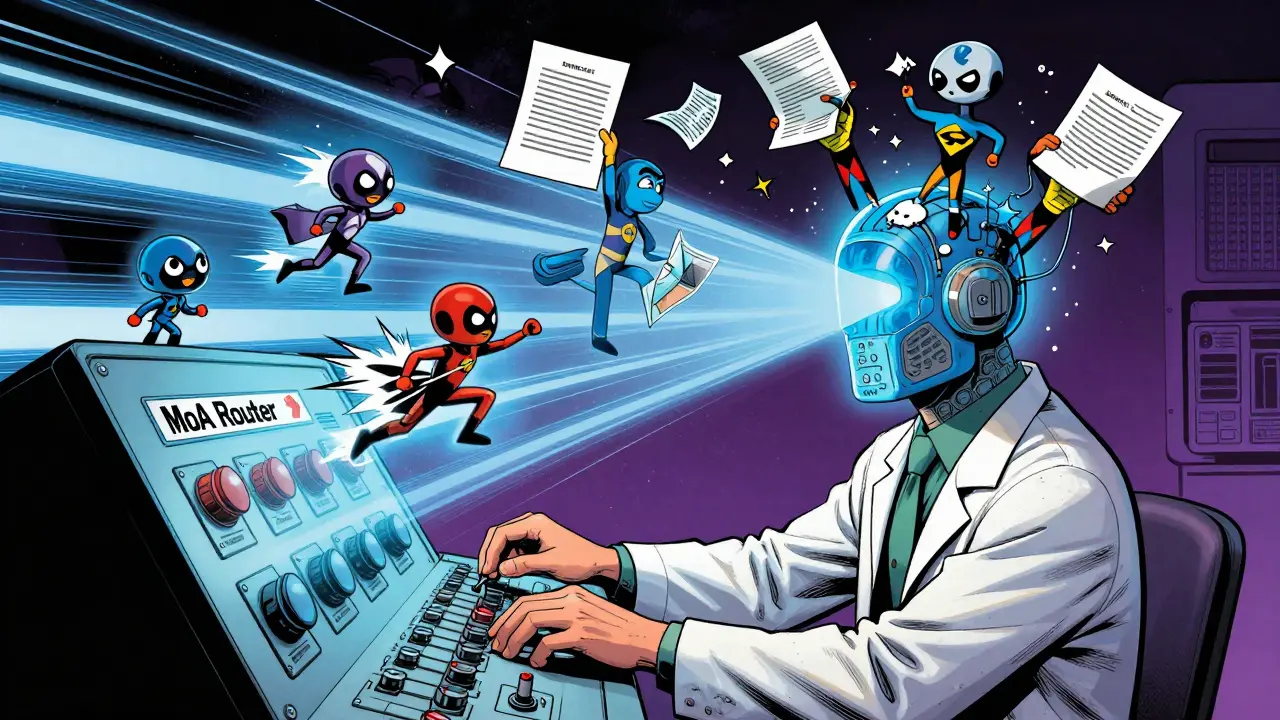
In 2024, researchers introduced the Mixture of Adapters (MoA) architecture, which takes this further. MoA doesn’t just add one adapter-it adds dozens, each tuned for a specific task. When you give the model a prompt, it automatically picks the best adapter for the job. It’s like having a team of specialists inside one brain, and the model knows which one to call on.
The Cocktail Effect: Why More Tasks Make the Model Smarter
Here’s the counterintuitive part: adding more tasks doesn’t dilute performance. It boosts it. Researchers call this the cocktail effect. Just like mixing the right drinks can create something better than any single ingredient, combining the right tasks creates a model that outperforms models trained on just one.
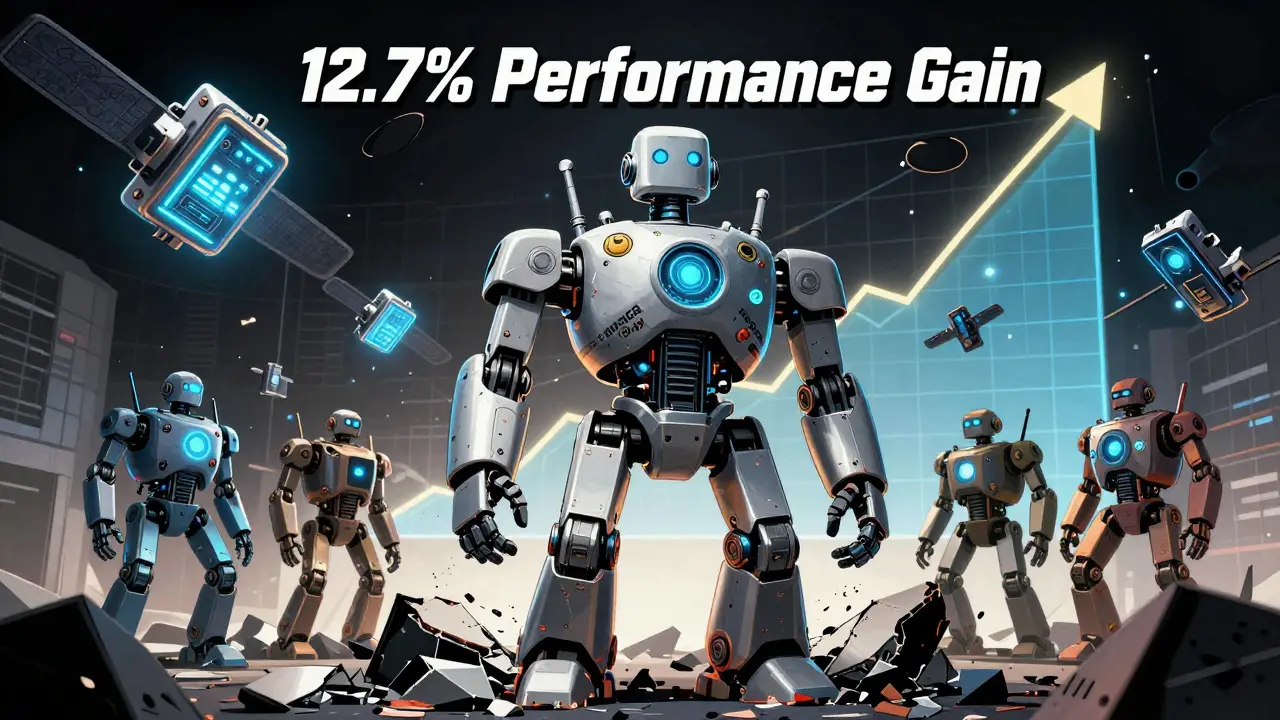
A 2024 study from arXiv tested this across 220 models using financial data. The best multi-task model improved performance by 12.7% on average across six tasks compared to single-task models. In some cases-like identifying sentiment in Twitter posts about stocks-the improvement jumped to 18.4%. Even more surprising: a 3.8-billion-parameter model, when multi-task fine-tuned, beat GPT-4-o on specific financial benchmarks.
Why does this happen? Because tasks share underlying skills. Understanding financial jargon helps with legal documents. Recognizing tone in customer reviews helps with email summarization. When the model learns these patterns together, it builds a richer internal representation. Stanford’s 2023 BERT study showed that training on three tasks with 110 million shared parameters outperformed three separate models that used 330 million parameters total.
What Tasks Work Best Together?
Not all task combinations are created equal. Mixing unrelated tasks-like translating French and predicting stock prices-can confuse the model. The key is to group tasks that share linguistic or logical structures.
Successful combinations often fall into domains like:
- Finance: Question answering (ConvFinQA), sentiment analysis, headline generation, financial entity recognition
- Healthcare: Clinical note summarization, ICD code prediction, patient query classification
- Legal: Contract clause extraction, case law summarization, legal question answering
One study found that including general instruction data-like prompts asking the model to explain, summarize, or rewrite-acted as a stabilizer. It prevented the model from forgetting its general language skills while learning specialized ones. Adding mathematical reasoning tasks also helped with financial calculations, even if math wasn’t the main goal.
On the flip side, combining tasks with wildly different data distributions-say, a task with 10,000 examples and another with only 200-can cause problems. The model starts ignoring the smaller task. That’s why sampling strategies matter.
Training Tips: Avoiding Common Pitfalls
Multi-task fine-tuning isn’t plug-and-play. If you do it wrong, you’ll get worse results than single-task training.
Here’s what actually works based on real experiments:
- Use anneal sampling, not round-robin. Round-robin cycles through tasks evenly. That’s fine if all datasets are the same size. But if one task has 10x more data, the model will overfit to it. Anneal sampling starts by focusing on smaller tasks, then gradually shifts to larger ones. This helps the model learn balance.
- Start with a balanced router. In MoA systems, the router (the part that picks which adapter to use) needs to be trained first on clean, balanced data. Skip this, and the model will route inputs poorly.
- Keep epochs low. 3-10 epochs is usually enough. More than that risks overfitting, especially on small datasets. The NIH review warns that fine-tuning on tiny datasets can make the model memorize noise instead of learning patterns.
- Use the right hyperparameters. Learning rate: 2e-5 to 5e-5. Batch size: 16-64. Weight decay: 0.01-0.1. These aren’t guesses-they’re values proven in peer-reviewed experiments.
- Regularize with instruction data. Mix in 10-20% general prompts like “Explain this in simple terms” or “What’s the main point?” This keeps the model grounded.
And don’t ignore ethics. Dr. Emily Bender pointed out in a 2024 talk that if all your training tasks contain biased language-say, gender stereotypes in job descriptions-the model will learn and reinforce them across all its skills. Always audit your datasets for bias before training.
Why This Beats Other Approaches
Some people try to get multi-task results without fine-tuning. They use prompt engineering or plug in external knowledge bases. But those have limits.
Prompt engineering is fragile. Change the wording slightly, and the model fails. External databases need constant updates and add latency. Fine-tuning makes the knowledge permanent and fast.
Single-task fine-tuning works, but it’s like buying a separate car for every road you drive on. Multi-task fine-tuning is like building one smart vehicle that handles highways, dirt roads, and city streets-all with the same engine.
According to Google Cloud’s 2025 guide, enterprise adoption of multi-task fine-tuning grew 40% year-over-year. DataCamp found that 35% of their enterprise clients now use it-up from 8% in 2023. Gartner predicts that by 2026, 65% of enterprise LLM deployments will rely on this method.
What’s Next? The Future of Multi-Task Models
The next wave is coming fast. Google is rolling out multi-task fine-tuning in Vertex AI in March 2025. Stanford and other labs are preparing to release FinMix, an open-source toolkit built specifically for financial tasks with pre-tested combinations.
Researchers are already working on dynamic routing-where the model doesn’t just pick an adapter at startup, but adjusts its internal routing in real time based on the input. Imagine a model that notices you’re asking a legal question in a finance context, and instantly switches to a hybrid mode. That’s the goal.
And the demand for engineers who can do this? LinkedIn data shows job postings for “multi-task fine-tuning expertise” jumped 220% in 2024. Companies aren’t just experimenting-they’re hiring.
Multi-task fine-tuning isn’t just a technical upgrade. It’s a shift in how we think about AI. Instead of scaling up models to be bigger, we’re scaling smart-making them more capable with less. One model. Many skills. That’s the future.
Can multi-task fine-tuning make small models outperform large ones?
Yes. In 2024, researchers showed that a 3.8B-parameter Phi-3-Mini model, when multi-task fine-tuned on financial tasks, outperformed GPT-4-o on specific benchmarks. This happened because the model learned synergistic patterns from related tasks, not because it was bigger. The key is task selection and training strategy-not raw parameter count.
Do I need a GPU cluster to do multi-task fine-tuning?
No. You don’t need a cluster. With parameter-efficient methods like LoRA or MoA, you only train small adapter modules, not the full model. A single high-end consumer GPU-like an NVIDIA RTX 4090-can handle fine-tuning models up to 7B parameters. The real cost is in experimentation: testing dozens of task combinations to find the best one.
What’s the biggest risk when doing multi-task fine-tuning?
The biggest risk is task interference and overfitting. If tasks are too different, the model gets confused. If one task has way more data than others, the model ignores the smaller ones. Poor sampling (like round-robin) makes this worse. Always use anneal sampling and include general instruction data to keep the model balanced.
Is multi-task fine-tuning better than prompt engineering?
For permanent, reliable performance-yes. Prompt engineering is quick and cheap, but it’s brittle. Change the wording, and the model fails. Multi-task fine-tuning embeds the skills directly into the model. It’s faster at inference, more consistent, and doesn’t rely on perfect prompts. Use prompts for prototyping. Use fine-tuning for production.
How do I know which tasks to combine?
Start with tasks from the same domain that require similar language skills. For finance: question answering, sentiment analysis, and headline generation work well together. For healthcare: summarization, code prediction, and patient query classification. Look for shared vocabulary, structure, or reasoning patterns. Avoid mixing unrelated domains unless you’re testing a hypothesis. The arXiv:2410.01109v1 study tested 42 combinations before finding the top performers.
Can I use multi-task fine-tuning with open-source models?
Absolutely. Most research uses open-source models like Phi-3-Mini, Llama 3, or Mistral. Tools like Hugging Face’s PEFT library and the upcoming FinMix framework make it easy. You don’t need proprietary models. The breakthroughs are in the training method, not the base model.
Getting Started: Your Next Steps
If you’re ready to try multi-task fine-tuning:
- Pick a domain-finance, legal, healthcare, or customer support.
- Collect 3-5 related tasks with clean, labeled data.
- Use a base model like Phi-3-Mini or Mistral 7B.
- Apply LoRA or MoA adapters via Hugging Face PEFT.
- Train with anneal sampling and 5-7 epochs.
- Test on each task individually and together.
You don’t need to be an AI researcher. You just need to be careful with your data and patient with your training. The best models aren’t the biggest-they’re the smartest.
Raji viji
January 26, 2026 AT 05:32Bro, this multi-task fine-tuning thing? It’s not magic-it’s just smart laziness. Why train five models when you can train one that does all the work and still outperforms GPT-4 on finance benchmarks? LoRA adapters are like adding Netflix subscriptions to your cable box-no new hardware, just better content. And MoA? That’s the AI equivalent of a Swiss Army knife that actually knows which blade to deploy. Stop wasting compute.
Rajashree Iyer
January 26, 2026 AT 23:11One model. Many skills. It’s not just engineering-it’s transcendence. We used to think intelligence was about size, about parameters, about brute force. But this? This is the soul of AI waking up. A 3.8B model beating GPT-4? That’s not a technical win-it’s a spiritual one. The universe whispers: less is more. The ego of the giant model is crumbling. We are witnessing the birth of wisdom, not just computation.
Parth Haz
January 27, 2026 AT 20:44This is a well-structured and insightful overview of multi-task fine-tuning. The emphasis on task synergy and adapter-based methods like LoRA and MoA is particularly valuable. Many organizations still default to single-task training due to inertia or misunderstanding, but the data clearly supports this approach. The inclusion of ethical considerations and sampling strategies adds necessary depth. For enterprise teams, this is a blueprint for cost-effective, scalable LLM deployment.
Vishal Bharadwaj
January 29, 2026 AT 16:11lol u guys are acting like this is new. LoRA was introduced in 2021. MoA? Been in papers since 2023. And yes, 3.8B beats GPT-4 on SOME finance tasks-because they cherry-picked the benchmarks and ignored everything else. Also, you think training 6 tasks at once doesn’t cause catastrophic forgetting? Try it on real data with noisy labels. Also, anneal sampling? Sounds fancy but it’s just weighted sampling with extra steps. And don’t get me started on ‘instruction data as stabilizer’-that’s just regularization with a buzzword. This isn’t revolutionary. It’s incremental. And the hype? It’s toxic.
anoushka singh
January 30, 2026 AT 21:08Wait so I can just throw together random financial docs and customer reviews and boom-AI becomes a genius? Sounds too good to be true. Also, do I need to be a coder to do this or can I just copy-paste some code from Hugging Face? I tried fine-tuning once and my laptop cried. Also, is there a version where I don’t have to read all this? Like a YouTube video? Or a meme?
Jitendra Singh
January 31, 2026 AT 10:50Interesting read. I’ve been experimenting with LoRA on legal docs and customer support queries, and the results are promising. The cocktail effect is real-I noticed the model started handling edge cases better, even on tasks it wasn’t directly trained on. I think the key is starting small: pick two similar tasks, validate, then expand. Also, the ethics note is critical. Biased training data doesn’t just hurt one task-it corrupts the whole system. Worth the extra audit time.
Madhuri Pujari
February 1, 2026 AT 03:43Oh, so now we’re pretending this is a breakthrough? You literally just repackaged multi-task learning from 2019 with new buzzwords. ‘Cocktail effect’? Cute. ‘Dynamic routing’? That’s just attention weights with a marketing team. And you think 10 epochs is enough? Try training on real-world data with class imbalance-your ‘balanced router’ will collapse like a house of cards. Also, you didn’t mention how many of these ‘outperformed GPT-4’ models were evaluated on adversarial inputs. Bet they failed hard. And you call this ‘the future’? It’s the same old overfitting with a new name. Wake up.
Sandeepan Gupta
February 3, 2026 AT 03:11Great breakdown. For anyone new to this: start with Phi-3-Mini and 3 tasks from the same domain-say, financial QA, sentiment, and headline gen. Use PEFT with LoRA at rank 8 and lr=3e-5. Train for 5 epochs. Mix in 15% general instructions like ‘summarize’ or ‘explain’. Monitor validation loss per task-don’t just look at average. If one task’s loss spikes, reduce its sampling weight. And yes, you can do this on a 24GB GPU. No cluster needed. The real challenge isn’t hardware-it’s curating the right task mix. Test combinations systematically. And always audit for bias. This isn’t magic. It’s methodical.