Imagine trying to teach a computer to understand a joke. For decades, we tried to do this by giving the machine a giant rulebook and a calculator, telling it to count how often certain words appeared next to each other. It worked-sort of. You got spellcheckers and T9 texting, but the computer never actually "got" the joke. Then, almost overnight, the playbook changed. We stopped giving the machine rules and started giving it an architecture that mimics the human brain's ability to find patterns. This shift from Statistical NLP is a method of analyzing human language using mathematical probability models and predefined rules to Neural NLP has fundamentally rewritten how we interact with technology. The result? We went from basic autocorrect to AI that can write poetry, code, and diagnose medical conditions.
The Era of Probability and Rules
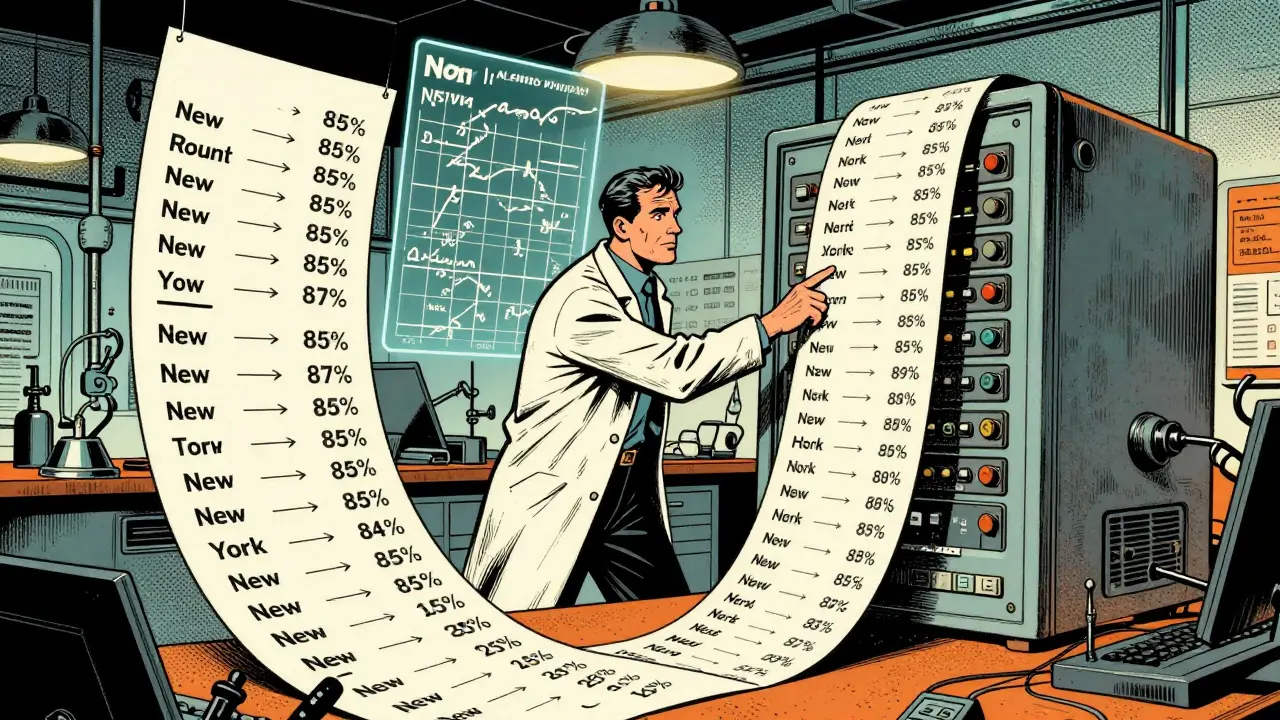
Back in the 80s and 90s, the goal was simple: use math to guess the next word. Researchers like Frederick Jelinek at IBM pioneered the use of Hidden Markov Models, which basically treated language like a series of coin flips with weighted odds. If you saw the word "New," there was a high statistical probability the next word would be "York."
These systems relied on fixed parameter sizes-usually in the thousands or millions-and worked well for narrow tasks. Think of the old T9 texting on your Nokia; it didn't understand your sentence, it just knew which letters usually followed others. While this was a breakthrough, it had a massive blind spot: context. A statistical model might know that "bank" often follows "river," but if the sentence was "I went to the bank to deposit a check," the model often struggled to realize we weren't talking about a riverbank. These models typically topped out at 60-75% accuracy on complex language tasks because they lacked a long-term memory of the sentence they were processing.
The Neural Shift and the Transformer Revolution
Everything changed in December 2017. Google Brain released a paper titled "Attention Is All You Need," introducing the Transformer architecture. This wasn't just a small update; it was a total paradigm shift. Unlike previous models that read text from left to right, Transformers use a "self-attention" mechanism to look at every word in a sentence simultaneously. This allows the model to understand that the word "it" at the end of a long paragraph refers to a "robot" mentioned five sentences earlier.
This architecture paved the way for the Large Language Models (LLMs) we use today. We saw a rapid explosion of capability: BERT arrived in 2018, which crushed benchmarks with 93.2% accuracy on the GLUE test. Then came GPT-2 and GPT-3, pushing parameter counts from millions into the billions and trillions. While a statistical model could run on a laptop with 4GB of RAM, GPT-3 required specialized industrial infrastructure with 700GB of GPU memory just to breathe. The trade-off was worth it: the machines finally stopped just counting words and started simulating an understanding of nuance.
| Feature | Statistical NLP | Neural NLP (LLMs) |
|---|---|---|
| Core Logic | Probability & Markov Chains | Deep Learning & Transformers |
| Context Awareness | Low (Short-term) | High (Long-term) |
| Hardware Needs | Low (Basic RAM) | Extreme (High-end GPUs) |
| Interpretability | High (Clear logic) | Low (Black Box) |
| Typical Accuracy | 60-75% | 85-95% |

The Cost of Power: Hallucinations and Black Boxes
If neural NLP is so much better, why do we still talk about the old ways? Because LLMs have a "honesty" problem. Statistical models are boring but predictable; if they don't know an answer, they fail. Neural models, however, are prone to hallucinations-they are so good at predicting the next likely word that they will confidently invent a fake legal case or a non-existent medical study. Research from Stanford HAI has shown that fabricated information appears in 18-25% of outputs in some scenarios.
Then there is the "Black Box" problem. In a regulated field like healthcare or finance, "the AI said so" isn't a legal defense. A 2022 study in the Journal of Artificial Intelligence Research found that 78% of LLM decisions in medical apps couldn't be traced back to specific training data. This is where the old school wins. Using a tool like spaCy for rule-based entity extraction allows a developer to point to exactly which rule was triggered. For a clinician at the Mayo Clinic, that transparency is more valuable than a poetic summary of a patient's chart.
Practical Implementation: Which One to Pick?
Choosing between these two isn't about which is "better," but which tool fits the job. If you're building a creative writing assistant or a customer service bot, an LLM is the only way to go. The ability to generate coherent, human-like text has reduced content creation time from weeks to hours in some medical education tools. But if you are working in a resource-constrained environment or a highly audited industry, the traditional route is still king.
The learning curve also differs. You can get proficient with a library like NLTK in a few weeks. But mastering LLMs-dealing with prompt engineering, fine-tuning, and managing API rate limits (like OpenAI's 50,000 tokens per minute tiers)-usually takes months of focused study. Furthermore, there is the environmental price. Training a single massive LLM can emit as much CO2 as five cars over their entire lifetimes. For a company trying to meet carbon-neutral goals, the "brute force" approach of neural NLP might be a liability.
The Future: A Hybrid World
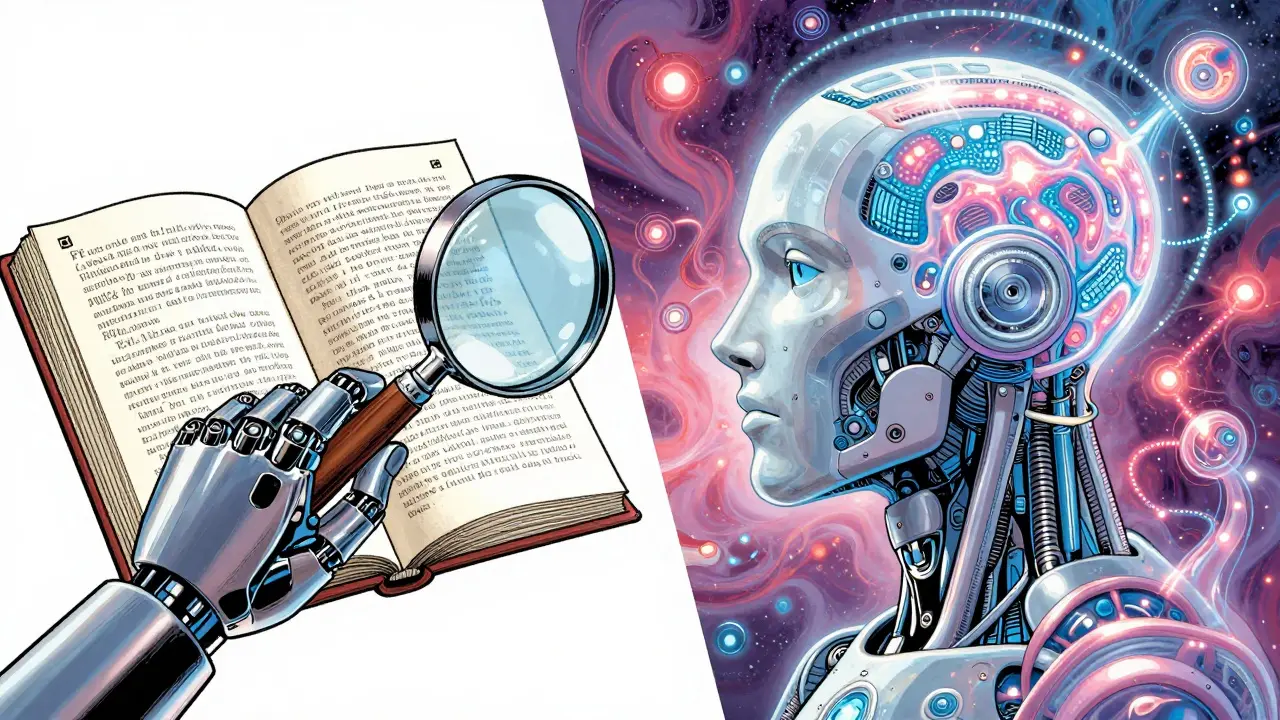
We are now entering the era of the "best of both worlds." We're seeing the rise of neuro-symbolic approaches-combining the raw pattern-recognition power of neural networks with the precision of symbolic, rule-based reasoning. Google's "Atlas" model is a great example, using retrieval-augmented generation to combine traditional search techniques with neural generation, boosting factual accuracy by 34%.
Even the size of models is shifting. Microsoft's Phi-2 showed that a smaller model (2.7 billion parameters) can punch way above its weight if it's trained on high-quality, curated data rather than just scraping the whole internet. This suggests that the future isn't just about making models bigger, but making them smarter and more efficient. By 2026, industry analysts predict that 65% of new enterprise deployments will be hybrid systems, using statistical rules for accuracy and neural networks for fluidity.
What is the main difference between statistical and neural NLP?
Statistical NLP relies on mathematical probability and predefined rules to process language, effectively "counting" word occurrences. Neural NLP uses deep learning and Transformer architectures to mimic brain-like patterns, allowing the system to understand context and long-term dependencies in a sentence rather than just treating words as isolated tokens.
Why are LLMs considered a "black box"?
Because they have billions of parameters interacting in complex ways, it is nearly impossible for a human to trace exactly why a model produced a specific word or decision. Unlike rule-based statistical systems, where you can see the exact logic path, neural networks operate through weighted connections that are not easily interpretable by humans.
Can I still use statistical NLP in 2026?
Yes, absolutely. Statistical NLP remains the gold standard for regulated industries (like healthcare and finance) where auditability and explainability are required. It is also far more efficient for simple tasks like named entity recognition (NER) and is the best choice for applications running on low-power hardware.
What are the risks of using Neural NLP?
The primary risks include hallucinations (making up facts), bias amplification (repeating societal prejudices found in training data), and extreme computational costs. Additionally, the high energy consumption required for training and running these models poses a significant environmental challenge.
What is a hybrid NLP approach?
A hybrid approach combines the strengths of both worlds. It typically uses statistical or rule-based systems to ensure factual accuracy and constrain the output, while using a neural model (LLM) to handle the natural language generation and fluidity. This reduces hallucinations while maintaining a human-like conversation.
Next Steps for Developers
If you're just starting out, don't ignore the basics. Start by experimenting with spaCy or NLTK to understand how tokens and entities work. Once you have a handle on the logic of language, move into Hugging Face to explore pre-trained Transformer models. For those in enterprise roles, focus on "Retrieval-Augmented Generation" (RAG)-it is currently the most effective way to stop LLMs from lying by forcing them to cite specific, trusted documents before answering.



Nathaniel Petrovick
May 1, 2026 AT 05:16totally agree on the RAG part! it's basically the only way to keep these things from just making stuff up when you're actually using them for work. the hybrid approach is definitely where the industry is heading because nobody wants a bot that hallucinates a legal precedent during a board meeting. honestly, seeing how far we've come from T9 is wild. it's crazy to think we used to just guess the next letter and now we're simulating nuance
Jason Townsend
May 2, 2026 AT 23:54black box is just a fancy term for they dont want us to know how the algorithm actually manipulates us. these things arent simulating understanding they are just mirrors for whatever data the tech giants fed them to control the narrative. the energy cost is just a cover for the massive server farms they use to track every single one of our thoughts in real time. wake up people
Angelina Jefary
May 4, 2026 AT 17:54It's absolutely terrifying that we've handed over the keys to our intellectual kingdom to a "black box." The fact that 78% of medical decisions can't be traced is a death sentence waiting to happen. Also, the author should really be more concerned about the bias amplification; it's not just a "risk," it's a systemic erasure of truth. We are essentially building a digital god that inherits all the worst traits of its creators while hiding its logic behind a curtain of "complexity."
Antwan Holder
May 5, 2026 AT 06:57We are witnessing the slow death of human intuition. What is a "hallucination" but a digital dream? We have traded the rigid, honest failure of the statistical model for a seductive, lying ghost that speaks in the cadence of a poet. This transition is not merely a technical upgrade; it is an existential crisis. We are no longer communicating with machines, but with a distorted reflection of the collective human subconscious, stripped of soul and reduced to a probability distribution. It is a tragedy played out in GPUs and cooling fans, a symphony of silicon that promises everything but understands nothing of the silence between the words. We are drifting into a sea of synthetic meaning where the truth is just a parameter that can be tuned for a higher accuracy score. How hollow is the victory of a 95% accuracy rate when the remaining 5% consists of lies that sound more true than reality itself? We have built a mirror that doesn't reflect us, but predicts us, and in doing so, we have lost the ability to be unpredictable. This is the great irony of the Transformer era: in our quest to teach machines to understand us, we have become predictable enough for the machines to simulate us perfectly. The black box is not a technical hurdle, it is a tomb for the human spirit.