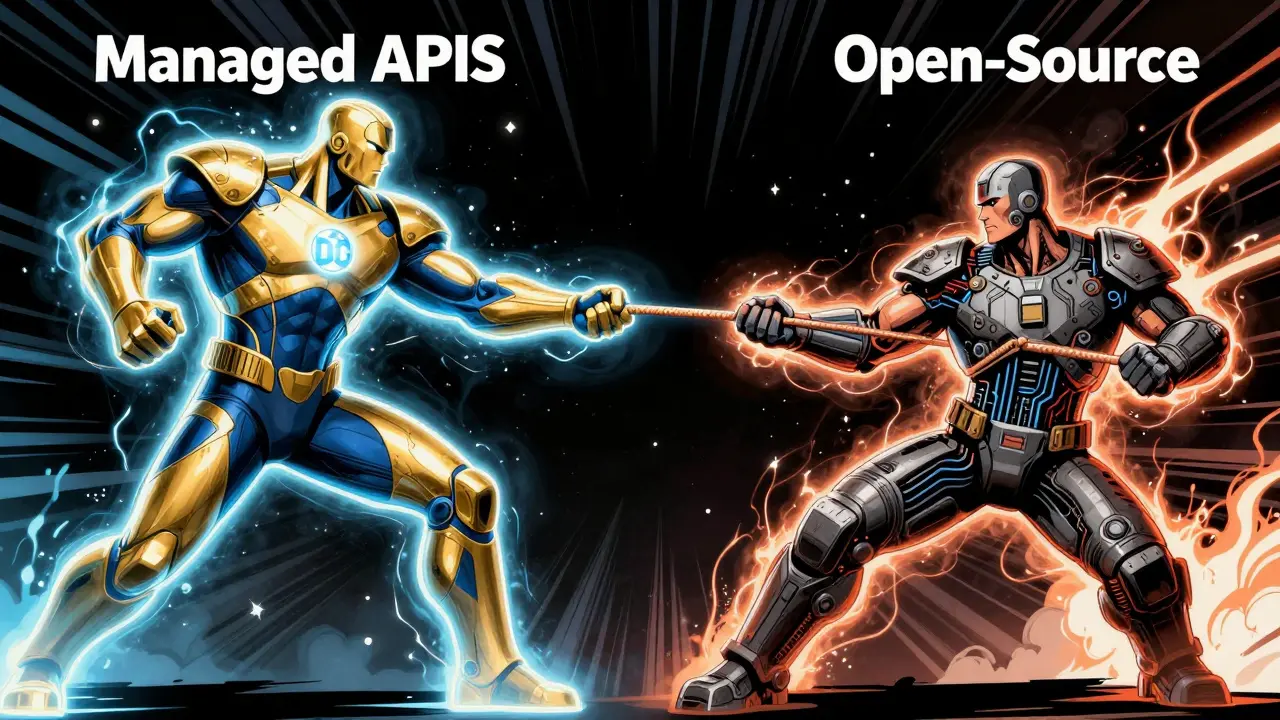
Picking the right brain for your application usually comes down to a tug-of-war between total control and raw convenience. For a long time, the choice was easy: if you wanted a model that actually worked for complex tasks, you paid the "tax" for a managed API. If you wanted privacy or lower costs, you settled for an open-source model that might hallucinate more often. But as we hit 2026, that gap has practically vanished for most general tasks. The real question isn't just "which is smarter?" but "which one can your team actually maintain without losing their minds?"
The State of the Model Gap in 2026
If you're looking at raw knowledge and basic reasoning, the fight is basically a draw. Llama 3.1 405B is a massive open-weights model from Meta that matches GPT-4 performance across a wide array of general benchmarks. It's no longer a case of "open-source is just for toys." We're seeing models like DeepSeek V3.2 hitting an Elo rating of 1460 on LMArena, which puts it right on the heels of Gemini 3 Pro at 1501. For a standard chatbot or a document summarizer, you likely won't notice a difference in quality.
However, if your task involves high-stakes coding or multi-step logical proofs, the managed models still hold the crown. For example, on the SWE-bench Verified test-which measures how well a model can actually fix real bugs in a codebase-managed models are hitting 71.7% accuracy, while open models lag at 49.2%. If you're building an autonomous software engineer, that 22% gap is a dealbreaker. Managed models simply have a tighter grip on complex instruction following and edge-case reasoning.
Breaking Down the Costs: Per Token vs. Total Ownership
On paper, open-source looks like a steal. When you host a model yourself, you aren't paying a "per-token" tax to a provider. If you run Llama-3-70-B on your own gear, your input costs can drop to around $0.60 per million tokens. Compare that to a closed API where you might be paying $10 per million input tokens. We're talking about a potential 95% reduction in raw inference costs for high-volume users.
But here is the catch: GPUs aren't free. To run a 70B model efficiently, you're looking at a cluster of roughly 8 NVIDIA A100 GPUs. That is a massive upfront capital expenditure. You also need to pay for the engineers who know how to handle quantization, GPU clustering, and scaling. For a small team, the "free" nature of open-source is a myth because the operational overhead-the salaries and the electricity-quickly eats those token savings.
| Feature | Open-Source (Self-Hosted) | Managed API (Closed) |
|---|---|---|
| Inference Cost | Very Low ($0.60 - $0.70 / M tokens) | High ($10 - $30 / M tokens) |
| Upfront Hardware | High (Requires GPU Clusters) | Zero |
| Ops Expertise | Requires MLOps Team | None (Plug-and-Play) |
| Scaling | Manual / Custom | Elastic / Automatic |

The Latency and Performance Paradox
Speed isn't just about how fast the text streams onto the screen; it's about how long the model "thinks" before it starts. Managed providers have a massive advantage here because they spend billions on inference optimization that you can't replicate in a home lab. For heavy reasoning tasks, the difference is jarring. OpenAI's o3 can wrap up a complex reasoning assignment in about 27 seconds, whereas a self-hosted DeepSeek R1 might take nearly two minutes for the same task.
If your app requires real-time responses for a user-facing product, this latency gap can kill your user experience. You can optimize your own open-source stack with tools like vLLM or TensorRT-LLM, but you're fighting an uphill battle against the infrastructure giants who control the entire stack from the silicon up to the API gateway.
Privacy, Sovereignty, and the "Black Box" Problem
This is where open-source wins by a landslide. If you work in healthcare, finance, or government, sending your data to a third-party server is often a legal non-starter. With an open-source model, you have total data sovereignty. The data never leaves your virtual private cloud (VPC). You don't have to worry about a provider using your proprietary prompts to train their next version of the model.
Beyond privacy, there's the issue of control. Managed models are black boxes. When a provider updates the model, your prompts might suddenly stop working-a phenomenon known as "model drift." With open-source, you lock in the version. You can also perform full weight fine-tuning, allowing the model to learn your specific corporate jargon or niche industry data in a way that prompt engineering or Retrieval-Augmented Generation (RAG) simply cannot match.

Decision Matrix: Which Path Should You Take?
You shouldn't pick a model based on a benchmark chart; you should pick it based on your team's DNA. If you have a dedicated MLOps team and you're processing billions of tokens a month, the open-source LLMs route is the only way to keep your margins healthy. The ability to customize the model to your specific domain makes it a strategic asset rather than just a utility.
On the flip side, if you are a product-led team trying to get to market in three weeks, managed APIs are your best friend. The speed of integration is unmatched. You can swap from Claude 3.5 Sonnet to another model with a few lines of code. You trade a higher per-token cost for a much lower total cost of ownership (TCO) because you aren't paying five engineers to manage a GPU cluster.
For those in the middle, a hybrid approach is becoming the gold standard. Use a heavy-hitting managed model for complex reasoning and code generation, then distill that knowledge into a smaller, specialized open-source model for the high-volume, low-latency parts of your application. This gives you the "best of both worlds": frontier intelligence and operational efficiency.
Do open-source models really match GPT-4 in 2026?
For general conversation, summarization, and basic logic, yes. Models like Llama 3.1 405B are functionally equivalent. However, they still lag behind in specialized areas like high-end competitive programming and extremely complex, multi-step scientific reasoning.
Is it cheaper to host Llama 3.1 than to use an API?
Only at scale. If you have low volume, the API is cheaper because there's no hardware cost. But if you're processing millions of tokens daily, self-hosting can reduce your inference costs by 90% or more, provided you already have the GPU infrastructure.
What is the biggest risk of using managed models?
Vendor lock-in and data privacy. You are dependent on the provider's uptime, pricing changes, and their privacy policy. If they change the model's behavior, your application may break, and you have no way to "roll back" to a previous version unless the provider explicitly supports versioning.
How much hardware do I need for a medium-sized open LLM?
For a 70B parameter model, you typically need around 8 NVIDIA A100 GPUs to maintain production-grade speed. For smaller 8B or 13B models, you can get away with a single high-end consumer GPU or a smaller cloud instance, but the intelligence level is significantly lower.
Can I fine-tune a managed model?
Some providers offer limited fine-tuning via their APIs, but it is often expensive and restrictive. You cannot access the weights or change the architecture. Open-source models allow for full supervised fine-tuning (SFT) and RLHF, giving you total control over the model's behavior.
Next Steps for Implementation
If you're still undecided, start with a "Shadow Benchmark." Run your most common real-world prompts through both a managed API and a hosted open-source model. Don't look at general benchmarks-look at your own data. If the open-source model hits 95% of the accuracy you need, the cost savings and privacy gains usually make it the winner. If the open-source model fails on the 5% of tasks that are critical to your business, stick with the managed service and focus on optimizing your prompts to lower token usage.


Karl Fisher
April 5, 2026 AT 19:21It's just so quaint that people still think they can "manage" a cluster without a dedicated team of PhDs. I've seen so many startups try to "save money" with self-hosting only to realize they've just built a very expensive space heater for their office. The sheer audacity of thinking a few A100s and a prayer will replace a refined API is honestly the most entertaining part of the current AI gold rush. Let's be real, unless you're operating at a scale that makes Google look like a lemonade stand, the "cost savings" are just a fairytale we tell ourselves to feel more like engineers and less like API consumers.
Xavier Lévesque
April 5, 2026 AT 23:16Yeah, because spending a quarter million on hardware to save a few bucks on tokens is definitely the peak efficiency move here.
Buddy Faith
April 7, 2026 AT 16:33the whole thing is a trap anyway why u think they give us "open weights" lol they just want us to do the unpaid labor of finding the bugs for them and then theyll close the gates again once they've sucked all the data out of our private vpcs the hardware costs are a distraction from the real play which is total data hegemony
Sandi Johnson
April 9, 2026 AT 13:45Oh absolutely, because nothing says "data sovereignty" like trusting a model whose training data was scraped from the dark corners of the internet without a single shred of oversight. I'm sure the "black box" of a managed provider is terrifying compared to the "clear box" of a model where we have no idea why it suddenly decided to start hallucinating 18th-century poetry in the middle of a Python script.
Eva Monhaut
April 10, 2026 AT 07:42The hybrid approach mentioned at the end is a total game changer for those of us trying to balance budget and brilliance. It's like having a master architect design the blueprint and a fleet of nimble builders handle the repetitive bricks. Using a frontier model for the heavy lifting and distilling that wisdom into a lean, mean, open-source machine is a sophisticated way to scale without burning through your entire venture capital runway in a single month. It really allows for a more graceful evolution of the product.
Scott Perlman
April 10, 2026 AT 22:02this is a great way to look at it thanks for the help
Thabo mangena
April 12, 2026 AT 21:54It is indeed a most prudent observation that the choice of infrastructure must align with the inherent strengths of one's organization. One must acknowledge that the pursuit of technological autonomy through open-source implementation is a noble endeavor that fosters immense innovation within the global community. While the capital requirements are substantial, the long-term strategic advantage of possessing a proprietary, fine-tuned model cannot be overstated for any entity seeking enduring stability in this volatile era of artificial intelligence. I believe that such a commitment to infrastructure will yield fruitful results for those who possess the patience and expertise to cultivate it properly.