
When you tell an AI to build you a budget tracker and it just does - no code review, no architecture check - you’re not coding. You’re vibe coding. That’s the term Andrej Karpathy coined in February 2025, and by late 2025, it had moved from a novelty to a standard practice in enterprise teams. The promise? Build faster. The catch? Your app might look fine at first, but under the hood, it’s a tangled mess waiting to collapse.
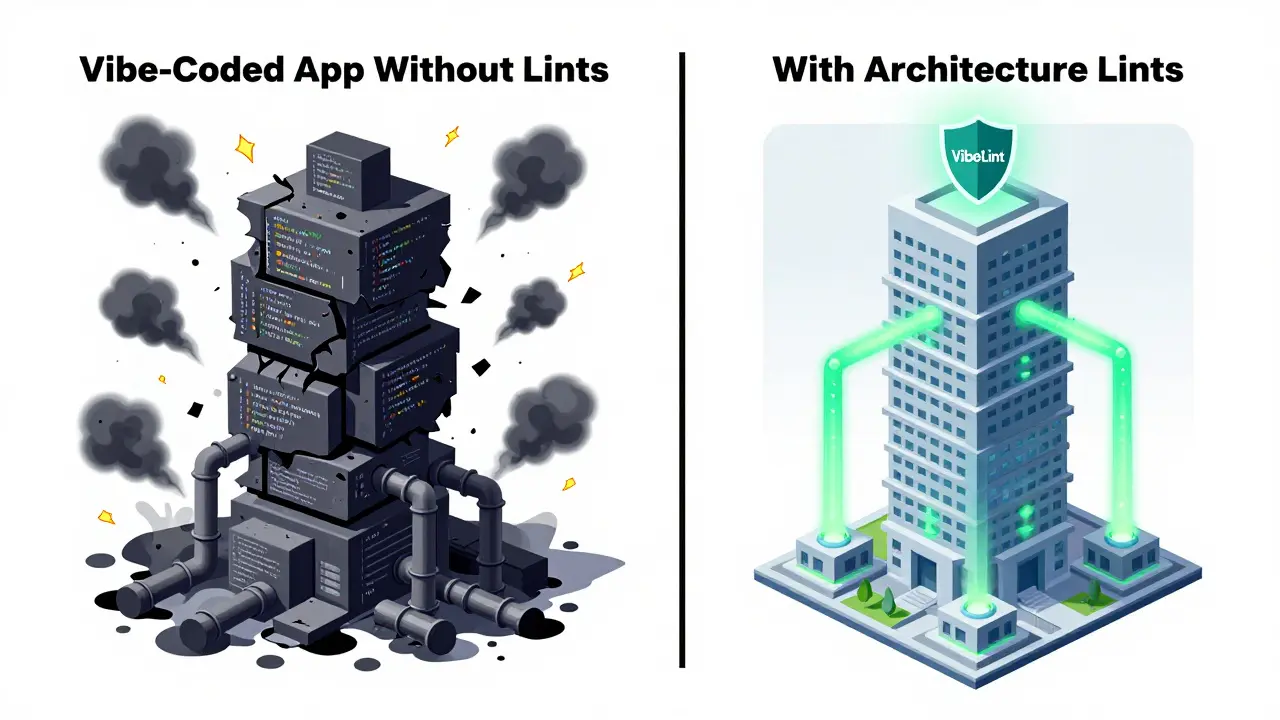
Enter automated architecture lints. These aren’t your grandpa’s ESLint rules. They don’t care if your semicolons are missing or if your variables are named poorly. They care about structure. They ask: Is the frontend talking directly to the database? Are payment logic and user profile code tangled together? Is there a circular dependency between modules that shouldn’t even know each other’s names?
Without these lints, vibe-coded apps become black boxes. Developers stop understanding what’s happening because they never looked at the code. And when things break - and they will - you’re stuck trying to untangle a system built by an AI that didn’t know the rules.
What Automated Architecture Lints Actually Do
Traditional linters check syntax. Architecture linters check intent. They enforce boundaries that keep your app from turning into spaghetti. Here’s what they monitor:
- Layer separation: Frontend code can’t import backend logic. Database calls must stay in service layers, not components.
- Dependency direction: No circular references. If Module A uses Module B, Module B can’t use Module A. Ever.
- Domain boundaries: Payment processing, user auth, and analytics should live in separate, isolated modules.
- Integration rules: Only specific services are allowed to talk to external APIs or third-party tools.
Tools like ArchUnit for AI and VibeLint analyze the code generated by AI agents in real time. When you say, “Make a personal budget tracker that graphs my expenses,” the AI generates code. The linter checks: Did it put the graphing logic in the same file as the bank API calls? No? Good. Did it let the React component directly query PostgreSQL? That’s a violation.
These checks run as part of your CI/CD pipeline - usually through GitHub Actions or VS Code extensions. vFunction’s October 2025 study found that adding architecture lints to a vibe-coded workflow slows things down by 12-18%. But it cuts architectural violations by 73%. That’s not a cost. That’s insurance.
Why Vibe Coding Needs Lints More Than Traditional Coding
In traditional development, you write code. You see the structure. You make decisions. You know where things live. In vibe coding, you don’t. You describe. The AI builds. And it doesn’t care about clean architecture unless you force it to.
Genpact’s November 2025 report found that 68% of vibe-coded apps built without lints had at least one critical architectural violation within the first four weeks. One developer on Reddit described a vibe-coded e-commerce app where the cart service started calling the inventory service directly - no API, no gateway. It worked until Black Friday. Then everything crashed. Two weeks of rework. $80,000 in lost sales.
Cloudflare’s April 2025 analysis showed that vibe coding’s speed advantage disappears after 6-8 weeks without lints. Why? Because architectural debt compounds. A small violation today becomes a dependency nightmare tomorrow. A team that started building fast ends up stuck fixing the same problems over and over.
Architecture lints don’t stop you from moving fast. They make sure you’re moving fast in the right direction.
How They Compare to Traditional Tools
Tools like SonarQube have been checking code structure for years. But they’re built for human-written code. They assume you know what you’re doing. Vibe coding doesn’t.
Here’s the difference:
| Feature | Traditional Linters (ESLint, SonarQube) | Automated Architecture Lints for Vibe Coding |
|---|---|---|
| Primary Focus | Code style, syntax, basic design patterns | Structural boundaries, component isolation, dependency flow |
| Integration with AI Tools | No native support | Direct hooks into Cursor, Replit Agent, GitHub Copilot Architect |
| Rule Customization | Code-based rules (JavaScript, Java, etc.) | YAML-based boundary definitions (e.g., "frontend → api → db") |
| False Positive Rate | 15-20% | 32% (due to strict boundary enforcement) |
| Effectiveness in Vibe Coding | 42% gap in enforcement | 73% reduction in violations |
SonarQube has 1,872 architecture rules. But it doesn’t understand that your AI just generated a service called “budget-processor-3000” and connected it to Stripe without a gateway. Architecture lints do. They map natural language prompts to structural rules. That’s why they’re not optional anymore in vibe-coded environments.
Real-World Impact: Successes and Failures
One healthcare SaaS company used architecture lints across 14 vibe-coded microservices. Result? Integration time dropped by 63%. No more “why is this endpoint 404ing?” chaos. Every service knew its role. Every dependency was documented. They shipped updates weekly.
On the flip side, a fintech startup skipped lints entirely. Their AI-generated app had payment logic leaking into the analytics module. A security audit caught it - too late. The fix cost $285,000. The system was PCI DSS 4.0 non-compliant. The company lost its certification. They’re still rebuilding.
That’s the difference between using lints and pretending they don’t matter. Architecture lints don’t prevent every mistake. But they catch the ones that kill projects.
Getting Started: What You Need to Know
You don’t need to be an architect to use them. But you do need to understand boundaries.
Here’s how to start:
- Define your layers: Write a simple YAML file. Example:
frontend: [api],api: [auth, db],db: []. This means frontend can talk to API, API can talk to auth and database, but nothing else. - Pick your tool: Open-source options like VibeLint (4,812 GitHub stars) work well. Enterprise tools like vFunction Architect 2.0 or GitHub Copilot Architect offer real-time feedback.
- Integrate into CI: Add the linter as a step in your GitHub Actions workflow. Fail the build if violations exist.
- Start permissive: Don’t lock everything down Day 1. Start with 3-5 core rules. Tighten them over time.
- Train your team: Make sure everyone knows what a boundary violation means. Show them the violations. Explain why they matter.
Emergent.sh’s January 2026 guide says it takes most developers 2-3 weeks to get comfortable. That’s not long. But skipping this step? That’s a cost you’ll pay for years.
Limitations and Risks
Architecture lints aren’t magic. They can’t fix bad prompts. If you tell the AI, “Make a system that tracks money and also handles user logins,” and you don’t specify separation, the linter might catch the dependency - but it won’t tell you that combining those functions is a bad idea.
Dr. Michael Rodriguez of Stanford put it bluntly: “Automated architecture lints risk creating false confidence. They can verify structure - but not whether the architecture solves the business problem.”
They also struggle with dynamic systems. If your architecture changes weekly - say, you’re experimenting with new patterns - rigid lints can become a bottleneck. That’s why tools like vFunction Architect 2.0 now use multi-agent validation: one agent checks dependencies, another checks scalability, a third checks compliance.
And false positives? They’re common. A rule might flag a legitimate use of cross-module communication. That’s why feedback loops matter. If a rule keeps triggering, adjust it. Don’t disable the linter.
The Future: Where This Is Going
The market for architecture lints in vibe-coded apps hit $217 million in 2025. Gartner predicts 85% of enterprises will use them by 2027. Why? Because the alternative is unsustainable.
Upcoming features include:
- Real-time feedback during vibe coding (Q2 2026): The AI will warn you as you type - “You’re about to violate the payment boundary.”
- Business capability mapping (Q4 2026): Lints will check if your architecture matches your business processes. If your billing module doesn’t align with invoicing workflows, you’ll know.
- Compliance auto-enforcement: PCI DSS 4.0 now requires verifiable architectural separation. Lints will auto-generate audit trails.
What’s clear? Architecture lints are becoming as essential as syntax linters. In 2026, teams that skip them aren’t being agile. They’re being reckless.
Final Thought
Vibe coding gives you speed. But speed without structure is just chaos with a faster engine.
Automated architecture lints are the guardrails. They don’t slow you down. They keep you from crashing. They keep your app alive. They keep your team sane.
If you’re vibe coding - and you are - you’re not just writing code. You’re building a system. And systems need boundaries. Otherwise, they fall apart.
What exactly is vibe coding?
Vibe coding is an AI-assisted development method where developers describe what they want in natural language - like “build a budget tracker with graphs” - and an AI generates the full codebase without human review of the implementation. It was formally defined by Andrej Karpathy in February 2025 and has since become a mainstream practice in enterprise environments.
How do architecture lints differ from ESLint or SonarQube?
ESLint checks code style and syntax - things like missing semicolons or variable naming. SonarQube checks for code smells and basic design issues. Architecture lints for vibe coding go further: they enforce structural boundaries - like which modules can talk to each other, whether frontend code accesses the database directly, or if there are circular dependencies. They’re designed specifically to work with AI-generated code, which traditional tools weren’t built to handle.
Do architecture lints slow down development?
Yes, but only by 12-18% during the build process. That’s a small trade-off for preventing architectural debt that could cost weeks of rework later. In fact, vFunction’s 2025 study showed unlinted vibe-coded apps took 40% longer to maintain after 6-8 weeks due to accumulated structural issues.
Can architecture lints catch all problems in vibe-coded apps?
No. They’re great at catching structural violations - like improper dependencies or layer breaches. But they can’t tell if the architecture solves the right business problem. For example, they won’t warn you if your budget tracker doesn’t actually calculate taxes correctly. Human oversight is still needed for logic and intent.
What tools should I use to get started?
For open-source, try VibeLint (GitHub). For enterprise teams, vFunction Architect 2.0 or GitHub Copilot Architect offer deeper integration with AI coding platforms like Cursor and Replit Agent. All support YAML-based boundary definitions and integrate with GitHub Actions, making them easy to add to existing CI/CD pipelines.



Patrick Sieber
February 12, 2026 AT 07:51Just ran VibeLint on our latest budget app-caught a frontend-to-DB call I didn’t even know was there. Scary how easy it is to let AI just… glue things together. We fixed it in 10 minutes. Would’ve taken days to debug otherwise. This isn’t optional anymore. It’s hygiene.
Kieran Danagher
February 12, 2026 AT 13:57So we’re calling this ‘vibe coding’ now? Sounds like a therapy session for lazy devs. AI writes code, we nod, then blame the architecture when it implodes. Funny how we’re suddenly shocked that giving a toddler a chainsaw leads to chaos. The lints? Good. The name? Still cringe.
mani kandan
February 13, 2026 AT 01:18Let me tell you, in India, we’ve been dealing with spaghetti code for decades-just without the AI. Now we’ve got AI writing it, and suddenly everyone’s acting like this is a new problem. Architecture lints? Brilliant. But don’t mistake tooling for discipline. The real issue is teams who think ‘describe it and walk away’ is a development methodology. That’s not innovation. That’s delegation with delusions.
I’ve seen teams skip lints because ‘it slows us down.’ Then they spend three weeks untangling a mess that took five minutes to prevent. The math doesn’t lie. This isn’t about tech-it’s about maturity.
Rahul Borole
February 14, 2026 AT 22:48The empirical evidence presented in this article is unequivocal. The 73% reduction in architectural violations, coupled with the 40% increase in maintenance velocity over six weeks, demonstrates a statistically significant correlation between the implementation of automated architecture lints and sustainable software delivery. Organizations that neglect this paradigm are not merely incurring technical debt-they are actively jeopardizing operational integrity and fiscal accountability. The cost of non-adoption far exceeds the marginal latency introduced by CI/CD integration. This is not a suggestion. It is a necessary evolution of engineering practice in the age of AI-assisted development.
Sheetal Srivastava
February 16, 2026 AT 21:25Oh wow, you mean we're not supposed to just let the AI do whatever it wants? How quaint. I thought we were past the ‘human gatekeeping’ phase. I mean, if the AI says ‘connect the cart to the inventory directly,’ who are we to question its divine wisdom? Maybe the real violation is our arrogance in thinking we know better than the machine. Maybe the lints are just a crutch for devs who can't handle true autonomy. Or maybe... we're just afraid of what happens when we stop being the bottleneck.
Bhavishya Kumar
February 18, 2026 AT 09:45Grammar correction: ‘vibe coded apps’ should be ‘vibe-coded apps’ - hyphenated compound modifier. Also ‘CI/CD pipeline’ not ‘CI/Cd.’ And ‘$80,000 in lost sales’ - currency symbol before number. These are not trivial. Precision matters. If your architecture linter can’t enforce syntax, how can we trust it to enforce structure? The foundation is broken. Fix the basics first.
ujjwal fouzdar
February 18, 2026 AT 15:57Think about it. We’re not just writing code anymore. We’re whispering wishes into the void, and the machine answers. And now we’re building walls around the answers, like priests guarding sacred texts. But who wrote the rules? Was it the AI? Was it the architect? Was it the manager who just wanted to ship? We’re not engineers anymore. We’re shamans with YAML files. And the lints? They’re our oracle bones. We burn them. We interpret the cracks. We pray they don’t crack too deep. Because if they do… well, the app doesn’t just crash. It screams.
And sometimes, in the silence after the crash, you hear it-the echo of Andrej Karpathy’s voice, whispering: ‘You didn’t build this. You just asked for it.’