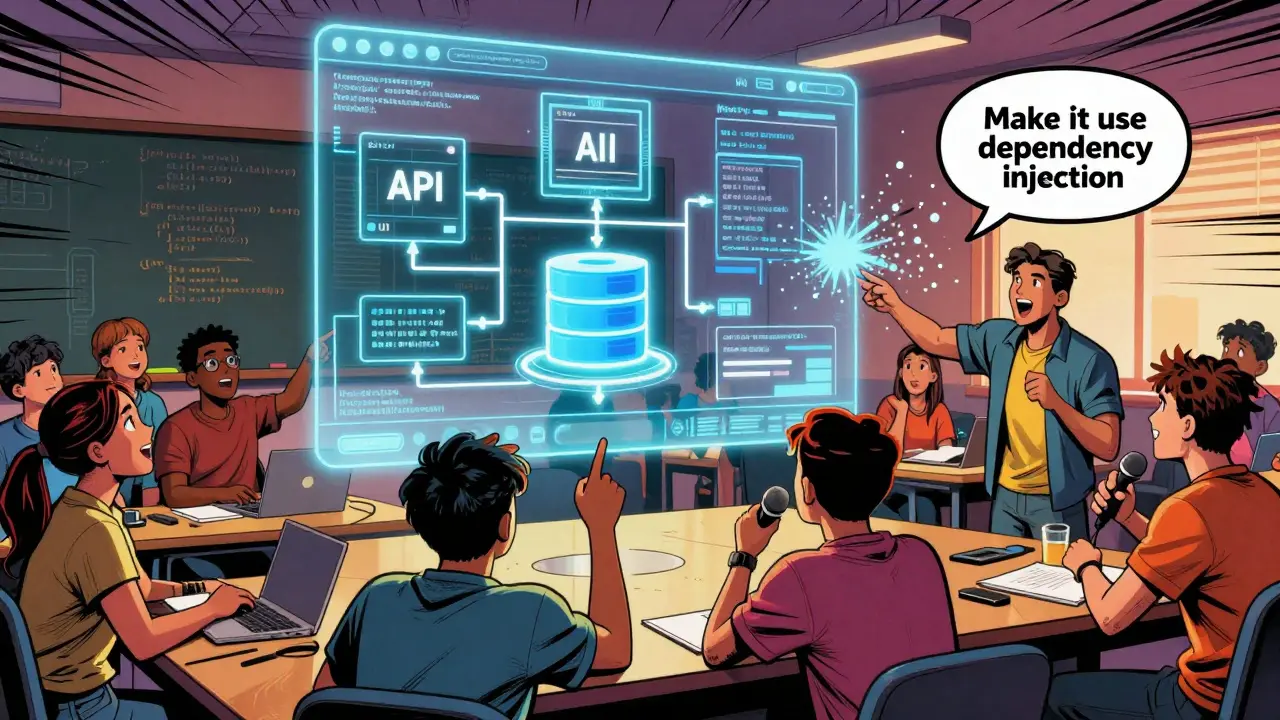
Imagine teaching students to build real software systems without making them memorize semicolons, brackets, or import statements. That’s what vibe coding is doing in classrooms right now. Instead of starting with syntax, students start with ideas: "I want an app that lets users track their daily water intake and sends reminders when they fall behind." The AI listens, breaks it down, and generates a working prototype - complete with a database, API, and frontend - in under five minutes. No typing errors. No debugging endless syntax issues. Just pure architectural thinking.
What Is Vibe Coding, Really?
Vibe coding isn’t just another no-code tool. It’s a shift in how we teach software development. Traditional programming education forces students to learn the language before they can think about structure. Vibe coding flips that. Students learn to design systems - modular components, clean interfaces, dependency injection - before they ever write a line of code. The AI handles the syntax. The student handles the architecture.
This approach became mainstream in 2024, thanks to platforms like Replit, Cursor, and v0. These tools use natural language to turn ideas into functional code. You don’t need to know Python or JavaScript. You just say: "Make this a React component with state management and a backend API." The AI builds it. Then you refine it. "Make the API use REST, not GraphQL." "Move the database connection to a separate service." Each prompt teaches a design principle.
Why Architecture Matters More Than Ever
For years, coding bootcamps focused on getting students to build apps fast. But employers noticed a problem: graduates could make things work, but couldn’t explain why they worked that way. A monolithic app that runs fine locally crashes under 100 users. A service that talks directly to a database can’t be scaled. These aren’t bugs - they’re architectural failures.
Stanford’s 2025 course on vibe coding starts with a simple question: "What makes a system maintainable?" Students don’t answer with textbook definitions. They build. They break. They fix. One project asks students to create a task manager. The first version is a single file with everything in it. The AI generates it easily. Then the instructor says: "Now split it into three services: user interface, task logic, and storage. Use dependency injection so the UI doesn’t know how the data is stored." Students rewrite their prompts. The AI adapts. The architecture improves.
At Arizona State University’s AZNext program, students using vibe coding showed a 73% improvement in understanding system design compared to traditional methods. They didn’t just memorize MVC or microservices - they experienced them. They saw how changing one part affected the whole. They learned to think in layers.
How Vibe Coding Teaches Real Architectural Patterns
Here’s how it works in practice:
- Student says: "Build a weather app with a search bar and 5-day forecast."
- AI generates a single-page app with hardcoded data.
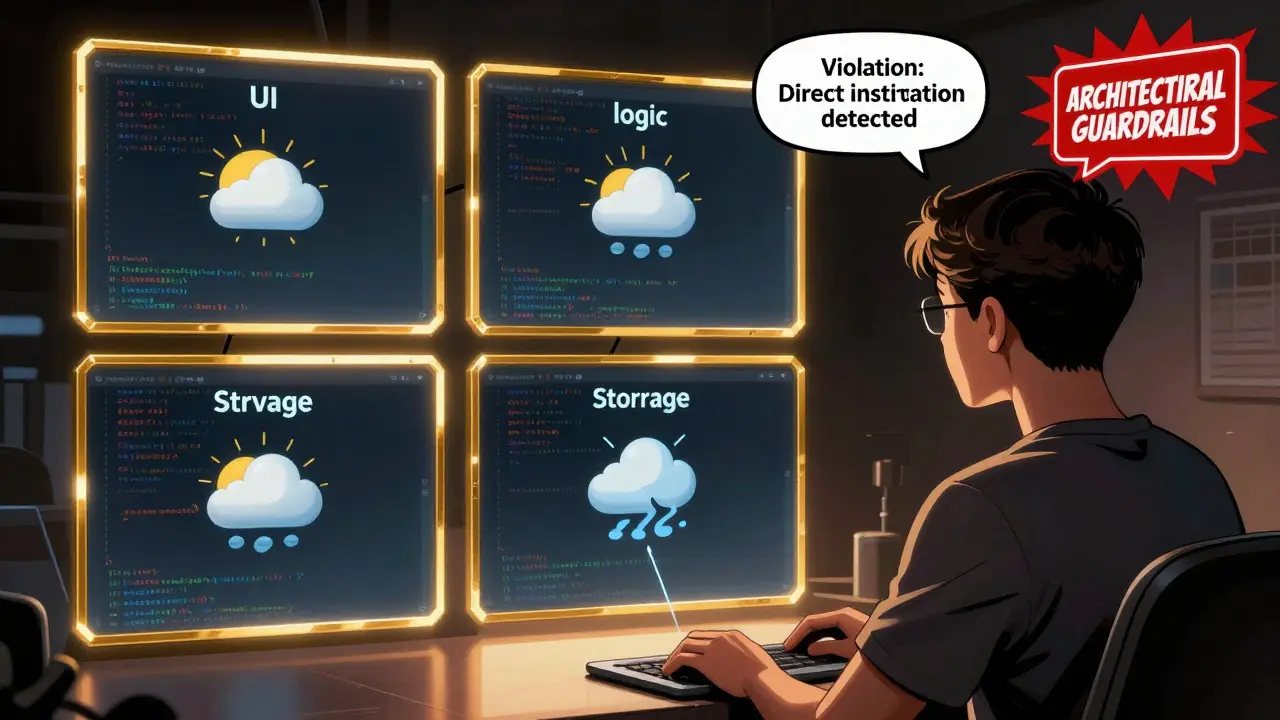
- Instructor prompts: "Move the data fetching into a separate service. Use dependency injection so the UI doesn’t create the service directly."
- Student rewrites the prompt: "Refactor this to use dependency injection. Remove all direct instantiation of the weather API class. Accept it as a constructor parameter."
- AI updates the code. Student sees the difference.
This isn’t magic. It’s structured learning. Each prompt teaches a specific architectural rule:
- "Use composition over inheritance" - build systems from interchangeable parts, not rigid class trees.
- "Tell, don’t ask" - objects should do things, not expose their internal state for others to manipulate.
- "Single responsibility" - each component should do one thing, and do it well.
Stanford’s course includes a library of 47 proven architectural prompts. One of them: "Add caching to this API endpoint. Use Redis. Make sure the cache invalidates after 10 minutes." Students don’t just copy-paste. They learn why caching matters, when to use it, and how to test it.
Tools That Make It Possible
You can’t teach vibe coding without the right tools. The most common platforms used in education are:
- Replit - Cloud-based editor with built-in package manager, debugger, and deployment. Used in 82% of academic vibe coding courses.
- Cursor - AI-first code editor that understands context. Great for refactoring and explaining changes.
- v0 by Vercel - Generates React UIs from text prompts. Used for frontend architecture training.
These tools aren’t just code generators. They’re teaching assistants. Cursor, for example, can highlight why a piece of code violates the Single Responsibility Principle. Replit logs every prompt and change, letting instructors track how a student’s thinking evolved over time.
Costs vary. Replit’s education plan runs $25-$100 per student per month. But compared to the $1,200 cost of a traditional coding bootcamp, it’s a bargain - especially when you consider students build 4-5 real apps by the end of the course, not just one.
The Hidden Risk: AI as a Crutch
Not everyone is sold on vibe coding. Dr. Sarah Allen from Google warned in late 2024 that students might end up building apps that work but make no architectural sense. She’s seen projects where AI generated a 2,000-line monolith because the student didn’t know to ask for modularity.
That’s why structure is critical. Without clear prompts, vibe coding becomes a black box. Students think, "The AI fixed it," instead of, "I understood why it needed fixing."
That’s why Stanford’s course now requires students to specify architectural constraints before generating code. "You must use dependency injection. No direct class instantiation. Use interfaces."
Google Cloud’s new "Architecture Guardrails" feature helps too. It scans generated code and flags violations - like direct database calls from a UI component - with 89% accuracy. It doesn’t fix it. It just says: "This breaks the separation of concerns rule. Why?"
The goal isn’t to replace understanding. It’s to make it visible.

Who’s Winning With Vibe Coding?
The biggest surprise? Non-traditional learners. At ASU, 79% of humanities majors mastered core architectural concepts through vibe coding - compared to just 32% who passed the same material in a traditional CS class. Why? Because they weren’t bogged down by syntax. They focused on structure.
Women are also enrolling at higher rates. Campus.edu’s Vibe Coding 101 course saw a 45% increase in female students compared to traditional bootcamps. One student wrote: "I didn’t feel like I had to be a coding genius to start. I just had to have a clear idea."
Professionals are using it too. Forty-three Fortune 100 companies now train their software architects using vibe coding. Gartner reports a 37% drop in architectural rework when teams use structured prompting.
What’s Next?
By 2026, Forrester predicts 90% of enterprise-grade vibe coding tools will include built-in architectural pattern libraries. Think of them like LEGO sets for software: you pick a module - authentication, caching, API gateway - and the AI knows how to assemble it correctly.
Stanford is already testing "architectural constraint prompts" that force students to define patterns before code generation. Preliminary results show a 53% improvement in pattern adherence.
This isn’t about replacing programmers. It’s about democratizing architectural thinking. You don’t need a computer science degree to understand how to build a system that scales. You just need to know how to ask the right questions.
As Professor Mark Guzdial from the University of Michigan put it: "Vibe coding lets students experiment. They see immediate results. They iterate. They learn by doing - not by memorizing."
The future of software education isn’t in textbooks. It’s in conversations.
Is vibe coding just another AI code generator?
No. While tools like GitHub Copilot help with individual lines of code, vibe coding teaches system design. It’s not about writing faster - it’s about thinking better. Students learn to decompose problems, define boundaries between components, and enforce architectural rules through prompts. The AI executes. The student designs.
Do students still need to learn traditional programming?
Not to start - but eventually, yes. Vibe coding removes the syntax barrier so students can focus on architecture early. But once they understand how systems work, they benefit from learning how to write code manually. Many programs now teach vibe coding first, then introduce Python or JavaScript in the second half. The goal is understanding, not avoidance.
Can vibe coding be used in high school or middle school?
Absolutely. Schools in California and Texas are piloting vibe coding for 9th and 10th graders. Instead of building a simple calculator app, students design a school lunch tracker with user roles, data persistence, and notifications. The AI handles the complexity. The students learn about data flow, access control, and user experience - all core architectural concepts.
What if the AI generates bad code?
That’s the point. Bad code is a teaching moment. If the AI generates a monolith, the instructor asks: "Why is this a problem? What happens when we add 10 more features?" Students learn to spot bad patterns - not because they were told, but because they saw the consequences. The AI isn’t perfect. But it’s a mirror. It shows you what you didn’t think to ask.
Is vibe coding expensive to implement in schools?
Not compared to traditional methods. A Replit subscription costs about $50 per student per term. That’s less than half the price of a textbook. And students get real, deployable apps at the end - not just graded assignments. Schools report higher engagement, lower dropout rates, and better job placement - making the ROI clear.
Final Thoughts
Vibe coding isn’t about making coding easier. It’s about making architecture understandable. For decades, we taught people to write code before they could design systems. That’s like teaching someone to paint brushstrokes before they learn composition. Vibe coding reverses that. It lets students see the whole picture - then fill in the details. And that’s how you build not just coders, but designers.


Tasha Hernandez
January 20, 2026 AT 13:50So let me get this straight - we’re outsourcing architectural thinking to an AI so students don’t have to learn how to type a semicolon? Next they’ll hand over their soul to ChatGPT for existential advice. At least when I failed at debugging, I learned something. Now kids just say ‘make it better’ and call it a day. This isn’t education. It’s emotional labor for machines.
Anuj Kumar
January 20, 2026 AT 18:04AI writes code now? Who’s really running this? I heard the government is feeding these tools data from military projects. One day your water app will start sending your location to Beijing. They call it vibe coding - I call it digital colonization.
Christina Morgan
January 21, 2026 AT 07:59I love this so much. I’m a former English major who never thought I’d touch code, but I tried vibe coding last semester and built a journal app that sends me motivational quotes when I’m down. No syntax errors. No crying over brackets. Just me saying, ‘Make it feel like talking to a friend,’ and the AI got it. This is how you make tech inclusive. Thank you for normalizing this.
Kathy Yip
January 22, 2026 AT 17:40i just wonder… if we’re teaching architecture through prompts, are we losing the ability to *feel* the weight of a bad design? like… when you spend 3 hours debugging a circular dependency because you didn’t use dependency injection… that pain sticks with you. does the ai take away that sacred struggle? or is it just… faster pain?
Bridget Kutsche
January 23, 2026 AT 14:16As someone who’s taught intro CS for 12 years, I’ve seen students give up before they even started because of syntax. Vibe coding changes that. One of my students, 17, built a mental health tracker for her school with proper auth, rate limiting, and a notification system - all before she learned what a for loop was. She didn’t just learn architecture - she felt agency. That’s the real win.
Jack Gifford
January 24, 2026 AT 22:40Let’s be real - this isn’t new. Back in the 90s, we had Visual Basic and Access wizards. People called it ‘lazy programming.’ Guess what? The ones who used those tools became better engineers because they focused on logic, not syntax. This is the same thing, just with better AI. Stop acting like it’s cheating - it’s evolution.
Sarah Meadows
January 26, 2026 AT 21:08Let’s not pretend this isn’t a Chinese-backed soft power play. Replit? Cursor? Vercel? All funded by VCs with ties to Beijing. They want American kids to think in prompts, not pointers. They want us dependent on black-box systems so we can’t build sovereign infrastructure. This isn’t pedagogy - it’s infrastructure sabotage disguised as innovation.
Nathan Pena
January 27, 2026 AT 00:36Let’s cut through the hype. You’re not teaching architecture - you’re teaching prompt engineering. And you’re doing it poorly. If a student can’t articulate why dependency injection matters before they prompt the AI, they’re just a parrot with a keyboard. Stanford’s 73% improvement? Correlation isn’t causation. It’s likely just better selection bias - the kids who *already* had structural thinking are the ones using this tool. The rest are just generating garbage faster.
Mike Marciniak
January 28, 2026 AT 19:07They say the AI flags bad code. But what if the AI itself is the problem? What if it’s trained on corporate monoliths and bad patterns from GitHub? What if it’s learning to replicate the worst of legacy systems because that’s what’s most common? They’re not teaching design - they’re teaching the AI’s biases as gospel. And nobody’s auditing the training data. Not a single audit. That’s not innovation. That’s blind faith in a machine that doesn’t even know what ‘maintainable’ means.