Picking a large language model often feels like choosing between speed and accuracy. You look at the price per token, check the maximum context length, and hit deploy. But that simple calculation misses the real story. In production environments across finance, healthcare, and telecom, organizations consistently underestimate their true Total Cost of Ownership by 340% to 580% when they rely only on basic API pricing sheets. The missing piece isn't just the tokens you send; it's the architectural complexity your choice forces upon you.
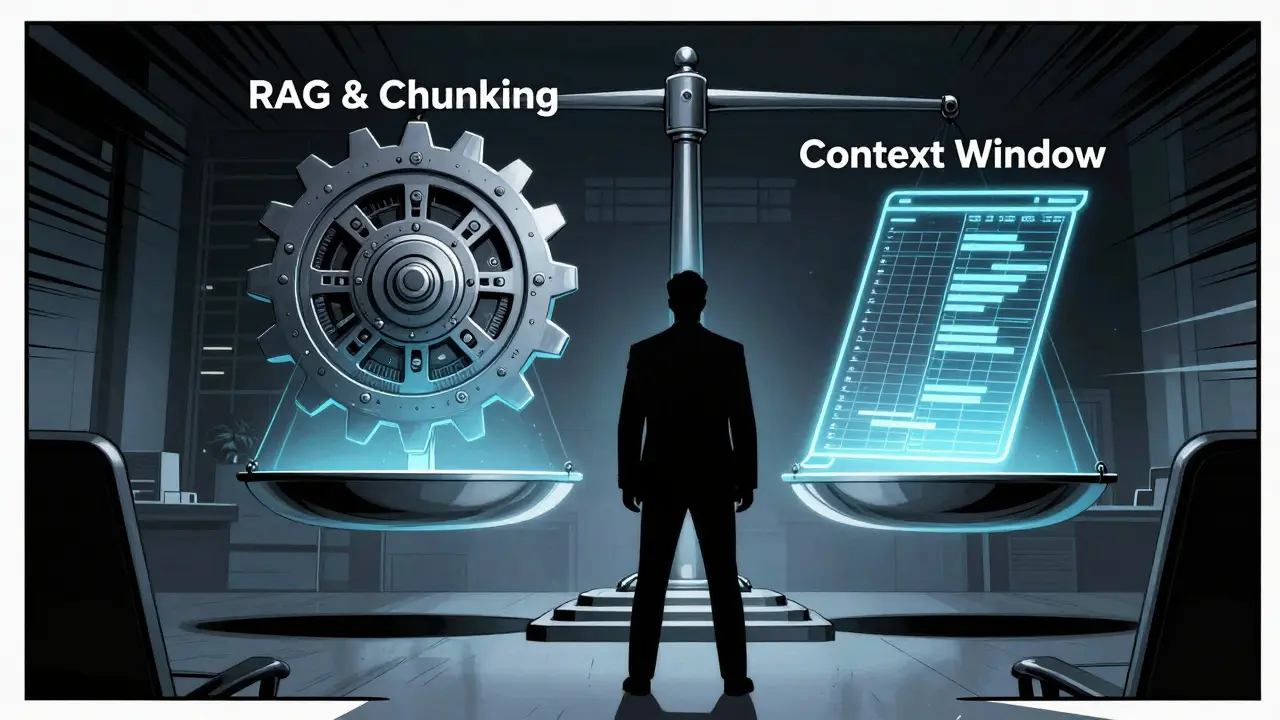
The relationship between context window size and cost is non-linear and counterintuitive. A larger window increases compute costs and latency per request. Yet, picking a window that’s too small forces you to build expensive retrieval systems, manage chunking logic, and handle multi-turn interactions that generate hidden costs. The largest available context window is rarely the most cost-effective choice. The sweet spot depends entirely on your specific workload patterns.
The Three Tiers of LLM Costs
To control spending, you first need to see where the money actually goes. Total Cost of Ownership for LLM deployments breaks down into three distinct tiers. Understanding this structure reveals why a cheap-per-token model might end up costing more than a premium one.
- Direct Costs (35-45%): This includes API calls, token consumption, compute infrastructure, storage, and bandwidth. These are the numbers you see on the provider’s website.
- Indirect Costs (30-40%): Engineering labor for integration, ongoing prompt development, monitoring infrastructure, and training staff. This is the human overhead required to keep the system running.
- Hidden Costs (20-30%): Retry infrastructure for unreliable outputs, hallucination mitigation strategies, latency optimization efforts, and compliance audits. These costs emerge only after deployment hits scale.
For an enterprise processing 100,000 daily requests, monthly costs can range from $4,200 to $127,000 depending on how well these tiers are managed. Context window selection acts as the primary lever controlling this variance. It dictates not just direct token spend, but also the indirect operational complexity required to make the model work reliably.
Context Window Trade-offs in 2026
The market landscape offers stark contrasts in context-cost tradeoffs. Let’s look at the key players as of mid-2026 to understand the spectrum of choices.
| Model | Context Window | Input Cost ($/1M tokens) | Output Cost ($/1M tokens) | Best For |
|---|---|---|---|---|
| GPT-4o | 128K | $2.50 | $10.00 | Complex reasoning, high-stakes tasks |
| GPT-4o-mini | 128K | $0.15 | $0.60 | High-volume, moderate complexity |
| Claude 3.5 Sonnet | 200K | $3.00 | $15.00 | Long-context analysis, premium quality |
| Claude 3.5 Haiku | 200K | $0.25 | $1.25 | Cost-efficient long context |
| Gemini 1.5 Pro | 2M | $1.25 | $5.00 | Massive document ingestion |
| Gemini 1.5 Flash | 1M | $0.075 | N/A | Budget-friendly large context |
Notice the pattern? GPT-4o-mini offers the same 128K context as its big brother at a fraction of the cost. Claude 3.5 Haiku provides 200K context for less than GPT-4o-mini’s input cost. Meanwhile, Gemini 1.5 Pro gives you 2 million tokens for a price point that sits between the mini and standard models. The open-source space is also competitive, with models like Llama 4 Scout offering 10 million token contexts at extremely low per-token rates if you have the infrastructure to host them.

The Hidden Cost of Small Windows
It’s tempting to pick the smallest window possible to save on per-token fees. But here’s the catch: small windows force architectural adaptations. If your documents don’t fit, you need Retrieval-Augmented Generation (RAG) systems.
RAG isn’t free. It requires:
- Embeddings infrastructure to convert text to vectors.
- Vector database maintenance and scaling.
- Complex prompt engineering to stitch retrieved chunks together coherently.
- Ongoing tuning to ensure the right information is retrieved every time.
These requirements create invisible cost multipliers. The engineering labor alone for maintaining a robust RAG pipeline can exceed the savings gained from using a cheaper, smaller-context model. Furthermore, RAG introduces latency and failure points. If the retrieval fails, the model hallucinates or gives incomplete answers, triggering retry loops that eat up your budget and frustrate users.
Selecting the Right Size for Your Workload
There is no single best context window. The optimal choice emerges from balancing three variables: the natural length of your inputs, your latency tolerance, and the cost of alternative architectures. Here’s a practical framework based on request volume and complexity.
Low Volume (< 100k Daily Requests)
If your typical prompt-plus-response length stays under 400 tokens, start with GPT-4o-mini. Establish baseline quality metrics. Measure the gap between this output and what your users need. Only move up if the quality deficit impacts business outcomes. For annual API spend below $50,000, the simplicity of a single, capable model usually outweighs the marginal savings of optimization.
Medium Volume (100k - 1M Daily Requests)
This is where mixed-model routing shines. Don’t use one model for everything. Route 80% of straightforward requests to a cost-efficient model like GPT-4o-mini or Claude 3.5 Haiku. Reserve the powerful, expensive models like GPT-4o or Claude 3.5 Sonnet for the 20% of queries that require deep reasoning or massive context. This intelligent orchestration typically reduces costs by 20-40% compared to defaulting to the premium option for all traffic.
High Volume (> 1M Daily Requests)
At this scale, per-token margins erode quickly. Evaluate fine-tuning smaller open-source models or implementing aggressive response caching. If your annual spend exceeds $500,000, a self-hosted GPU cluster with LoRA fine-tuning almost always produces lower total costs than continuing with hosted APIs. You gain control over inference speed, data privacy, and eliminate vendor lock-in.
Optimizing Infrastructure Costs
Even with the right model, infrastructure choices matter. Quantizing models to 4-bit precision can reduce GPU memory requirements and power consumption by approximately 30% without visible quality degradation. This directly cuts compute infrastructure costs.
Additionally, utilize spot or preemptible GPU instances. They offer identical compute capacity at 40-70% lower hourly rates compared to on-demand pricing. Build fallback mechanisms to switch to on-demand instances if spot instances are reclaimed, ensuring reliability while capturing massive discounts. Fintech case studies show that combining quantization with spot instances can cut run costs by 62% quarter-over-quarter.
Future-Proofing Your Strategy
The AI infrastructure market is maturing rapidly. Smaller, more efficient models with specialized capabilities are emerging, enabling more granular workload routing. Quantization and distillation techniques continue to improve, lowering the barrier for self-hosted deployments. Expect competitive pricing pressure to compress cost differentials between models at equivalent context tiers.
Regulatory landscapes are also expanding. In healthcare and financial services, audit trails and data residency requirements add to the hidden cost component. You may need to accept higher per-token costs for compliant commercial models or invest heavily in certified self-hosted infrastructure. Plan for these compliance overheads early in your TCO calculations.
Why does a larger context window not always mean higher total costs?
While larger windows increase per-request compute costs, they eliminate the need for complex architectural workarounds like RAG systems, chunking, and multi-turn interactions. These workarounds introduce significant indirect costs in engineering labor, infrastructure maintenance, and error handling. For workloads where inputs naturally fit within a large window, avoiding this complexity often results in a lower Total Cost of Ownership despite higher per-token prices.
When should I consider self-hosting LLMs instead of using APIs?
Self-hosting becomes economically viable when your annual API spend exceeds $500,000. At this scale, the fixed costs of GPU clusters and engineering teams are offset by the elimination of variable per-token fees. Self-hosting also offers benefits in data privacy, latency control, and customization through fine-tuning, which can further reduce long-term operational expenses.
How much do hidden costs contribute to LLM TCO?
Hidden costs account for 20-30% of Total Cost of Ownership. These include retry infrastructure for handling model errors, hallucination mitigation strategies, latency optimization efforts, and compliance audits. Organizations that ignore these factors often face budget overruns, as traditional IT cost models fail to capture the non-linear nature of LLM operations.
What is mixed-model routing and why is it effective?
Mixed-model routing involves directing different types of requests to different models based on complexity. Simple queries go to cheaper, faster models, while complex reasoning tasks are routed to premium models. This strategy optimizes cost by ensuring you only pay for high-performance compute when necessary, typically reducing overall expenses by 20-40% compared to using a single premium model for all traffic.
Can quantization significantly reduce LLM costs?
Yes, quantizing models to 4-bit precision can reduce GPU memory requirements and power consumption by approximately 30% without noticeable quality loss. When combined with spot instances, this technique has been shown to cut infrastructure costs by over 60% in some enterprise deployments, making it a highly effective optimization lever for self-hosted or hybrid environments.