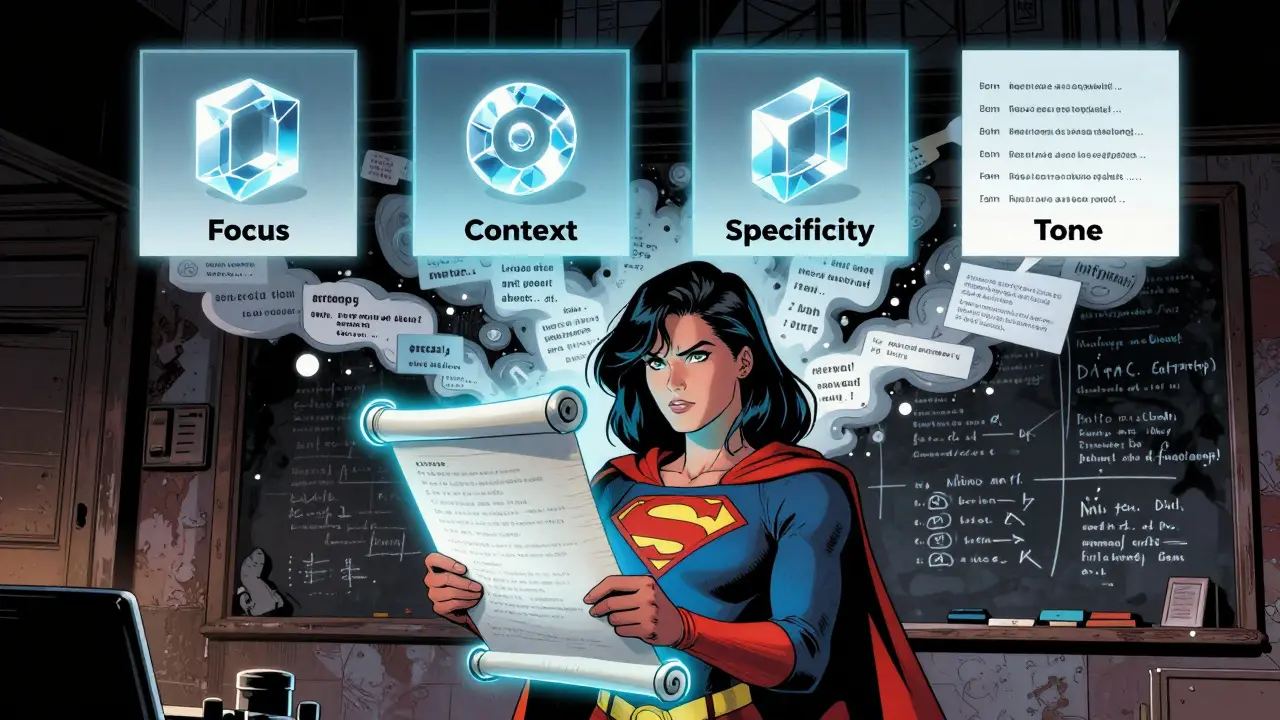
When you ask an AI a question, how do you know if your prompt is any good? It’s not enough to just get an answer. You want an answer that’s accurate, relevant, and useful - not vague, off-topic, or full of fluff. The difference between a weak prompt and a strong one isn’t luck. It’s design. And the best way to measure that design is with a rubric - a clear, structured set of criteria that tells you exactly what makes a prompt work.
Why Rubrics Matter for AI Prompts
Early on, people treated prompt writing like guesswork. Try something, see what happens, tweak it, try again. But as AI became part of classrooms, customer service, legal work, and content creation, that approach stopped working. You can’t train a team or grade student work if everyone’s using different standards. One person’s "clear" is another’s "confusing." That’s where rubrics come in. They turn fuzzy ideas like "be specific" or "give context" into observable, measurable behaviors.
Take a simple example. You ask an AI: "Tell me about climate change." That’s too broad. The AI might give you a 500-word essay when you only wanted a one-paragraph summary. A better prompt says: "Summarize the main causes of climate change in 100 words or less, for a high school student. Use simple language and avoid jargon. Include three key factors." Now you have something you can evaluate. A good rubric doesn’t just say "be specific." It says: "Includes exact length requirement, target audience, and at least two formatting constraints."
What Makes a Good Prompt Rubric?
Not all rubrics are created equal. The best ones follow three core rules.
- Use concrete language - No "good," "poor," or "excellent." Instead: "Specifies the desired output format (e.g., bullet points, table, paragraph)."
- Limit the number of criteria - Five is the sweet spot. More than that and people get overwhelmed. Fewer and you miss key details.
- Anchor each level with examples - Show what "proficient" looks like. Don’t just describe it - show it.
According to research from North Carolina State University, rubrics that include real examples at each performance level improve understanding by over 40%. A rubric that says "context is adequate" is useless. One that says "mentions the user’s goal, audience, and constraints" is actionable.
The Four Core Criteria
Based on analysis of over 1,200 educator-developed rubrics and real-world testing, four criteria consistently appear as the most important for measuring prompt quality:
- Focus - Does the prompt stay on task? A strong prompt doesn’t wander. It answers the core request without extra fluff or unrelated details.
- Context Provision - Does it give the AI everything it needs? Background, purpose, audience, constraints - all of it. A prompt without context is like asking a chef to cook without knowing what dish you want.
- Specificity - How precise are the instructions? Vague prompts lead to vague outputs. Specific ones? They get you what you need. Look for numbers, formats, examples, and limits.
- Tone Appropriateness - Is the language suited to the audience? A prompt for a five-year-old shouldn’t sound like a legal brief. A prompt for a data scientist shouldn’t sound like a children’s book.
Each of these criteria can be broken into performance levels. For example, under Specificity:
- Beginning: No clear instructions. Only a general topic.
- Developing: Includes one or two constraints (e.g., "write a summary" but no length or audience).
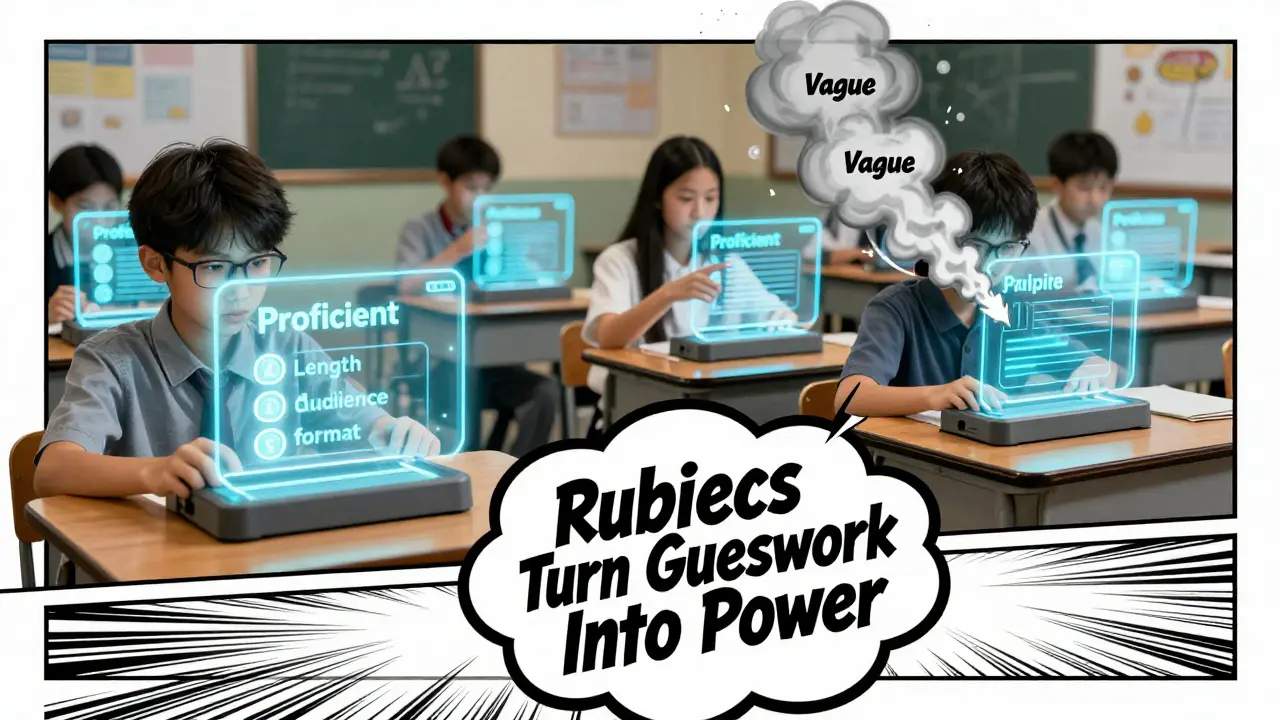
- Proficient: Includes three key elements: length, audience, and format.
- Exemplary: Includes all elements above plus a sample output or example of desired tone.
Types of Rubrics: Analytic, Holistic, Single-Point
There’s no one-size-fits-all rubric. The type you choose depends on your goal.
Analytic rubrics give separate scores for each criterion. They’re detailed. They’re slow. But they’re powerful for teaching. If a student’s prompt fails on context but nails specificity, you can say exactly why. This is the gold standard for classrooms and training programs. Research from CBE-Life Sciences Education shows they improve grading consistency by 32% - but take 47% longer to use.
Holistic rubrics give one overall score. "Excellent," "Good," "Needs Work." They’re fast. Great for quick checks. But they don’t help someone improve. If you’re just screening 50 prompts for a meeting, this works. If you’re teaching someone to write better prompts, it doesn’t.
Single-point rubrics are the quiet hero. They only describe what "proficient" looks like. Everything else is open for feedback. No "beginning," "developing," or "exemplary" levels. Just: "Here’s what good looks like. What’s missing? What’s extra?" This style is preferred by 78% of students in classroom testing. Why? Because it’s clear, it’s not overwhelming, and it feels like a conversation, not a grade.
How to Build Your Own Rubric
Here’s a practical six-step process used by top education tech teams:
- Analyze the assignment - What are you asking the AI to do? Write a summary? Generate code? Draft an email? Write down the exact task.
- Choose your rubric type - Use analytic for complex tasks, single-point for learning, holistic for speed.
- Pick 3-5 criteria - Stick to Focus, Context, Specificity, Tone. Add one more if needed (like "Bias Mitigation" for sensitive topics).
- Define performance levels - Describe what each level looks like. Use examples. Avoid vague words.
- Test it - Try it on five sample prompts. One that’s weak, one that’s okay, one that’s great. You’ll find gaps fast.
- Refine - Did any level feel unclear? Did two criteria overlap? Fix it. Then use it.
Tools like Appaca AI and RISEPoint can generate a first draft in minutes. But don’t trust them blindly. Human review is still key. A 2023 study found AI-generated rubrics reduce development time by 65% - but need 30% more tweaking to be accurate.
What Not to Do
Many rubrics fail before they’re even used. Here are the top mistakes:
- Overlapping criteria - "Clarity" and "Specificity" are often the same thing. Merge them.
- Uneven jumps between levels - If "Developing" to "Proficient" requires two changes, but "Proficient" to "Exemplary" requires five, people get frustrated.
- Using vague language - "Good," "clear," "well-written" - these mean nothing. Replace them with observable actions.
- Forgetting examples - A rubric without examples is just a list of words.
One user on GitHub called this "the most common flaw" in rubrics they’ve reviewed. "I saw one where moving from Developing to Proficient required adding two things. But to get to Exemplary, you had to add five. It felt random. Students gave up.""
Where This Is Heading
The future of prompt evaluation isn’t just human-made rubrics. It’s AI-assisted ones. In October 2024, researchers at arXiv showed a system that could automatically spot flaws in a rubric and generate improvements - with 83% accuracy. Tools like Appaca AI’s Adaptive Rubric Engine now adjust criteria weighting based on whether the prompt is for creative writing, technical analysis, or customer service.
Some schools are even testing real-time feedback. As you type a prompt, the system highlights missing context or vague wording - right then and there. Imagine getting feedback on your prompt like a spellchecker, but for clarity.
But experts warn against over-standardization. Dr. Elena Rodriguez wrote in January 2025: "Rubrics must balance structure with flexibility. Some of the best prompts break the rules - because they’re creative, not just correct."
So use rubrics to teach the fundamentals. But leave room for innovation. The goal isn’t to make everyone write the same prompt. It’s to make sure every prompt - whether simple or bold - gets the AI to do what you actually need.
What’s the difference between a prompt rubric and a grading rubric?
A grading rubric scores student work - like an essay or project. A prompt rubric scores the *input* - the question or instruction you give to the AI. It’s not about how well the student wrote an answer. It’s about how well they wrote the question. The goal is to improve the quality of the prompt itself, not the output.
Can I use a rubric for creative prompts, like storytelling?
Yes - but adapt it. For creative tasks, focus less on rigid constraints and more on clarity of intent. Instead of "Includes exact word count," ask: "Does the prompt clearly state the mood, tone, or style?" A good creative prompt might say: "Write a 300-word sci-fi story with a reluctant hero, set on Mars, using dark humor." That’s specific without being mechanical.
Do I need to use all four criteria every time?
Not always. For simple tasks - like asking for a definition - Focus and Specificity might be enough. For complex ones - like writing a business report - Context and Tone become critical. Start with the basics. Add criteria as needed. The goal is usefulness, not completeness.
How do I train others to use a prompt rubric?
Start with examples. Show three prompts: one weak, one good, one great. Have them score each one using the rubric. Then compare answers. The gaps in scoring reveal misunderstandings. After two or three rounds, people start seeing patterns. This is called calibration - and it’s the fastest way to build shared understanding.
Are there free templates I can use?
Yes. North Carolina State University’s Teaching Resources offers a free, downloadable single-point rubric for AI prompts. Appaca AI also provides open-source templates on their website. Look for ones that include concrete examples - not just labels. The best templates show you what "proficient" actually looks like in writing.

Jen Deschambeault
February 17, 2026 AT 10:08Kayla Ellsworth
February 18, 2026 AT 03:52Soham Dhruv
February 20, 2026 AT 00:32Bob Buthune
February 21, 2026 AT 21:54TIARA SUKMA UTAMA
February 22, 2026 AT 05:30