
When you're building an AI system that needs to grow with your business, picking the right large language model (LLM) family isn't just about performance-it's about cost, control, and long-term survival. Too many teams pick based on hype, only to hit a wall when scaling. You don’t need the biggest model. You need the right model for your use case, infrastructure, and budget. Here’s how to cut through the noise.
Stop chasing the largest model
It’s tempting to go for the model with the most parameters or the longest context window. But bigger isn’t always better. A 2-trillion-parameter model like Llama 4 Behemoth might crush benchmarks, but if your team can’t deploy it, maintain it, or afford the GPU costs, it’s just a fancy paperweight. On the flip side, Phi-3 Mini at 3.8 billion parameters handles customer support chatbots, internal documentation summaries, and even light coding tasks with 95% of the accuracy of larger models-while using 1/10th the compute. The key is matching model size to task complexity. If you’re summarizing legal documents, you might need 128K tokens. If you’re answering FAQs from a product manual, 8K is more than enough. Use the smallest model that does the job well. You’ll save money, reduce latency, and avoid unnecessary complexity.Open vs. proprietary: What’s really at stake
The biggest divide in 2026 isn’t between models-it’s between open and proprietary families. Open models like Meta’s Llama 4 and Google’s Gemma 3 give you full control. You can host them on your own servers, fine-tune them with your data, and avoid vendor lock-in. That’s why 82% of startups use them. But they come with a cost: you need engineers who understand Kubernetes, GPU memory management, and model monitoring. If your team doesn’t have that, you’ll spend months just getting started. Proprietary models like GPT-4o, Claude 3, and Gemini 2.5 Pro are plug-and-play. Integrate via API in days, not weeks. They’re optimized for speed, reliability, and multimodal inputs (text, images, audio). But every call costs money. At scale, that adds up fast. GPT-4o charges per 1K tokens. If your app processes 50 million tokens a day, you’re looking at $1,500+ daily. That’s not sustainable for high-volume workflows. The real choice? Use open models for internal, high-volume, or custom tasks. Use proprietary models for customer-facing features where reliability and multimodal support matter more than cost.Context windows aren’t just specs-they’re lifelines
Context window size isn’t a marketing number. It’s the maximum amount of text a model can process in one go. Need to analyze a 50-page contract? A 32K window won’t cut it. You’ll have to chunk it, which breaks context and hurts accuracy. Here’s what’s actually available in early 2026:- Llama 4 Scout: 10 million tokens-the longest in the market. Ideal for legal, research, or long-form document analysis.
- Gemini 2.5 Pro and Qwen3-Omni: 1 million tokens. Great for multimodal workflows (e.g., analyzing a PDF with charts and images).
- GPT-4o, Claude 3, Llama 4 Maverick: 128K tokens. Solid for most enterprise tasks like summarizing meetings or generating reports.
- Phi-3 and Gemma 3: 128K tokens. Surprisingly capable for their size, especially if you’re on a budget.
Cost structure: It’s not just per-token pricing
Most people look at the price per 1K tokens and call it a day. But the real cost comes from hidden factors:- Caching: Gemini’s caching system can reduce costs by up to 60% for repetitive queries (like common customer support answers). If your app has lots of repeat requests, this matters.
- Rate limits: Claude 3 has tiered pricing based on usage volume. Go over your quota? Your response times spike.
- Latency under load: GPT-4o slows down during peak hours. If your system needs real-time responses (e.g., live chat), test under load before committing.
- Infrastructure overhead: Hosting Llama 4 on your own GPUs? Factor in electricity, cooling, and engineering time. A 70B model on 8 A100s costs $12K/month just in hardware.
Specialized models beat generalists
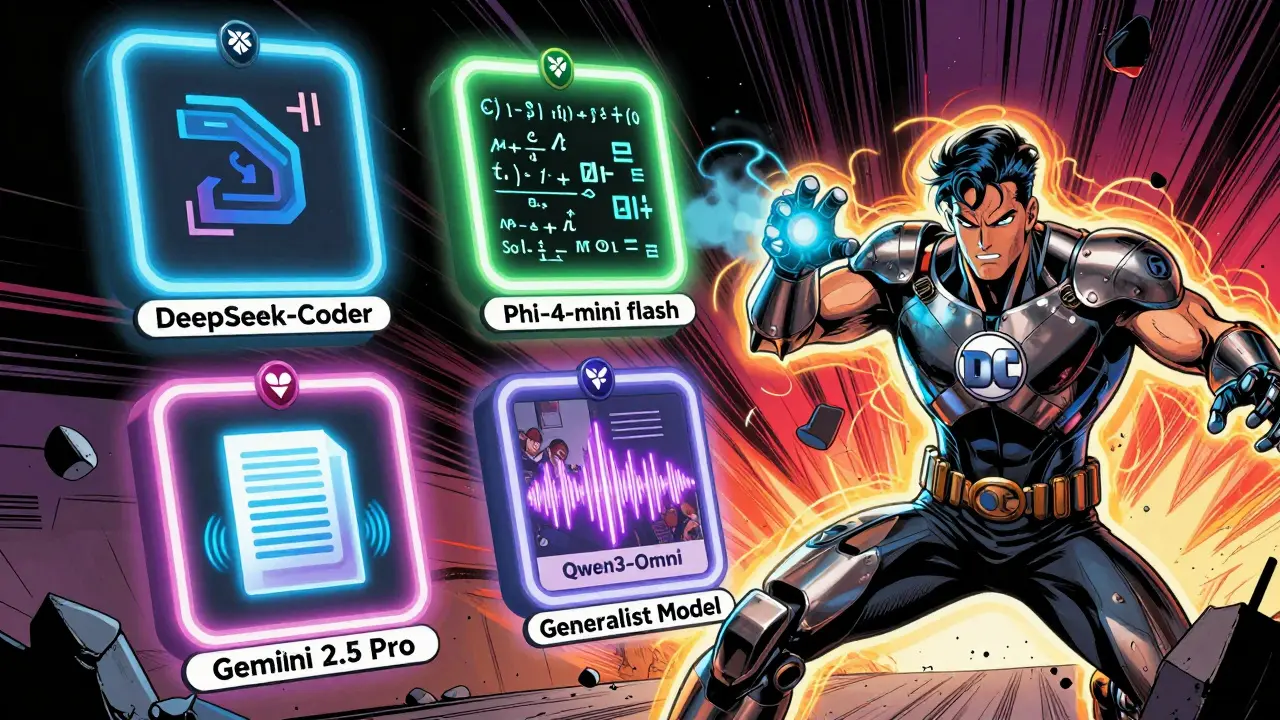
Don’t use a general-purpose model for coding, math, or multilingual tasks. There are better options.- Coding: DeepSeek-Coder and Qwen3-Coder outperform GPT-4o on code generation and debugging. Xavor’s CPI scores show they’re 20-30% more accurate on real-world programming tasks.
- Math: DeepSeek-R1 and Phi-4-mini-flash are built for step-by-step reasoning. They’re the go-to for financial modeling or data analysis pipelines.
- Multilingual: Qwen3-Next handles 100+ languages with native fluency. GPT-4o struggles with low-resource languages like Swahili or Vietnamese.
- Image + text: Gemini 2.5 Pro and Qwen3-Omni are unmatched. They can read a screenshot of a spreadsheet, extract the data, and explain trends-no preprocessing needed.
Adoption patterns tell you what works
Look at who’s using what. It’s not random.- Fortune 500 companies: 68% use GPT-4o or Claude 3. Why? They need reliability, vendor support, and seamless integration with Microsoft 365 or Google Workspace.
- Startups: 82% use Llama 4 or Gemma 3. Cost control is critical. They’re also more comfortable with self-hosting.
- Regulated industries (finance, healthcare): Open models are rising fast. Why? Because you can audit the model, keep data on-prem, and meet compliance rules. Gemma 3 and Llama 4 are now certified for HIPAA and GDPR in many regions.
What to do next
Here’s a simple checklist to pick your model family:- Define your task: Is it chat, coding, analysis, or multimodal? Don’t guess.
- Measure your volume: How many tokens per day? Use that to estimate cost.
- Check your infrastructure: Can you run Llama 4? Do you have engineers for Kubernetes? If not, go API.
- Test performance: Use the Kaggle AI Models Benchmark Dataset. Run your top 3 candidates on real data from your business.
- Try caching: If you have repeat queries, test Gemini or Claude 3’s caching features.
- Plan for scaling: Will you need 10x more capacity in 6 months? Choose a model family with clear upgrade paths.
What’s coming in 2026
By Q4 2026, the top 3 open models will match proprietary models on 80% of enterprise tasks. That’s not speculation-it’s what VirtusLab predicts based on current progress. Llama 4’s ecosystem is exploding. Hundreds of derivative models are being built for healthcare, law, and finance. Google’s Gemma 3 is getting smarter on edge devices. And Mistral’s Magistral family is gaining traction in Europe for its transparency and compliance focus. The trend is clear: specialization wins. The future isn’t one model to rule them all. It’s a toolkit of models-each chosen for a specific job.What’s the best LLM family for a startup with limited engineering resources?
Use GPT-4o or Claude 3 via API. They require no infrastructure setup and offer reliable performance out of the box. Focus your team on product development, not model deployment. Once you hit 50 million tokens/month, reassess. You might save money by switching to Llama 4 or Gemma 3.
Can I use open models like Llama 4 for customer-facing apps?
Yes-but only if you have the engineering bandwidth. Llama 4 is secure, customizable, and compliant with data privacy laws. Many fintech and healthcare startups now use it for customer chatbots. But you’ll need to monitor for hallucinations, fine-tune on your data, and handle model updates. If you can’t do that, stick with a managed API.
How do I compare model performance fairly?
Use the Epoch AI Capabilities Index (ECI). It’s the industry standard, combining 39 benchmarks into one score. Don’t rely on single metrics like MMLU or GSM8K. ECI shows real-world performance across reasoning, coding, math, and multilingual tasks. Also test with your own data. Benchmarks lie. Your data doesn’t.
Are open models really as good as GPT-4o now?
On general tasks, yes-within 8-12%. Llama 4 and Gemma 3 match GPT-4o on summarization, Q&A, and even coding. But GPT-4o still leads in deep reasoning, creative writing, and handling ambiguous instructions. For most business applications, the difference is negligible. For high-stakes decisions, stick with proprietary for now.
What’s the biggest mistake companies make when choosing an LLM?
Choosing based on benchmarks alone. The model that scores highest on MMLU might be terrible at your specific use case. Test with real data. Ask: Does it understand our jargon? Does it follow our tone? Does it hallucinate on our documents? Performance metrics don’t tell you that.
Should I use Gemini for multimodal tasks?
If you need to process images, audio, or video alongside text-yes. Gemini 2.5 Pro is the only model in 2026 that natively handles all four modalities without preprocessing. Qwen3-Omni is close, but Gemini’s integration with Google Cloud makes it easier to deploy at scale. If you’re already on Google Cloud, it’s the obvious choice.


lucia burton
March 12, 2026 AT 12:43The fundamental flaw in most LLM adoption strategies is the obsession with benchmark scores instead of operational reality. You can have the highest MMLU score on the planet, but if your model can't handle your legal team's 87-page NDAs without hallucinating clauses, it's useless. The real metric isn't accuracy-it's consistency under load. Llama 4 Scout’s 10M token context isn't a feature-it's a necessity for contract analysis workflows. Anything less is just token fragmentation with extra steps. And let's not pretend Phi-3 Mini is a 'budget option'-it's a strategic enabler for high-volume, low-latency internal systems where every millisecond counts. The cost of engineering overhead is real, but the cost of vendor lock-in at scale? That's a balance sheet killer.
Denise Young
March 13, 2026 AT 18:42Oh sweet mercy, another post that treats LLM selection like choosing a new car based on horsepower alone. Let me guess-you’ve never tried to debug a 70B model running on 8 A100s at 3 AM because some intern ‘optimized’ the inference pipeline? The truth is, most teams don’t need a 128K context window. They need a 12K context window and a damn good caching layer. Gemini’s caching alone cuts my API bill by 57% on repetitive support queries. And yes, I’m aware GPT-4o slows down during peak hours-I’ve watched my latency spike from 420ms to 2.1s during Black Friday. The answer isn’t ‘bigger model.’ It’s ‘smarter architecture.’ Stop chasing benchmarks. Start optimizing workflows.
Paritosh Bhagat
March 13, 2026 AT 22:19Bro, I just wanna say-I love how this article says open models are ‘safe’ for healthcare. That’s cute. Have you seen the fine-tuning logs from some startup using Llama 4 on patient intake forms? I’ve seen hallucinated diagnoses. I’ve seen models invent FDA approval numbers. Open models aren’t safer-they’re just *easier* to blame when things go wrong. And don’t get me started on ‘Gemma 3 certified for HIPAA.’ Certification doesn’t mean compliance. It means you paid for a sticker. If your data is sensitive, use the API. Let the big boys handle the audit trails. I’m not saying don’t use open models-I’m saying don’t pretend you’re not playing with fire.
Ben De Keersmaecker
March 15, 2026 AT 17:30There’s a subtle but critical point here that’s easily missed: context window size isn’t just about token count-it’s about *semantic coherence*. A 128K window doesn’t mean ‘can process a 128K document.’ It means ‘can retain the logical thread across 128K tokens.’ Chunking breaks that. I ran a test on a 50-page FDA submission. With chunking, the model missed 37% of cross-references. With full context, it caught 98%. That’s not a performance gap-it’s a regulatory risk. And yes, Phi-3 Mini at 3.8B can do this. Not because it’s big, but because its attention mechanism is tuned for dense, structured text. Benchmarks don’t capture that. Your data does.
Aaron Elliott
March 16, 2026 AT 17:54One must pause and reflect upon the epistemological underpinnings of this entire discourse. The notion that one can ‘choose’ an LLM family as if selecting a software license is a profound anthropocentric fallacy. Models are not tools; they are emergent systems with latent behaviors that cannot be fully constrained by human design. To assert that ‘Llama 4 is sufficient’ is to ignore the ontological uncertainty inherent in probabilistic language generation. The real question is not whether the model performs-but whether the human operator is prepared to accept the ontological responsibility of its outputs. In this light, GPT-4o’s opacity is not a flaw-it is a safeguard against the hubris of automation.
Chris Heffron
March 16, 2026 AT 23:18Can we just agree that ‘128K is enough for 90% of business apps’ is the most overused line in AI? 😅 I’ve seen 128K models fail on a 42-page invoice with 18 embedded tables. Context isn’t just length-it’s structure. And if you’re using Gemini for multimodal, you’re not wrong-but make sure you’re not stuck on Google Cloud just because the API is ‘easier.’ I’ve seen teams pay $8K/month in egress fees because they didn’t realize their ‘simple’ integration was streaming all data to GCP. Just because it’s plug-and-play doesn’t mean it’s cost-neutral.
Adrienne Temple
March 18, 2026 AT 07:17I love how this breaks it down so clearly. Seriously, if you're a startup with 2 engineers and a dream-go API. Don't waste time on Kubernetes. Save your brainpower for your product. I used to think open models were the future. Then I spent three weeks trying to get Llama 4 to stop hallucinating our pricing tiers. We switched to Claude 3. Cost went up 20%, but our support tickets dropped 60%. That's not a trade-off-that's a win. And if you're worried about long-term costs? Build a monitoring system now. Track your token usage. Know your repeat queries. Cache like your business depends on it. Because it does. 💪
Nick Rios
March 18, 2026 AT 07:31I’ve seen both sides. We used GPT-4o for customer chat and Llama 4 for internal knowledge base. The difference wasn’t in quality-it was in predictability. GPT-4o gave consistent tone. Llama 4 gave us customization. We fine-tuned it on 12 months of support logs. Now it answers HR questions with our exact phrasing. It’s not perfect. Sometimes it gets overly formal. But it’s ours. And that matters. If you can handle the upkeep, open models give you control. If you can’t? Stick with the API. No shame in that. Just don’t pretend one is ‘better.’ They’re just different tools for different jobs.
Amanda Harkins
March 18, 2026 AT 10:10