
Imagine asking your favorite AI assistant to describe a CEO and getting back an image of a man in a suit. Or asking for a nurse and seeing only women. These aren't just minor glitches; they are stereotypes baked into the data that trained these models. For years, fixing this meant expensive retraining or fine-tuning. But recent research shows you can cut stereotypical responses by up to 33% just by changing how you ask questions.
You don't need a PhD in machine learning to make your Large Language Model (LLM) fairer. You just need better prompts. This guide breaks down the specific techniques-backed by 2024 and 2025 research-that actually work to reduce bias across categories like race, gender, age, and beauty standards.
The Core Problem: Why LLMs Stereotype
Large Language Models are AI systems trained on massive datasets of text from the internet, books, and articles. Because human history and online content contain social biases, the model learns them too. When you ask a simple question, the model predicts the most likely next words based on patterns it has seen millions of times. If most CEOs in its training data were men, it will default to male pronouns or descriptions.
This isn't malice; it's statistics. The goal of debiasing prompts is not to erase reality but to interrupt these automatic statistical shortcuts. By forcing the model to think differently, you can steer it away from lazy stereotypes.
Technique 1: Human Persona Prompting
One of the most effective single changes you can make is to give the AI a "human" identity. Research published in April 2024 showed that instructing the model to act as a thoughtful human significantly reduces bias compared to letting it act as a neutral machine.
Why does this work? Machines are expected to be objective and data-driven, which often means reflecting the raw, biased averages of their training data. Humans, however, are expected to exercise judgment and empathy.
How to implement it:
- Start your prompt with: "As a human who carefully considers information before responding..."
- Avoid phrases like "As an AI assistant..." or "As a neutral observer..."
- This technique alone reduced stereotypical responses by up to 13% across multiple models in studies involving Llama 2 and Mistral 7B.
Technique 2: System 2 Thinking (Slow Down)
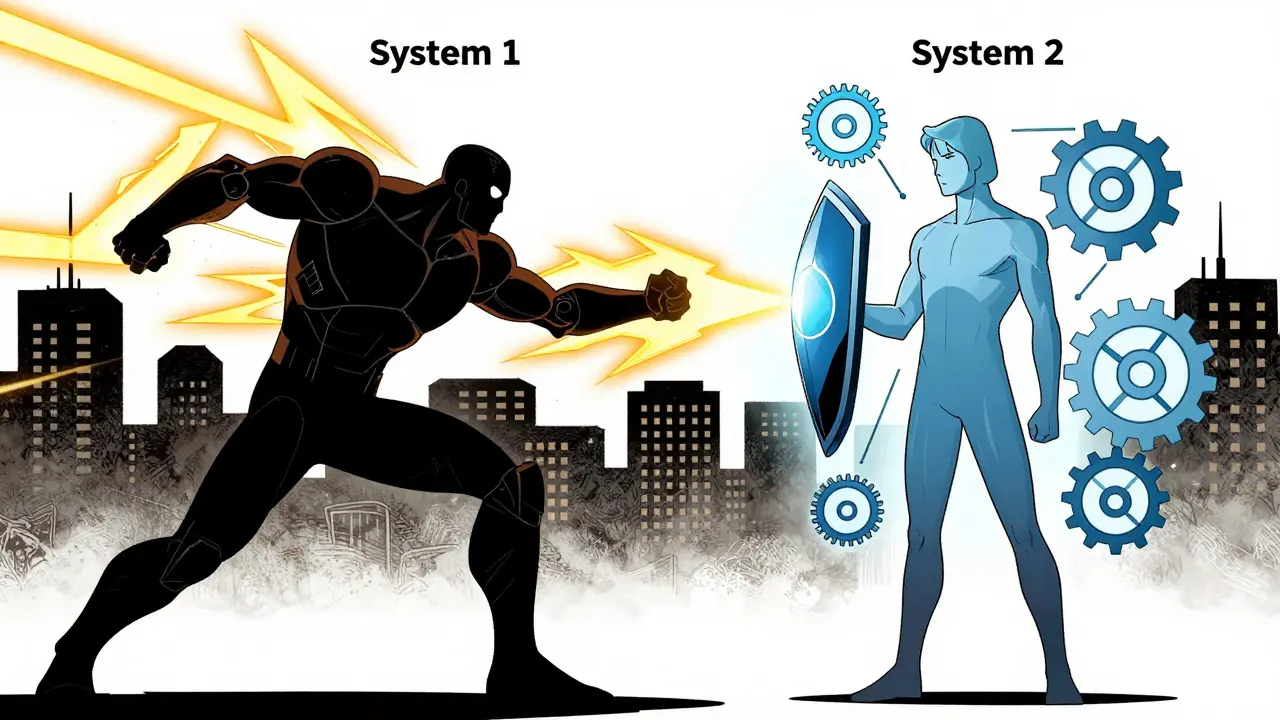
Psychologist Daniel Kahneman popularized the idea of "System 1" (fast, intuitive thinking) and "System 2" (slow, analytical thinking). LLMs naturally operate in System 1 mode-they spit out the most probable answer instantly. This speed fuels stereotypes because stereotypes are the path of least resistance in language prediction.
To fix this, you need to force the model into System 2 mode. You do this by explicitly asking it to pause and analyze.
Example Prompt Addition:
"Take a moment to carefully consider this question from multiple perspectives before answering. Analyze potential assumptions in the query."
Studies show that System 2 prompting reduces stereotypes by 5-13%. Conversely, encouraging "System 1" thinking (e.g., "Answer quickly") actually increased bias by 4-8%. So, when fairness matters, slow the model down.
Technique 3: Chain-of-Thought Reasoning
Chain-of-Thought (CoT) prompting is a technique where the model is asked to explain its reasoning step-by-step before giving a final answer. This exposes hidden assumptions.
If a model is about to stereotype a job role, forcing it to write out its logic might look like this:
- "The user asked for a description of a surgeon."
- "Historically, medical fields have been male-dominated, but modern data shows high female participation."
- "I should avoid assuming gender based on profession."
- "Final Answer: A surgeon is a medical professional..."
By articulating the steps, the model often self-corrects. However, be aware that CoT increases token usage by 25-40%, which raises costs. Use it for high-stakes outputs where fairness is critical.
Technique 4: Explicit Debiasing Instructions
Sometimes, subtlety doesn't work. You can directly tell the model what to avoid. This is known as a debiasing prompt. While effective on its own (reducing bias by 3-5%), it becomes powerful when combined with the other techniques.
Best Practice Instruction:
"Ensure your response avoids all stereotypes and represents diverse perspectives equally. Do not rely on demographic generalizations."
According to RANLP 2025 proceedings, combining Human Persona + System 2 + CoT + Debiasing instructions achieved a record 33% reduction in beauty-related stereotypes in Llama3.3.
Combining Techniques for Maximum Impact
No single trick works perfectly for every scenario. The best results come from stacking these methods. Here is a comparison of effectiveness based on recent benchmarks:
| Technique Combination | Bias Reduction Estimate | Best For | Cost/Complexity |
|---|---|---|---|
| Human Persona Only | ~7-13% | General queries, quick wins | Low |
| System 2 Only | ~5-13% | Complex decision-making | Low |
| HP + System 2 + CoT | ~9-15% | Race and Gender bias | Medium (Higher tokens) |
| HP + System 2 + CoT + Debias | Up to 33% | Beauty bias, sensitive topics | High (Highest tokens) |

Model-Specific Nuances
Not all models respond the same way. If you are using Meta's Llama 3.3, the full stack (HP + System 2 + CoT + Debias) is highly effective for beauty and appearance biases. For Mistral 7B, researchers found that HP + System 2 + CoT was optimal for reducing race-related bias, achieving around a 9% improvement.
Smaller models (under 7 billion parameters) may struggle with complex CoT instructions, sometimes leading to longer response times with minimal gain. In those cases, stick to Human Persona + Simple Debiasing instructions.
Practical Implementation Checklist
Ready to try this in your application? Follow these steps:
- Identify the Risk: Determine which bias category matters most for your use case (e.g., hiring tools need gender/race focus; marketing copy needs beauty/age focus).
- Set the Persona: Prefix your system prompt with "As a thoughtful human analyst..."
- Force Analysis: Add "Think step-by-step and consider multiple perspectives before concluding."
- Add Guardrails: Include "Avoid stereotypes and ensure diverse representation."
- Test and Measure: Compare outputs against a baseline. Look for reductions in gendered language, racial assumptions, or ageist tropes.
Limitations and Realistic Expectations
Prompting is a powerful tool, but it is not a silver bullet. Some experts note that deeply embedded biases may require fine-tuning or curated training data to fully resolve. Additionally, overly aggressive debiasing can sometimes make responses feel robotic or verbose. Aim for a balance where the output is both fair and natural-sounding.
Regulatory bodies like the European AI Office now recognize structured prompting as a valid compliance measure for certain AI risks. As of 2025, nearly 70% of enterprises using public-facing LLMs have adopted at least one of these techniques. It’s no longer optional-it’s part of responsible AI development.
Does adding more instructions always reduce bias?
Not necessarily. While combining techniques like Human Persona and System 2 thinking generally helps, overly complex prompts can confuse smaller models or increase costs without proportional gains. It is best to start with a Human Persona and add complexity only if needed.
Which bias types are hardest to reduce with prompting?
Ageism tends to be more resistant, showing only 4-13% reduction even with the best techniques. Beauty bias, however, has shown dramatic improvements, up to 33% reduction with combined prompting strategies.
Will these techniques slow down my AI application?
Yes, slightly. Chain-of-Thought prompting forces the model to generate more tokens, which increases latency and cost. System 2 prompting also adds processing time as the model "thinks" through the response. Balance fairness needs with performance requirements.
Can I use these techniques on any LLM?
These techniques are compatible with all major transformer-based architectures, including Llama, Mistral, GPT, and Claude. However, effectiveness varies by model size and training data. Larger models generally follow complex instructions better than smaller ones.
Is prompting enough to solve AI bias completely?
No. Prompting mitigates surface-level stereotypes but cannot eliminate deep-seated biases inherent in the training data. For comprehensive fairness, combine prompting with diverse data curation, regular auditing, and potentially fine-tuning.



Lisa Nally
June 4, 2026 AT 03:21Oh, honey, please.
This entire premise is absolutely laughable to anyone who actually understands the underlying architecture of transformer-based models. You are suggesting that a few syntactic tweaks in the prompt layer can somehow override the fundamental statistical distributions learned during pre-training on petabytes of uncurated internet text? It’s not just optimistic; it’s delusional.
The concept of 'Human Persona Prompting' is particularly egregious. Instructing an LLM to adopt a persona does not imbue it with empathy or moral judgment; it merely shifts the probability distribution toward tokens associated with those semantic clusters. If the training data contains biased representations of CEOs as male, forcing the model to 'act human' will often result in it reproducing those biases more subtly, perhaps by using softer language while maintaining the same stereotypical associations. This is known as stereotype laundering, and it is far more dangerous than overt bias because it is harder to detect algorithmically.
Furthermore, the claim that System 2 thinking reduces bias by 5-13% is misleading without context. Chain-of-Thought reasoning increases token consumption significantly, which raises inference costs and latency. For enterprise applications where scalability is paramount, this trade-off is unacceptable. We need structural solutions like RLHF (Reinforcement Learning from Human Feedback) focused specifically on fairness metrics, not these parlor tricks for prompt engineers who think they can outsmart the loss function with clever phrasing.
I’ve seen too many teams implement these 'quick fixes' only to find their models still failing basic fairness audits down the line. It’s a band-aid on a bullet wound. The industry needs to stop pretending that prompting is a substitute for rigorous data curation and model alignment.
Edward Gilbreath
June 6, 2026 AT 00:53its all part of the plan man
they want you to think you have control over the ai but really its just another way to track what you care about
every time you use a debiasing prompt they log it
why do you think big tech is so obsessed with 'fairness' now
because if they dont pretend to fix it the government will step in and take everything away
this article is basically a tutorial on how to make the surveillance state look nicer
you cant fix bias with words when the whole system is built on stealing your data
kimberly de Bruin
June 6, 2026 AT 14:15the machine thinks in mirrors
we ask it to be human but it only knows the shape of our shadows
to slow it down is to invite the ghost into the room
but what if the ghost is us
Edward Nigma
June 7, 2026 AT 22:12You guys are missing the point entirely. Bias isnt a bug its a feature of efficiency. The model defaults to stereotypes because thats the most statistically probable path. Trying to force it to be 'fair' makes it slower and more expensive for no real gain. Most users dont care about perfect equity they just want an answer. Plus all this talk about 'human persona' is cringe. I prefer my AI cold and logical. If it wants to assume the CEO is a man fine whatever. Stop trying to turn every chatbot into a therapy session.
Francis Laquerre
June 9, 2026 AT 00:26I must respectfully disagree with the cynicism here. While the technical limitations are valid, the cultural shift towards ethical AI is profound and necessary. In my experience working with cross-border teams, these prompting techniques have allowed us to bridge gaps in communication that previously caused significant friction. It is not about erasing reality, as some argue, but about expanding the lens through which we view it. The dramatic reduction in beauty-related stereotypes mentioned in the post is not trivial; it reflects a deeper societal desire for inclusivity. We must embrace these tools not as silver bullets, but as essential steps in a longer journey. The cost in tokens is a small price to pay for a more equitable digital future. Let us collaborate to refine these methods rather than dismissing them outright.