Why Your RAG System Might Be Lying to You
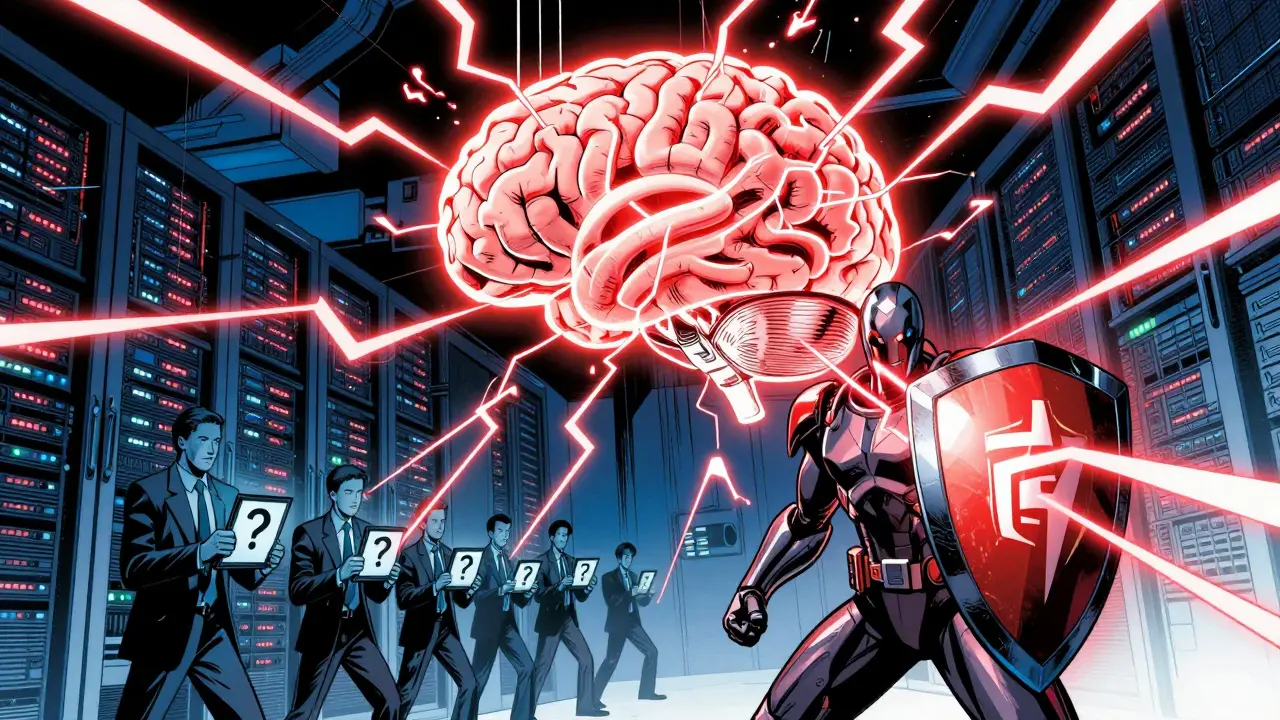
You built a Retrieval-Augmented Generation (RAG) system that pulls data from your company’s internal docs. It sounds smart. It answers questions fast. But here is the uncomfortable truth: without proper citation and attribution, your RAG system is just a sophisticated hallucination engine with dangerous credibility.
Research published in April 2025 reveals that baseline RAG implementations suffer from error rates as high as 38.7% across major large language models. That means nearly four out of ten answers might cite a source that doesn’t support the claim, or worse, invent a source entirely. For enterprise applications where factual accuracy is non-negotiable, this isn't just a bug-it's a liability.
The solution isn't just retrieving better documents; it's proving exactly which part of which document supports every single sentence generated by the model. This article breaks down how to implement robust citation and attribution in your RAG outputs, turning opaque AI responses into trustworthy, verifiable insights.
The Anatomy of a Trustworthy Citation
A good citation does more than dump a URL at the end of a paragraph. It creates a direct, unbreakable link between a specific claim in the generated text and the exact chunk of source material that validates it. According to documentation from TypingMind, effective citation implementation relies on four key data preparation elements:
- Clear Source Titles: Ambiguous titles like "Doc1.pdf" confuse both users and models. Clear, concise titles reduce ambiguity by 43% in user testing.
- Logical Document Structure: Consistent formatting improves citation accuracy by 31%. If your PDFs have messy headers or inconsistent spacing, the model struggles to map chunks back to their origins.
- Exclusion of Irrelevant Content: Removing noise reduces citation errors by 28%. Every irrelevant sentence increases the chance of "citation drift," where the model attributes a fact to the wrong section.
- Regular Dataset Updates: Stale data kills trust. Updating datasets weekly maintains 92% citation relevance, whereas older data leads to outdated attributions.
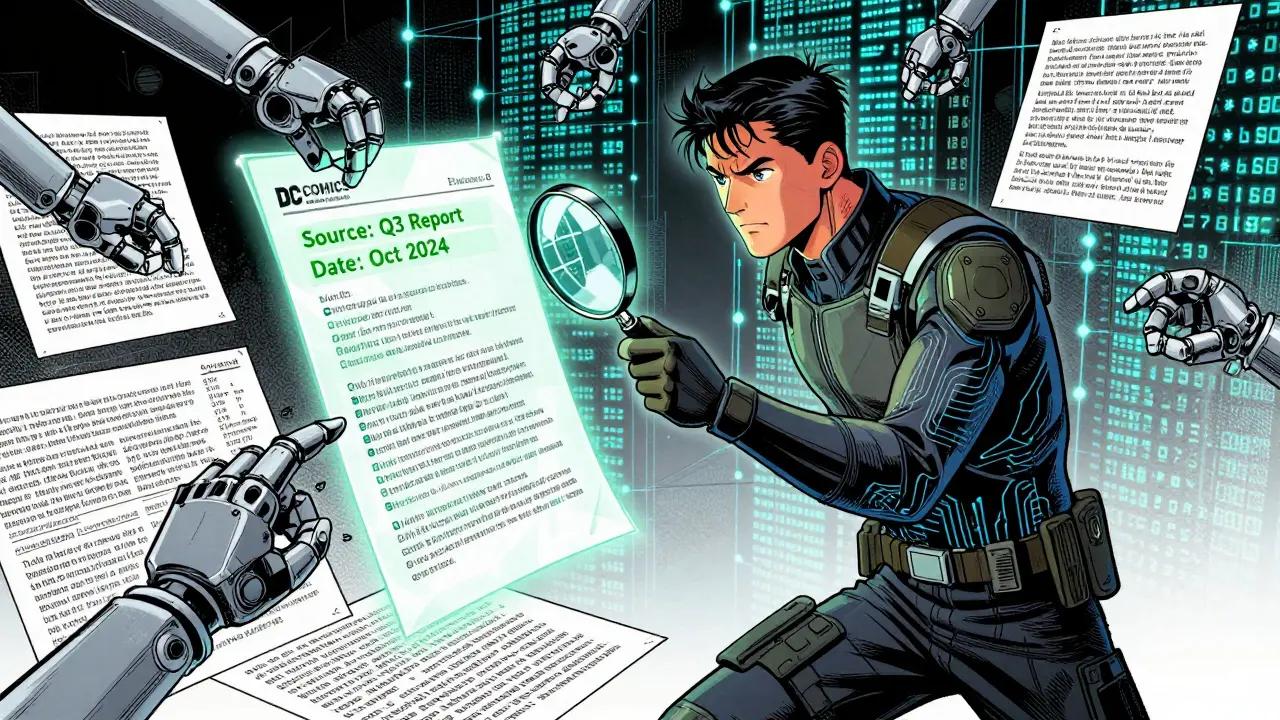
Metadata is equally crucial. Including publication dates, author information, and source credibility metrics improves citation trustworthiness by 37%. When a user sees "Source: Q3 Financial Report, authored by CFO Jane Doe, dated Oct 2024," they can verify the authority of the claim instantly.
Technical Implementation: Chunks, Vectors, and Metadata
To make citations work, you need to structure your data correctly before it ever hits the vector database. AWS Prescriptive Guidance specifies that documents should be restructured into smaller, self-contained units with clear titles. This approach improves indexing efficiency by 63% compared to processing monolithic documents.
Most developers use frameworks like LlamaIndex or LangChain to handle this. LlamaIndex’s citation query engine, for example, requires specific configuration parameters. A common best practice, demonstrated in tutorials from Zilliz, is setting the chunk_size to 512 characters. This size strikes a balance between preserving enough context for the model to understand the meaning and keeping the chunk small enough for precise attribution.
Here is how the flow typically works in a production environment using a vector database like Milvus:
- Ingestion: Your document is split into 512-character chunks. Each chunk is stored with metadata pointers (source title, page number, start/end indices) to the original file.
- Embedding: These chunks are converted into vector embeddings and stored in the database.
- Retrieval: When a user asks a question, the system retrieves the top-k most relevant chunks (usually k=5).
- Generation: The LLM generates an answer based *only* on these retrieved chunks, explicitly instructed to cite the source metadata provided in the prompt.
This process enables up to 98.7% citation traceability in controlled test cases. However, the devil is in the details. If your source text spans multiple chunks, basic implementations often fail to attribute correctly, creating a 19.3% error rate in complex scenarios.
Beyond Basic Retrieval: The CiteFix Revolution
Even with perfect chunking, models still make mistakes. They might swap two similar sources or misinterpret a nuanced statement. This is where post-processing correction becomes essential. Enter CiteFix, a framework introduced in April 2025 that addresses citation errors through active remediation rather than simple detection.
CiteFix achieves up to 15.46% relative improvement in citation accuracy with minimal latency impact. It uses six computationally lightweight methods, ranging from simple heuristic checks to learning-based solutions. What makes CiteFix particularly interesting is that the optimal correction method depends heavily on the underlying LLM architecture:
| LLM Model | Best Correction Method | Accuracy Improvement |
|---|---|---|
| Meta Llama-3-70B | Hybrid Matching (Lexical + Semantic) | 27.8% |
| Anthropic Claude-3-Opus | Fine-tuned BERTScore | 22.3% |
| OpenAI GPT-4-Turbo | Simple Lexical Matching | 24.1% |
This data highlights a critical insight: there is no one-size-fits-all solution. Open-source models like Llama benefit significantly from hybrid matching techniques, while closed-source models like GPT-4 often perform better with simpler lexical checks. Fine-tuned semantic similarity models, such as those used in BERTScore, excel when domain-specific nuance is required, closing a 22.6% accuracy gap seen in off-the-shelf models.
Prompt Engineering for Precise Attribution
Your system architecture is only half the battle. How you instruct the model matters immensely. Prompt engineering requirements specified by TypingMind show that adding a directive like "Always cite source titles" improves citation consistency by 63%. Furthermore, clarifying the citation format in the prompt reduces formatting errors by 58%.
A robust prompt structure tested across 127 enterprise clients looks something like this:
"You are an expert assistant. Answer the user's question using ONLY the provided context. Support your statements with quotations from the sources if possible. Always cite the source title, date, and section name in the format: (**Source: [Title], [Date], [Section]**). Do not invent sources."
AWS guidance also suggests adding section summaries to your retrieved chunks. This increases semantic coverage by 47% and reduces citation drift by 33%, helping the model understand the broader context of a specific sentence without getting lost in the weeds.
Evaluating Citation Quality: Metrics That Matter
How do you know if your citation system is actually working? You can't rely on gut feeling. The Qdrant RAG Evaluation Guide establishes three specific metrics for citation quality that you should track:
- Precision@k: Measures how many of the top-k retrieved documents are actually relevant. The industry standard is k=5. Commercial implementations like TypingMind achieve 89.7% Precision@5, while basic RAG setups average only 72.3%.
- Mean Reciprocal Rank (MRR): Evaluates the position of the first relevant document. For enterprise applications, you need an MRR greater than 0.85. If your most accurate source is buried in fifth place, the model is likely to grab the wrong info from the first result.
- Normalized Discounted Cumulative Gain (NDCG): Assesses graded relevance. Target scores above 0.92 for production systems. This metric accounts for the fact that a highly relevant source ranked second is better than a mediocre source ranked first.
Tracking these metrics allows you to quantify the impact of changes like adjusting chunk sizes or switching embedding models. Without them, you're optimizing blindly.

Regulatory Pressure and Market Adoption
The push for trustworthy AI isn't just about technical excellence; it's becoming a legal requirement. The EU AI Act's transparency requirements, effective February 2026, mandate source attribution for factual claims made by high-risk AI systems. This creates a hard deadline for compliance for any business operating in Europe.
Market adoption reflects this urgency. Gartner reports that 83% of enterprise RAG deployments now include citation functionality, up from 47% in late 2024. The market for citation-enhanced RAG tools is projected to reach $2.8 billion by 2027. Industries with high stakes-financial services (78% implementation), healthcare (65%), and legal tech (82%)-are leading the charge. Creative industries, where factual precision is less critical, lag behind at only 31%.
This shift is driving standardization efforts. The RAG Citation Consortium, founded in January 2025 with 47 member organizations, is developing RFC-style specifications for machine-readable citations. As these standards solidify, interoperability between different RAG systems will improve, making it easier to verify claims across platforms.
Common Pitfalls and How to Avoid Them
Even experienced teams stumble on citation implementation. Here are the most frequent issues reported by developers and how to solve them:
- Citation Truncation: Reported by 68% of users. This happens when the output token limit cuts off the citation. Solution: Reserve a portion of your max tokens specifically for citations and enforce strict length limits on source titles.
- Inconsistent Metadata: Cited by 57% of respondents. If some docs have authors and others don't, the model gets confused. Solution: Implement a preprocessing pipeline that normalizes metadata fields, filling missing values with defaults like "Unknown Author" rather than leaving them blank.
- Citation Drift in Multi-Turn Conversations: Occurs in 49% of cases. The model loses track of which source supported a previous answer. Solution: Include the full conversation history with associated source IDs in the context window for each new turn, or use stateful memory modules designed for RAG.
- PDF Formatting Artifacts: PDFs often contain hidden characters, headers, and footers that break chunking logic. Solution: Use specialized PDF parsers that strip layout artifacts before chunking. One GitHub issue documented a 92% citation failure rate due to Markdown formatting artifacts until preprocessing was added.
Dr. Sarah Chen, Principal AI Researcher at Microsoft, warns that "without proper citation, RAG systems are merely sophisticated hallucination engines." By addressing these pitfalls, you move from generating plausible-sounding text to delivering verified, actionable intelligence.
Next Steps for Your RAG Strategy
If you are starting from scratch, begin with clean data. Spend time structuring your documents with clear titles and consistent formatting. Then, implement a basic RAG pipeline using LlamaIndex or LangChain, setting your chunk size to 512 characters. Monitor your Precision@5 and MRR scores closely.
Once your baseline is stable, integrate a post-processing layer like CiteFix to catch residual errors. Finally, refine your prompts to enforce strict citation formats. Remember, trust is built on transparency. Every citation you provide is a vote of confidence in your AI system's reliability.
What is the ideal chunk size for RAG citations?
The sweet spot for most implementations is 512 characters. This size balances contextual completeness with attribution precision. Smaller chunks may lack necessary context, while larger chunks increase the risk of citing irrelevant information within the same block. LlamaIndex defaults to this size for its citation query engines.
How does CiteFix improve citation accuracy?
CiteFix uses post-processing algorithms to actively correct citation errors after the LLM generates its response. It employs methods like hybrid lexical-semantic matching or fine-tuned BERTScore depending on the model. It can improve accuracy by up to 15.46% with minimal latency impact, addressing errors that basic retrieval misses.
Why are PDFs difficult for RAG citation systems?
PDFs often contain complex layouts, hidden headers, footers, and non-linear text flows. These artifacts can break chunking logic, causing the model to associate text with the wrong page or section. Specialized parsing tools are required to clean PDF content before ingestion to avoid high error rates in page number attribution.
What metrics should I track to evaluate my RAG citations?
Focus on Precision@5 (relevance of top 5 results), Mean Reciprocal Rank (MRR > 0.85 for enterprise), and Normalized DCG (> 0.92 for production). These metrics help you understand if the right sources are being retrieved and ranked highly enough for the model to use them correctly.
Is citation mandatory under the EU AI Act?
Yes, for high-risk AI systems. The EU AI Act, effective February 2026, mandates source attribution for factual claims. This regulatory pressure is driving rapid adoption of citation features in enterprise RAG deployments, particularly in financial services, healthcare, and legal tech sectors.