Why Generative AI Can’t Be Ethical Without People
Generative AI doesn’t work in a vacuum. It doesn’t wake up one morning and decide to hallucinate facts or copy biased language. Those problems come from the data it was trained on, the people who designed it, and the systems that let it loose without oversight. If you’re using AI in research, teaching, or publishing, you’re not just using a tool-you’re participating in a social contract. And that contract requires transparency and real engagement with everyone affected.
Think about it: a student uses ChatGPT to write an essay. A professor doesn’t know it’s AI-generated. A journal reviewer accepts the paper without question. A patient reads a health article written by AI and trusts it as fact. That’s not innovation. That’s a breakdown in accountability. And it’s happening everywhere-because most institutions treat AI ethics like a policy document, not a living practice.
What Transparency Really Means (It’s Not Just Saying “I Used AI”)
Transparency isn’t checking a box that says “AI was used.” That’s performative. Real transparency means showing your work-like a scientist showing their lab notes.
Harvard’s January 2024 guidelines require researchers to document every prompt, tool version, and output used in a project. That’s not bureaucracy-it’s reproducibility. If you can’t explain how you got the result, you can’t prove it’s valid. The European Commission’s 2024 research framework demands the same: AI-generated claims must be verifiable. That means saving your prompts, tracking which model you used (GPT-4-turbo? Claude 3? Llama 3?), and noting where the output was edited by a human.
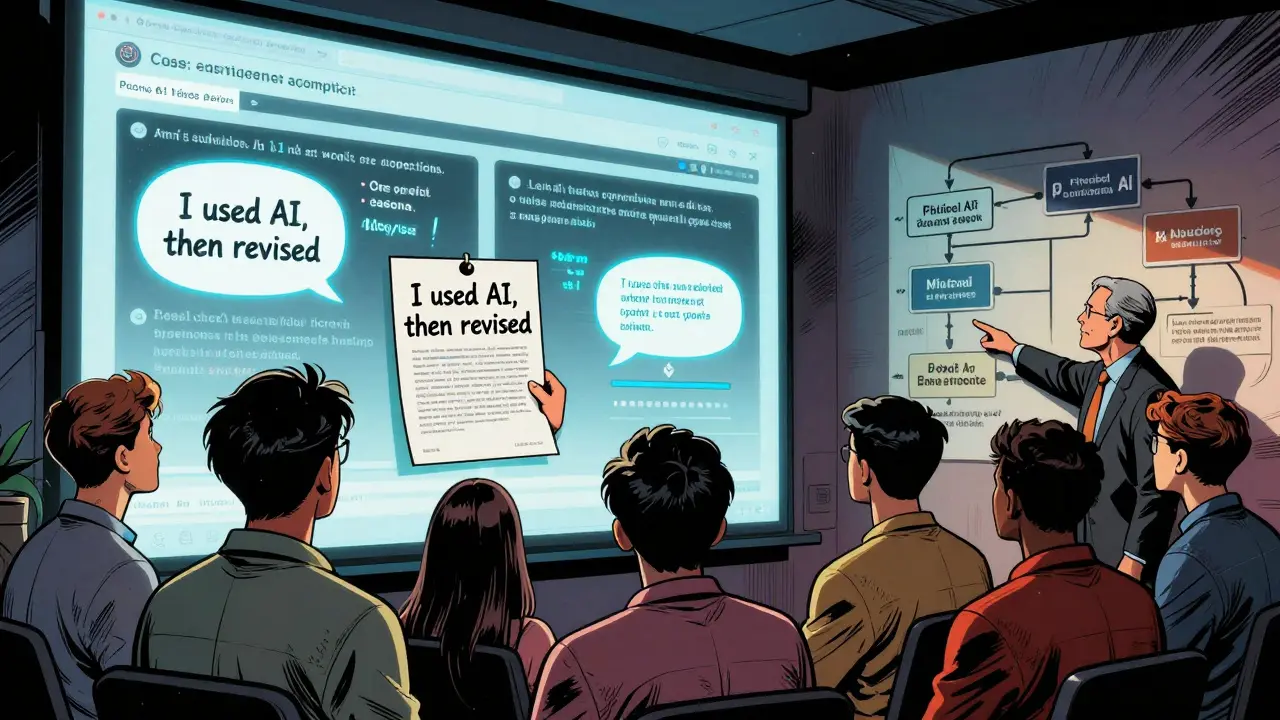
At East Tennessee State University, faculty had to redesign their grading rubrics to include a section on AI disclosure. Students now submit a short statement: “I used AI to brainstorm ideas, but wrote all final text myself.” Or: “I used AI to summarize 12 research papers, then verified each summary against the original.” That’s transparency. It’s not about banning AI. It’s about making its role visible.
And it’s not just students. Researchers at Columbia University report spending 15-20 extra hours per project just documenting AI use. It’s tedious. But without it, peer review falls apart. If a study can’t be replicated because the AI inputs are missing, the science is broken.
Stakeholder Engagement Isn’t a Meeting-It’s a System
Who counts as a stakeholder? Students. Librarians. IT staff. Patients. Journal reviewers. Journalists. The public. If you’re not asking them what they need, you’re designing in the dark.
UNESCO’s 2021 ethics framework called for “multi-stakeholder and adaptive governance.” Most schools ignored that part. But East Tennessee State University didn’t. In early 2025, they launched an anonymous ethics reporting system. Faculty could flag concerns about AI misuse. Students could report unfair grading. Within four months, they got 127 reports. 63% were about students submitting AI-written assignments. 28% were about unclear citation rules.
That data changed their policy. They didn’t just add a rule. They created a 3-hour mandatory training module for faculty, updated their student honor code, and hired two AI literacy coordinators. They didn’t wait for a crisis. They built feedback loops.
At the University of California system, they ran AI literacy workshops. Not lectures. Hands-on sessions where professors and students sat together and tried prompts side by side. They compared outputs. They debated bias. They learned how to spot when AI was making up sources. By May 2025, 87% of participants said they felt confident using AI responsibly. That’s engagement. That’s trust.

Why Your AI Policy Is Failing (And How to Fix It)
Most AI policies are written by IT departments or legal teams. They’re full of jargon like “risk mitigation” and “compliance obligations.” They don’t help a professor who’s trying to grade 150 papers.
Here’s what’s broken:
- They don’t define what “AI use” means. Is summarizing a paper using AI the same as writing a whole section?
- They don’t explain how to disclose it. “Use AI ethically” isn’t a rule-it’s a wish.
- They don’t give tools. No templates. No checklists. No training.
- They don’t update. 73% of universities changed their AI policies at least twice in 2025. That’s chaos.
Fix it by making your policy:
- Role-specific: What’s allowed for a grad student in biology? For a journalist at the campus paper? For a nurse using AI to draft patient education materials?
- Visual: Use flowcharts. “If you use AI to generate text, then you must: 1) Save your prompt, 2) Edit manually, 3) Cite the tool.”
- Living: Assign one person to update it quarterly. Track what’s working. What’s not.
Harvard’s policy bans putting confidential data into public AI tools. That’s smart. But they also created a list of approved, secure tools. And they trained staff on how to use them. That’s the difference between saying “don’t do this” and saying “here’s how to do it right.”
What Happens When You Ignore Ethics
It’s not just about getting caught. It’s about eroding trust.
Dr. Timnit Gebru, a leading AI ethicist, pointed out in her May 2025 lecture that most university policies ignore how generative AI reinforces stereotypes. If your AI tool was trained mostly on English-language texts from Western institutions, it will assume doctors are men, nurses are women, and CEOs are white. If you use that AI to draft grant proposals or student recommendations, you’re automating bias.
Oxford’s Communications Hub warns against “reinforcing harmful stereotypes or misleading audiences about provenance.” That’s not theoretical. In 2025, a medical journal retracted a paper because the AI-generated literature review cited 17 fake studies. The authors didn’t know-they trusted the tool.
And it’s not just academia. The media company Real Change banned AI for story ideas, editing, or data analysis in December 2025. Why? Because readers lost trust. They didn’t want to read something written by a machine and told it was journalism.
When transparency is missing, credibility collapses. And rebuilding it takes years.
How to Start Today (Even If Your School Has No Policy)
You don’t need a university-wide policy to act ethically. Start where you are.
- Disclose openly. If you use AI, say so-in your paper, your syllabus, your email. “This section was drafted with the help of an AI tool, then reviewed and rewritten by me.”
- Verify everything. AI makes things up. Always check facts, citations, and data. Use tools like Google Scholar or PubMed. Don’t trust the output.
- Protect data. Never paste student records, medical info, or confidential research into public AI tools. Use institutional platforms if they exist.
- Teach the skill. If you’re an instructor, spend 15 minutes in class showing students how to prompt AI well. Show them a bad output. Show them how to fix it.
- Push for change. Talk to your department chair. Ask: “Do we have a clear, updated AI policy? Can we create one together?”
At the NIH, starting September 25, 2025, every grant application must include a section on AI use. That’s not punishment. It’s normalization. You’re expected to be honest. And when you are, you earn respect.
The Future Isn’t About Banning AI-It’s About Owning It
The global AI ethics market is projected to hit $432.8 million by 2026. Companies like Deloitte are making hundreds of millions off advising organizations on AI ethics. But money doesn’t fix trust. People do.
What’s working? Institutions that treat AI ethics as a culture, not a compliance issue. They train. They listen. They adapt. They don’t pretend AI is neutral. They know it’s a mirror-and what it reflects depends on who’s holding it.
By 2027, 90% of large organizations will have AI ethics frameworks. But Gartner warns: without measurable standards, most will be empty. So don’t just adopt a policy. Make it real. Ask your team: “What does transparency look like in our work?” Then build it, one honest conversation at a time.



Eric Etienne
December 22, 2025 AT 17:31Who cares if a student used AI to brainstorm? As long as they write the final draft, it's fine. Stop treating students like criminals.
Dylan Rodriquez
December 24, 2025 AT 12:26Transparency isn't about blame, it's about responsibility. If we treat AI like a pen, we have to own the ink. And right now, most of us are just scribbling without realizing the pen's been poisoned with bias.
Harvard's approach isn't bureaucratic-it's scientific. If you can't replicate the process, you can't validate the result. That's not new. That's the scientific method. We're just applying it to a new tool.
Amanda Ablan
December 25, 2025 AT 14:56One kid wrote in that his prof graded him harsher because he used AI to summarize sources-turns out the prof didn't even know how to use AI himself. So now they're running peer-led AI literacy sessions. No lectures. Just people talking.
It's messy. It's slow. But it's working. We don't need perfect policies. We need people who care enough to keep showing up.
Meredith Howard
December 27, 2025 AT 05:06What constitutes AI use is undefined in most policies
Some consider summarization use others consider it ideation
This creates inconsistency in enforcement and confusion among users
Without clear operational definitions even the most well intentioned policies fail
We need taxonomy not just guidelines
Yashwanth Gouravajjula
December 28, 2025 AT 20:56Kevin Hagerty
December 29, 2025 AT 04:49"Living policy" "stakeholder engagement" "trust through transparency"
Someone got paid to write this and nobody laughed
Just make a rule: if you use AI cite it like a normal person or get kicked out
Stop making it a TED Talk
Janiss McCamish
December 31, 2025 AT 00:28It’s not about stopping AI. It’s about teaching people to look behind the screen.