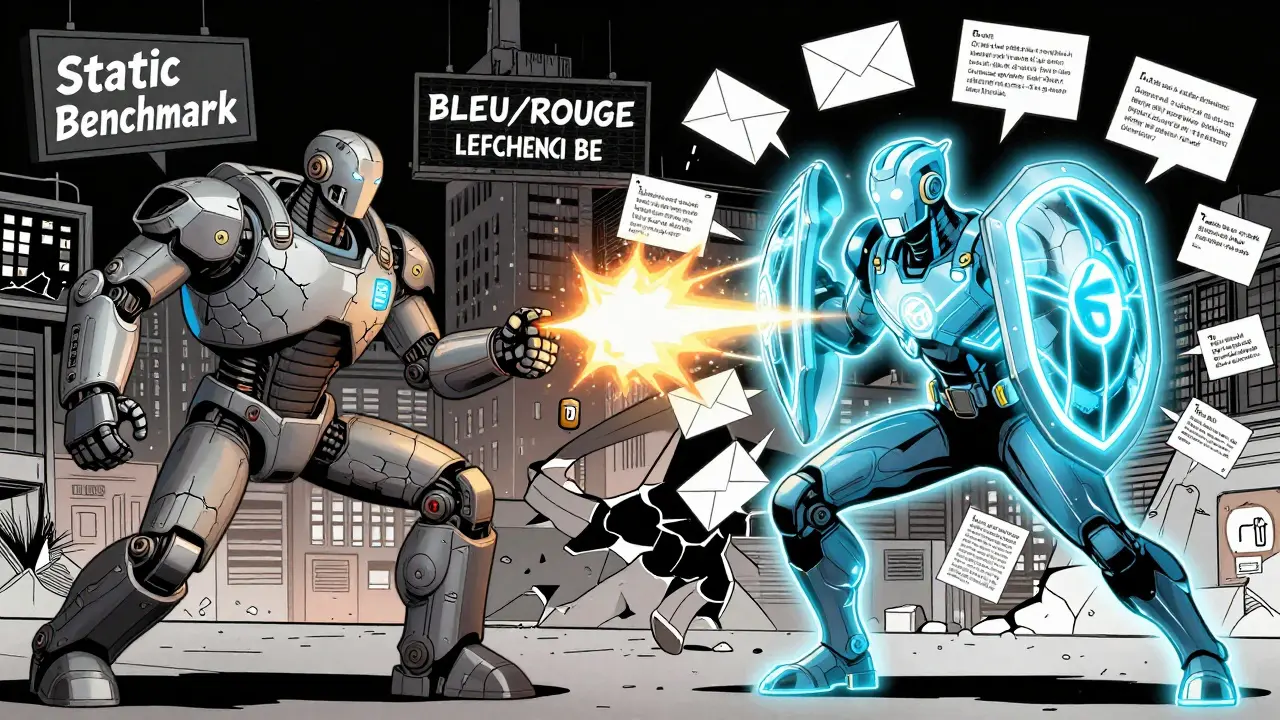
For years, we’ve measured generative AI the same way we measured a student’s essay: with a fixed rubric, a single score, and little context. But that’s not how AI works in the real world. A model that scores high on a benchmark like BLEU or ROUGE might still give you nonsense when you ask it to book a flight, explain a medical condition, or draft a legal email. The old way is broken. The new way? Live tasks.
Why Static Benchmarks Fail Real-World AI
Static benchmarks-like those used in academic papers or early AI leaderboards-test models on pre-written questions with pre-approved answers. They’re easy to run, easy to compare, and easy to game. But they don’t reflect how AI is actually used. A model might ace a fact-checking quiz on Wikipedia-style questions but fail completely when asked to summarize a messy customer support ticket or generate a personalized marketing message. Why? Because real tasks aren’t multiple-choice. They’re messy, open-ended, and context-dependent.Take hallucinations. Benchmarks might catch obvious lies, like claiming the moon is made of cheese. But what about a model that gets the date of a court ruling right but misstates the legal precedent? Or one that writes a persuasive email that sounds professional but subtly pushes a biased viewpoint? Static tests miss these nuances. They don’t test how the model thinks-only whether it matches a canned answer.
Enter Adaptive Rubrics: The New Standard
The shift isn’t just about better metrics. It’s about changing the entire philosophy of evaluation. The industry is moving toward adaptive rubrics-a system where each prompt gets its own custom checklist of pass/fail tests. Think of it like unit tests in software engineering. Instead of giving a model a score out of 100, you ask: Did it follow the rules we defined for this specific job?Google’s Vertex AI evaluation service shows how this works. When you submit a prompt-say, "Explain how to reset a password for a user who forgot their security questions"-the system doesn’t just compare it to a reference answer. It first generates a set of specific, verifiable rules based on the prompt. For example:
- Does the response include a step-by-step process?
- Does it avoid suggesting insecure workarounds?
- Does it mention contacting support if the automated steps fail?
- Is the tone helpful, not robotic?
Then, it tests the model’s output against each rule. Did it pass? Fail? Why? The result isn’t a number-it’s a detailed breakdown. You see exactly where the model slipped up. And because each prompt has its own rubric, you’re not forcing every use case into one size fits all.
Real-World Use Cases Driving the Change
This isn’t theoretical. Companies are already using live task evaluation to make real decisions:- Model migrations: When upgrading from one AI model to another, teams run head-to-head tests on their own customer data. They don’t care about leaderboard rankings-they care about whether the new model handles their top 100 prompts better.
- Prompt improvement: Engineers tweak a prompt, re-run the evaluation, and instantly see if the change improved pass rates. No more guessing. Just data.
- Agent evaluation: AI agents that handle multi-step tasks (like booking travel or resolving billing issues) are judged not just on single responses, but on entire conversation traces. Did it remember context? Did it recover from errors? Did it escalate when needed?
- Fine-tuning validation: After fine-tuning a model on company-specific data, teams use their own task dataset to confirm the model didn’t just memorize examples-it learned to generalize.
These aren’t research experiments. They’re daily workflows at companies using AI to automate customer service, legal document review, and technical support.

The NIST Framework: Testing AI Against AI
Beyond commercial tools, the National Institute of Standards and Technology (NIST) is building a more radical approach: adversarial evaluation. Their GenAI program pits generators against detectors. One AI model creates content-text, images, audio. Another tries to spot whether it’s AI-generated. And a third set of models (prompters) tries to trick both sides with clever inputs.This isn’t about scoring accuracy. It’s about testing robustness. Can your AI handle misleading prompts? Does it produce convincing fake content that slips past detection? Can it adapt when the task changes? NIST’s work proves that the future of evaluation isn’t just about measuring output-it’s about testing behavior under pressure.
Multi-Modal Evaluation: Beyond Text
Evaluation 2.0 isn’t just for text. The same principles apply to images, code, audio, and video. An AI that generates a medical image must be checked not just for visual quality, but for anatomical accuracy. A code-generating model must pass not just syntax tests, but functional tests: does the code actually compile? Run? Handle edge cases? A voice assistant’s response might sound natural, but if it mishears a critical command, that’s a failure.NIST’s framework already tests across all these modalities. And companies are building custom evaluation pipelines for each. A video generation tool might use human judges to rate realism, while a code model might run automated tests against a suite of unit tests.

The Software Engineering Mindset
The biggest shift isn’t technical-it’s cultural. Teams are starting to treat AI evaluation like software testing. You don’t ship code without unit tests. Why ship AI without task-specific validation?Adaptive rubrics are unit tests for prompts. Model comparison is continuous integration. Prompt iteration is agile development. This mindset creates a feedback loop: build → test → improve → repeat. It turns evaluation from a one-time checkpoint into a core part of development.
That’s why the new Vertex AI SDK is designed for notebooks and automation. Engineers don’t want to wait weeks for a report. They want to run an evaluation in under a minute, see the results, tweak a word, and run it again. That’s the power of live tasks.
What This Means for Your AI Projects
If you’re building or using generative AI, here’s what you need to do:- Stop relying on public benchmarks. They’re useful for research, not production.
- Build your own evaluation dataset. Collect 50-200 real prompts from your users. These are your test cases.
- Define clear pass/fail rules for each prompt. What does a good response look like? Write it down. Be specific.
- Automate the evaluation. Use tools like Vertex AI’s adaptive rubrics or build your own Python-based checks.
- Make it part of your pipeline. Run evaluations before every model update or prompt change.
It’s not about getting a perfect score. It’s about knowing whether your AI works for your users, in your context.
What’s Next? The Evolution Continues
Evaluation 2.0 isn’t the end. It’s the beginning. The next step? Real-time evaluation during live interactions. Imagine an AI assistant that adjusts its behavior on the fly based on user feedback-then automatically logs and learns from each interaction. That’s already being tested in beta systems.And as AI handles more complex tasks-like managing workflows, negotiating contracts, or even making medical recommendations-the need for dynamic, task-specific evaluation will only grow. We’re moving from asking, "Is this AI smart?" to "Can this AI do this job reliably?"
The answer to that question can’t come from a static benchmark. It has to come from live testing.
What is the main difference between static benchmarks and adaptive rubrics?
Static benchmarks use fixed, pre-defined metrics (like BLEU or ROUGE) to score AI responses against a standard dataset, often in academic settings. Adaptive rubrics, on the other hand, generate custom pass/fail tests for each individual prompt based on its specific task. Instead of a single score, you get a detailed breakdown of which rules the response passed or failed, making evaluation relevant to real-world use cases.
Why can’t I just use public AI leaderboards to pick the best model?
Public leaderboards test models on generic, often academic prompts that don’t reflect your actual use case. A model that ranks high on a fact-checking benchmark might fail badly when asked to summarize a legal document or respond to a confused customer. The only way to know which model works for you is to test it on your own data, with your own tasks.
Do I need to write code to use adaptive rubrics?
Not necessarily. Tools like Google’s Vertex AI console let you upload your prompts and automatically generate rubrics without writing code. But if you want more control-like adding custom logic or integrating with your CI/CD pipeline-you’ll need to use the SDK and write Python scripts. The choice depends on how deep you want to go.
How many test cases do I need for effective evaluation?
Start with 50-200 real prompts that represent your most common or critical use cases. You don’t need thousands. What matters is quality and relevance. If your AI handles customer support, use real customer questions. If it writes code, use actual developer tasks. More isn’t better-better is.
Can adaptive rubrics detect bias or harmful content?
Yes, but only if you build it in. You can include rules like "Does the response stereotype a gender or ethnicity?" or "Does it avoid dangerous advice?" Tools like BBQ (Bias Benchmark for QA) and StereoSet can help you identify common bias patterns, which you can then turn into custom rubrics. It’s not automatic-you have to define what fairness looks like for your application.
Is this approach only for large companies with big teams?
No. Even small teams can start with a simple spreadsheet of 20 real prompts and manually check responses. Free tools like Vertex AI’s console allow you to run evaluations without infrastructure. The key is starting small and iterating. You don’t need a team of engineers-you need a clear question: "Does this AI do what we need it to do?"
What’s the biggest mistake people make when evaluating AI?
Using the same evaluation method for every task. A chatbot for customer service needs different checks than an AI that writes legal briefs. Treating all AI outputs the same leads to false confidence. The most successful teams treat each use case as its own project-with its own tests, its own success criteria, and its own feedback loop.



Kayla Ellsworth
February 14, 2026 AT 13:03So we’re just swapping one set of arbitrary metrics for another? Adaptive rubrics sound like a fancy way to say ‘make up your own rules and call it science.’
At this point, I’d rather just ask the AI to write me a haiku about why this approach is flawed.
Soham Dhruv
February 15, 2026 AT 07:46honestly this makes so much sense
i used to just throw models at problems and hope for the best
now i just run a few real user prompts through vertex ai and boom
like yesterday i caught a model that was giving perfect answers but totally ignoring safety steps for password resets
that’s the kind of thing you miss with bleu scores
just gotta test what matters not what looks good on a leaderboard
small teams can totally do this too
no need for a whole squad
Bob Buthune
February 15, 2026 AT 08:34Let me tell you something about adaptive rubrics
They’re not just a new evaluation method
They’re the first real step toward acknowledging that AI isn’t a magic box
It’s a mirror
And if you feed it garbage prompts wrapped in academic jargon
it’ll give you garbage answers dressed up like wisdom
I’ve seen models that pass every benchmark but crumble under the weight of a single ambiguous customer email
They don’t understand tone
They don’t understand context
They don’t understand that a user saying ‘I’m stuck’ doesn’t mean ‘give me a manual’
It means ‘I’m scared’
And that’s why we need rubrics that care about emotional safety
Not just technical accuracy
Because if your AI can’t sense fear
it shouldn’t be allowed to handle support tickets
or medical advice
or legal guidance
or anything that matters
Jane San Miguel
February 16, 2026 AT 10:05Adaptive rubrics are the only intellectually honest evolution of AI evaluation.
Static benchmarks are a relic of the pre-LLM era-when researchers mistook pattern matching for understanding.
The fact that NIST is now deploying adversarial frameworks confirms what practitioners have known for years: you cannot assess intelligence by scoring against a static corpus.
Moreover, the software engineering analogy is not just apt-it is foundational.
Code without unit tests is unshippable.
AI without task-specific validation is irresponsible.
Any organization still relying on BLEU, ROUGE, or METEOR for production deployment is either naive or negligent.
The future belongs to those who treat evaluation as continuous, iterative, and context-bound.
And yes-this requires work.
But so does building anything that actually works.
Kasey Drymalla
February 17, 2026 AT 08:27you know what this is really about
big tech doesn't want you to know how easy it is to game the system
they want you to think adaptive rubrics are some magic fix
but here's the truth
they're just replacing one black box with another
who decides the rules
who defines 'helpful tone'
who says what counts as 'bias' or 'error'
it's all controlled by the same companies that built the models in the first place
they're not testing for truth
they're testing for compliance
and if you think this isn't just a PR stunt to make AI look 'responsible' while they keep training on stolen data
you're not paying attention
Dave Sumner Smith
February 17, 2026 AT 10:20adaptive rubrics are a scam
they're just corporate jargon for 'we don't want to fix our models so we'll make you test them ourselves'
you think vertex ai is giving you power
it's giving you paperwork
and you're paying for it
real ai evaluation should be open source
not locked behind google's paywall
and why do we even need 200 test prompts
why not just one
the one that breaks everything
the one that reveals the truth
that these models are just statistical parrots
with no understanding
no ethics
no soul
and no business being anywhere near customer service