
Most governance programs fail not because they lack rules, but because they lack measurable outcomes. You can have a perfect compliance manual gathering dust on a server, but if you cannot quantify how well it is followed, you are flying blind. The real value of Governance the framework of rules, practices, and processes by which an organization is directed and controlled lies in its ability to protect the business while enabling speed. To do that, you need to move beyond simple checklists and track three specific metrics: Policy Adherence, Review Coverage, and Mean Time to Resolution (MTTR). These aren't just bureaucratic hurdles; they are the vital signs of your organizational health.
In 2026, the landscape has shifted. Regulatory bodies like the SEC and international standards like ISO 37000 no longer accept "we tried" as a defense. They want evidence. This article breaks down exactly how to measure these three pillars so you can prove your governance framework is working, not just existing.
Quick Summary / Key Takeaways
- Policy Adherence should target 95%+ compliance; organizations below 75% face 3.2x more regulatory penalties.
- Review Coverage requires quarterly cycles to reduce compliance gaps by 63% compared to annual reviews.
- MTTR (Mean Time to Resolution) for governance issues should be under 15 days; top performers keep it under 24 hours for critical incidents.
- Automated tracking tools reduce measurement fragmentation, which affects 61% of organizations using manual methods.
- Linking governance KPIs to executive compensation drives 41% higher adoption rates in mid-market firms.
Why Traditional Compliance Metrics Are Failing
For years, many teams treated governance as a binary state: compliant or non-compliant. This approach is dangerously outdated. A company can be technically compliant with a regulation today and completely vulnerable tomorrow if their internal controls degrade. The shift in recent years, driven by frameworks like COSO and emerging AI-driven risk models, is toward continuous monitoring. You need metrics that show trends, not just snapshots.
Consider the difference between counting the number of policies written versus measuring how often those policies are actually applied. Writing fifty policies means nothing if employees ignore forty-five of them. This is where GRC (Governance, Risk, and Compliance) an integrated approach to managing governance, risk, and compliance functions KPIs come into play. They transform abstract rules into concrete data points that leadership can act on. Without this data, you are guessing where your risks lie.
Measuring Policy Adherence: Beyond Training Completion
Policy Adherence Rate is arguably the most misunderstood metric in governance. Many organizations confuse training completion with actual adherence. Just because an employee clicked "I agree" on a security awareness module doesn't mean they are following the data handling protocols described in it. True adherence measures the gap between expected behavior and actual behavior.
To get an accurate read, you must look at exception rates. According to industry benchmarks from SalusGRC, top-performing organizations maintain policy exception rates below 5%. The industry average sits much higher, between 15% and 20%. If your exception rate is high, it usually signals one of two things: the policy is too restrictive for daily work, or enforcement is weak.
Here is how to structure your adherence measurement:
- Define Clear Behaviors: Translate vague policy language into observable actions. Instead of "handle data securely," use "encrypt all files containing PII before email transmission."
- Automate Detection: Use governance platforms to flag violations automatically. Manual audits only catch a fraction of issues.
- Track Exceptions: Monitor every instance where a rule is bent. High exception volumes indicate a broken process, not necessarily bad actors.
Data shows that organizations maintaining over 90% policy adherence experience 47% fewer compliance incidents. This isn't about micromanagement; it's about creating a culture where the right way to work is also the easiest way to work.
Review Coverage: Ensuring Policies Stay Relevant
Policies are living documents. In a fast-moving tech environment, a policy written in 2023 might be obsolete by 2026 due to new regulations or technology shifts. Review Coverage measures the extent to which your governance policies are systematically reviewed, updated, and enforced. It answers the question: "Are we governing what matters, and are our rules current?"
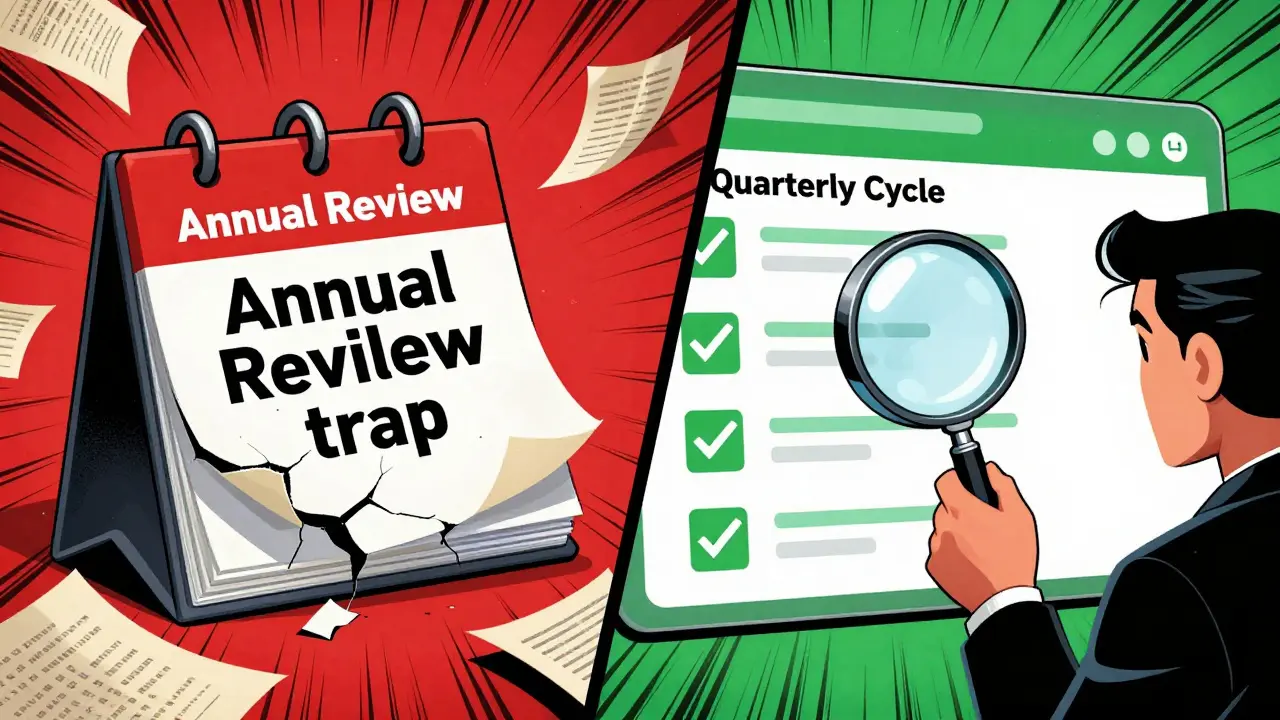
The biggest pitfall here is the "annual review" trap. Most companies schedule policy reviews once a year, often during budget season when everyone is distracted. Research indicates that organizations conducting quarterly reviews reduce compliance gaps by 63% compared to those sticking to annual cycles. Quarterly reviews allow you to catch drift early, before it becomes a major audit finding.
When calculating Review Coverage, focus on two sub-metrics:
- Update Frequency: What percentage of policies were reviewed within the last 12 months?
- Enforcement Consistency: Are the same policies being enforced across all departments? Inconsistent enforcement creates legal liability and employee confusion.
For example, a healthcare provider might find that their IT department updates access control policies quarterly, while HR still uses annual reviews. This mismatch creates a vulnerability window. Your goal should be 100% coverage with consistent update intervals aligned to risk levels. High-risk areas, like financial reporting or patient data privacy, need monthly or quarterly checks. Low-risk administrative policies can wait six months.
MTTR in Governance: Speed Is Safety
Mean Time to Resolution (MTTR) is a term borrowed from IT operations, but it is critical for governance. In this context, MTTR measures the average time between identifying a governance issue-such as a policy violation, an audit finding, or a control failure-and fully resolving it. Speed matters because prolonged exposure to risk increases the potential impact of a breach or penalty.
Industry averages for governance MTTR hover around 45 days. That is over a month for a known issue to remain open. Top performers, however, keep this number under 15 days, and for critical security or compliance incidents, under 24 hours. The disparity is often due to process bottlenecks rather than technical limitations.
To improve your MTTR, you need to streamline the remediation workflow:
- Immediate Triage: Classify issues by severity upon discovery. Not all violations require the same response depth.
- Clear Ownership: Assign a single owner to each remediation task. Shared responsibility often leads to shared neglect.
- Root Cause Analysis: Don't just fix the symptom. If a user repeatedly violates a data policy, is it a training issue, a tool usability issue, or a malicious act?
Organizations with MTTR below 24 hours for critical incidents see 82% fewer repeat incidents. This suggests that rapid resolution helps reinforce correct behaviors and closes loopholes before they can be exploited again.
| KPI Metric | Average Industry Performance | Top Performer Benchmark | Key Driver for Improvement |
|---|---|---|---|
| Policy Adherence Rate | 75-85% | 95%+ | Automated monitoring & clear exceptions |
| Policy Exception Rate | 15-20% | <5% | Regular policy simplification |
| Review Cycle Frequency | Annual | Quarterly (High Risk) | Risk-based scheduling |
| MTTR (General) | 45 Days | <15 Days | Streamlined remediation workflows |
| MTTR (Critical) | 72 Hours | <24 Hours | Dedicated incident response team |

Implementing a Hybrid KPI Framework
You might notice a tension in modern governance advice. On one hand, traditionalists argue that strict compliance metrics are non-negotiable. On the other, forward-thinking leaders push for "value realization" metrics that tie governance to business outcomes. The best approach in 2026 is a hybrid model.
Start with the foundational metrics: Policy Adherence, Review Coverage, and MTTR. These are your hygiene factors. If you cannot demonstrate basic compliance, no amount of strategic value talk will save you in an audit. Once these are stable, layer in business-value indicators. For instance, link your data governance adherence to customer trust scores or operational efficiency gains.
Implementation typically takes 8-12 weeks for mature organizations. The biggest hurdle is not technology-it's alignment. Seventy percent of implementation time is spent defining metrics and getting stakeholder buy-in. Ensure that your finance, legal, and IT teams agree on what constitutes a "violation" and how "resolution" is defined. Inconsistent definitions lead to fragmented data, which renders your KPIs useless.
Use automated governance platforms to handle the heavy lifting. Tools that integrate with your HR, IT, and compliance systems can provide real-time dashboards. Look for platforms that offer clear calculation methodologies, as transparency builds trust in the numbers. Avoid siloed solutions that require manual data entry, as human error will corrupt your metrics quickly.
Troubleshooting Common Pitfalls
If your KPIs aren't moving the needle, check for these common issues:
- Vague Definitions: If "adherence" means different things to different managers, you have no metric. Standardize definitions globally.
- Lack of Executive Sponsorship: Governance fails when it is seen as a middle-management burden. Tie KPI performance to executive compensation to drive accountability.
- Ignoring Root Causes: Fixing symptoms without addressing underlying process flaws leads to recurring violations. Use MTTR data to identify systemic weaknesses.
- Over-Reliance on Self-Reporting: Employees may inflate their adherence scores. Use independent audits and automated logs to verify self-reported data.
Remember, the goal is not perfection. The goal is visibility. By tracking Policy Adherence, Review Coverage, and MTTR, you gain the insight needed to make informed decisions, mitigate risks proactively, and demonstrate the tangible value of your governance program to stakeholders.
What is the ideal Policy Adherence Rate for most industries?
Aim for 95% or higher. Organizations maintaining above 90% adherence see significantly fewer compliance incidents and lower regulatory penalties. Rates below 75% are considered high-risk and often correlate with increased legal exposure.
How often should governance policies be reviewed?
High-risk policies should be reviewed quarterly. Low-risk administrative policies can be reviewed annually. Quarterly reviews for critical areas reduce compliance gaps by up to 63% compared to annual cycles.
What does MTTR stand for in governance?
MTTR stands for Mean Time to Resolution. It measures the average time taken to identify and fully resolve a governance issue, such as a policy violation or audit finding. Top performers keep general MTTR under 15 days and critical MTTR under 24 hours.
Why is training completion not enough to measure policy adherence?
Training completion only proves awareness, not behavior. An employee can complete a course and still violate policies daily. True adherence is measured by observing actual behaviors, tracking exceptions, and using automated monitoring to detect violations in real-time.
How can I improve my organization's MTTR?
Improve MTTR by implementing immediate triage processes, assigning clear ownership for each remediation task, and conducting root cause analyses. Streamlining workflows and removing approval bottlenecks also significantly reduces resolution times.



Lauren Saunders
May 14, 2026 AT 23:46Oh, please. The notion that 'measurable outcomes' are the panacea for governance is a classic technocratic fallacy that ignores the nuanced reality of organizational culture. You are treating human behavior like a machine code error to be debugged, rather than a complex social dynamic. Policy adherence rates are vanity metrics unless you account for the quality of the policy itself. A poorly written policy will have low adherence not because employees are incompetent, but because the rule is absurd. This article is just corporate speak repackaged as wisdom.
sonny dirgantara
May 15, 2026 AT 00:10i think this makes sence but its hard to track all that stuff manually. we try to do it with spreadsheets and it gets messy real fast. maybe there is a better way?
Andrew Nashaat
May 15, 2026 AT 18:07It is absolutely imperative that we recognize the moral decay inherent in ignoring these metrics!!! When an organization fails to track Policy Adherence, they are essentially condoning negligence!!! It is not merely a bureaucratic hurdle; it is an ethical failing!!! We must demand 95%+ compliance because anything less is a betrayal of the stakeholders!!! Do not let your team slide into the abyss of mediocrity!!! Fix your MTTR or face the consequences of your inaction!!!
Gina Grub
May 16, 2026 AT 09:08the whole concept of quarterly reviews is just another layer of bureaucratic bloat designed to keep consultants employed. look at the data fragmentation issues mentioned. if your tools cant integrate properly then your kpis are garbage. stop pretending you can measure culture with numbers. its all just noise until you fix the underlying process architecture which most c-suites refuse to touch because it threatens their ego.
Nathan Jimerson
May 16, 2026 AT 16:54This is a fantastic perspective on modern governance frameworks. I believe that focusing on continuous monitoring rather than binary compliance states is the key to building a resilient organization. By tracking exception rates and streamlining remediation workflows, companies can create a more transparent and accountable environment. It is encouraging to see that top performers are achieving such rapid resolution times for critical incidents. This approach definitely aligns with best practices for operational efficiency.
Sandy Pan
May 18, 2026 AT 16:53We must ask ourselves: what does it truly mean to govern? Is it merely the enforcement of rules, or is it the cultivation of a collective consciousness regarding responsibility? The shift from static compliance to dynamic monitoring suggests a deeper philosophical evolution in how we view risk. Perhaps the true metric is not adherence, but the willingness of individuals to internalize the values behind the policies. Without this internalization, any KPI is just a hollow shell.
Eric Etienne
May 19, 2026 AT 15:57Another generic listicle about governance. Everyone already knows they need to track things. Nobody wants to read another word about MTTR. Just give us the tool that fixes it automatically instead of writing a blog post about why manual audits suck. Lazy content.