
Imagine spending two hours every day typing notes instead of treating patients. For many physicians today, this isn't a hypothetical-it's Tuesday. A 2023 Mayo Clinic study confirmed that doctors spend up to two hours on administrative tasks beyond their clinical shifts. Enter Large Language Models (LLMs). These AI systems, once experimental curiosities, are now reshaping how healthcare providers handle paperwork and prioritize patient care. But are they ready for prime time? The short answer is yes, but with significant caveats regarding accuracy, bias, and integration.
The core promise of LLMs in medicine lies in two specific areas: automating clinical documentation and enhancing triage decisions. While general-purpose models like GPT-4 grab headlines, specialized healthcare LLMs such as Med-PaLM 2 and BioBERT are doing the heavy lifting in hospitals. By October 2026, adoption has grown, yet only about 15% of US hospitals fully integrate these tools into daily workflows. Why the gap? Because implementing AI in healthcare isn't just about code; it's about trust, safety, and seamless workflow integration.
Alleviating the Documentation Burden
Physician burnout is often driven by the "pajama time" spent catching up on charts after dinner. Nuance DAX Copilot, powered by Microsoft Azure, exemplifies the current state-of-the-art in ambient listening technology. It listens to the doctor-patient conversation and drafts a clinical note automatically. In pilot studies at Massachusetts General Hospital, 78% of participating physicians reported saving an average of 1.8 hours per shift. That’s nearly two extra hours for family or sleep.
However, speed shouldn't come at the cost of accuracy. A JAMA Network Open study found that while GPT-4-based assistants reduced note-writing time by 48%, they still required human oversight. Physicians noted instances where the AI "hallucinated" details-adding medications never mentioned or misinterpreting symptoms. One emergency room doctor reported a near-miss when the system included a drug interaction warning for a medication the patient wasn't taking. This highlights a critical rule: AI drafts, humans decide. The technology excels at structure and syntax but lacks true clinical judgment.
Triage Accuracy and the Human Factor
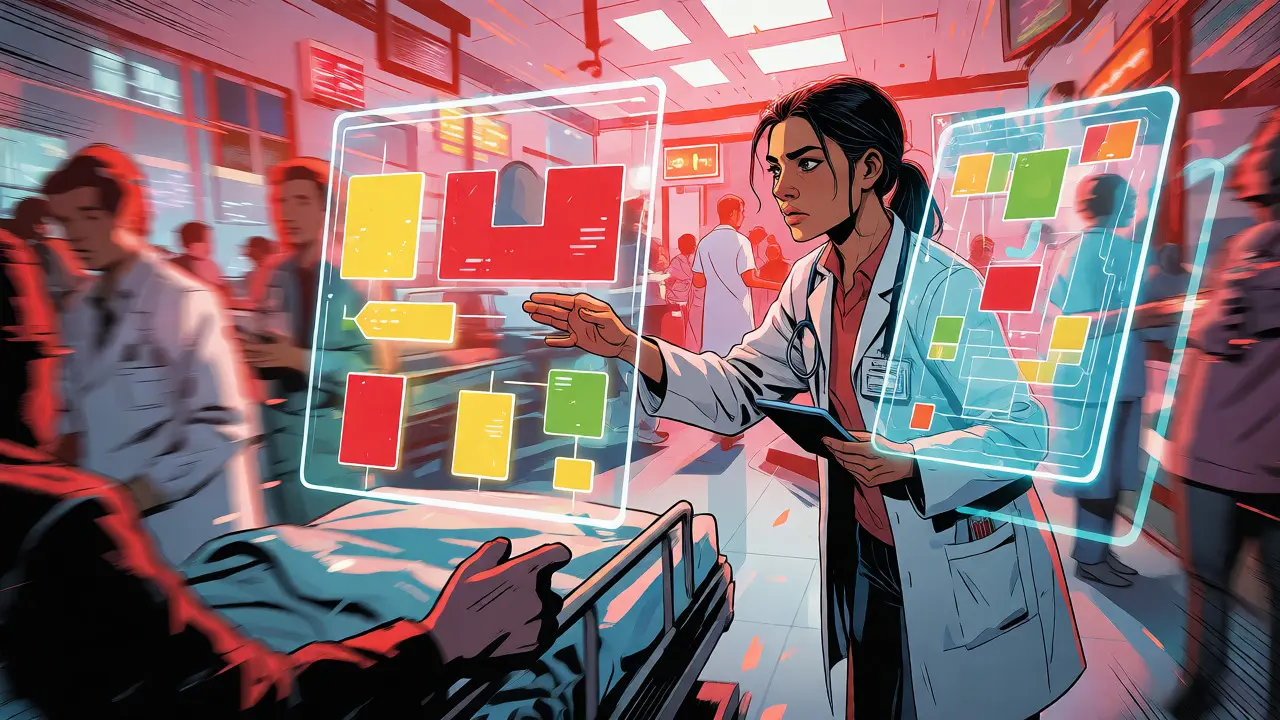
In emergency departments, minutes matter. Traditional triage relies on nurses assessing vital signs and patient complaints against protocols like the Manchester Triage System. Can AI do this better? Research from JMIR suggests mixed results. When tested against professional raters, GPT-4 achieved a kappa agreement score of 0.67, which is substantial but not perfect. Interestingly, it performed comparably to untrained doctors (kappa=0.68) but fell short of expert nurses.
| Metric | GPT-3.5 | GPT-4 | Human Expert |
|---|---|---|---|
| Triage Agreement (Kappa) | 0.54 | 0.67 | 1.00 (Consensus) |
| Documentation Time Reduction | 29% | 48% | N/A (Baseline) |
| Overtriage Rate | High | 23% | Low |
| Rare Condition Handling | Poor | Good | Variable |
A key finding is the tendency toward overtriage. LLMs often assign higher urgency than necessary in 23% of cases. While this might seem safer, it can clog emergency rooms with low-acuity patients, delaying care for those truly critical. Conversely, human clinicians tend to undertriage more often. The ideal future isn't replacing nurses with robots but using AI as a second set of eyes to flag potential oversights before finalizing the priority level.
Technical Foundations and Limitations
How do these models actually work? Most healthcare LLMs are built on transformer architectures like BERT or GPT, fine-tuned on billions of tokens of medical text. This includes de-identified electronic health records (EHRs), clinical guidelines, and medical literature. Specialized models like BioBERT incorporate biomedical ontologies, giving them a deeper understanding of relationships between diseases and treatments.
Despite these advances, limitations persist. Performance drops significantly when encountering rare conditions not well-represented in training data-a phenomenon known as distribution shift. Studies show accuracy can fall by 12-18% in these scenarios. Furthermore, missing data poses a challenge. If vital signs aren't available during a telehealth consultation, model accuracy decreases by 22%. Integration with EHR systems via HL7 FHIR standards remains a bottleneck, with only 37% of implementations achieving seamless two-way data exchange.
Implementation Challenges and Bias
Deploying AI in a hospital isn't as simple as installing software. It requires cultural change. Hospitals with dedicated "clinician champions" saw 3.2 times higher usage rates of AI tools compared to those without. The learning curve typically spans 2-3 weeks, with common pitfalls including poor prompt phrasing and excessive editing time initially.
Perhaps the most concerning issue is bias. An arXiv study revealed that LLM triage performance varied by 14.7 percentage points across racial groups. Black and Hispanic patients systematically received lower urgency scores than clinically warranted. This isn't just a technical glitch; it's a safety risk. Without rigorous validation and diverse training data, AI could exacerbate existing health disparities rather than alleviate them.
The Future of Hybrid Workflows
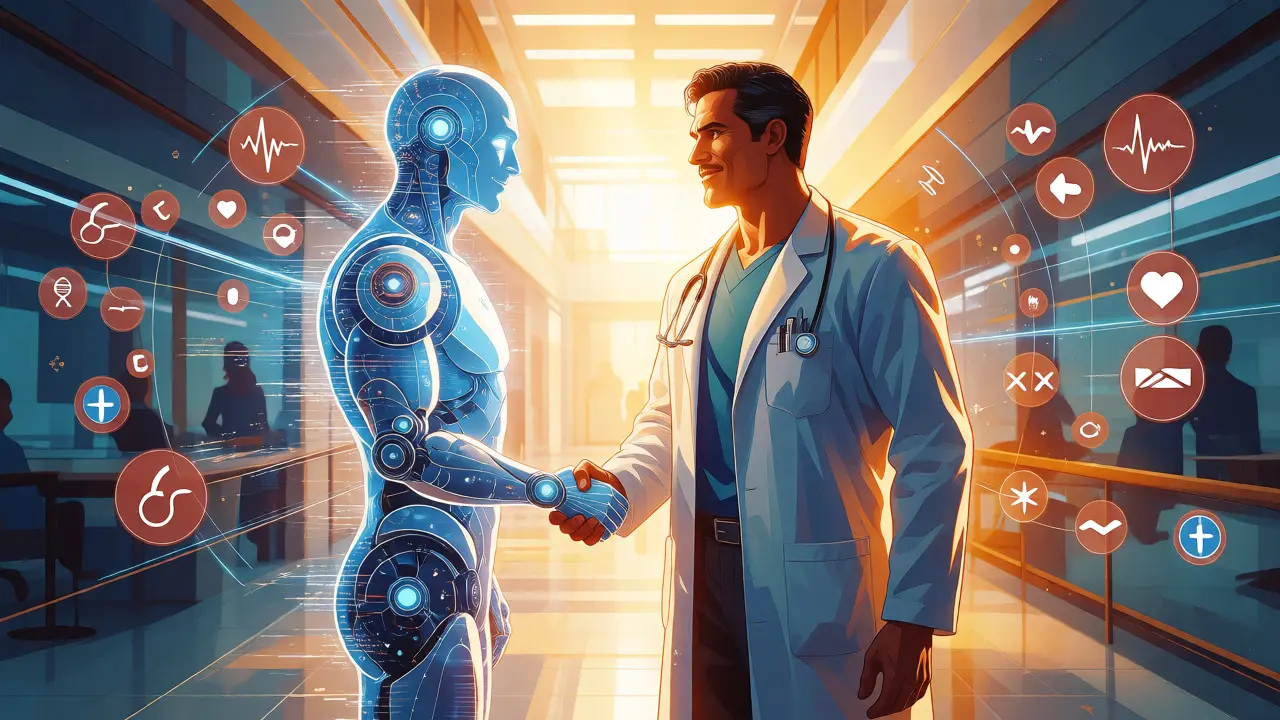
The path forward isn't full automation but hybrid human-AI workflows. In this model, LLMs handle initial documentation and sorting, while clinicians focus on validation and complex decision-making. This approach maintained 99.2% accuracy in recent emergency department studies while cutting documentation time in half. Companies like Amazon Web Services with HealthScribe and Google Health with Med-PaLM 3 are pushing boundaries, aiming for multimodal capabilities that analyze both text and medical imaging.
Regulatory landscapes are also shifting. The FDA classifies most healthcare LLMs as Class II medical devices, requiring clearance. Meanwhile, the EU’s AI Act imposes stricter validation requirements. As we move through 2026, expect tighter regulations and a stronger emphasis on explainability. Doctors need to know why an AI suggested a certain diagnosis or triage level, not just that it did.
Do Large Language Models replace doctors?
No, they do not. LLMs act as assistive tools that reduce administrative burden and support decision-making. They lack the holistic judgment, empathy, and ethical reasoning of human clinicians. Current best practices involve AI drafting notes or suggesting triage levels, which are then reviewed and finalized by medical professionals.
What is the biggest risk of using AI for medical documentation?
The primary risk is "hallucination," where the AI generates plausible but incorrect information, such as adding a medication the patient didn't take. This can lead to dangerous drug interactions if not caught. Rigorous human review of all AI-generated content is essential to mitigate this risk.
How accurate are LLMs in emergency triage?
Accuracy varies by model. Advanced models like GPT-4 have shown substantial agreement with professional nurses (kappa score ~0.67). However, they tend to overtriage (assign higher urgency than needed) in about 23% of cases. They are generally less prone to missing critical urgency than untrained humans but still require nurse verification.
Why is adoption of healthcare LLMs slow in some hospitals?
Barriers include high integration costs (averaging $287,000 per system), concerns about HIPAA compliance and data privacy, and the complexity of integrating with legacy Electronic Health Record (EHR) systems. Additionally, staff resistance due to fear of job displacement or distrust in AI accuracy plays a role.
Are there biases in healthcare AI models?
Yes. Studies have shown that LLMs can exhibit racial biases, with Black and Hispanic patients sometimes receiving lower urgency scores in triage scenarios. This stems from biases present in the historical training data. Continuous monitoring and algorithmic fairness checks are required to address these disparities.


Anthony .
October 31, 2026 AT 09:10It is honestly refreshing to see this tech finally stepping in to save our sanity. 🌿 We have been drowning in paperwork for so long that I almost forgot what it felt like to actually look a patient in the eye without worrying about the clock ticking down on my charting quota. The idea of gaining back nearly two hours a day is not just convenient; it is a lifeline for physician well-being and, by extension, better care for everyone involved. 🙏
I think the key here is maintaining that human connection while letting the AI handle the mundane syntax and structure. It feels like we are finally moving toward a model where technology serves us rather than controlling us, which is exactly the kind of inclusive evolution we need in healthcare. Let's keep pushing for these tools to be intuitive enough that they don't add another layer of stress during the transition period. 🤝✨