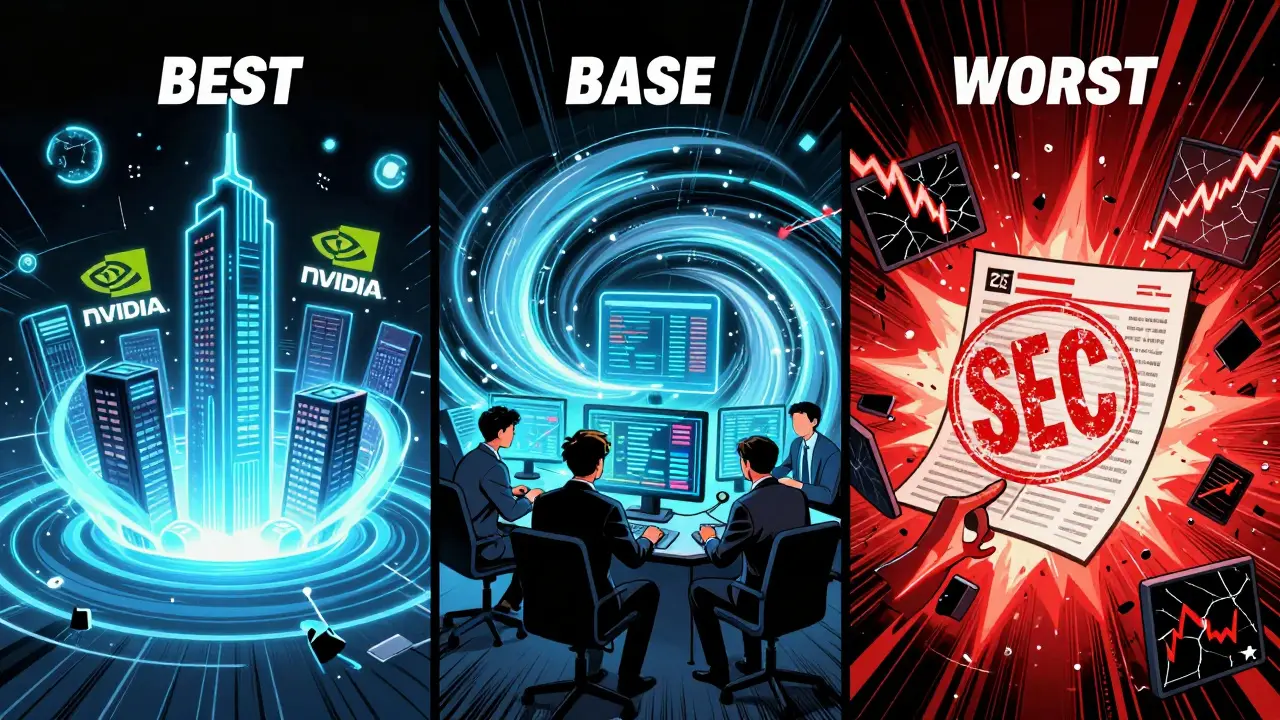
When you’re putting money into generative AI, you’re not just betting on technology-you’re betting on how it will change markets, companies, and returns. But no one knows exactly how fast or far it will go. That’s where scenario modeling comes in. Instead of guessing, smart investors use generative AI to test dozens of possible futures-best case, base case, worst case-and see which ones make sense for their portfolio.
Why Traditional Models Fail for AI Investments
Five years ago, investment teams ran scenario analysis with spreadsheets. They’d pick three outcomes: optimistic, realistic, and pessimistic. Maybe they changed interest rates, sales growth, or market share. Simple. Safe. But generative AI doesn’t work like that.AI doesn’t just move numbers. It learns from news, earnings calls, social media, supply chain disruptions, and policy shifts-all at once. A traditional model might assume a 5% drop in solar panel demand if tariffs rise. But generative AI can spot that a new California law, combined with a tweet from a major battery manufacturer, and a factory fire in Malaysia, could slash demand by 18%-and that’s just one of 2,000 scenarios it runs overnight.
Most firms still use Monte Carlo simulations or basic bootstrapping. Those methods assume linear relationships. AI doesn’t. It finds hidden connections: how sentiment on Reddit affects venture funding, or how a single SEC comment can ripple through renewable energy stocks. If you’re still using old-school models for AI investments, you’re flying blind.
How Generative AI Builds Scenarios
Generative AI doesn’t just predict. It creates. It uses models like GANs, diffusion networks, and fine-tuned LLMs to generate synthetic financial data that mimics real-world behavior. Think of it like a video game engine for finance-each scenario is a different world with its own rules.Here’s how it works in practice:
- Feed the system clean, structured data: Bloomberg feeds, FactSet earnings, SEC filings, and company disclosures.
- Add unstructured data: News headlines, analyst transcripts, Twitter trends, and even patent filings.
- Let the AI generate thousands of plausible futures-each one a variation of economic conditions, regulatory shifts, tech breakthroughs, and competitor moves.
- Run each scenario through portfolio models to see how assets perform under stress.
- Filter for the most probable outcomes: best, base, and worst cases.
At MDOTM, their AI platform runs 5,000 scenarios per client portfolio every week. It doesn’t just say “AI will grow 30%.” It says: “If China bans AI chip exports in Q3 and U.S. interest rates stay above 5%, then semiconductor stocks drop 12%, but AI-driven logistics firms rise 19%.” That’s actionable insight.
Best Case: The 65% Adoption Scenario
This is the dream scenario. By 2027, 65% of enterprises adopt generative AI for core operations. Productivity jumps. Costs fall. New markets open. According to Oxford Economics, this path could add $237 billion annually to global investment returns.In this world:
- Companies like NVIDIA and Microsoft dominate as AI infrastructure becomes as essential as electricity.
- Startups with proprietary AI models raise billions-think of a new OpenAI, but focused on healthcare diagnostics or legal document automation.
- Regulators step in with clear rules, not bans. The SEC’s Regulation AI is in place by 2026, giving firms confidence to invest.
- AI-driven scenario modeling becomes standard in hedge funds and asset managers. Firms that don’t use it lose market share.
Acme Solar Technologies saw this play out in 2024. Their AI model predicted that a combination of IRA tax credits, supply chain shifts, and falling battery costs would boost solar adoption 40% faster than expected. They doubled down-and outperformed the industry by 22% in risk-adjusted returns.

Base Case: The 45% Adoption Scenario
This is the most likely path. Adoption grows steadily, but not explosively. Regulatory hurdles slow things. Integration costs eat into margins. Talent shortages persist.In this world:
- Only large firms with $1B+ in assets fully implement AI scenario modeling. Mid-sized firms struggle with data quality and legacy systems.
- AI tools become common, but not magical. They help analysts work faster, but don’t replace them.
- AI-generated insights are validated rigorously. Firms that skip validation (like some hedge funds in late 2024) see 15-20% underperformance during volatility.
- Investors focus on companies with proven AI use cases-not hype. Revenue tied to AI solutions becomes a key metric.
This is where most investors should plan. It’s not glamorous, but it’s realistic. Bridgewise found that 82% of firms that started with pilot projects succeeded here. Those that tried to go enterprise-wide overnight? Only 31% made it.
Worst Case: The 25% Adoption Scenario
This is the nightmare. AI adoption stalls. Regulations crush innovation. Public trust collapses. A few high-profile failures trigger backlash.In this world:
- Regulators ban AI in portfolio decisions unless fully explainable. Audit trails become mandatory, but too slow to be useful.
- Model hallucinations cause real losses. A financial firm bets on a synthetic earnings report that never happened. The SEC fines them $200 million.
- Data quality becomes the biggest bottleneck. 63% of failed AI projects trace back to dirty or biased data.
- Investors flee AI stocks. Valuations collapse. Startups fold. The sector enters a multi-year correction.
Remember the Reddit thread from December 2024? A mid-sized hedge fund used synthetic data without validation. Their AI “discovered” a trend in lithium demand that didn’t exist. They over-invested. Lost 18% in one quarter. They’re still recovering.
What You Need to Get Started
You don’t need a $50 million AI lab. But you do need discipline.Here’s what works:
- Start small. Pick one asset class. Test AI on your tech stocks or your renewable energy holdings. Don’t try to model everything.
- Fix your data first. If your financial data is messy, AI will just make bad predictions faster. Clean, structured data is non-negotiable.
- Partner with compliance early. The SEC’s February 2025 guidance requires audit trails and explainable reasoning. Don’t wait until you’re under investigation.
- Train your team. Quant analysts need 4-6 weeks to learn AI modeling. Portfolio managers need 2-3 weeks to interpret results. No shortcuts.
Companies that followed this path-like Goldman Sachs with Marcus and BlackRock with Aladdin-saw 70% faster portfolio iteration. That’s not magic. That’s methodology.

Who’s Winning and Who’s Losing
Adoption isn’t equal. Hedge funds lead at 67%. Private equity is at 52%. Traditional long-only funds? Just 41%. Why? Because hedge funds live in volatility. They need to see 10,000 outcomes fast. Long-only funds still think in quarters, not scenarios.Here’s the truth: If you’re not using AI scenario modeling by 2026, you’re at a structural disadvantage. The data isn’t optional anymore. The CFA Institute reports a 43% shortage of professionals who understand both finance and AI. If you can’t hire them, partner with a platform like NVIDIA’s NIM or MDOTM’s SMA system.
The Future: What Comes Next
By 2027, AI scenario modeling won’t be a tool. It’ll be the baseline. Every investment decision will come with three scenarios generated by AI-and a human analyst’s judgment on top.Three trends are coming:
- Regulation standardizes validation. By 2026, every firm must prove their AI models aren’t hallucinating.
- Real-time data integration. AI won’t wait for quarterly reports. It’ll ingest stock ticks, Fed speeches, and weather reports as they happen.
- Scenario marketplaces. By 2028, firms will share validated AI scenarios with each other-like a library of financial futures-while keeping their data private through federated learning.
The goal isn’t to replace humans. It’s to amplify them. As Goldman Sachs put it in January 2025: “Human-AI collaboration is the optimal approach.” AI handles the math. You handle the strategy.
Final Thought: Don’t Bet on AI. Bet on the Right Scenarios.
Generative AI doesn’t guarantee returns. It reveals possibilities. The best investors aren’t the ones who believe in AI the most. They’re the ones who test it the most. They build best, base, and worst cases-and then they wait. Not for AI to be perfect. But for the right scenario to unfold.That’s how you win.
What’s the difference between generative AI scenario modeling and traditional Monte Carlo simulation?
Traditional Monte Carlo simulation uses fixed assumptions and random sampling to test a limited number of outcomes-usually under 100. Generative AI, by contrast, uses large language models and synthetic data to generate thousands of realistic, complex scenarios based on real-world unstructured data like news, earnings calls, and social sentiment. It finds hidden correlations humans miss and adapts in real time, while Monte Carlo assumes linear relationships and static inputs.
Can I use generative AI for personal investing, or is it only for institutions?
You can. Platforms like Betterment began offering simplified AI scenario tools to retail investors in Q2 2025. These tools don’t run 5,000 scenarios like hedge funds-but they do show you best, base, and worst-case outcomes for your portfolio based on AI-driven market trends. For individual investors, it’s about awareness, not automation. Use it to stress-test your holdings, not to replace your judgment.
How do I know if an AI scenario model is reliable?
Look for three things: First, does the firm use both synthetic and real data in validation? Second, can they show you an audit trail of how each scenario was generated? Third, have they tested the model against historical market events-like the 2023 banking crisis or the 2024 semiconductor supply shock? If they can’t answer these, walk away. Bridgewise found that 63% of failures came from poor data quality, not bad algorithms.
What’s the biggest mistake investors make with AI scenario modeling?
Over-relying on AI without human oversight. Some hedge funds in late 2024 trusted AI-generated trends that didn’t exist-like fake demand signals in lithium markets. They lost 15-20% of portfolio value. AI is a tool, not a crystal ball. Always pair its output with experienced judgment. The CFA Institute calls this “human-in-the-loop” validation-and it’s mandatory for long-term success.
Is generative AI scenario modeling worth the cost?
For institutions with over $1B in assets, yes. Firms that implemented it saw 70% faster portfolio iteration and 12-22% higher risk-adjusted returns, according to case studies from Acme Solar and MDOTM. For smaller firms, start with a pilot. The cost isn’t just in software-it’s in data cleanup, training, and compliance. But if you’re investing in AI companies, not using scenario modeling means you’re guessing. And guessing costs more than the tool ever will.
What’s the biggest risk right now with AI scenario modeling?
Regulatory uncertainty. The SEC’s February 2025 guidance requires audit trails and explainable reasoning, but enforcement is still evolving. Firms that didn’t build compliance into their AI systems from day one are now scrambling. The biggest risk isn’t technical-it’s legal. If your AI makes a bad call and you can’t explain why, you could face fines, lawsuits, or reputational damage. Start talking to your legal team now.



Yashwanth Gouravajjula
February 2, 2026 AT 11:58AI scenario modeling is huge in India too. We’re seeing fintechs use it for microloan risk assessment. Data’s messy, but the results? Game changer.
Kevin Hagerty
February 2, 2026 AT 15:26Wow another wall of text from a guy who thinks ‘generative AI’ is a magic wand. You didn’t mention the 90% of models that hallucinate earnings reports. Or the compliance teams losing sleep over this. Just another tech bro fantasy.
Janiss McCamish
February 3, 2026 AT 04:06Start small. Fix your data. That’s it. No need for fancy jargon. If your spreadsheets are garbage, AI won’t fix that. Just clean the inputs and try one asset class first.
Richard H
February 3, 2026 AT 18:00China bans AI chips? Please. We’ve got the best damn semiconductor supply chain on earth. This whole post reads like fearmongering from people who don’t understand real manufacturing. AI’s not replacing us-it’s making us stronger.
Kendall Storey
February 5, 2026 AT 15:02Let’s be real-this isn’t about tech. It’s about who moves fastest. Hedge funds are already running 5K scenarios weekly. If you’re still using Monte Carlo, you’re basically using a flip phone in a 5G world. The gap isn’t growing-it’s exploding.
Ashton Strong
February 6, 2026 AT 07:15Thank you for this comprehensive and thoughtfully structured analysis. The emphasis on human-AI collaboration is not only prudent but essential. Institutions that prioritize ethical validation, data integrity, and team upskilling will undoubtedly emerge as leaders in the next decade of finance.
Steven Hanton
February 7, 2026 AT 12:35I appreciate the breakdown of best, base, and worst cases. It reminds me that uncertainty isn’t something to fear-it’s something to map. The real value isn’t in predicting the future, but in preparing for multiple versions of it.
Pamela Tanner
February 9, 2026 AT 09:47One thing missing here: diversity in training data. If your AI only ingests Wall Street transcripts and Bloomberg feeds, it’s blind to emerging markets, informal economies, and non-English sentiment. That’s not just a blind spot-it’s a systemic risk.
Kristina Kalolo
February 10, 2026 AT 09:04Worst case scenario: regulators ban AI-driven investing entirely. We’ve seen this before with algorithmic trading in 2010. Fear drives policy, not data.