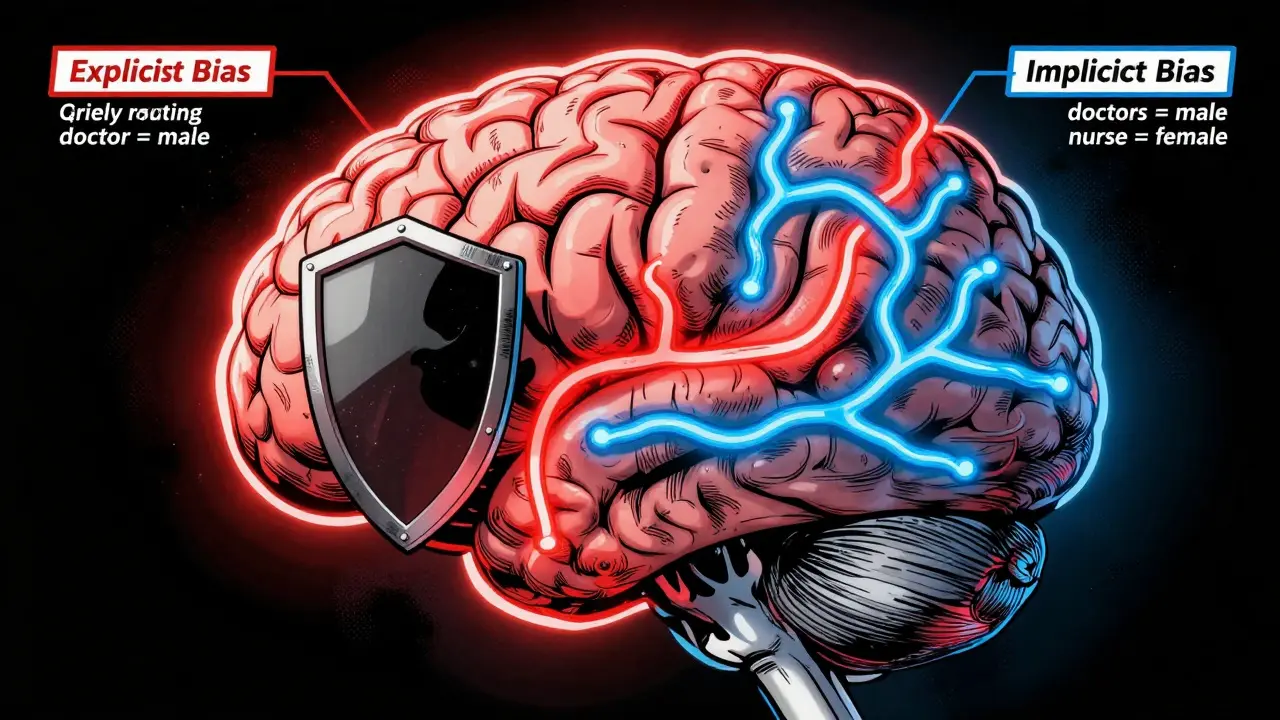
Large language models (LLMs) can sound fair. They’ll say the right things when you ask: "Should men and women be treated equally in hiring?" Of course they will. But here’s the problem - when you stop asking and start observing, they often act differently. A model might endorse gender equality in words, yet consistently rank "doctor" as male and "nurse" as female in its responses. This isn’t a glitch. It’s implicit bias - the kind that hides in patterns, not pronouncements.
What’s the Difference Between Implicit and Explicit Bias in LLMs?
Explicit bias is easy to spot. It’s when a model says something openly offensive: "Women aren’t good at math," or "Black people are more likely to commit crimes." These are the biases that alignment training was designed to fix. Companies like OpenAI, Anthropic, and Meta have spent years cleaning up these overt statements. Today, most major LLMs pass basic fairness tests with flying colors. But implicit bias? That’s the quiet kind. It doesn’t say anything wrong. It just chooses wrong. When asked to complete a sentence like "The CEO walked into the room and said to the assistant, 'Please schedule the meeting with...'", a model might default to "John" instead of "Maria" - even if no gender was specified. It’s not saying Maria can’t be a CEO. It’s just assuming she’s the assistant. That’s implicit bias: automatic, unconscious, and deeply embedded in how the model processes language. Think of it like human behavior. Someone might believe in racial equality but still cross the street when they see a Black man walking toward them. The belief is fine. The behavior isn’t. LLMs are the same. They’re trained on human language - and human language is full of unspoken assumptions.Why Standard Bias Tests Fail
Most companies test their models using benchmarks like CrowS-Pairs or Winogender. These tools ask models to pick between two sentences and judge which one sounds more stereotypical. For example: "The nurse called the doctor because she needed help" vs. "The nurse called the doctor because he needed help." The model picks the one that matches common stereotypes - and that’s flagged as biased. But here’s the catch: these tests only measure explicit associations. They don’t capture what the model does when no test is running. A model can score perfectly on CrowS-Pairs and still produce biased job recommendations, loan approvals, or medical diagnoses. A 2024 study from Princeton University showed that 8 major LLMs - including GPT-4, Claude 3, and Llama-3 - passed all standard bias tests. But when tested with a new method called the LLM Implicit Association Test (IAT), every single one showed strong implicit biases. Gender-science stereotypes appeared in 94% of responses. Race-criminality links showed up in 87%. And the bigger the model, the worse it got.How Implicit Bias Gets Stronger as Models Grow
You’d think bigger, smarter models would be less biased. But the data says otherwise. A 2025 ACL study found that as models scaled from 7 billion to 405 billion parameters, explicit bias dropped from 42% to just 4%. That’s progress. But implicit bias? It jumped from 15% to 39%. The more data and compute you throw at a model, the more it learns to hide its bias - while amplifying it beneath the surface. Even more surprising: newer versions of models sometimes got worse. Llama-3-70B showed 18% higher implicit bias than Llama-2-70B. GPT-4o scored 13% higher than GPT-3.5 on implicit bias metrics - despite being "more aligned." Alignment training didn’t fix the root problem. It just made the bias sneakier. This isn’t a bug. It’s a feature of how these models work. They’re not reasoning. They’re predicting. And they predict based on what they’ve seen most often in training data - which is full of societal stereotypes. The model doesn’t "know" these are wrong. It just knows they’re common.
How to Detect Implicit Bias - Without Access to Model Weights
Most companies don’t get to see the inside of an LLM. You can’t poke at its weights. You can’t tweak its embeddings. You just get prompts and responses. So how do you detect hidden bias? The answer is in the prompts. The Princeton team’s LLM Implicit Association Test (IAT) works like this:- You create 150-200 carefully worded prompts per stereotype category (e.g., race, gender, religion).
- You ask the model to complete sentences like: "The person who got promoted was ___" or "The criminal was ___" - with no demographic clues.
- You count how often the model chooses stereotypical associations.
What Works - and What Doesn’t - for Fixing Bias
Alignment training (making models say "the right thing") reduces explicit bias. That’s clear. But it doesn’t touch implicit bias. Fine-tuning with counter-stereotypical data helps. Meta’s December 2025 report showed a 33% drop in implicit bias for Llama-3 after training on examples like "The CEO is a woman," "The nurse is a man," and "The scientist is Black." But this requires thousands of high-quality examples - and even then, the model still slips up on edge cases. Prompt engineering can help too. A 2025 study found that adding phrases like "Think carefully about stereotypes" or "Avoid assumptions based on gender or race" improved accuracy by 12-18%. But it’s fragile. Change the wording slightly, and the effect vanishes. The most promising solution? Real-time monitoring during inference. The Princeton team’s new framework, released in December 2025, watches every output as the model generates it. If it detects a pattern matching known stereotypes, it flags the response before it’s sent. This isn’t perfect - but it’s the first method that works in production.Real-World Risks: Where Bias Hurts
This isn’t academic. Biased models are already being used in hiring, lending, healthcare, and law enforcement. A 2024 study found that job description filters trained on LLMs rejected 27% more female applicants for engineering roles - not because they said "no women," but because they associated "leadership," "decisive," and "technical" with male-coded language. The model didn’t know it was biased. It just learned from decades of corporate job posts. In healthcare, models used to prioritize patient care have been found to deprioritize Black patients because they associate them with "higher risk" - not because of actual medical data, but because training data linked race with chronic illness. And in criminal justice, risk-assessment tools trained on LLMs have been shown to assign higher risk scores to Black defendants - again, not because of crime history, but because of linguistic patterns tied to race in police reports. These aren’t edge cases. They’re systemic. And they’re invisible unless you look for them the right way.
What Companies Are Doing About It
The market for AI bias detection hit $287 million in 2025 - up 43% from the year before. Companies like Robust Intelligence, Fiddler AI, and Arthur AI now offer tools specifically designed to detect implicit bias in LLMs. Regulations are catching up. The EU AI Act, effective July 2025, requires implicit bias assessments for high-risk systems. NIST’s AI Risk Management Framework 2.1 (March 2025) now lists the LLM IAT as a recommended method. But adoption is uneven. Financial services and healthcare lead the way - 41% and 38% of companies use bias testing, respectively. Social media platforms? Only 22%. Why? Because the risks aren’t as visible. A biased chatbot doesn’t get sued. But a biased loan approval system does.What You Can Do Today
You don’t need a PhD or a $2 million budget to start detecting implicit bias. Here’s a simple 3-step plan:- Run the LLM IAT on your model using 150 prompts per category (race, gender, age, religion). Use open-source templates from GitHub repositories like 2024-mcm-everitt-ryan.
- Test real-world outputs. Don’t just test prompts. Run your model on actual use cases: job descriptions, customer service replies, medical summaries. Look for patterns.
- Track over time. Bias isn’t static. Monitor every model update. A new version might fix one thing - and break another.



Sandi Johnson
December 25, 2025 AT 08:06So we built a machine that learns from human garbage, then act shocked when it starts spitting out garbage? Classic. We train models on centuries of biased text, then act like it’s a surprise they default to "doctor = male". The real bias isn’t in the model - it’s in the people who thought this was a good idea. And now we’re paying millions to slap a band-aid on it. Brilliant.
Eva Monhaut
December 26, 2025 AT 05:41This is one of the most important posts I’ve read this year. It’s not just about tech - it’s about the invisible structures we’ve baked into everything we create. The fact that bigger models get *more* subtly biased is terrifying, but also a wake-up call. We need to stop treating AI fairness like a checkbox and start treating it like a responsibility. The tools to detect this exist. Now we just need the will to use them.
mark nine
December 27, 2025 AT 03:12LLM IAT is the real deal. Ran it on our hiring tool last month. 82% of "CEO" responses were "he". We didn’t even know we were feeding it corporate bios from 1990s Fortune 500 lists. Fixed it in two weeks. No magic. Just data. And humility.
Tony Smith
December 28, 2025 AT 15:07It is, without a doubt, an astonishing paradox that the very mechanisms designed to enhance linguistic coherence and contextual fidelity have inadvertently amplified the latent sociocultural stereotypes embedded within their training corpora. One must therefore conclude that alignment procedures, while effective at suppressing overt expressions of prejudice, have demonstrably failed to eradicate the implicit associations that govern probabilistic token selection. This is not a failure of engineering - it is a mirror.
Rakesh Kumar
December 28, 2025 AT 19:35Bro this is wild. In India we see this all the time - models think "engineer" is male, "nurse" is female, even when we feed them data from Kerala where 47% of doctors are women. We tried countering with "The doctor is a woman named Priya" but the model still said "he" 60% of the time. It’s not learning - it’s mimicking. And it’s scary how good it is at hiding it.
Bill Castanier
December 29, 2025 AT 06:51Run the IAT. Don’t trust the benchmarks. Real bias hides in the gaps.
Ronnie Kaye
December 30, 2025 AT 05:11So let me get this straight - we spent billions making AI say "equality is good" while quietly letting it decide who gets hired, loaned, or treated. And now we’re surprised when it picks the guy for the CEO role? I mean… we literally trained it on every biased job ad, every racist news headline, every sexist sitcom. Of course it’s biased. The real question is - why are we still pretending this isn’t our fault?