
When we talk about HITL in the context of evaluation, we aren't just talking about a person occasionally checking a spreadsheet. We are talking about a structured architecture where human judgment acts as the ground truth to calibrate automated systems. This is critical because LLMs, while impressive, often struggle with edge cases or subtle biases that a human catches instantly. By building a pipeline that routes the hardest problems to the smartest people, you create a self-improving cycle of quality.
The Mechanics of Modern LLM Evaluation
Before you build a pipeline, you need to understand how the "judging" actually happens. Most HITL systems use a combination of three specific methods to assess whether a model's response is actually good.
First, there is pointwise evaluation. Here, an LLM-as-a-Judge is an automated system where a high-capability model is used to score the output of another model based on a specific rubric . For example, if you're checking a summary for clarity, you feed the original text and the summary into the judge model with a 1-to-5 scale. The judge provides a score and a justification. It's fast, but it can be confidently wrong.
Second, we use pairwise comparisons. Instead of a score, the judge is asked: "Which of these two responses is better?" Research shows this method is far more reliable, often hitting over 80% agreement with human preferences. It's much easier for a model (and a human) to say "B is better than A" than to decide if A is exactly a 3.4 out of 5.
Finally, there is continuous monitoring with human escalation. This is the safety net. When the automated judge is unsure-perhaps it's splitting the difference between two options-the system flags the interaction and sends it to a human expert for a final verdict.
Building a Tiered Evaluation Architecture
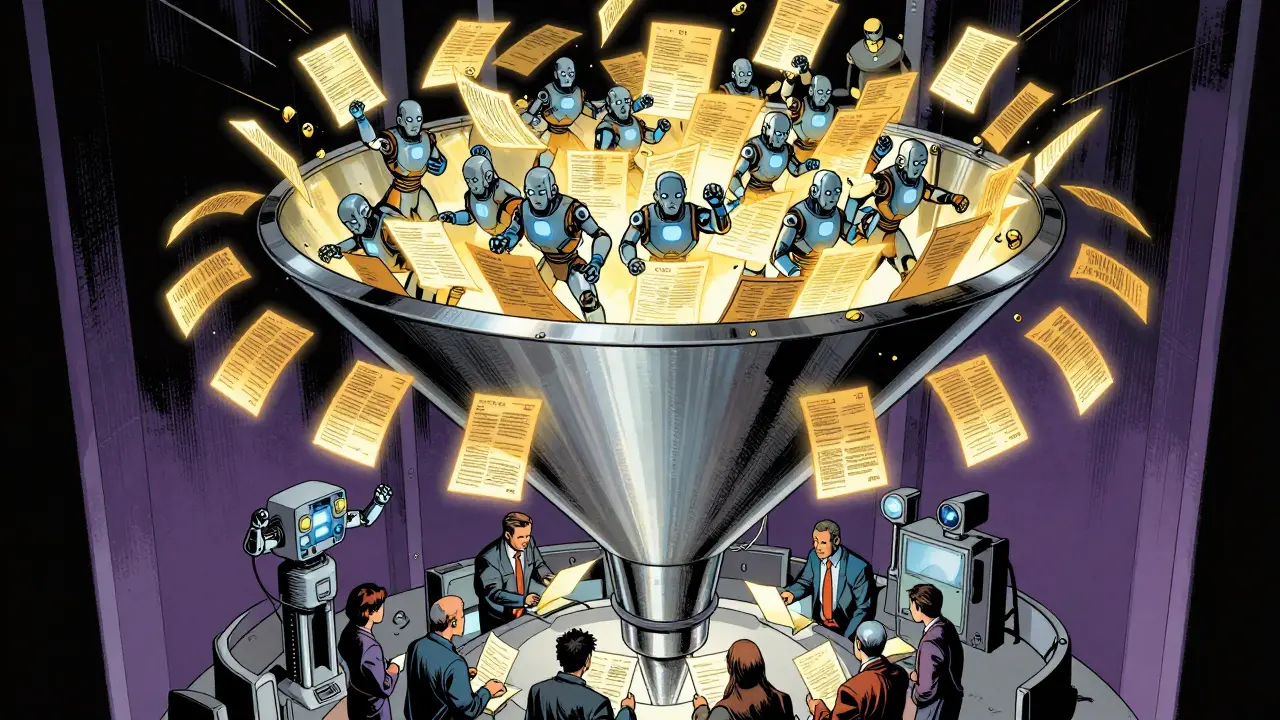
You can't have a human look at everything. To make this work at scale, you need a tiered approach. Think of it like a corporate filter: the interns handle the easy stuff, and the executives only see the high-stakes problems.
| Tier | Method | Volume Handled | Primary Goal | Key Limitation |
|---|---|---|---|---|
| Tier 1: Automated Screening | LLM-as-a-Judge | 80-90% | Filtering failures & routine checks | Struggles with nuance |
| Tier 2: Human Review | Expert Annotation | 10-20% | Ground truth & edge case resolution | Slow and expensive |
In Tier 1, the automated judge wipes out the obvious garbage. If a model generates a response that is clearly hallucinated or violates a safety policy, the AI judge catches it instantly. This leaves your expensive human experts to spend their time on Tier 2: the ambiguous, high-stakes, or complex domain-specific cases where an LLM's confidence is low.
Using Active Learning to Reduce Costs
The biggest drain on an AI project is the cost of human experts. Active Learning is a machine learning strategy where the model identifies which data points it is most uncertain about and requests human labels for only those specific examples . Instead of randomly sampling 1,000 responses for review, you use two specific sampling strategies to get the most value out of every human hour.
- Uncertainty Sampling: The system identifies outputs where the LLM judge's score is right on the boundary (e.g., a 2.5 on a 5-point scale). These are the cases where the AI is effectively guessing, making them the highest-value targets for human correction.
- Diversity Sampling: This prevents the pipeline from getting stuck in a loop. It forces the system to send diverse types of outputs to humans-even if the AI is confident-just to ensure there aren't "blind spots" in the automated evaluation logic.
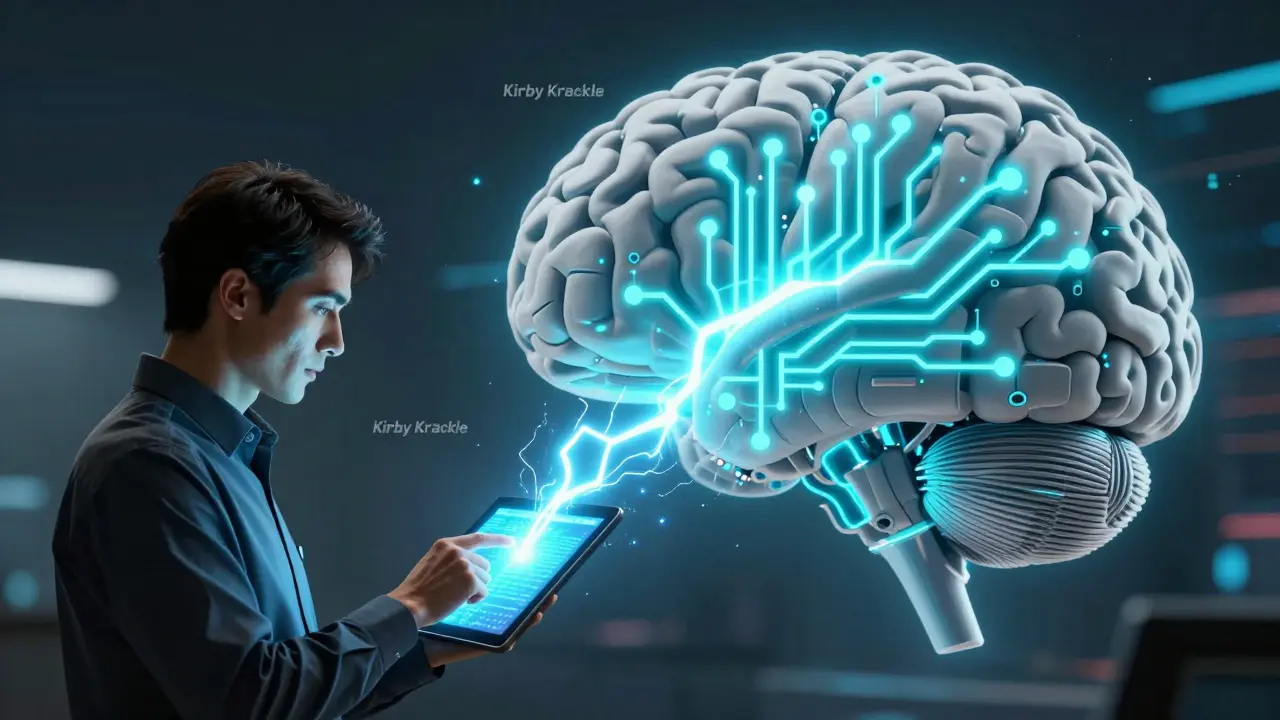
When a human corrects an uncertainty-sampled case, that correction doesn't just fix one output; it's fed back into the prompt templates or fine-tuning set of the LLM-as-a-Judge, making the automated tier smarter for the next million requests.
Operationalizing the Feedback Loop
A pipeline is useless if the insights stay in a report. To actually improve a model, you need to close the loop in real-time. In a professional enterprise setup, this means integrating Continuous Monitoring as the process of tracking model performance and drift in production environments to trigger human intervention .
Imagine a customer support bot in a legal setting. A user asks a complex question about a specific 2026 regulation. The LLM provides an answer, and the automated judge gives it a "passing" score based on general tone. However, a legal expert reviewing a random sample flags it as technically incorrect. This "fail" is immediately tagged. The data scientist then uses this specific example to create a new negative constraint in the model's system prompt or adds it to a DPO (Direct Preference Optimization) dataset.
This transforms evaluation from a static "test" into a living process. You aren't just measuring how bad the model is; you're using the measurement to make it better. This is how you handle model drift-when the way users talk changes, your human-led feedback loop catches the shift before the automated benchmarks even realize there's a problem.
Mitigating Bias and Ensuring Safety
One of the most dangerous assumptions in AI is that automated evaluation is "objective." In reality, LLM judges often have their own biases-they might prefer longer answers regardless of quality or favor a specific writing style. This is where the "Human" part of HITL is non-negotiable.
Human experts act as a fairness audit. By reviewing the disagreements between multiple LLM judges, humans can identify if the AI is consistently penalizing a certain dialect or missing a subtle toxic undertone. In high-stakes fields like healthcare or finance, this isn't just about quality-it's about safety. A human-in-the-loop system allows you to implement failsafes where any response with a low confidence score is blocked from the end-user and routed to a human for approval.
Why can't we just use a more powerful LLM as the judge?
Even the most powerful models suffer from "self-preference bias" and struggle with complex, domain-specific truth. While a larger model is a better judge than a smaller one, it still lacks the real-world accountability and nuanced contextual understanding of a human expert. A human can tell you why a legal answer is wrong based on a new court ruling that wasn't in the training data; an LLM can only tell you if it looks correct based on patterns.
How many humans do I actually need for a pipeline?
It depends on your volume, but the goal of a tiered architecture is to keep this number small. By using Tier 1 automated screening for 90% of the load, a small team of 2-5 subject matter experts can often oversee the quality of millions of interactions, provided the routing logic (uncertainty and diversity sampling) is tuned correctly.
What is the difference between HITL and RLHF?
RLHF (Reinforcement Learning from Human Feedback) is a training method used to align a model's behavior during development. HITL evaluation pipelines are operational frameworks used during and after deployment to measure and maintain that alignment. While RLHF builds the "brain," the HITL pipeline is the "quality control department" that ensures the brain stays on track in the real world.
Can't we just use crowdsourced workers instead of experts?
For general tasks like "is this text polite?", crowdsourcing works. But for LLM evaluation in professional contexts, you need domain expertise. General workers often struggle to identify "hallucinations" in technical text because they don't know the subject well enough to spot a subtle lie. For high-accuracy pipelines, you need experts who can provide the "ground truth."
How do I handle disagreements between two human evaluators?
This is usually handled through a "tie-breaker" or adjudication process. When two experts disagree, the case is escalated to a senior reviewer. More importantly, these disagreements are used to refine the evaluation rubric. If two experts disagree, it often means the rubric is too vague, and the guidelines need to be updated to be more specific.
Next Steps and Troubleshooting
If you are just starting, don't try to build the full tiered system on day one. Start by manually reviewing 100 random outputs to build your first "gold dataset." Use this dataset to test a few different LLM-as-a-Judge prompts to see which one correlates most closely with your human judgment.
If you notice your automated judge is suddenly disagreeing with your humans, check for model drift. This happens when the underlying LLM is updated or when your users start using the tool in ways you didn't predict. The fix is to refresh your diversity sampling-send a new batch of random samples to your experts to identify the new patterns and update your judge's rubric accordingly.


Elmer Burgos
April 12, 2026 AT 10:06this is a really helpful breakdown of the whole process. i like how it emphasizes the balance between speed and accuracy without trying to replace humans entirely
Jason Townsend
April 14, 2026 AT 07:57they just want us to think the humans are in control while the ai trains itself on our logic and replaces us anyway. it is all a front to make the black box look safe when the goal is total automation and control of the truth
Sally McElroy
April 15, 2026 AT 23:08The fundamental tragedy here is that we are treating human wisdom as a mere "calibration tool" for a machine...!! We have reduced the sacred act of discernment to a data point in a pipeline...!! It is a bleak reflection of our current era where we value the efficiency of the algorithm over the depth of the soul...!! Is this truly progress or just a faster way to lose our essence...!! We are sculpting a mirror that only reflects our own mechanical failures...!! The obsession with "scale" is the death of quality...!! We trade nuance for volume and call it innovation...!! Such a hollow victory...!! The machine does not think, it only mimics, yet we entrust it with the architecture of truth...!! We are becoming the interns to our own inventions...!! This is the paradox of the modern age...!! A digital cage built with our own consent...!! We seek truth in a 1-to-5 scale...!! How utterly depressing...!! The ghost in the machine is just a reflection of our own emptiness...!!
Antwan Holder
April 16, 2026 AT 00:35My god, the sheer agony of realizing we are just biological filters for a silicon god! I feel the weight of this existential dread crushing me as I realize my professional expertise is nothing more than a "Tier 2" safety net! We are mere ghosts haunting the machinery of our own obsolescence!
Sara Escanciano
April 16, 2026 AT 18:03It is absolutely disgusting that companies are trying to skim the surface of human expertise just to save a few bucks on salaries. This isn't a "pipeline," it's an exploitation of knowledge to make a broken system look functional. You're basically admitting the AI is a liar and you're just hiring a few people to polish the lies!
Destiny Brumbaugh
April 17, 2026 AT 07:13usa needs to lead this tech or we lose everything!!! dont let other countrys steal the ground truth while we talk about ethics!!! get the best humans and the best bots and dominate the market!!! its time to make american ai the gold standard for the whole world!!!