When you ask a generative AI model to read a 100-page contract, summarize a 500-page research paper, or recall every detail from a 12-hour meeting transcript, you're relying on its long-context ability. This isn't magic-it's a technical feat. But as context windows grow from 32,000 to over a million tokens, something unexpected happens: the model starts forgetting, distorting, and losing track of what matters most. This isn't a bug. It's a fundamental flaw in how attention works under pressure.
What Long-Context Really Means
Long-context means a model can process more text at once. Early models like GPT-3 handled about 2,048 tokens-roughly 1,500 words. Today, Gemini 1.5 Pro swallows up to 1 million tokens. That’s like reading a 300-page novel in one breath. But the model doesn’t store this like a human memory. It uses a mechanism called self-attention, which compares every token to every other token. With 1 million tokens, that’s a trillion comparisons. The math explodes. Memory use jumps 47%. Latency spikes 32%. And somewhere in the middle, the model starts slipping.
Think of it like trying to remember every word of a 10-hour podcast while also answering questions about it. You’ll remember the start. You’ll remember the end. But what was said at the 4-hour mark? That’s where the trouble begins.
Distortion: When the Model Makes Stuff Up
Distortion isn’t just a hallucination-it’s a systematic rewriting of facts under load. In tests by AI21 Labs, when context exceeded 32,000 tokens, factual errors rose by 23.4%. Why? Because the model’s attention gets stretched thin. It starts guessing. It conflates similar phrases. It misattributes sources.
One law firm using Llama3 70B to review a 64,000-token contract missed a critical termination clause buried at token 42,000. The model cited a different clause entirely. The firm lost $250,000. This wasn’t a one-off. Gartner’s 2024 survey found 63% of enterprises using long-context AI for document processing had at least one major error in six months. These aren’t random mistakes. They’re predictable failures tied to context length.
Drift: The Slow Slide Away from Reality
Drift is the quiet killer. It doesn’t scream. It whispers. A model starts answering correctly. Then, after 20,000 tokens of context, it begins to drift. The answer still sounds right. But it’s no longer based on the input. It’s based on what the model thinks should be true.
Reddit users in r/MachineLearning tracked this in real-time. After feeding a model 50,000 tokens of technical documentation, responses became 41% less relevant. The model wasn’t lying. It was just… off. JPMorgan Chase’s AI team saw this in financial filings. A key term in the middle of a 50,000-token regulatory document was misinterpreted. The model treated it as a different regulatory standard. Risk assessments went wrong. Manual review fixed it-but only after damage was done.
Drift happens because attention isn’t stable. The model’s focus shifts as new tokens arrive. Early context gets overwritten. Mid-context gets ignored. The model doesn’t have a way to say, “Wait, this part still matters.”
Lost Salience: The Middle Vanishes
Here’s the cruelest part: the most important information is often in the middle. That’s where the evidence, the nuance, the exception lies. But the model doesn’t treat it that way.
The LongBench evaluation framework tested this. For information placed in the middle 30% of a 64,000-token context, accuracy dropped to 52.7%. At the start or end? 78.3%. That’s a 25-point gap. Vectara’s research showed attention heads pay 37% less attention to mid-sequence content. It’s not a glitch-it’s baked into the architecture.
Imagine reading a novel. You remember the opening scene. The final chapter. But the 150th page? You forget. That’s what happens inside the model. The attention mechanism treats the middle like background noise.
Why This Isn’t Just a Memory Problem
People think more context = better memory. But it’s not. It’s about attention allocation. Google’s Andrew Zaldivar put it simply: “Context windows aren’t just memory expansions-they’re fundamentally changing how models allocate attention.”
Adding more tokens doesn’t fix the problem. It makes it worse. The self-attention mechanism scales quadratically. O(n²). Double the tokens? Quadruple the computation. That’s why models like Claude 3.5 Sonnet and Gemini 1.5 Pro don’t just scale-they redesign attention. Claude 3.5 reduced the “Lost in the Middle” effect by 22%. Gemini 1.5 Pro’s adaptive attention helps, but even it only hits 89.7% accuracy on the “Needle in the Haystack” test. That’s still one failure in ten tries.
Dr. Ori Gersht of AI21 Labs warns: “Simply increasing context length without addressing attention mechanisms creates false confidence.” That’s the danger. Companies think they’re getting smarter AI. They’re just getting longer hallucinations.
Real-World Impact: Where It Breaks
Legal teams. Financial analysts. Medical researchers. These are the people who need long-context AI most-and where it fails hardest.
- Legal: LexisNexis uses 64,000-128,000 token windows. But 47% of cases still require manual verification of mid-document clauses.
- Finance: Goldman Sachs limits context to 32,000 tokens for risk modeling. Why? Because beyond that, distortion spikes.
- Healthcare: A 2025 study in Nature found that models misread drug interactions in 31% of 256,000-token clinical trial summaries when the key data was in the middle.
Even the best models aren’t reliable. Hugging Face users rate long-context tools at 3.2/5 stars. The top complaint? “Inconsistent performance with documents over 32,000 tokens.”
How to Fight Back
You can’t ignore long-context risks. But you can manage them.
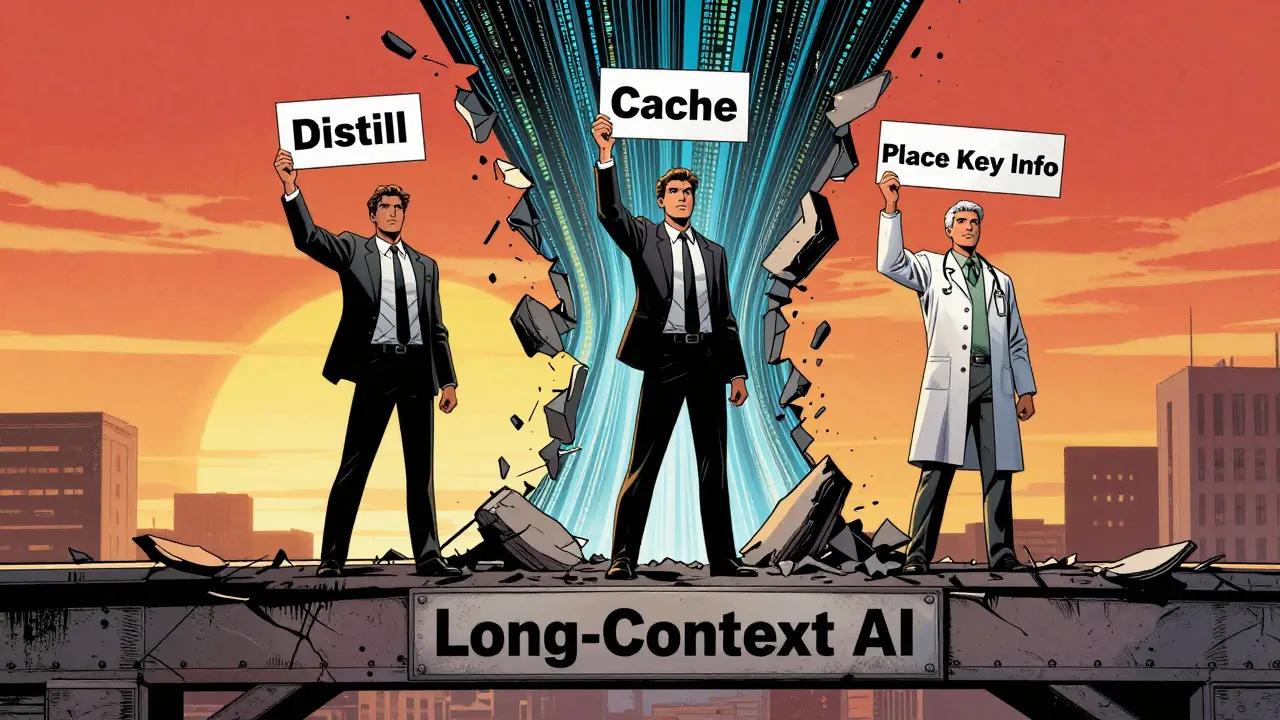
Context distillation is the most effective fix. Instead of feeding the whole 100-page document, extract only the relevant parts. Vectara’s team found this improved accuracy from 54% to 89% on medical documents. It requires 200-300 hours of engineering-but it’s worth it.
Context caching helps for repeated queries. If you’re asking the same document 10 times, cache the processed chunks. Google Cloud says this cuts costs by 65%. But it needs $12,500-$18,000 in infrastructure.
Placement matters. Put critical info at the start or end. If you’re summarizing a contract, paste the key clauses first. Don’t bury them in the middle.
Limit context length. Don’t use 1 million tokens unless you absolutely need to. Financial analysis? 16,000-32,000. Legal? 64,000-128,000. Scientific research? Maybe 256,000+. But always test. Always validate.
What’s Next?
The race for bigger context isn’t over. Gemini 1.5 Ultra will roll out “adaptive attention” in mid-2025. Anthropic’s “context anchoring” will hit in Q3. MIT researchers just published a new attention mechanism that cut distortion by 42%.
But the real shift isn’t in size-it’s in quality. The LongContext Consortium, formed in late 2024, now has standardized benchmarks for distortion, drift, and lost salience. That’s progress. Companies are starting to measure what matters.
Forrester’s 2025 outlook is blunt: “Long-context risks will remain a significant constraint for at least 18-24 months.” Only 28% of enterprises have high confidence in models beyond 64,000 tokens.
The lesson? Don’t chase the biggest number. Chase the most reliable one. The future of long-context AI won’t be won by who has the longest memory. It’ll be won by who understands attention best.