
Getting a Large Language Model (LLM) to 80% accuracy is relatively easy. Getting it to 99% is where the real struggle begins. In high-stakes environments-think medical diagnoses, legal contracts, or financial audits-that final 20% gap isn't just a technical hurdle; it's a liability. This is why Human-in-the-Loop is a structured workflow that integrates human expertise into AI systems to validate, correct, and improve model outputs. Also known as HITL, it transforms human judgment from a manual chore into a strategic data asset for fine-tuning and alignment.
Why Automation Isn't Enough for the Last Mile
You've probably seen the "hallucination" problem. A model can sound incredibly confident while being completely wrong. While techniques like RLHF (Reinforcement Learning from Human Feedback) help, they often happen in a vacuum before deployment. In a real-world production environment, you need a living system where humans don't just grade a static dataset, but actively intercept the AI's mistakes in real-time.
The core problem is that LLMs lack a true concept of "truth"; they predict the next token based on patterns. When an error carries a material consequence-like a security vulnerability in code or a legal misquote-the cost of a mistake outweighs the cost of human review. If you wouldn't let a junior intern send a million-dollar invoice without a second pair of eyes, you shouldn't let an LLM do it either.
Operational Patterns for HITL Workflows
Not every task requires a human to look at every single output. Depending on your risk tolerance, you can implement different structural patterns to balance speed and accuracy.
- Approval Gates: The model generates a candidate answer, and a subject matter expert (SME) must sign off before it reaches the end user. This is a hard stop for quality control.
- Correction Gates: This is where the magic happens for fine-tuning. Experts don't just say "yes" or "no"; they edit the output. These corrections are stored as gold-standard labeled data, which can then be fed back into the model's training set.
- Adjudication Workflows: When two human reviewers disagree on whether a response is correct, a senior reviewer steps in to make the final call. This ensures that the "ground truth" used for training is consistent and not based on a single person's whim.
For lower-risk tasks, you might prefer Human-on-the-Loop (HOTL). Unlike HITL, where the human is a required step in the process, HOTL is a monitoring system where humans only intervene when the AI flags a low-confidence score or a high-risk keyword. It's the difference between a checkpoint (HITL) and a security camera (HOTL).
| Feature | Human-in-the-Loop (HITL) | Human-on-the-Loop (HOTL) |
|---|---|---|
| Intervention | Required for every output | By exception / trigger |
| Scale | Low (bottlenecked by humans) | High (automated flow) |
| Risk Profile | Critical / High-Stakes | Low to Medium Risk |
| Primary Goal | Guaranteed Accuracy | Operational Efficiency |

Building a Tiered Validation Hierarchy
To prevent your SMEs from burning out, you can't have them reviewing every comma. You need a filter system that catches the "easy" mistakes automatically so humans only handle the complex nuances. A smart architecture typically follows a four-tier approach:
- Automated Checks: Use simple regex or unit tests. If the model is supposed to output JSON but provides a paragraph, the system should reject it immediately without bothering a human.
- LLM-as-a-Judge: Use a more powerful model (like GPT-4o or Claude 3.5 Sonnet) to grade a smaller model's output based on a specific rubric. The "judge" can tag a response as "potentially risky," which triggers a human review.
- SME Review: This is the core HITL step. A human expert reviews the high-risk cases, corrects the output, and assigns a severity level to the error.
- Continuous Monitoring: Audit the remaining high-confidence outputs through random sampling to detect "model drift," where the AI's performance degrades over time.
By the time a task reaches a human, the noise has been filtered out. The result is a highly concentrated stream of high-value corrections that are perfect for the next fine-tuning cycle.
Turning Feedback into Training Data
The real ROI of a review workflow is the data it generates. In a naive setup, a human fixes a mistake, the user gets the right answer, and the knowledge is lost. In a professional MLOps pipeline, every single correction is an Entity-Attribute-Value triplet that informs the model's future behavior.
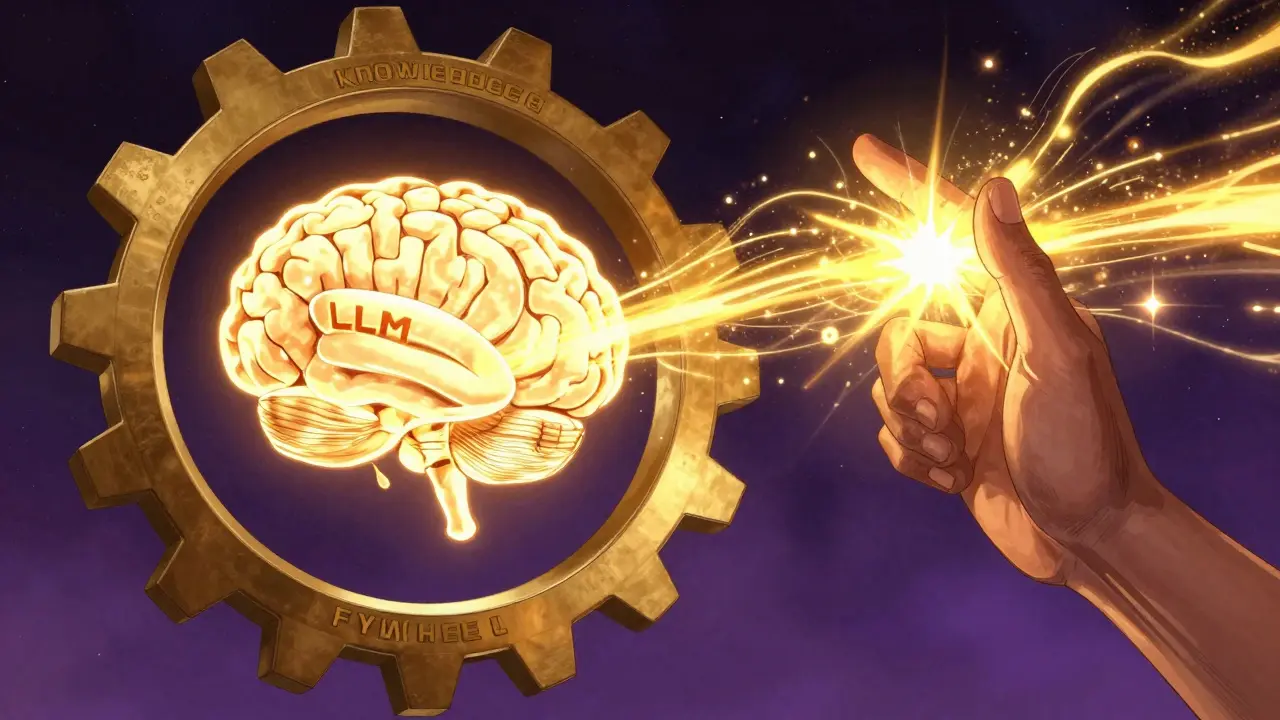
Imagine a legal AI that consistently struggles with "force majeure" clauses. An SME corrects ten examples. These ten examples are now far more valuable than 10,000 generic legal documents because they represent the specific failure point of your current model version. By treating human corrections as a structured dataset, you create a flywheel: the model fails, the human fixes, the model is fine-tuned on the fix, and the failure rate drops.
This is fundamentally different from Active Learning. While Active Learning is about the model asking, "Which data should I learn from next to be more efficient?", HITL is about the business asking, "Is this output safe and accurate enough to ship?" One optimizes for training speed; the other optimizes for operational reliability.
Implementation Pitfalls and Best Practices
Setting up these workflows isn't just about the API; it's about the psychology of the reviewer. If the interface is clunky, your SMEs will start rushing, and your "gold data" will become contaminated with human error.
To avoid this, focus on traceability. Every change should be logged with a timestamp, the reviewer's ID, and the reasoning for the change. If a reviewer changes "Company A" to "Company B," the system should prompt them for a quick reason (e.g., "wrong entity identified"). This metadata is crucial when you're debugging why a model suddenly started behaving strangely after a fine-tuning run.
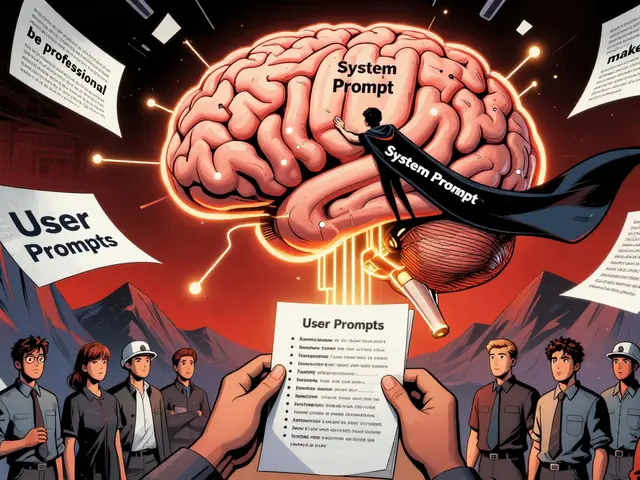
Additionally, be wary of the "black box" effect. If the human doesn't understand why the model chose a certain path, they can't provide a meaningful correction. Provide the reviewer with the prompt, the model's internal confidence score, and any retrieved context (RAG) used to generate the answer. Transparency in the review UI leads to precision in the training data.
When should I switch from HITL to HOTL?
You can transition to Human-on-the-Loop once your model's accuracy in a specific domain stabilizes-typically at 95% or higher-and the number of human interventions drops below a predefined threshold. At this point, the risk of a random error is lower than the cost of reviewing every single output.
Does HITL slow down the user experience?
Yes, if implemented as a synchronous block. To mitigate this, use asynchronous workflows where the user is notified when the review is complete, or use a "draft" state where the AI provides a preliminary answer clearly marked as "pending expert review."
How does this differ from standard RLHF?
RLHF usually happens during the initial alignment phase using curated datasets. HITL is an operational framework that happens during deployment, capturing real-world failures and turning them into a continuous training loop for a living model.
What is the best way to handle disagreements between reviewers?
Implement an adjudication layer. When two reviewers disagree, the case is escalated to a third, more experienced subject matter expert. Their decision becomes the final label for the training set, ensuring high-quality data consistency.
Can HITL help with model distillation?
Absolutely. By using humans to validate the outputs of a massive teacher model, you can create a high-precision dataset used to train a smaller, more efficient student model, combining the power of the large model with human-verified accuracy.
Next Steps for Implementation
If you're starting from scratch, don't build a full system on day one. Start by flagging the 5% of cases your model is most uncertain about and routing those to a manual review spreadsheet. Once you see the patterns in those errors, build an API-driven routing system that feeds those corrections back into a fine-tuning pipeline. The goal isn't to eliminate the human, but to make the human the most efficient part of the machine learning process.


Ian Cassidy
April 8, 2026 AT 02:15This basically just describes a high-end data flywheel for MLOps. Simple as that.
lucia burton
April 9, 2026 AT 01:50The operationalization of these tiered validation hierarchies is absolutely pivotal for mitigating catastrophic forgetting during the iterative fine-tuning process because if you don't have a robust mechanism to synthesize these high-fidelity gold-standard triplets, you're basically just throwing stochastic noise at the weights and hoping the loss function converges on something that isn't a complete hallucination in a production-grade environment where the latency-throughput tradeoff is already stressing the infrastructure to its absolute limits!
michael Melanson
April 10, 2026 AT 06:42I really like the idea of starting with a simple spreadsheet for the first 5% of errors. It's a practical way to validate the workflow before committing to a full API build.
Denise Young
April 11, 2026 AT 22:03Oh sure, because we all know that having a 'senior reviewer' step in to solve the adjudication deadlock is a totally frictionless process that won't result in a massive organizational bottleneck where the most expensive person in the company spends six hours a day deciding if a comma should be a semicolon in a synthetic dataset. I love how this framework assumes that the cognitive load on the SME is just a minor detail in the quest for a 99% accuracy rate while we're all just pretending that the hyper-parameter tuning on the student model won't just introduce a whole new set of regressions that the original human expert missed during the initial gated approval phase.
Sam Rittenhouse
April 11, 2026 AT 22:30It is truly heartbreaking to think about the immense pressure placed on these human experts who are essentially acting as the soul of the machine. We are asking them to carry the weight of these high-stakes decisions on their shoulders, fighting against the tide of algorithmic confidence to ensure that a medical or legal error doesn't devastate someone's life! It's an exhausting, invisible labor that deserves so much more recognition than just being called a 'strategic data asset' in a technical manual.
Kenny Stockman
April 12, 2026 AT 17:51Just take it easy on the SME burnout. Using a simpler UI and maybe some game-like incentives can make the review process feel less like a chore and more like a win.
Paritosh Bhagat
April 13, 2026 AT 19:33While I appreciate the friendly tone of this discussion, I must point out that the author's use of the term 'gold-standard' is slightly cliché, though logically acceptable. It is almost a tragedy that some of you are ignoring the moral imperative of absolute accuracy in medical AI; we simply cannot afford to be lax with our grammar or our ethics when lives are on the line, even if the implementation is a bit tedious for the staff.
Antonio Hunter
April 14, 2026 AT 14:17In my experience mentoring junior engineers, I've found that the transparency in the review UI mentioned here is actually the most critical part because without seeing the RAG context, the human reviewer is essentially guessing why the model failed, which leads to corrections that are superficially correct but fundamentally misunderstand the root cause of the model's logic error, eventually poisoning the training set with inconsistent labels that make the model drift even more unpredictable over long-term deployment cycles.
Ben De Keersmaecker
April 15, 2026 AT 20:41Interesting perspective on the difference between Active Learning and HITL. I've noticed that in different corporate cultures, the 'risk tolerance' part of the HOTL transition is handled very differently depending on the region.
Zach Beggs
April 16, 2026 AT 14:15The distinction between HITL and HOTL makes a lot of sense for scaling.