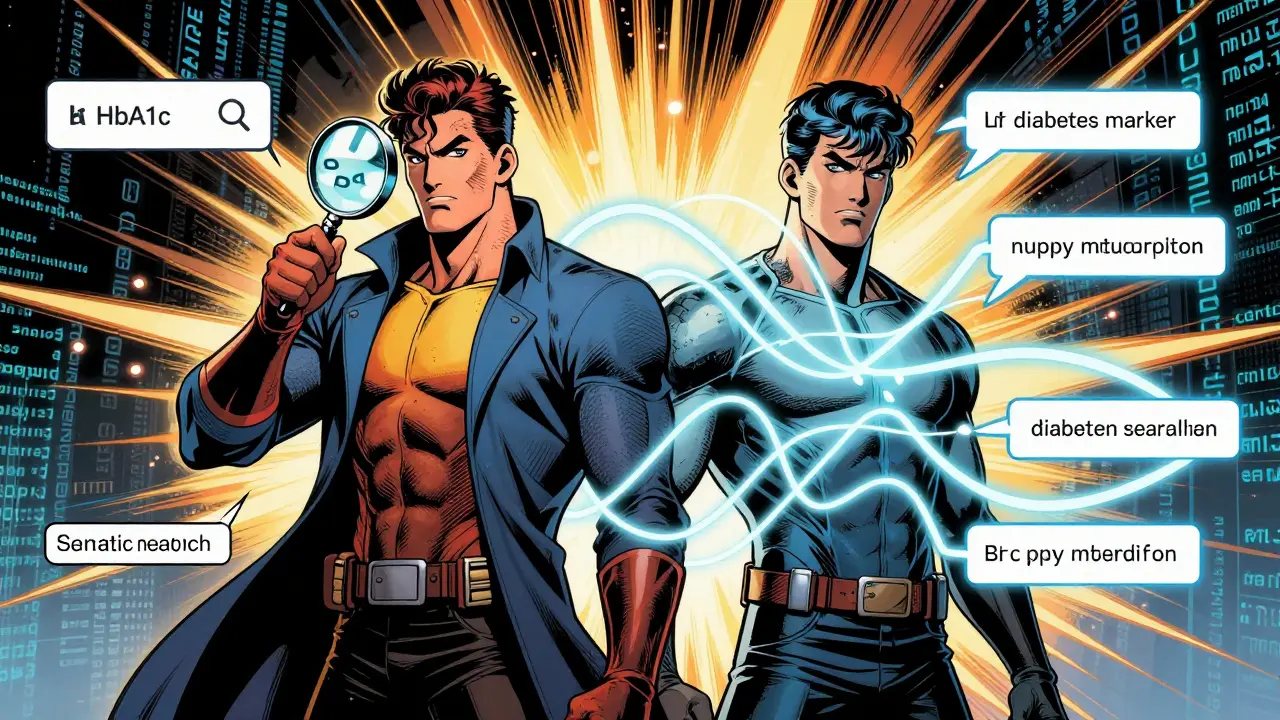
Large Language Models (LLMs) are powerful, but they don’t work in a vacuum. They need good context to give accurate, useful answers. That’s where Retrieval-Augmented Generation (RAG) comes in. RAG pulls relevant information from your data before the LLM generates a response. But here’s the problem: if you rely only on semantic search - the kind that understands meaning - you’ll miss critical answers. A query like "What is HbA1c?" might not return the right medical document if the term isn’t paraphrased. On the flip side, if you use only keyword search, you get exact matches but miss context. A user asking "How to fix slow Python loops?" might not get results about NumPy vectorization if the exact phrase "slow loops" isn’t used. Hybrid search fixes this by combining both methods - and it’s now the standard for serious RAG systems.
How Hybrid Search Works
Hybrid search doesn’t pick one method over the other. It runs both at the same time. One part of the system uses semantic search, which turns your question into a vector - a list of numbers representing meaning. It then finds chunks of text with the closest vector patterns, using cosine similarity. The other part uses keyword search, typically with the BM25 algorithm. BM25 looks for exact word matches and weighs them based on how often they appear in the document versus how common they are across all documents. Rare terms get higher scores.
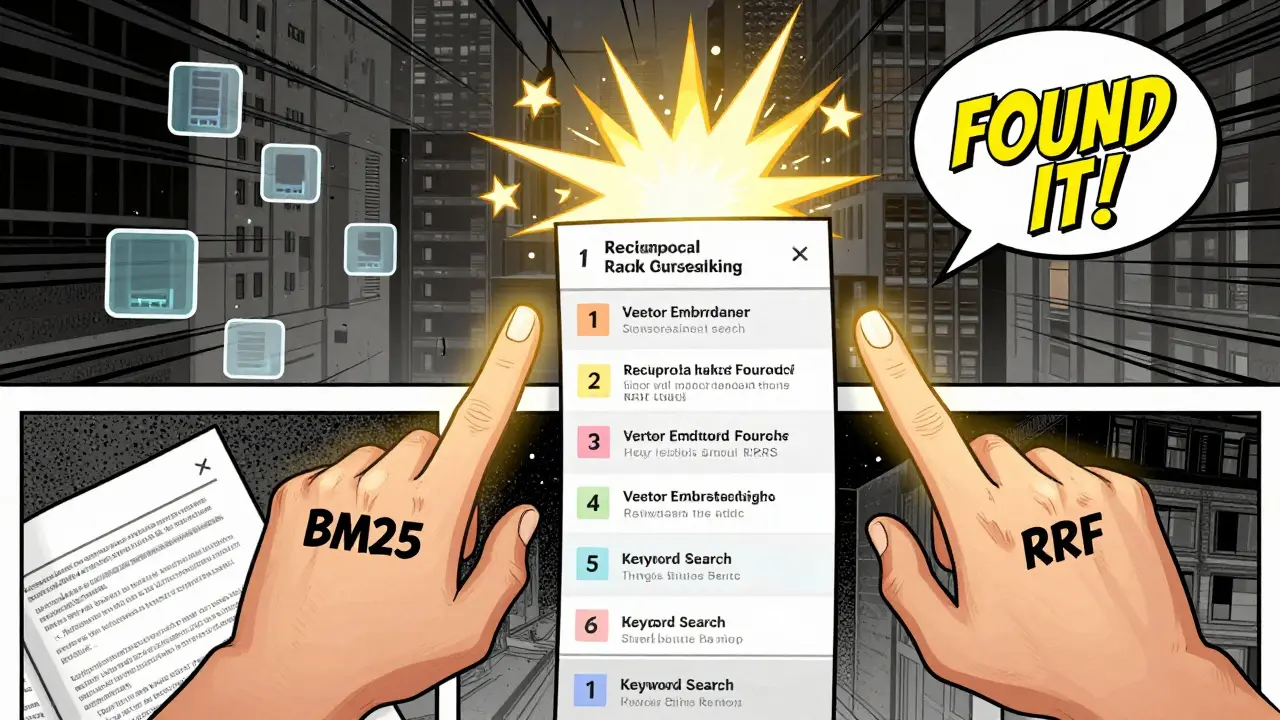
After both searches run, their results are merged. You don’t just take the top 5 from each. You combine them using fusion techniques. The most common method is Reciprocal Rank Fusion (RRF). RRF doesn’t care how high a result ranks in one system - if it shows up in both, it gets a boost. A document ranked #12 in semantic search but #3 in keyword search might end up as the #1 result. Another method is weighted fusion: you assign, say, 70% weight to keyword search and 30% to semantic. This works well in domains where exact terms matter more, like legal or medical data.
Think of it like asking two experts: one reads between the lines, the other reads word-for-word. Together, they cover more ground than either alone.
Where Hybrid Search Shines
Not all use cases need hybrid search. But for certain applications, it’s not optional.
- Healthcare RAG: Medical abbreviations like "COPD," "HbA1c," or "MRI" rarely get paraphrased. Pure semantic search often ignores them. Hybrid search ensures these exact terms are retrieved. Systems using hybrid retrieval saw a 35.7% improvement in accuracy for these queries.
- Developer tools: Code snippets, function names like "np.dot" or "lambda," and error messages are literal. A semantic model might try to "understand" "np.dot" as "numpy dot product" and miss the exact syntax. Hybrid search catches both.
- Legal and compliance: Laws, case numbers, and regulatory codes must be retrieved exactly. "Section 12(b) of the Securities Act" won’t be paraphrased. Keyword search ensures it’s found. Semantic search helps with related concepts like "disclosure requirements."
- E-commerce: A user searching for "wireless headphones with noise cancellation" might not use the exact product name. Semantic search finds similar items. Keyword search ensures "noise cancellation" isn’t ignored.
Studies from Meilisearch show hybrid search improves precision at the top 5 results by 28-42% for technical queries. In healthcare, it cut "zero-result" queries by over 35%. For developers, Reddit user data_engineer_42 reported a jump from 58% to 92% success rate for "HbA1c" searches after switching to a 30/70 hybrid setup.
The Downsides You Can’t Ignore
Hybrid search isn’t magic. It adds complexity.
First, you need two systems: one for vectors (like FAISS, Pinecone, or Chroma) and one for keywords (like Elasticsearch, Meilisearch, or even a simple BM25 index). That means more infrastructure, more storage - often 30-40% more - and more maintenance.
Second, latency. Running two searches and fusing results adds 18-25% more time than a single method. For real-time apps, that can mean slower responses.
Third, tuning weights is hard. There’s no universal setting. Legal systems need 80% keyword weight. General knowledge apps do better with 60% semantic. Startup teams often guess - and get it wrong. LangChain’s GitHub issues show 147 open tickets on hybrid configuration alone. Most users struggle with "How do I know what weights to use?"
And here’s the kicker: in broad, conversational use cases - like a chatbot answering "What’s climate change?" - hybrid search adds little value. Semantic search alone handles that fine. The extra overhead isn’t worth it.
How to Implement It
There’s no single right way, but there are proven paths.
- Choose your tools: For keyword search, use Meilisearch or Elasticsearch. For vector search, use Pinecone, Chroma, or FAISS. LangChain’s EnsembleRetriever is the most popular wrapper - it handles fusion out of the box.
- Index your data twice: Create one index for dense vectors (using embeddings from models like all-MiniLM-L6-v2). Create a second index for sparse keywords using BM25. This doubles your storage needs but is necessary.
- Pick a fusion method: Start with RRF. It’s robust and doesn’t need tuning. If you need more control, try weighted fusion. Begin with 50/50 and test.
- Test with real queries: Don’t rely on benchmarks. Use your own data. Try 100 real user questions. Measure recall (did it find the right answer?) and precision (did it find only the right answer?).
- Tune iteratively: If medical terms are missing, increase keyword weight. If conceptual answers are off, increase semantic weight. Small shifts - 5% at a time - can make a big difference.
Most teams take 2-3 weeks to implement this properly. If you’re new to RAG, start with a single method. Add hybrid search only when you start seeing "I know the answer should be here, but it’s not showing up" complaints.
What’s Next?
Hybrid search is evolving. Meilisearch now offers "Dynamic Weighting," which auto-adjusts the keyword/semantic balance based on whether your query looks like a code snippet, a medical term, or a casual question. Stanford researchers built systems that use an LLM itself to decide whether to lean on keywords or vectors - improving accuracy by over 40%.
But the biggest trend is specialization. Hybrid search isn’t becoming universal. It’s becoming essential for domain-specific applications: healthcare, law, finance, engineering. For general chatbots, it’s overkill.
Gartner predicts 78% of enterprise RAG systems will use hybrid search by 2026. But they also warn: "Don’t use it because it’s trendy. Use it because you need exact terms in your domain."

Frequently Asked Questions
What’s the difference between semantic search and keyword search?
Semantic search understands meaning. It converts text into vectors and finds similar ones, even if words don’t match. Keyword search looks for exact words and scores them based on frequency. Semantic is great for "What causes diabetes?" Keyword is better for "What is HbA1c?" Hybrid search uses both.
Do I need hybrid search for my chatbot?
Only if your data includes exact terms that can’t be paraphrased - like code, medical abbreviations, legal codes, or product SKUs. For general knowledge chatbots, semantic search alone works fine. Hybrid adds cost and latency without clear gains.
What’s the best fusion method to start with?
Start with Reciprocal Rank Fusion (RRF). It doesn’t require tuning weights and works well across domains. Once you have real data, you can switch to weighted fusion if you need finer control.
Why does hybrid search need more storage?
Because you’re storing two separate indexes: one for vector embeddings (dense) and one for BM25 keyword scores (sparse). Each index has its own structure and data. This doubles your storage needs - but it’s necessary for dual retrieval.
Can I use hybrid search with any LLM?
Yes. Hybrid search is about retrieval - what data you feed the LLM. It works with any LLM: GPT, Llama, Claude, or open-source models. The LLM doesn’t care how you got the context - only that it’s accurate and relevant.
Is hybrid search the future of RAG?
For technical, regulated, or domain-specific RAG systems - absolutely. For casual, open-ended chatbots - probably not. The future is context-aware retrieval: systems that choose the best method per query. Hybrid search is the current best practice for precision-critical applications.
Next Steps
If you’re building a RAG system and your users keep saying, "I know the answer should be in here," it’s time to consider hybrid search. Start by auditing your top 20 failed queries. Do they involve acronyms, code, or exact phrases? If yes, hybrid search will help. If they’re vague or conceptual, stick with semantic search.
Don’t implement hybrid search just because it’s popular. Implement it because you’ve seen the gap. The data doesn’t lie - when exact terms matter, hybrid search closes the gap. When they don’t, it just slows you down.



Zelda Breach
March 2, 2026 AT 07:00Alan Crierie
March 2, 2026 AT 21:15Nicholas Zeitler
March 3, 2026 AT 09:01Teja kumar Baliga
March 4, 2026 AT 13:21k arnold
March 4, 2026 AT 19:03Tiffany Ho
March 6, 2026 AT 00:31michael Melanson
March 6, 2026 AT 02:06