You’ve probably noticed that when you check your bill from an AI provider like OpenAI or Anthropic, the numbers for "output" look scary compared to "input." It feels unfair at first. You send a massive document to the model (input), and it spits out a short summary (output). Intuitively, reading should be harder than writing a quick note, right? But in the world of Large Language Models (LLMs), the math says otherwise. Output tokens consistently cost more-often four to eight times more-than input tokens.
Why is this happening? Is it just corporate greed, or is there a hard technical reason behind these price tags? The answer lies in how GPUs actually process information. To save money on your API bills, you need to understand the difference between parallel processing and sequential generation. Let’s break down why generating text is computationally expensive and what you can do about it.
The Core Difference: Parallel vs. Sequential Processing
To understand the cost gap, we have to look at the engine under the hood. When you send data to an LLM, the model converts your text into numbers called tokens. These are chunks of characters, roughly equivalent to words or parts of words. The way the model handles these tokens depends entirely on whether they are going in or coming out.
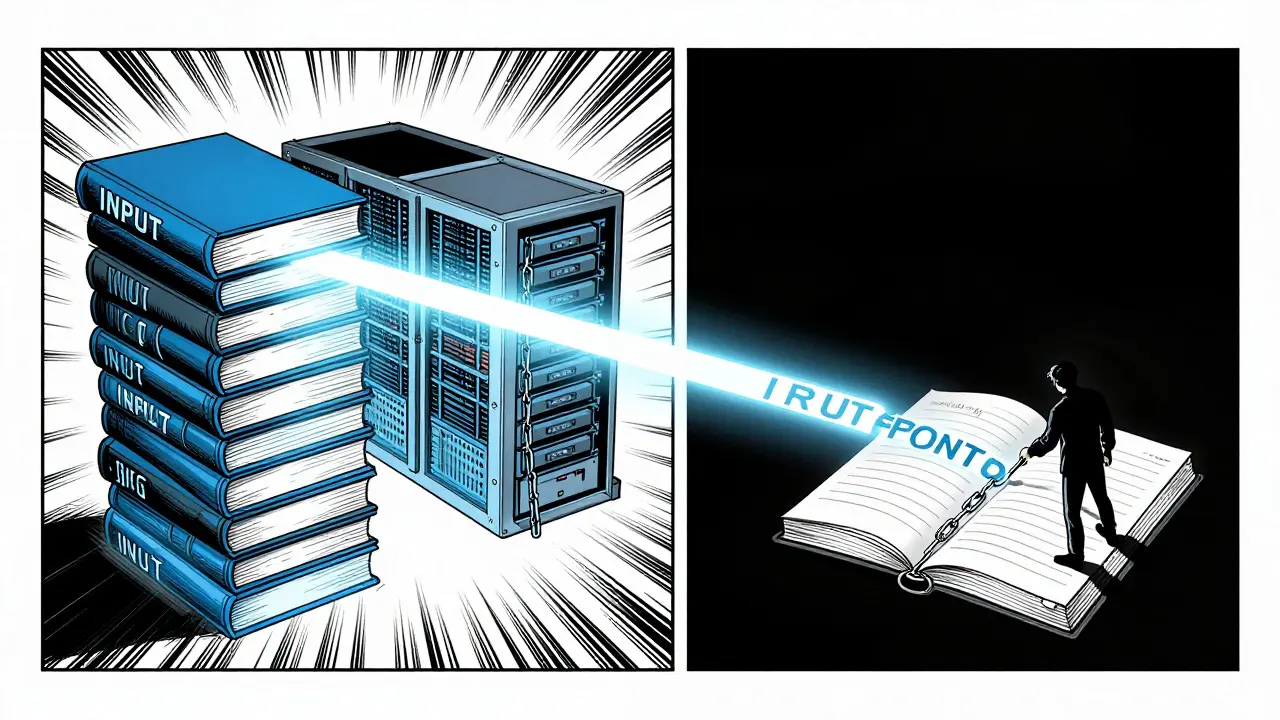
Input tokens are processed in parallel. Imagine you hand a librarian a stack of fifty books and ask them to read them all. They pick up the whole stack and start reading. Whether the stack has ten books or one hundred, the act of receiving and scanning the context happens in a single computational pass. The GPU loads all those input tokens into memory at once and processes them together. This is efficient. The computational work doesn’t scale linearly with every single word; it scales with the batch size.
Output tokens are generated sequentially. Now imagine asking that librarian to write a new book based on those fifty. They can’t write the whole book at once. They have to write the first sentence. Then, looking at that first sentence, they write the second. Then the third. Each new word depends on every word that came before it. This is called autoregressive generation.
For every single output token the model produces, it must perform a full inference pass over the entire context window-including your original input and all previous output tokens. If the model generates 100 words, it runs that heavy calculation 100 times. That is why output is expensive. It’s not just writing; it’s re-evaluating the entire conversation history for every single word it creates.
Real-World Pricing Data: The Multiplier Effect
This technical reality shows up clearly in the pricing sheets of major providers in 2026. The industry has settled on a standard multiplier where output costs significantly more per million tokens than input.
| Model Provider | Model Name | Input Cost ($) | Output Cost ($) | Multiplier |
|---|---|---|---|---|
| OpenAI | GPT-4o Mini | $0.15 | $0.60 | 4x |
| OpenAI | GPT-4o | $2.50 | $10.00 | 4x |
| Anthropic | Claude Sonnet 4 | $3.00 | $15.00 | 5x |
| Anthropic | Claude Opus 4 | $15.00 | $75.00 | 5x |
| OpenAI | GPT-5.2 Pro | $21.00 | $168.00 | 8x |
As you can see, the median ratio sits around 4x. For premium models like GPT-5.2 Pro, that ratio jumps to 8x. This means if you’re using a high-end model, a verbose response isn’t just slightly more expensive-it’s exponentially more costly. A 1,000-word essay generated by GPT-5.2 Pro could cost as much as feeding the model hundreds of thousands of words of context.
The Hidden Cost: Reasoning Tokens
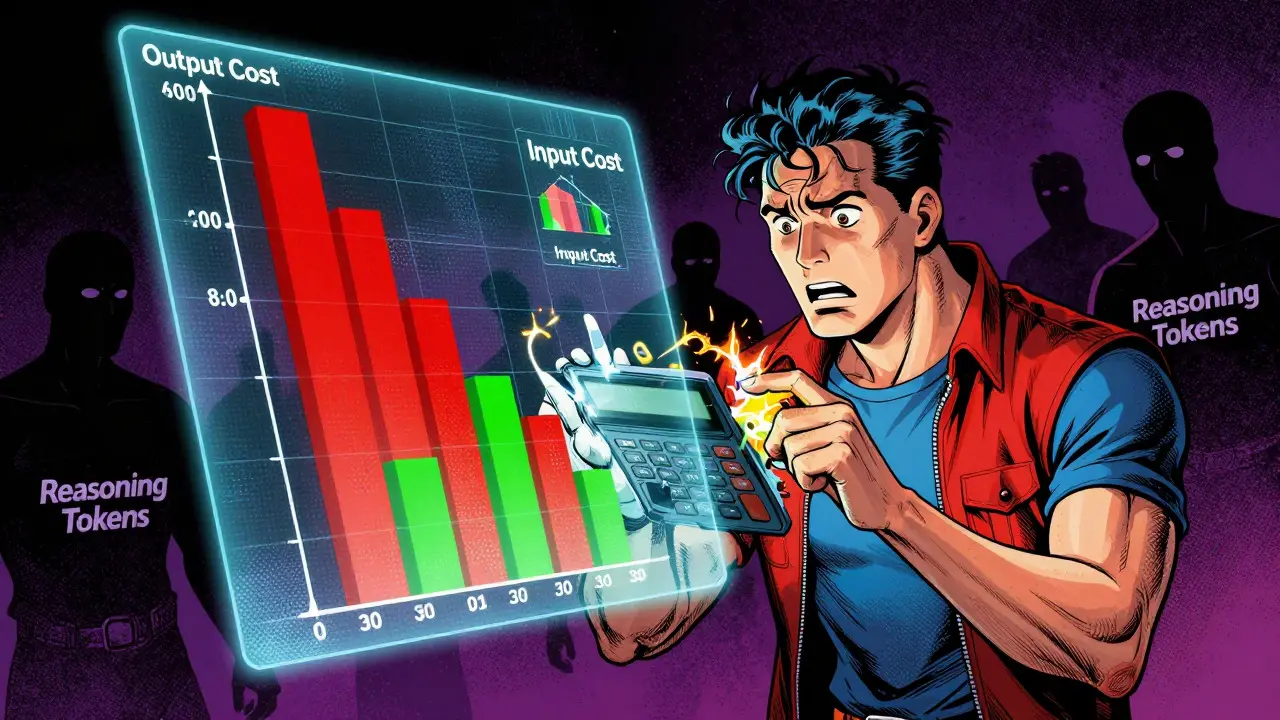
There’s a third category you need to watch out for: reasoning tokens. Many modern models now use a "chain-of-thought" approach where the model thinks internally before answering. These internal steps are often hidden from you but still count toward your bill.
In many cases, reasoning tokens cost even more than standard output tokens. You might get a short, concise answer, but if the model spent 500 tokens "thinking" through the logic behind it, you pay for those 500 tokens too. This creates a three-tier pricing structure:
- Input Tokens: Cheapest. Parallel processing.
- Output Tokens: Expensive. Sequential generation.
- Reasoning Tokens: Most expensive. Complex intermediate computations.
If you’re debugging why your bill spiked despite short responses, check if your model is enabled for extended reasoning. Those hidden tokens add up fast.
Why Input Volume Still Matters
Here’s a counter-intuitive fact: even though output tokens are more expensive *per unit*, input tokens often make up the bulk of your total bill. Why? Because volume.
In real-world applications, especially those using Retrieval-Augmented Generation (RAG), you might feed the model 50,000 tokens of context to generate just 500 tokens of output. Even at a lower rate, 50,000 inputs can outweigh the cost of 500 outputs. Research from LeptonAI indicates that typical usage patterns generate 3 to 10 times more input tokens than output tokens.
This creates a tricky budgeting scenario. You can’t just focus on shortening the output. You also need to manage how much context you’re stuffing into the prompt. Sending a 100-page PDF to a model when only page 5 matters is throwing money away, even if the output is free.
Optimization Strategies: How to Lower Your Bill
Understanding the mechanics gives you leverage. Here are practical ways to reduce costs without sacrificing quality.
1. Compress Your Context Window
Don’t send raw logs or unstructured documents if you don’t have to. Pre-process your data. Summarize long conversations before appending them to the next prompt. Use vector databases to retrieve only the most relevant snippets rather than dumping the entire knowledge base into the context window. Every token you remove from the input reduces the computational load for every output token generated.
2. Constrain Output Length
Be explicit in your system prompts. Instead of saying "Analyze this code," say "Identify the top three bugs in this code and list them briefly." Vague prompts lead to verbose explanations. Verbose explanations trigger sequential processing loops that burn cash. Force the model to be concise.
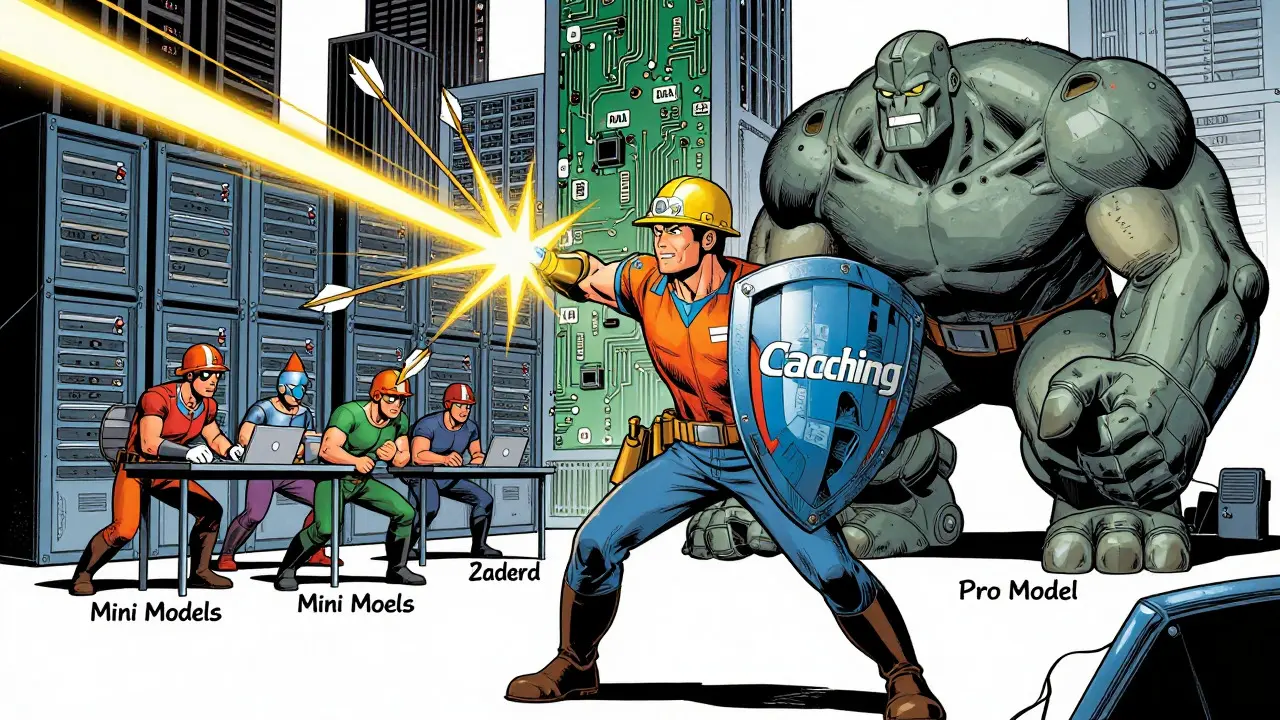
3. Leverage Caching
Providers like DeepSeek have introduced caching mechanisms that drastically cut input costs. If you send the same system prompt or common context repeatedly, the provider caches it. In DeepSeek’s case, cached input tokens cost $0.028 per million, while uncached ones cost $0.28. Structure your prompts so the static parts (like instructions) come first and repeat across requests. This allows the cache to hit, flattening your input costs significantly.
4. Choose the Right Model Tier
Not every task needs GPT-5.2 Pro. For simple classification, summarization, or basic Q&A, smaller models like GPT-4o Mini or Claude Haiku are sufficient. They have lower absolute prices, and because the output multiplier is similar, saving on the base rate saves you everywhere. Reserve the expensive, high-reasoning models for complex tasks where accuracy is critical.
Is the Pricing Fair?
Some developers argue that the 4x to 8x multiplier is inflated. Hardware costs for sequential generation are high, but perhaps not *that* high. Providers likely use these multipliers to simplify billing and encourage efficient usage. If output were cheap, users would treat the API like a chatbot, flooding it with endless, unnecessary dialogue. By making output expensive, providers incentivize engineers to build efficient systems that minimize generation length.
Whether it’s pure engineering economics or strategic pricing, the result is the same: you pay for compute intensity. The best defense is awareness. Track your input-to-output ratios, prune your context, and demand brevity from your models.
What is the main reason output tokens cost more than input tokens?
Output tokens cost more because they are generated sequentially (one by one), requiring the model to run a full inference pass for each token. Input tokens are processed in parallel, allowing the GPU to handle them all in a single pass.
How much more expensive are output tokens typically?
In 2026, the industry standard multiplier is approximately 4x for mid-tier models and up to 8x for premium models like GPT-5.2 Pro. This means output tokens cost 4 to 8 times more per million tokens than input tokens.
Do reasoning tokens cost extra?
Yes. Reasoning tokens, which represent the model's internal thought process, are often billed separately and can cost more than standard output tokens. They add a hidden layer of expense to complex queries.
Can I reduce my LLM costs by shortening my prompts?
Yes. Shorter inputs reduce the context window size, which lowers the computational load for every subsequent output token. Additionally, using caching features for repeated system prompts can drastically cut input costs.
Which costs more: a long input or a long output?
While output tokens have a higher per-token price, long inputs often drive higher total bills due to volume. However, a very long output is more dangerous because its cost scales sequentially. A 10,000-token output is significantly more expensive than a 10,000-token input.