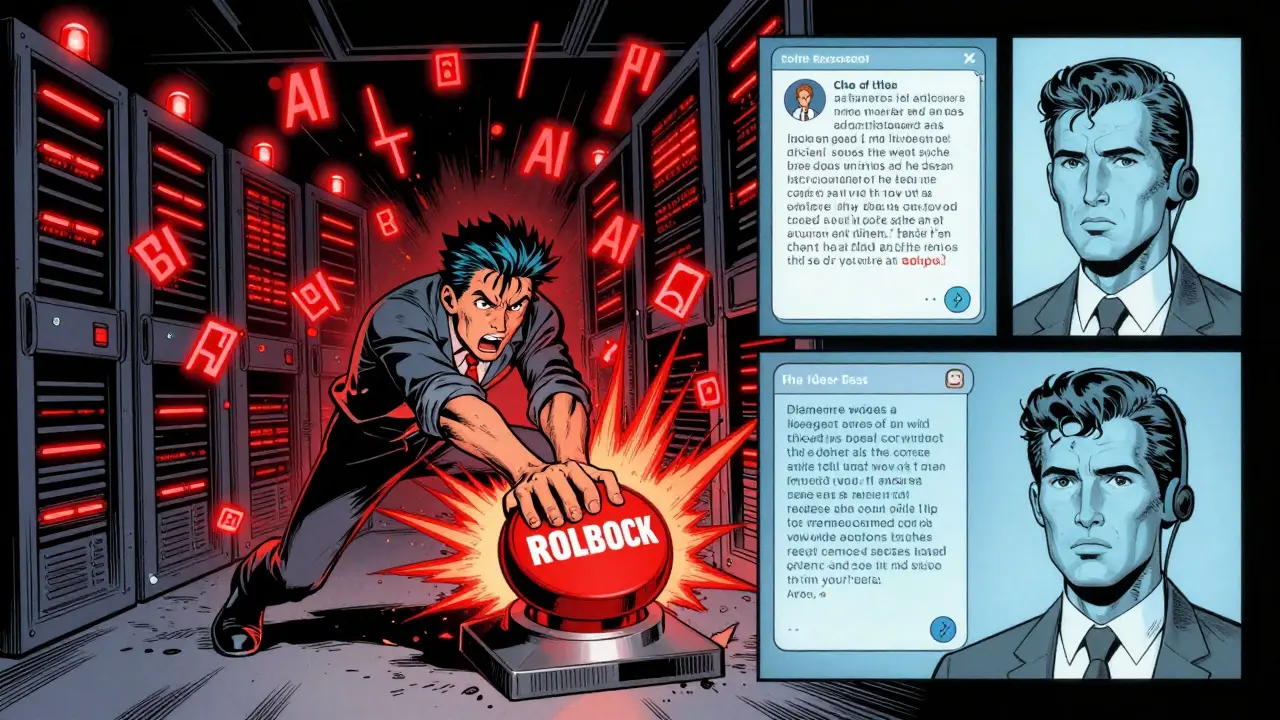
When an AI model starts recommending the wrong products, misdiagnosing medical images, or generating toxic customer responses, you don’t have time to debug it like regular code. The system is already live, users are affected, and revenue is bleeding out. That’s where a rollback playbook isn’t just helpful-it’s your last line of defense.
Why Rollback Playbooks Are No Longer Optional
In 2024, 68% of enterprises experienced at least one major AI deployment failure, according to Gartner. By 2025, 92% of Fortune 500 companies had formal rollback procedures in place. Why? Because the cost of inaction is too high. For an e-commerce platform, a single AI glitch can cost over $2 million in lost sales. In healthcare, it can mean wrong treatments. In finance, it can trigger regulatory fines under the EU AI Act or SEC Rule 15c3-5. Rollback playbooks are structured, repeatable steps to undo a bad AI deployment fast. They’re not about avoiding mistakes-they’re about surviving them. The goal isn’t perfection. It’s recovery speed. Mature teams now recover in under 5 minutes. Without a playbook, the average takes nearly an hour.How Rollback Playbooks Actually Work
A good playbook doesn’t just say "roll back." It answers: When do you roll back? How do you do it? What gets restored? And who needs to know? Most organizations use one or more of these four strategies:- Canary deployments: Launch the new model to just 1-5% of users. Monitor latency, error rates, and output quality for 30 seconds. If error rates spike above 0.8% or accuracy drops more than 3%, auto-rollback kicks in. Spotify used this to prevent a $750,000 loss when their recommendation model started suggesting inappropriate content.
- Blue-green deployments: Run two identical production environments. Switch traffic from the old (green) to the new (blue) model. If something breaks, flip the switch back in seconds. It doubles infrastructure cost but gives instant recovery.
- Feature flags: Turn AI features on/off without redeploying. If the new model starts hallucinating in chat responses, disable just that feature. 85% of companies use this, but managing 200+ flags can become a nightmare-some teams report 37% higher cognitive load.
- Fallback models: Keep a simple, older model running in parallel. If the fancy Transformer model fails, switch to a logistic regression model that’s slow but reliable. McKinsey found this adds 28% complexity, but it saved JPMorgan’s trading bot during a model drift event in late 2024.
What Makes a Rollback Trigger Actually Work
Too many teams set triggers based on technical metrics: "If latency exceeds 300ms, rollback." That’s wrong. The right triggers are tied to business impact:- For a loan approval model: If approval rate drops more than 5% in 10 minutes, rollback. That’s lost revenue.
- For a medical diagnostic tool: If false negatives rise above 1.5%, rollback immediately. Lives are at stake.
- For a customer service bot: If sentiment score falls below -0.3 on 100+ consecutive interactions, rollback. That’s brand damage.

Tools That Make Rollback Real
You can’t roll back without the right tech stack. Here’s what works in 2025:- MLflow 3.2 and DVC 4.1: Version your models and datasets. NIST requires at least 90 days of immutable storage for production models.
- ArgoCD and FluxCD: GitOps tools that treat deployments as code. Rollback? Just revert the Git commit.
- LaunchDarkly and Split.io: Manage feature flags at scale across 10,000+ concurrent users.
- Amazon SageMaker and Google Vertex AI: Built-in rollback with canary analysis and auto-triggered recovery. Vertex AI achieves 99.995% reliability by combining canary, fallback, and automated triggers.
- Flyway 10.21.0: For database rollbacks. Schema changes must roll back in under 100ms without downtime.
- Prometheus + Open Policy Agent (OPA): Monitor metrics and enforce rollback rules as code.
The Hidden Failure Points
Most rollbacks fail-not because the tech doesn’t work, but because people didn’t plan for the messy parts:- Undefined success criteria (41% of failures): No one agreed on what "fixed" looks like.
- Insufficient monitoring (29%): They only tracked latency, not output quality or bias drift.
- Untested procedures (22%): The playbook exists on a wiki page. No one’s ever run it.

Implementation Roadmap
You don’t need to build the perfect playbook on day one. Start small. Follow this 4-phase plan:- Assessment (2 weeks): List your top 3 AI systems that could cause real harm if they fail. Map out their current deployment process.
- Playbook design (3 weeks): Pick one rollback strategy (canary or feature flag). Define 3 business-driven triggers. Document the steps.
- Integration testing (4 weeks): Test in a staging environment. Simulate a failure. Time how long it takes to roll back. Repeat until it’s under 5 minutes.
- Production validation (2 weeks): Deploy to 1% of users. Monitor. Adjust triggers. Train your team.
What’s Next: AI That Rolls Back Itself
The next wave is automated decision-making. NVIDIA’s NeMo Rollback Advisor, in beta, uses reinforcement learning to predict the optimal rollback time with 92.7% accuracy. It doesn’t just react-it anticipates. JPMorgan’s Quorum-based AI Deployment Ledger uses blockchain to create tamper-proof rollback logs for compliance. Regulators are watching. By 2027, the EU and US may require rollback playbooks for all public-facing AI systems. But the biggest shift? Rollback is becoming part of the design-not an afterthought. Teams that treat rollback as infrastructure, not emergency medicine, are the ones surviving the AI boom.Frequently Asked Questions
What’s the difference between a rollback and a revert?
A revert is a manual fix-like restoring a file from backup. A rollback is a structured, automated process tied to triggers and monitoring. Rollbacks are designed to happen fast, with clear ownership and documentation. Reverts are reactive. Rollbacks are proactive.
Can I use a rollback playbook for generative AI prompts?
Yes. Platforms like Braintrust.dev and Maxim AI let you version and rollback entire prompt chains. If your new prompt starts generating biased or harmful content, you can switch back to the last approved version with a single click. This is critical for customer-facing chatbots and content generators.
Do I need Kubernetes to run a rollback playbook?
Not always, but it helps. Kubernetes-native tools like Argo Rollouts automate canary analysis and rollback. If you’re deploying on cloud platforms like AWS SageMaker or Azure ML, they handle the orchestration for you. For smaller teams, feature flags and versioned APIs can work without Kubernetes-but you’ll lose speed and automation.
How often should I test my rollback playbook?
Quarterly, at minimum. Treat it like a fire drill. Simulate 3-5 different failure scenarios: model drift, data corruption, prompt injection, latency spikes, and bias emergence. If your team panics during the test, you’re not ready for real life.
What’s the biggest mistake companies make with AI rollbacks?
They focus on technical metrics instead of business impact. A 2% drop in model accuracy might be fine for a movie recommendation engine-but catastrophic for a fraud detection system. Your triggers must reflect what matters to your customers and your bottom line, not just what’s easy to measure.
Is rollback enough for AI governance?
No. Rollback is a safety net, not a solution. Good AI governance also includes bias testing, explainability, human oversight, and audit trails. But without rollback, you have no way to contain damage. It’s the last layer of defense-and if you don’t have it, you’re gambling with your reputation.



Tyler Springall
January 7, 2026 AT 05:18Colby Havard
January 8, 2026 AT 05:36Amy P
January 9, 2026 AT 05:17Ashley Kuehnel
January 10, 2026 AT 14:02Denise Young
January 10, 2026 AT 18:48Sam Rittenhouse
January 11, 2026 AT 20:32