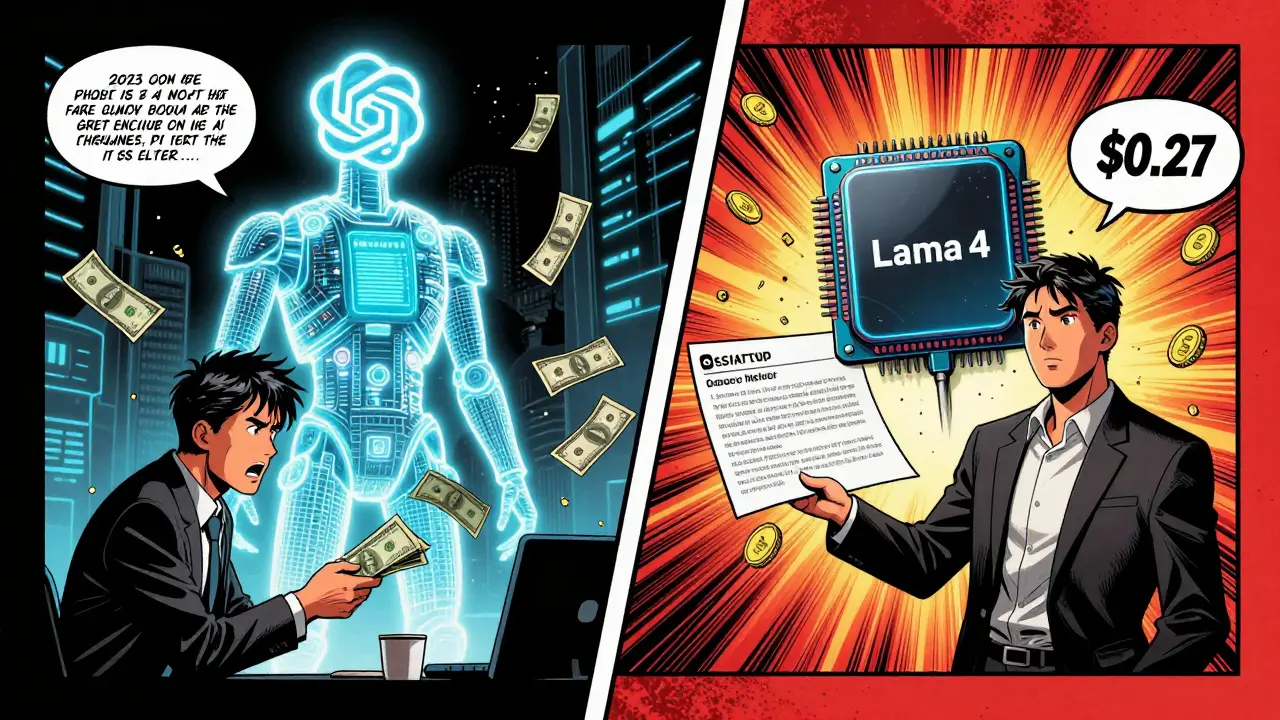
Three years ago, running a single query through a top-tier large language model cost $60 per million tokens. Today, you can do the same job for less than $0.75. That’s not an improvement-it’s a collapse. And it’s not slowing down. The price of AI is falling faster than anyone predicted, not because of charity or generosity, but because competition is turning powerful language models into something almost as common as electricity: a commodity.
How LLM Prices Plunged 98% in Just Three Years
In 2023, GPT-4 was the gold standard. If you wanted to ask it a question, analyze a document, or generate a report, you paid dearly. The cost? Around $60 per million tokens. That meant even a simple chatbot could rack up hundreds of dollars a month in usage fees. Now? GPT-4-level performance costs under $1 per million tokens. Some models are even cheaper.
Why? Three things: better hardware, smarter models, and more players. Companies like Meta, DeepSeek, and Mistral didn’t wait for OpenAI to lead. They built open-source models that match or beat older versions at a fraction of the cost. Meta’s Llama 4 Maverick, for example, charges just $0.27 per million input tokens and $0.85 for output. That’s 95% cheaper than what GPT-4 cost in 2023.
This isn’t just about bigger servers. It’s about how models are built. New techniques like Mixture-of-Experts (MoE) mean the AI doesn’t use all its neurons for every request-only the ones needed. Speculative decoding lets a small model guess the answer first, then checks it with a bigger one. Quantized models run on 4-bit or 8-bit precision instead of 16-bit, cutting compute needs in half. These aren’t buzzwords-they’re cost-cutting engines.
The Two-Tier Market: Commodity vs. Premium
The LLM market isn’t one big pile of cheap AI anymore. It’s split cleanly in two.
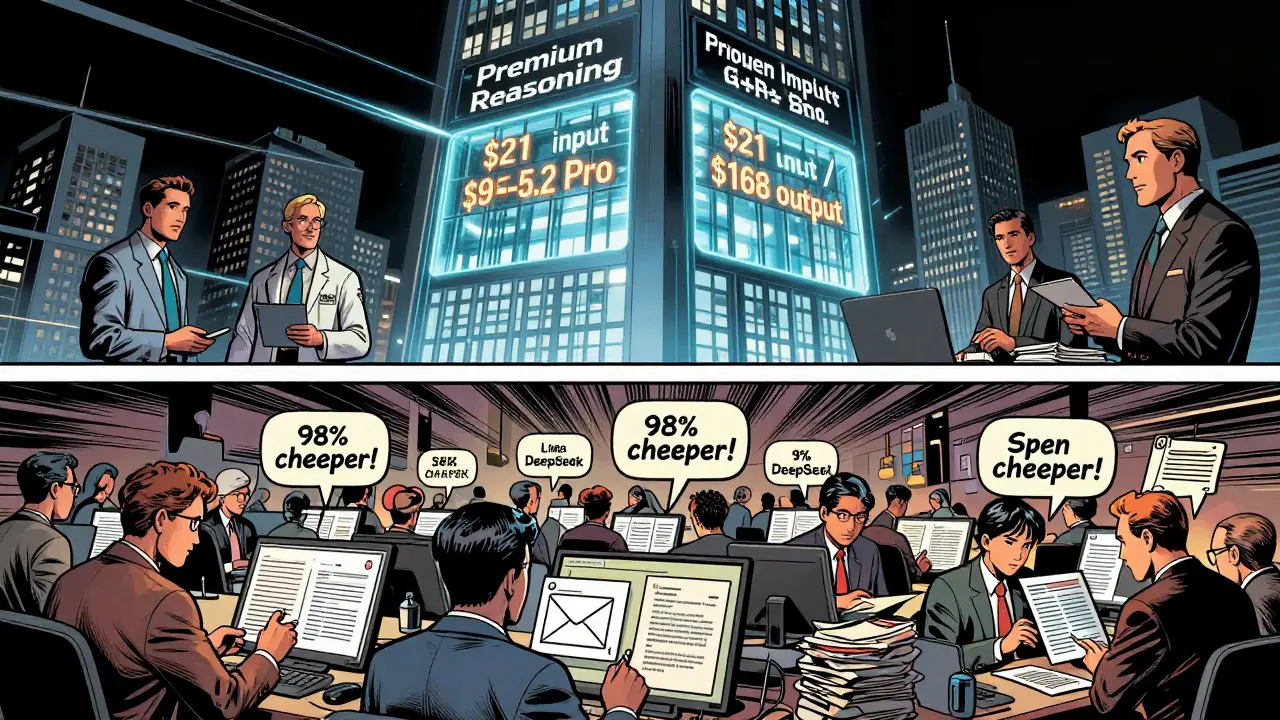
On one side, you’ve got commodity models. These handle everyday tasks: summarizing emails, answering FAQs, generating basic content, tagging data. They’re fast, reliable, and dirt cheap. Llama 4 Maverick, DeepSeek R1, and even smaller open-source models are pushing prices down to pennies per thousand queries. This is where most businesses will run their chatbots, content filters, and internal tools. Why pay more when $0.30 per million tokens does the job?
On the other side, there are premium reasoning models. These are the ones you use when accuracy matters. Legal contract analysis. Medical diagnosis support. Financial forecasting. Multi-step research. OpenAI’s GPT-5.2 Pro charges $21 per million input tokens and $168 per million output tokens. Anthropic’s Claude Opus 4? $15 input, $75 output. That’s an 8x difference between input and output.
Why the gap? Because these models don’t just respond-they think. They run internal reasoning chains, simulate multiple paths, check their own logic. That takes way more compute. And right now, there’s no open-source model that can match them at scale. So they keep their price premium. But here’s the catch: only a small fraction of businesses actually need this. Most just need to summarize a PDF or answer customer questions.
The Hidden Costs No One Talks About
Don’t be fooled by the low token prices. The real bill isn’t just what the LLM charges-it’s what else you’re running on top of it.
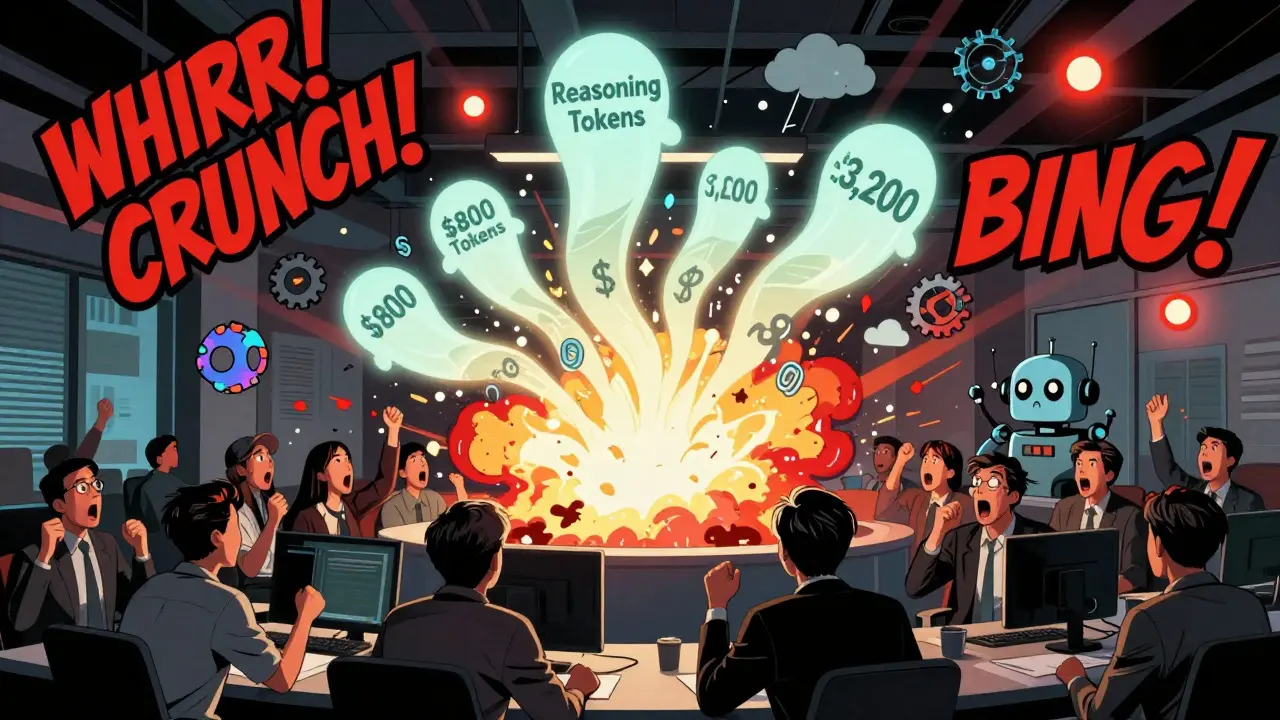
First, there are reasoning tokens. Models like GPT-o1 and Claude 3.5 Sonnet Thinking do internal processing before answering. You don’t see it, but you pay for it. If you ask for a detailed analysis, the model might generate 5,000 internal tokens before giving you a 500-token answer. Those 4,500 hidden tokens? They’re billed. Suddenly, your “$0.50 query” turns into a $4.50 one.
Then there’s embeddings. If you’re building a search system, you need to turn text into vectors and store them. Services like Pinecone or Weaviate charge per query and per gigabyte of storage. Rerankers-models that reorder search results-are another layer. And don’t forget post-processing: summarizing, filtering, classifying. Each step adds cost.
One startup I spoke to in Asheville was shocked when their monthly bill jumped from $800 to $3,200. They thought they were just using LLMs. Turns out, they were running embeddings on 200GB of documents, reranking 10,000 results daily, and triggering internal reasoning on every response. The LLM itself was only 20% of the cost.
Per-Token Is Dying. Per-Action Is Coming
Token-based pricing was fine when AI was new. But now, business users don’t care about tokens. They care about outcomes: “How much does it cost to summarize a contract?” “What’s the price to extract data from an invoice?”
That’s why companies are shifting to per-action pricing. Instead of charging per token, they charge per task. OpenAI already offers this in some enterprise tools. For example: $0.50 per contract review, $0.15 per invoice extraction, $2.00 per customer sentiment analysis. No counting tokens. No surprises. Just predictable costs tied to real work.
This isn’t just easier for users-it’s better for vendors. When you charge per outcome, you’re incentivized to make the model smarter, faster, and more accurate. You don’t want them to generate 10,000 tokens just to earn more. You want them to get it right in 500.
Team Plans and Enterprise Deals Are Changing the Game
If you’re not a developer running API calls, you don’t want to track tokens. That’s why team and enterprise plans are growing fast.
OpenAI’s team plan? $25 per user per month (if billed yearly). You get higher message limits, voice modes, admin controls, and data privacy guarantees. No per-token billing. Just a flat fee. Same for Anthropic and Mistral-they’re rolling out similar structures. Enterprise plans go further: custom models, private deployments, SLAs, audit logs, and 24/7 support. These aren’t for hobbyists. They’re for banks, hospitals, law firms, and government agencies that need reliability, not savings.
What’s interesting? The cheapest models are often the ones you can’t use in enterprise settings. Open-source LLMs might cost nothing, but if you need compliance, encryption, or audit trails, you’ll pay for the enterprise layer anyway.
What’s Next? 2026-2027 Predictions
Here’s what’s coming:
- Commodity models will hit $0.10 per million tokens by late 2026. We’re already seeing 7-billion-parameter models match 70-billion-parameter ones from two years ago. Efficiency gains aren’t slowing.
- Premium models will hold steady or rise. GPT-5.2 Pro and Claude Opus 4 won’t drop much. Their value isn’t in volume-it’s in precision. If you’re making decisions worth millions, $0.001 per token is still cheap.
- Per-action pricing will become standard. By 2027, most B2B AI tools will bill by task, not token. Think “$1.99 per legal brief summary” instead of “$0.0003 per token.”
- SLAs will matter more than speed. Companies will pay more for guaranteed uptime, data isolation, and response consistency than for raw performance.
- Open-source will dominate low-end use cases. Llama, DeepSeek, and Mistral will power 70% of chatbots, content generators, and internal tools by 2027. Closed models will focus on high-stakes, high-value tasks.
The big shift? AI is no longer a luxury. It’s infrastructure. Just like cloud servers in the 2010s, the basic layer is becoming cheap and universal. The real money is in what you build on top of it.
What This Means for You
If you’re using AI for routine tasks-email replies, content drafts, basic data sorting-switch to Llama 4 Maverick or DeepSeek R1. You’ll save 90% without losing quality.
If you’re in legal, finance, or healthcare, stick with premium models. But demand per-action pricing. Ask vendors: “Can I pay per contract reviewed, not per token?”
If you’re building a product, stop optimizing for token efficiency. Start optimizing for task efficiency. Can you combine embedding, reranking, and LLM into one fixed-cost workflow? That’s where the real savings are.
The era of overpaying for AI is over. The era of smart spending is just beginning.
Why are LLM prices falling so fast?
LLM prices are falling because of three forces: better model architectures (like Mixture-of-Experts), more competition from open-source models (Meta, DeepSeek, Mistral), and hardware improvements that let smaller models do what larger ones used to. Efficiency gains are compounding-models today achieve 2023-level performance with 1/10th the compute. This is similar to how cloud computing prices dropped once AWS, Google, and Azure scaled up.
Are open-source LLMs really cheaper than OpenAI’s models?
Yes, for general tasks. Meta’s Llama 4 Maverick costs $0.27 per million input tokens and $0.85 for output. OpenAI’s GPT-4o Mini is $0.0007 per million tokens, but that’s only for basic tasks. For anything requiring reasoning, GPT-5.2 Pro costs $21 input and $168 output-over 200x more. Open-source models are cheaper and good enough for 80% of use cases. Premium models still win for accuracy-critical work.
What are reasoning tokens, and why do they cost more?
Reasoning tokens are internal steps a model takes before giving an answer. For example, when analyzing a contract, the model might generate 10,000 internal tokens to think through clauses, risks, and implications. Even if your final answer is 500 tokens, you’re billed for all 10,500. This happens automatically in models like GPT-o1 and Claude 3.5 Sonnet Thinking. They’re not optional-they’re built into the process. That’s why complex tasks can suddenly become expensive.
Should I use per-token or per-action pricing?
If you’re a developer or engineer managing API calls, per-token gives fine control. But if you’re a product manager, marketer, or legal team, per-action is better. Paying $1.50 per contract summary is easier to budget than tracking 5,000 tokens. Most enterprise tools are shifting to per-action because it aligns cost with real business value-not technical output.
Will AI become free like electricity?
No-but basic AI will become as cheap as electricity. You won’t pay for the power grid, but you’ll pay for how you use it. LLMs will follow the same path: the infrastructure (the model) becomes cheap, but value-added layers (custom training, security, SLAs, integration) will cost money. Think of it like water: the pipe is cheap, but filtered, bottled, or smartly delivered water costs more.



mark nine
March 1, 2026 AT 19:49Open-source models aren't just cheaper-they're more flexible. You own the weights. You control the pipeline. That's worth more than any discount.
Sandi Johnson
March 3, 2026 AT 14:20Eva Monhaut
March 4, 2026 AT 18:46When we look back in 2030, we’ll say this was the moment AI stopped being a trophy and became a tool.
Rakesh Kumar
March 5, 2026 AT 08:51Tony Smith
March 5, 2026 AT 13:03Bill Castanier
March 6, 2026 AT 06:52