
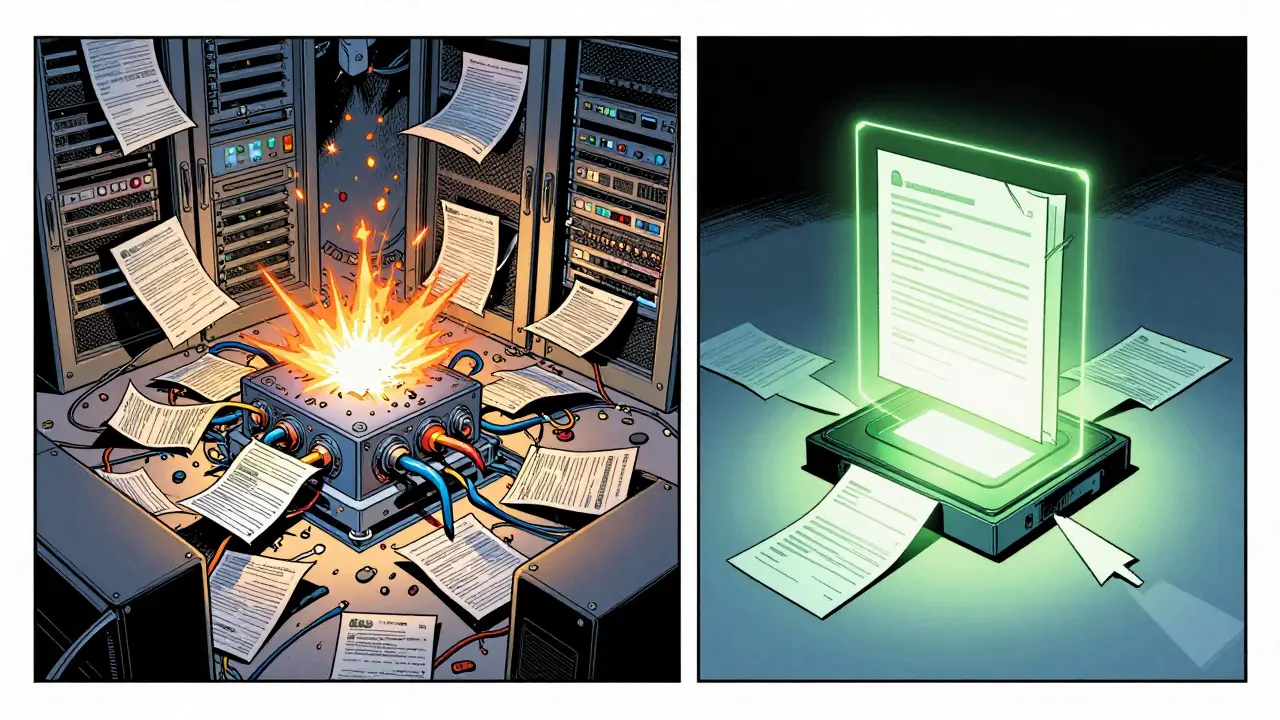
When you use a chatbot to answer questions about customer records, medical histories, or financial reports, you might think it’s just reading the data. But here’s the scary part: Privacy-Aware RAG exists because most systems don’t just read-they send that data straight to an AI model running in the cloud. And once it’s sent, there’s no guarantee it won’t be stored, logged, or leaked. In 2023, 68% of early RAG systems accidentally exposed sensitive information through unredacted prompts or source documents. That’s not a bug. It’s a default setting in standard setups.
What Is Privacy-Aware RAG?
Retrieval-Augmented Generation, or RAG, lets AI models pull information from your internal documents-like HR policies, support tickets, or patient records-to give smarter answers. But without privacy controls, every query you send includes raw data. A customer service rep typing, “What’s John Doe’s insurance ID?” sends that full sentence to an LLM. The model reads it, responds, and-depending on the provider-might log it for training. That’s a GDPR and HIPAA violation waiting to happen.
Privacy-Aware RAG fixes this by stripping out sensitive details before they ever reach the AI. It doesn’t block access. It doesn’t slow down answers. It just removes what shouldn’t be seen. Think of it like a redactor’s pen crossing out Social Security numbers before a document is shared. Only now, it’s automated, precise, and built into the AI pipeline.
Two Ways to Protect Data: Prompt-Only vs. Source Documents
There are two main strategies for making RAG privacy-aware. They work differently, and choosing between them changes your entire setup.
Prompt-only privacy works in real time. As soon as a user types a question, the system scans it for Personally Identifiable Information (PII)-names, addresses, account numbers-and removes them before sending the query to the LLM. The model answers based on cleaned text. Then, the answer is returned with the original context restored for the user. This method is fast: 150-300 milliseconds per request. It’s ideal for high-volume systems like call centers or live chat. But it only protects what’s in the prompt. If your source documents contain unredacted patient records, those still get embedded and stored in your vector database.
Source documents privacy works offline. Before any documents are turned into embeddings (the AI’s way of understanding text), every file is scanned and scrubbed. Names, IDs, dates, and financial figures are removed from the source material itself. The vector database then stores only clean versions. When a user asks a question, the system retrieves from these sanitized documents. This approach reduces real-time processing by 35-50% because the heavy lifting is done ahead of time. It’s better for compliance-heavy environments like hospitals or banks. But it uses 20-40% more storage because you’re keeping both the original and redacted versions.
How Accurate Is It? The Trade-Off Between Privacy and Performance
Here’s the hard truth: protecting data can hurt accuracy. Standard RAG systems get 92.3% of answers right on enterprise knowledge tasks. Privacy-Aware RAG, with aggressive redaction, drops to 88.7%. Why? Because removing too much context leaves the AI guessing. If you erase every dollar amount from financial reports, the model can’t answer, “What’s the monthly revenue for Region A?”
But the gap isn’t as wide as it sounds. With smart redaction settings, accuracy can climb back to within 2.1% of standard RAG. Google Cloud’s healthcare case study in November 2024 showed this: by adjusting how much data was removed based on the question type, they kept answers accurate while protecting PHI (Protected Health Information). The key? Don’t erase everything. Erase only what’s risky.
There are worse alternatives. Full anonymization-rewriting all data to look generic-cuts accuracy by 30-40%. Air-gapping, or running everything on-premises, stops cloud exposure but increases costs 4-7 times. Privacy-Aware RAG strikes a balance: strong protection without crippling performance.
Where It Works Best (and Where It Fails)
Privacy-Aware RAG shines in regulated industries. JPMorgan Chase’s pilot program in Q1 2025 hit 99.2% compliance with FINRA rules. Mayo Clinic maintained 98.7% protection of patient data. Salesforce deployed it across 12,000 agents with 99.8% PII protection.
But it struggles in areas where precision matters. Deloitte’s banking analysis found accuracy dropped from 94.1% to 82.6% when redacting financial figures. If your AI needs to pull exact numbers from contracts, invoices, or balance sheets, aggressive redaction breaks it. That’s why smart teams use layered redaction: keep raw numbers in secure, internal systems and only send sanitized summaries to the LLM.
Another failure point? Multilingual data. Current tools only catch 76.4% of non-English PII. If your company operates in Spain, Japan, or Brazil, you can’t rely on English-only redactors. Custom models trained on local formats are needed.
Implementation Challenges You Can’t Ignore
Setting up Privacy-Aware RAG isn’t plug-and-play. Teams report 8-12 weeks of work just to get it running. Why? Three big hurdles:
- Context matters. “John’s SSN is 123-45-6789” - you need to remove the number but keep “John.” Most tools can’t tell the difference between a name and a number without deep context. That requires custom AI models trained on your data.
- Configuration is messy. Gartner found 61% of tested solutions missed edge-case PII. A phone number written as “(555) 123-4567” gets caught. One written as “555.123.4567” doesn’t. You need continuous testing.
- Skills are rare. You need people who understand NLP, data security, and vector databases. Job postings for RAG roles now require LangChain, LlamaIndex, and experience with Pinecone or Weaviate. Only 42% of teams have someone trained in differential privacy.
Open-source tools are improving but still score 3.2/5 in documentation clarity. Commercial platforms like Private AI and Google Cloud’s Vertex AI hit 4.6/5. If you’re not a tech giant, buying a solution might save more than it costs.

What’s Next? The Future of Privacy-Aware RAG
By 2026, 85% of enterprise RAG systems will include privacy features-up from 32% in 2024. The EU AI Act forces this change: privacy-by-design is mandatory by Q3 2025. That’s why OpenAI, Google, and Salesforce are all adding redaction tools to their APIs.
New developments are making it smarter. Private AI’s version 2.3, released in October 2024, uses “adaptive redaction thresholds.” It checks the question type and decides how much to remove. A simple “What’s the policy on sick leave?” gets light redaction. A request for “List all employees with recent back injuries” triggers heavy scrubbing. This cuts over-redaction by 31%.
NIST and IETF are building official guidelines. By mid-2025, there will be standardized testing for privacy-preserving RAG. That means you won’t have to guess whether your setup works-you’ll have a checklist.
But the arms race continues. MIT’s research predicts any new privacy technique has a 12-18 month window before attackers find ways around it. That’s why continuous monitoring is non-negotiable. Measure your false negative rate. Run quarterly adversarial tests. Treat privacy like cybersecurity-not a one-time fix, but an ongoing practice.
Final Thoughts: Is Privacy-Aware RAG Worth It?
If you’re using RAG to answer questions about people, money, or health, then yes. The cost of a single breach-fines, lawsuits, reputational damage-far outweighs the setup time. The 14,000-patient HIPAA violation in 2024? That came from a simple oversight: unredacted medical record numbers. It wasn’t a hacker. It was a default setting.
Start small. Pick one high-risk use case-maybe customer support for financial accounts. Implement source documents privacy. Test it. Measure accuracy. Tune your redaction rules. Then scale. Don’t try to do everything at once.
Privacy-Aware RAG isn’t about stopping AI. It’s about letting AI work safely. The future of enterprise AI doesn’t belong to the fastest models. It belongs to the ones that protect what matters most.
What’s the difference between standard RAG and Privacy-Aware RAG?
Standard RAG sends raw user prompts and source documents directly to the LLM, exposing sensitive data like names, IDs, and financial details. Privacy-Aware RAG removes or masks that data before it reaches the model-either in the prompt or in the source documents-so the AI never sees or processes sensitive information.
Does Privacy-Aware RAG reduce answer accuracy?
It can, but not always. Aggressive redaction lowers accuracy by up to 3.6 percentage points. However, with smart, context-aware redaction (like Google Cloud’s approach), accuracy drops by less than 2.1%. The key is not removing everything-just what’s risky. Over-redacting creates knowledge gaps, which leads to hallucinations.
Which industries benefit most from Privacy-Aware RAG?
Financial services lead adoption at 58%, followed by healthcare (47%) and government (39%). These sectors face strict regulations like GDPR, HIPAA, and FINRA, where data leaks carry heavy fines. Retail and manufacturing lag behind at under 25% adoption because they handle less sensitive data.
Can I use open-source tools for Privacy-Aware RAG?
Yes, but with caution. Open-source toolkits like LangChain and LlamaIndex support privacy features, but their documentation averages only 3.2/5 in user ratings. Commercial platforms like Private AI and Google Cloud offer better redaction accuracy, easier configuration, and built-in compliance reporting. For mission-critical systems, commercial tools reduce risk.
How long does it take to implement Privacy-Aware RAG?
Most organizations need 8-12 weeks for a full rollout. This includes training custom redaction models, testing edge cases, integrating with existing systems, and validating compliance. Teams with existing NLP and data security expertise move faster. Those starting from scratch often take longer due to the learning curve.
What’s the biggest mistake companies make when implementing Privacy-Aware RAG?
Assuming the redaction tool catches everything. Gartner found 61% of solutions failed to detect edge-case PII-like phone numbers in unusual formats or names embedded in free text. The fix? Continuous monitoring, adversarial testing, and setting false negative rates below 0.5%. Never trust the tool. Always verify.


Mark Brantner
March 10, 2026 AT 04:22Tamil selvan
March 10, 2026 AT 17:05saravana kumar
March 10, 2026 AT 17:16Samar Omar
March 12, 2026 AT 05:18Kate Tran
March 14, 2026 AT 02:36Deepak Sungra
March 14, 2026 AT 21:35amber hopman
March 15, 2026 AT 21:07Jim Sonntag
March 17, 2026 AT 06:55