
You spent months fine-tuning a large language model. You poured resources into data cleaning, hyperparameter tuning, and compute cycles. Then you release it as an API or open-source checkpoint. Suddenly, a competitor with half your budget replicates your performance using simple query imitation. They didn't steal your code; they stole the essence of your model-the weights. This isn't science fiction. It's the current reality for anyone building proprietary Large Language Models. Protecting these assets requires more than just locking down your server room. You need technical mechanisms that prove ownership and resist theft.
The Core Threat: Why Model Weights Are Vulnerable
Traditional software protection relies on obfuscation. You hide the logic behind compiled binaries. But neural networks don't work that way. The "logic" is distributed across billions of floating-point numbers known as weights. If someone can access your model's outputs, they can reverse-engineer its behavior. This process, called model extraction, allows attackers to train a surrogate model that mimics yours. They might not get identical weights, but they get 95% of the utility at a fraction of the cost.
The value proposition here is stark. A single proprietary LLM represents millions in R&D spend. Losing exclusive access to that capability erodes market advantage immediately. Consider the timeline: OpenAI released GPT-3 in June 2020. By 2024, commercial interest had exploded, bringing sophisticated attack vectors alongside new defense tools. Today, models like ChatGPT-4.5, Claude 3.5, and Gemini 2.5 all employ hidden protection layers. You don't see them, but they are there, guarding the crown jewels.
Fingerprinting vs. Watermarking: Choosing Your Defense
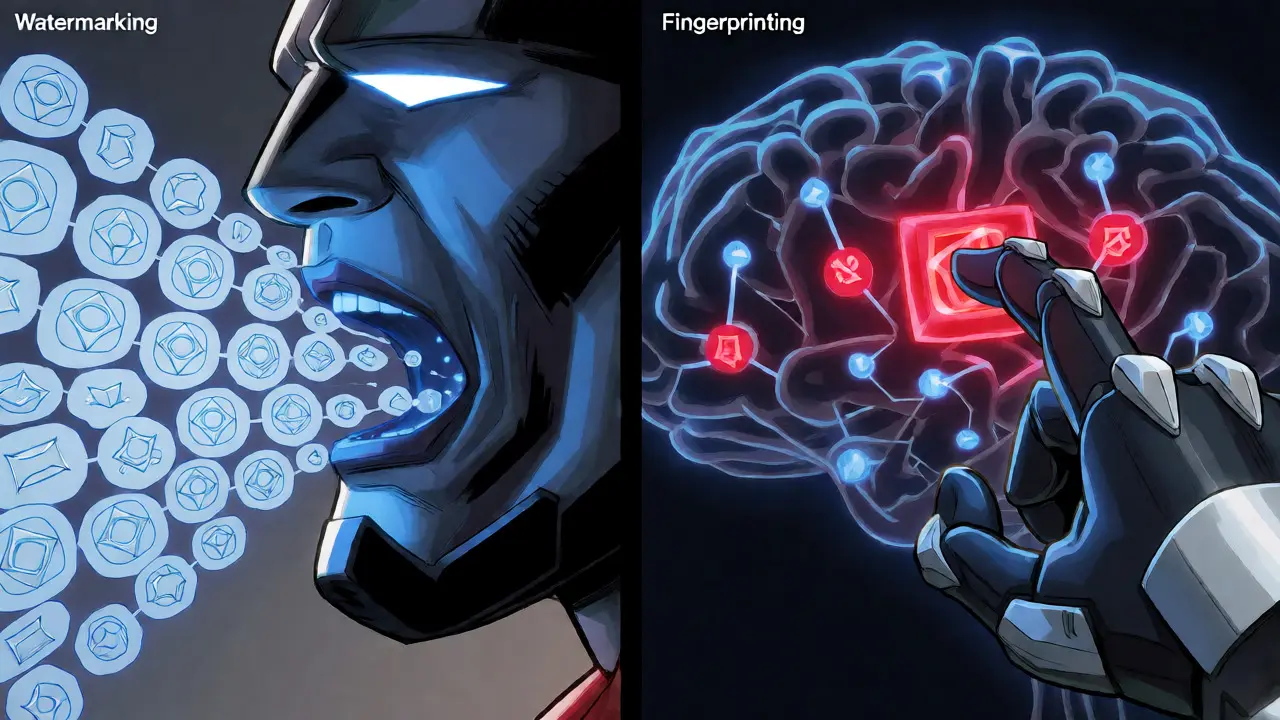
Two main strategies dominate the landscape: watermarking and fingerprinting. While often used interchangeably, they serve different purposes. Watermarking embeds signals in the output text. Fingerprinting embeds unique identifiers directly into the model parameters. Which one do you need?
Watermarking is best for tracing generated content. If you suspect someone is scraping your API to train their own model, watermarks help you detect those specific samples later. Techniques alter token selection probabilities slightly. For example, some tokens become statistically more likely after others. Detection algorithms analyze this pattern. However, watermarks struggle against distillation. If an attacker uses your outputs to train a smaller, faster model, the subtle statistical signatures often wash out. Studies show text watermarking fails in about 32% of distillation scenarios.
Fingerprinting, specifically parameter-triggered methods, offers stronger legal proof. You modify specific weight values by less than 0.5% to encode a unique ID. This ID survives quantization and pruning better than output-based marks. Research from Tsinghua University indicates fingerprinting maintains 89% identification accuracy even after aggressive model compression. For enterprise deployments where proving ownership in court matters, fingerprinting is the superior choice. It creates a direct link between the physical file and your organization.
| Feature | Text Watermarking | Model Fingerprinting | API Rate Limiting |
|---|---|---|---|
| Primary Goal | Trace generated content | Prove model ownership | Prevent brute-force extraction |
| Robustness to Distillation | Low (68% failure rate) | High (11% failure rate) | N/A (Doesn't protect weights) |
| Performance Impact | Minimal (<1% latency) | Low (<0.3% benchmark drop) | Variable (User experience friction) |
| Legal Evidence Strength | Moderate | Strong | Weak |
| Implementation Complexity | Medium | High | Low |
Technical Implementation: Embedding the Signature
How do you actually put a fingerprint into a billion-parameter matrix? You don't rewrite the whole thing. That would take too long and cost too much. Instead, engineers use Parameter-Efficient Fine-Tuning (PEFT) techniques like LoRA (Low-Rank Adaptation). LoRA adds small trainable matrices to existing layers without touching the original weights. You can train these small adapters to encode your signature. This approach requires only 0.1-0.5% additional training compute. DeepSeek researchers highlighted this efficiency in their May 2025 paper on GRPO frameworks.
Another method involves gradient masking. During training, you manipulate the gradients so that specific weight configurations emerge naturally. This hides the fingerprint within the natural noise of the optimization process. Standard analysis tools miss it because the false positive rate stays below 2%. You want stealth. If an attacker knows exactly where to look, they can try to scrub the signal. Stealthy embeddings make that hunt expensive and uncertain.
Hardware requirements shouldn't scare you off. Training-phase watermarking typically needs NVIDIA A100 GPUs with at least 40GB VRAM. Inference overhead remains negligible if implemented correctly. Real-time fingerprint verification should add less than 15ms to response times. Users won't notice. Competitors trying to strip the mark will notice when their extracted models fail validation checks against your public reference keys.
Legal and Compliance Dimensions
Technology alone doesn't win lawsuits. Courts require evidence. The European Data Protection Board’s April 2025 guidance warns that inadequate IP protection exposes training data privacy risks too. If your model leaks sensitive user data during extraction attacks, you face GDPR fines alongside lost revenue. Forty-three percent of tested commercial LLMs showed vulnerability to such combined breaches.
In the United States, the USPTO now recognizes watermarked models as sufficient evidence for establishing ownership in patent disputes involving AI-generated inventions. This shifts the burden of proof. Without a fingerprint, you must prove independent creation through messy documentation logs. With a verified fingerprint, you present a cryptographic link. Legal experts note that cases lacking watermarking evidence saw potential damages reduced by up to 62%. The Anthropic v. Unknown case in 2024 set a precedent here. Trade secret protection requires "reasonable measures." Embedding a robust fingerprint qualifies as a reasonable measure. Ignoring it does not.

Pitfalls and Practical Challenges
It’s not all smooth sailing. Integration takes time. Most organizations need three to six months to fully deploy robust IP protection. The initial assessment phase identifies critical assets. Then comes integration. Compatibility issues plague MLOps pipelines. Sixty-eight percent of respondents in a Cobalt.io survey cited pipeline conflicts as the primary obstacle. Quantization, a common technique to shrink model size, interferes with watermarking in 31% of tested cases. You might find your protected model performs worse than your unprotected baseline until you tune the interaction carefully.
Open-source tools offer flexibility but lack polish. Solutions like CODEIPPROMPT provide specialized infringement assessment for code generation. They integrate with plagiarism detectors like JPlag and Dolos. But they demand significant expertise. Documentation quality varies wildly. Commercial vendors like Patented.ai score higher on usability, averaging 4.5/5 on review platforms compared to 3.2/5 for many open-source alternatives. Yet, even top-tier solutions aren't bulletproof. Security researchers documented successful fingerprint removal attacks against three major commercial LLMs in September 2025. These attacks required 23-47 hours of specialized compute. Determined adversaries with big budgets can break defenses. Your goal isn't absolute invincibility; it's raising the cost of theft above the value of the prize.
Future-Proofing Your Strategy
The regulatory landscape is tightening. The EU AI Act’s Article 28a, effective February 2026, mandates appropriate technical measures to protect model IP for high-risk systems. Waiting for clarity is risky. Early adopters in financial services and healthcare already lead adoption due to strict compliance pressures. Market projections suggest the LLM IP protection sector will hit $4.2 billion by 2027. Don't wait for mandatory standards to force your hand.
Look toward emerging tech. Quantum-resistant watermarking is expected from IBM Research by Q2 2026. As quantum computing matures, current cryptographic assumptions may weaken. Cross-jurisdictional compliance tools are also under development by the World Intellectual Property Organization. These will simplify global deployment. Start with what works today: parameter-triggered fingerprinting combined with strict API governance. Use automated frameworks like DeepSeek’s GRPO to reduce implementation time. Automating the embedding process cuts manual effort by nearly two-thirds. This frees your team to focus on model performance rather than constant security patching.
What is the difference between model watermarking and fingerprinting?
Watermarking embeds signals in the output text generated by the model, helping trace specific content back to the source. Fingerprinting embeds unique identifiers directly into the model's internal parameters (weights), allowing verification of the model file itself regardless of its outputs. Fingerprinting is generally more robust against model distillation and better suited for legal proof of ownership.
Does protecting model weights slow down inference speed?
The impact is minimal when implemented correctly. Modern techniques like LoRA-based fingerprinting add less than 15ms of latency overhead during real-time verification. Performance degradation on standard benchmarks like MMLU is typically kept below 0.3%, which is imperceptible to end-users.
Can attackers remove watermarks from LLMs?
Yes, determined attackers can attempt to remove or obscure watermarks. Recent studies show that sophisticated attacks can circumvent state-of-the-art watermarking with 23-47 hours of specialized compute resources. However, the cost and complexity of these attacks act as a deterrent, making theft less economically viable for most competitors.
Is model fingerprinting legally admissible in court?
Increasingly, yes. The USPTO has recognized watermarked models as evidence for establishing ownership in patent disputes. Legal precedents indicate that trade secret protection requires "reasonable measures," and embedding verifiable fingerprints qualifies. Cases lacking such evidence have seen reduced damage awards.
How long does it take to implement IP protection for an LLM?
Full integration typically takes 3-6 months. This includes a 2-4 week assessment phase to identify critical assets, followed by 4-8 weeks of integration requiring expertise in PyTorch/TensorFlow and differential privacy. Automated frameworks can reduce this timeline by up to 63%.