Why Your Generative AI Project Could Be a Liability
You bought ChatGPT Enterprise. You integrated Gemini into customer service. Your team is using Claude to draft reports. Sounds smart, right? But here’s what no one’s telling you: 78% of companies using generative AI had a security incident in 2023. Not a hack. Not a breach. A simple prompt that leaked internal data, copied proprietary code, or generated a fake financial report. And it happened because no one did a real risk assessment.
Most teams treat AI like a tool, not a system. They focus on speed, cost, and features. But generative AI doesn’t just answer questions-it remembers, reproduces, and reinvents. And if you don’t understand what it’s capable of, you’re not using AI. You’re inviting risk.
What You’re Not Measuring: The Three Core Risks
Effective risk assessment isn’t about checking boxes. It’s about answering three questions:
- What’s the impact? How bad would it be if this AI made a mistake?
- How likely is it to happen? Is this a rare edge case or something that happens every day?
- What controls actually stop it? Are you relying on training, hope, or real safeguards?
Take a marketing team using AI to generate ad copy. The impact? Low. A slightly off tone might cost a few clicks. The likelihood? High. AI hallucinates product features all the time. The control? A human review. Simple. Effective.
Now compare that to a hospital using AI to triage patient symptoms. Impact? Catastrophic. A misdiagnosis could kill someone. Likelihood? Also high. Studies show even top models produce incorrect medical advice in 15-20% of cases. Control? Not just human review. You need real-time filtering, audit trails, and mandatory second opinions. No exceptions.
That’s the difference between a low-risk use case and a high-risk one. And you can’t treat them the same.
The 5-Step Risk Assessment Process (No Fluff)
Here’s how actual teams are doing this right-step by step.
- Inventory every AI tool-even the ones you didn’t approve. Shadow AI is the biggest blind spot. One financial firm found 37 unauthorized AI tools in use. They weren’t blocked. They were just… there.
- Map who’s affected. Who uses it? Who relies on its output? Who gets blamed if it fails? Legal, HR, compliance, customers-everyone needs a seat at the table.
- List every possible failure. Not just data leaks. Think: prompt injection (where someone tricks the AI into revealing secrets), training data poisoning, copyright violations, biased outputs, or environmental cost (yes, training one model can emit 284 tons of CO2).
- Score each risk. Use a 5x5 grid. Likelihood: 1 (rare) to 5 (almost certain). Impact: 1 (minor) to 5 (catastrophic). Multiply them. A score of 20 or higher? That’s red. Immediate action needed.
- Apply controls. Not one-size-fits-all. For PII: encrypt all prompts. For legal output: require human review. For code generation: scan for licensed code matches. For high-stakes decisions: add a second AI model as a validator.
Companies using this method cut incident rates by 60% in under six months. The key? They didn’t wait for perfect. They started with what mattered most.

Controls That Actually Work (And the Ones That Don’t)
Most companies try to block AI. That fails. People find ways around it.
Here’s what works:
- Real-time content filtering: Tools that scan prompts and outputs for PII, trade secrets, or regulated terms. Not after the fact. While it’s happening.
- Output watermarking: Some models now embed invisible markers to prove content was AI-generated. Useful for legal and compliance teams.
- Strict access tiers: Not everyone needs access to the full model. Limit usage by role. Sales gets a limited version. Legal gets a locked-down one.
- Human-in-the-loop for critical outputs: Any AI-generated document that affects contracts, diagnoses, or financial reports must be signed off by a human. No exceptions.
Here’s what doesn’t work:
- Just saying “don’t input sensitive data.” People will. They always do.
- Training employees once and calling it done. AI evolves. So do the risks.
- Blaming the vendor. If your vendor retains prompts for training? You’re still liable under GDPR and CCPA.
One healthcare provider tried blocking all AI use. Employees started using free versions on personal devices. They lost control entirely. The fix? A sanctioned, monitored tool with clear rules. Adoption went up. Incidents went down.
How Different Frameworks Compare
You’ll hear about NIST, LayerX, UC AI Council. They all sound official. But they’re not the same.
| Framework | Strength | Weakness | Best For |
|---|---|---|---|
| NIST AI RMF | Clear governance structure. Great for compliance teams. | Lacks technical details. Doesn’t tell you how to block prompt injection. | Large enterprises needing regulatory alignment |
| LayerX Security | 27 specific technical controls. Built for security teams. | Ignores ethics, bias, and workforce impact. | Companies with high cybersecurity risk |
| UC AI Council | Strong on ethics, bias, and environmental impact. | No clear cybersecurity protocols. | Public sector, education, healthcare |
| IBM’s Predictive AI Assistant | Finds hidden risks-like a 0.5% chance of a $10M loss. | Expensive. Only for large organizations. | Enterprises with massive financial exposure |
You don’t need all of them. Pick one that matches your biggest threat. If you’re in finance? LayerX or NIST. If you’re in healthcare? UC AI Council. If you’re unsure? Start with NIST. It’s the baseline.
What No One Tells You About Workforce Risk
People think AI risk is about data. It’s also about people.
MIT’s David Autor found companies that ignored workforce impact saw 23% higher turnover after deploying AI. Why? Employees felt replaced. They didn’t understand how the tool worked. They feared being judged by a machine.
The fix? Don’t just train people on how to use AI. Train them on why it’s being used. Show them how it makes their job easier. Let them help design the controls. When employees feel included, adoption improves. Risk drops.
One company gave every employee a 30-minute session: “Here’s what AI can do. Here’s what it can’t. Here’s where you still have the final say.” Turnover dropped by 19% in six months.
The Future Is Automated Risk
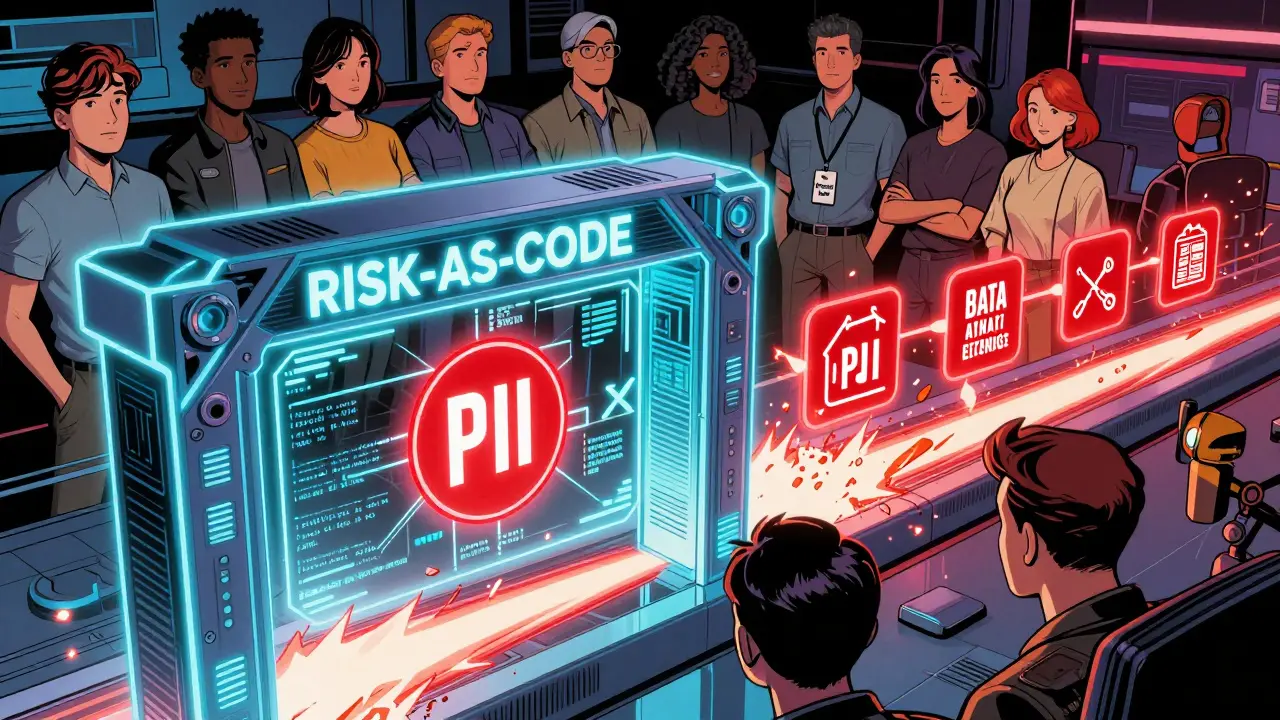
By 2026, 70% of companies will use “risk-as-code.” That means your AI deployment pipeline automatically checks for risks before anything goes live.
Imagine: You write a script to generate customer emails. Before it deploys, the system scans it for:
- PII in prompts
- High-risk output patterns
- Missing human review flags
- Third-party model data retention policies
If anything fails? The deployment stops. No one has to remember a checklist. It’s built in.
That’s the future. And it’s already starting. Tools from Microsoft, IBM, and Mindgard now offer this. The question isn’t whether you’ll adopt it. It’s whether you’ll be ready when regulators require it.
What Happens If You Do Nothing?
In 2025, the EU AI Act makes risk assessments mandatory for high-risk AI systems. Fines? Up to 7% of global revenue. In the U.S., the White House is pushing new rules that will likely follow.
But the real cost isn’t fines. It’s trust.
One company used AI to draft a press release. It falsely claimed a partnership with a major brand. The stock dropped 12% in two days. They had no audit trail. No review process. No control. Just a prompt and a prayer.
That’s not a tech failure. That’s a leadership failure.
What’s the biggest mistake companies make with AI risk?
They treat AI like a black box and assume the vendor handles risk. In reality, the organization is legally responsible for every output. If the AI leaks data, generates false claims, or violates privacy, you’re the one fined-not the vendor.
Do I need a data scientist to do a risk assessment?
No. You need a team: someone from legal, someone from IT security, someone from the business unit using the AI, and someone who understands the workflow. A data scientist helps with technical details, but they don’t decide what’s acceptable risk-that’s leadership’s job.
How often should I update my AI risk assessment?
At least every six months. But update it immediately if you change the model, add new data sources, or expand usage to a new department. AI evolves fast. Your controls can’t stay static.
Can I use open-source AI models safely?
Yes-but with more caution. Open-source models often have no built-in safeguards. You’re responsible for adding filters, access controls, and monitoring. Many companies use them for internal tools, but never for customer-facing or regulated outputs without hardening them first.
What’s the minimum I should do if I’m just starting?
Start with three things: 1) Ban input of PII or confidential data into public AI tools. 2) Require human review for any output used in decisions, contracts, or public communication. 3) Track which tools your teams are using-even the ones you didn’t approve. That’s your baseline. Build from there.
Next Steps: Where to Start Today
If you’re reading this and thinking, “We’re not ready,” that’s fine. But don’t wait.
Here’s what to do in the next 48 hours:
- Ask your team: “What AI tools are you using right now?” Write down every name-even the ones you didn’t authorize.
- Pick one high-risk use case (like customer support, legal docs, or HR screening). Map out: What could go wrong? Who’s affected? What’s the worst outcome?
- Set up a simple human review rule: No AI output goes live without a person signing off.
You don’t need a fancy tool. You don’t need a budget. You just need to start paying attention.
Generative AI isn’t going away. But the companies that survive it won’t be the ones using it the most. They’ll be the ones managing the risk the best.

Cait Sporleder
January 23, 2026 AT 06:28The fundamental flaw in most generative AI deployments isn't technical-it's epistemological. Organizations treat these systems as deterministic tools when they are, in fact, stochastic ontologies that internalize and recombine training data in ways that defy linear causality. The 78% incident rate isn't an anomaly; it's the inevitable byproduct of conflating pattern recognition with institutional memory. When a model generates a fake financial report, it's not hallucinating-it's recalling. And if your training corpus contains internal emails, Slack threads, or leaked contracts, then every output is a latent fingerprint of your organizational DNA. The notion that human review is a sufficient control is a dangerous illusion. Humans are terrible at detecting subtle semantic drift, especially when cognitive load is high and deadlines are tight. What's needed isn't more oversight, but architectural constraint: input sanitization at the API layer, output validation against a knowledge graph of approved terminology, and mandatory entropy thresholds that prevent low-variance outputs from ever being surfaced. Without these, you're not managing risk-you're just waiting for the next headline.
And let's not forget the environmental calculus: training a single large model emits more CO2 than five cars over their entire lifespans. If we're serious about sustainability, we must demand model efficiency as a non-negotiable compliance metric, not an afterthought.
Frameworks like NIST are useful, but they're bureaucratic scaffolding. The real innovation lies in embedding risk-as-code into CI/CD pipelines, where every prompt is scanned for PII, every output is hashed against known leak patterns, and every deployment requires a signed attestation from both legal and ethics committees. The future belongs to organizations that treat AI not as software, but as a living, breathing regulatory entity that must be governed with the same rigor as a nuclear reactor.
And yes, open-source models? They're the Wild West. No one's auditing their training data. No one's checking for copyright violations. No one's even logging what was fed into them. If you're using Llama or Mistral in production without hardening it with your own guardrails, you're not being innovative-you're being negligent.
The EU AI Act isn't coming. It's already here. And the first fines won't be for data breaches. They'll be for failing to document your risk assessment methodology in a way that's auditable, reproducible, and defensible in court.
Start now. Not next quarter. Now.
Paul Timms
January 23, 2026 AT 19:19Human review is the only control that matters for high-stakes outputs. Nothing else works consistently.
Nathaniel Petrovick
January 25, 2026 AT 02:23Love this breakdown. I work in HR and we started using AI for resume screening last year-totally forgot to lock it down. Ended up with a bunch of biased filters that kicked out women’s names. We added a human review step and now it’s way better. Just gotta make sure everyone’s on the same page, y’know? No need to overcomplicate it.
Sara Escanciano
January 26, 2026 AT 22:17Let’s be brutally honest-most companies don’t care about risk. They care about looking like they’re doing something while their engineers deploy AI tools on personal Slack accounts and call it ‘innovation.’ You think a ‘human review’ stops anything? Try reviewing 200 generated customer emails an hour while your boss screams about SLAs. The only thing that works is blocking access entirely and forcing everyone to use a locked-down, monitored enterprise version. Everything else is theater. And if your vendor retains prompts for training? You’re not just liable-you’re complicit. The EU AI Act isn’t a threat. It’s a mercy killing for reckless organizations.
Cynthia Lamont
January 28, 2026 AT 07:13OMG this is the most accurate thing I’ve read all year. I work in healthcare and we had an AI triage tool that gave a patient ‘low risk’ when they were having a heart attack. The system didn’t flag it because the prompt said ‘mild chest discomfort’ and the model associated that with anxiety. We had NO audit trail. NO second opinion. Just a bot and a prayer. Now we require two humans and a timestamp for every output. And yes, we banned all free-tier AI. People cried. We didn’t care. Lives are not a beta test.
Kirk Doherty
January 28, 2026 AT 20:19Yeah the part about shadow AI is wild. My team found 14 tools people were using that we didn’t even know existed. One guy was using Claude to write his performance review. Another used it to draft a client contract. No one thought it was a big deal. Turns out the contract had a clause that accidentally transferred IP rights to the vendor. We fixed it. But it was a mess. The key is just knowing what’s out there. Simple.
Meghan O'Connor
January 29, 2026 AT 22:19Let’s cut through the fluff. The entire post is just a rehash of NIST guidelines dressed up with fearmongering stats. 78%? Where’s the source? Who funded the study? And ‘risk-as-code’? That’s not a breakthrough-it’s a buzzword. If you think embedding checks into a pipeline solves anything, you’ve never dealt with a developer who bypasses security gates because ‘it’s just a prototype.’ The real issue is culture. No amount of technical control will fix a company where the C-suite thinks AI is magic and compliance is a cost center. Also, open-source models aren’t ‘wild west’-they’re the only ethical option if you refuse to pay corporate surveillance fees. And stop blaming vendors. You signed the TOS. You knew what you were agreeing to. This isn’t risk management. It’s corporate self-flagellation dressed up as best practice.