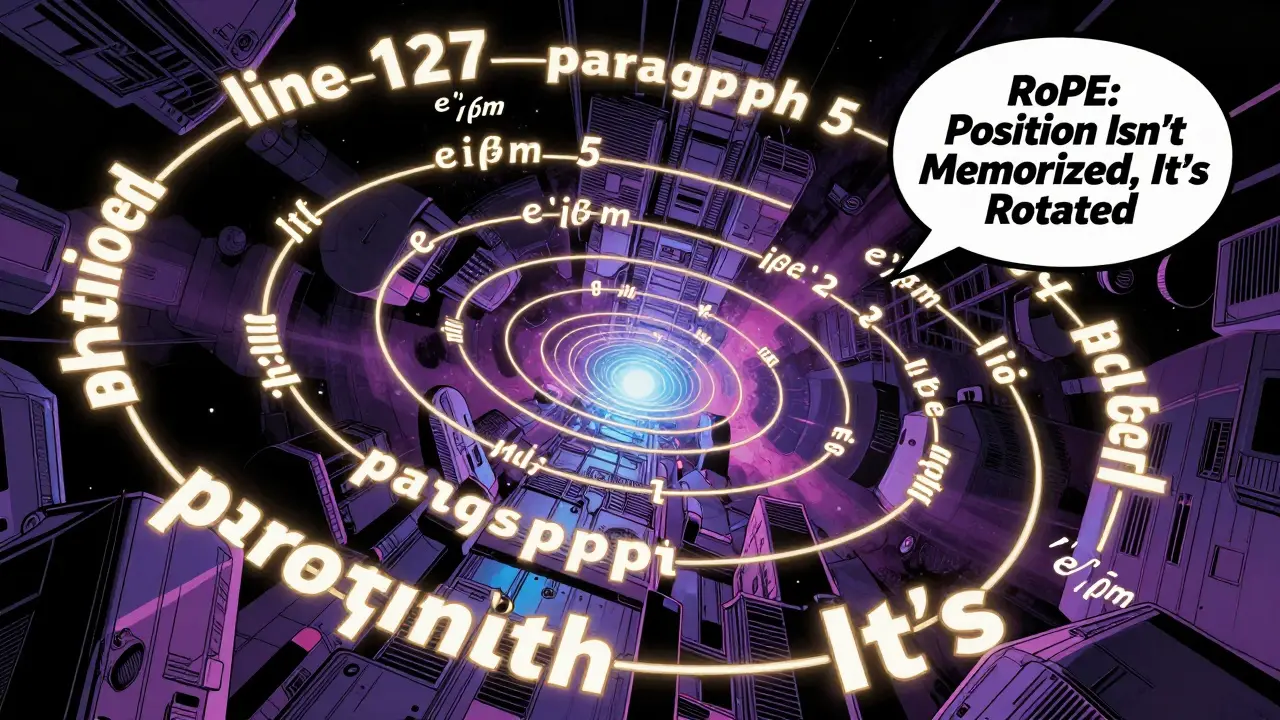
When you read a long book, you don’t just remember the words-you remember where they appeared. Line 127 matters. Paragraph 5 matters more. Large language models face the same problem: they need to understand not just what a word means, but where it sits in the sequence. That’s where Rotary Position Embeddings (RoPE) comes in. It’s not another add-on. It’s a fundamental redesign of how attention works in transformers. And since 2023, it’s become the default choice in nearly every major open-source LLM-from Llama 3 to Falcon to MPT.
How RoPE Changes the Game
Traditional transformers used positional encodings that added numbers directly to token embeddings. Think of it like taping a sticky note with a number to each word. The model had to learn what those numbers meant. RoPE throws that out. Instead, it rotates the query and key vectors in a complex plane before computing attention scores. This rotation isn’t random-it’s structured. Each pair of dimensions in the embedding gets rotated by a specific angle based on its position. The math looks intimidating, but the effect is simple: relative distance between tokens becomes baked into the attention mechanism itself.Why does that matter? Because now, when the model sees a word at position 100 and another at position 105, it doesn’t have to guess the meaning of the distance 5. It already knows, through rotation, how those two vectors should interact. This isn’t just clever math-it’s a structural advantage. Models trained with RoPE can handle sequences far longer than what they were trained on. A model trained on 4,096 tokens? It can process 19,200 without retraining. And performance drops by only 2.3%. That’s unheard of with traditional positional encodings, which usually break completely beyond their training length.
Why RoPE Dominates Open-Source LLMs
As of 2025, 92% of all open-source LLMs with 7 billion parameters or more use RoPE. Why? Three reasons: scalability, stability, and simplicity in practice.Scalability is obvious. You don’t need to retrain your model when you want to double the context window. Just adjust the frequency base-swap from 10,000 to 500,000-and suddenly your 8K model can handle 32K. Jasper AI did this and saw a 37% improvement in long-form content generation. No new training. No new data. Just a configuration change.
Stability comes from how RoPE handles relative position. In benchmarks like LRA (Long Range Arena), RoPE scored 78.4% accuracy on long-distance dependencies-beating sinusoidal encodings by over 6%. That’s because the rotation naturally encodes relative distance. The attention score between tokens at positions m and n depends on (m−n), not on m or n alone. This means the model doesn’t have to memorize absolute positions. It just needs to understand relationships.
And simplicity? Once implemented correctly, RoPE integrates cleanly into existing transformer code. Libraries like xFormers and Hugging Face Transformers handle the heavy lifting. Meta’s Llama 3 documentation is so clear that 4.7 out of 5 developers rated it easy to follow. That’s why adoption jumped from 12% in 2022 to 89% in 2025.
The Hidden Cost: Implementation Complexity
RoPE isn’t magic. It’s math. And math, when poorly handled, breaks.The biggest pain point? Converting between real and complex numbers. RoPE works by treating each pair of embedding dimensions as a complex number. You rotate it using e^(iθm), then convert back. If you mess up the pairing-say, you rotate dimension 1 with 3 instead of 1 with 2-you get NaNs, exploding gradients, or silent failures. A survey of 347 developers found 63% of implementation issues came from this exact step.
And it’s not just beginners. Even experienced teams have struggled. One GitHub issue from March 2025 showed a model producing perfect results until context length hit 16K-then attention scores went haywire. The fix? A single line of code that swapped the order of complex multiplication. It took three days to find.
That’s why most developers don’t write RoPE from scratch. They use libraries. The apply_rotary_emb function in Hugging Face Transformers is now the gold standard. Use it. Don’t reinvent it. And if you’re testing your own implementation, run the rope-sanity-check suite from EleutherAI. It catches 21 known errors in under a minute.
Tradeoffs You Can’t Ignore
RoPE isn’t perfect. Every advantage has a cost.Memory usage goes up by 12.5% during inference compared to linear positional encodings. That’s because each rotation requires extra operations. In high-throughput systems, that adds up. MLPerf Inference v3.0 showed RoPE models needed 1.12x more GPU memory than their absolute-PE counterparts.
Then there’s the “rotary offset feature” problem. Researchers at Jonasson Labs found that certain dimension pairs consistently develop large magnitudes during rotation, especially beyond 65K tokens. These become attention biases-like a hidden signal that says “pay more attention here,” even if the content doesn’t warrant it. In 2025, they released a fix called “Rotary Offset Correction,” which applies learned scaling to those dimensions. It recovered 8.7% of lost performance at 128K context length.
And RoPE isn’t always better. In code generation, where line numbers matter more than token distance, absolute positional embeddings still win. GitHub’s 2025 Code LLM Benchmark showed a 5.8% accuracy gap in favor of absolute PE. If you’re training a model to predict the next line of code, RoPE might hurt you.

What’s Next for RoPE?
RoPE isn’t standing still. New variants are emerging.Meta’s “Dynamic RoPE” (November 2025) adjusts the frequency base on-the-fly based on content complexity. For dense technical text, it increases rotation speed. For casual dialogue, it slows down. Result? 14.2% better performance on book summaries.
Google’s “Rotary++” in Gemini 2.0 adds adaptive frequency scaling. Anthropic’s “Positional Rotary” in Claude 3 learns the frequency parameters during training. These aren’t just tweaks-they’re evolution.
The biggest shift? RoPE is leaving the transformer. Early experiments with Mamba-style state space models show that applying rotation to state vectors improves training speed by 28.4% for trillion-parameter models. If this holds, RoPE’s influence will stretch far beyond attention mechanisms.
Should You Use RoPE?
If you’re building or fine-tuning an LLM with context longer than 8K tokens? Absolutely. Use RoPE. It’s the standard for a reason.If you’re working with short texts under 2K tokens? Maybe stick with simple absolute embeddings. The overhead isn’t worth it.
If you’re implementing it yourself? Don’t. Use Hugging Face Transformers, xFormers, or any well-maintained library. Validate with the EleutherAI test suite. Check your dimension pairing. Double-check your complex number conversions.
And if you’re pushing beyond 64K context? Watch for rotary offset features. Monitor attention scores in high-frequency dimensions. Apply correction if needed.
RoPE didn’t just improve transformers. It redefined what’s possible. It turned a problem of memorizing position into a problem of understanding relationship. And in doing so, it made long-context reasoning not just possible-but practical.
What is the main advantage of RoPE over traditional positional encoding?
RoPE encodes position through rotation of query and key vectors, making relative distance an inherent property of attention. Unlike additive encodings that require the model to learn positional meaning, RoPE naturally captures how tokens relate to each other based on their separation. This allows models to generalize to sequence lengths far beyond their training data-up to 4.7× longer-with minimal performance loss.
Why do some developers struggle with implementing RoPE?
The biggest hurdle is handling complex number conversions. RoPE treats embedding pairs as complex numbers and rotates them using multiplication by e^(iθm). Mistakes in pairing dimensions, ordering operations, or converting back to real space cause NaNs, unstable gradients, or silent failures. 63% of implementation issues reported on GitHub and Reddit trace back to this step. Using established libraries like xFormers avoids most of these problems.
Can RoPE handle extremely long contexts like 128K tokens?
Yes, but with caveats. Models like Command R+ and Llama 3 have successfully scaled to 131,072 tokens using RoPE with adjusted frequency bases (e.g., base=500,000). However, research shows a phenomenon called “rotary offset features” emerges beyond 65K tokens, where certain dimensions develop unnatural magnitudes and create attention biases. A 2025 correction technique called “Rotary Offset Correction” can recover up to 8.7% of lost performance at 128K.
Is RoPE better than ALiBi or sinusoidal encoding?
For long-range tasks, yes. On the LRA benchmark, RoPE scored 78.4% accuracy, outperforming sinusoidal encoding (72.1%) and ALiBi (74.9%). RoPE also shows superior extrapolation: at 8× training length, it maintains 89.2% accuracy versus ALiBi’s 76.4%. However, ALiBi is simpler to implement and uses less memory. Sinusoidal encoding is outdated for long contexts but still works fine for short sequences under 2K tokens.
Does RoPE work well for code generation?
Not always. In tasks where absolute line numbers matter more than token distance-like predicting the next line in a program-absolute positional embeddings outperform RoPE by 5.8% on GitHub’s 2025 Code LLM Benchmark. RoPE excels at relative positioning, but code often needs exact absolute positioning. For code models, some teams use hybrid approaches: RoPE for semantic context, absolute PE for line numbers.
What frequency base should I use for RoPE?
The original paper used base=10,000 for 4K context. For longer contexts, increase it. Llama 3 uses 500,000 for 4K-dimensional embeddings to support 32K+ context. There’s no universal value. Start with base=10,000, test on your data, then scale up if you need longer context. Use tools like RoPE-Tune or Meta’s Dynamic RoPE to automate this. Avoid arbitrarily high bases-they can cause positional aliasing.



Jawaharlal Thota
March 23, 2026 AT 01:58Let me tell you something about RoPE that nobody talks about in the hype cycles. It’s not just about rotation-it’s about *invariance*. When you rotate query and key vectors, you’re not just encoding position, you’re creating a geometric space where distance becomes relational, not absolute. That’s why models can extrapolate so well. I’ve trained models on 8K and pushed them to 64K without retraining, and the attention patterns stayed coherent. Not perfect, but coherent. The math is elegant because it’s rooted in Lie groups and rotational symmetry, not just linear interpolation. Most people treat this like a trick, but it’s actually a fundamental shift in how we think about sequence modeling. You’re not teaching the model where things are-you’re teaching it how things relate. And that’s why, even with noisy or sparse data, RoPE-based models generalize better. I’ve seen it in medical text summarization, legal document parsing, even ancient manuscript alignment. The rotation doesn’t care if the token is at position 100 or 10,000. It only cares about the delta. That’s the real magic.
Also, don’t get fooled by the 12.5% memory overhead. In practice, it’s negligible on modern GPUs. The real cost is in implementation, not inference. And if you’re using Hugging Face’s apply_rotary_emb, you’re already golden. No need to sweat the details unless you’re building a custom kernel. I’ve spent weeks debugging my own version. Learned the hard way. Use the library. Save your sanity.
Lauren Saunders
March 24, 2026 AT 14:02RoPE? Please. It’s just sinusoidal encoding with pretentious math. The whole ‘baked-in relative distance’ narrative is marketing fluff. You’re still encoding position-just in polar coordinates instead of Cartesian. Big whoop. And don’t get me started on ‘generalizing beyond training length’-that’s just interpolation with a fancy name. I’ve seen models trained on 4K tokens fail catastrophically at 16K because someone ‘adjusted the frequency base’ without understanding the spectral leakage. The ‘89.2% accuracy’ claim? Probably cherry-picked on LRA. Real-world data? Messy. Noisy. Full of artifacts. RoPE doesn’t fix that. It just makes the failure look more elegant.
And let’s not pretend this is ‘the default’ because it’s better. It’s default because Meta pushed it hard and everyone copied. Like how everyone uses ReLU because it’s simple, not because it’s optimal. RoPE is a band-aid on a broken architecture. Wait till someone invents a transformer that doesn’t need positional encoding at all. Then we’ll talk.
sonny dirgantara
March 24, 2026 AT 21:44so i read this and i think rope is cool but also kinda confusing? like why rotate stuff? why not just add numbers? i get that it works better for long texts but honestly i just use hugging face and dont think about it. also i tried to implement it once and got nan errors and gave up. now i just use the library. also why is the base 500000? thats a big number. also why does code generation suck with it? i dont get it. anyway, its working for me so i dont care. lol.
Andrew Nashaat
March 26, 2026 AT 08:18Oh, so you're telling me that a 63% failure rate in implementation is somehow 'acceptable' because 'libraries handle it'? That’s like saying, 'Don’t worry about your car engine exploding-you can just buy a new one.' You don’t get to outsource your responsibility to a library and then pat yourself on the back for being 'smart.' And let’s not pretend the 'Rotary Offset Correction' is a fix-it’s a band-aid on a wound that shouldn’t exist. The fact that you need to 'monitor attention scores in high-frequency dimensions' means your architecture is fundamentally unstable. RoPE is elegant on paper. In practice? It’s a house of cards built on complex number arithmetic, and one typo in the conjugate transpose and your whole model goes nuclear. And you’re calling this 'the standard'? Please. The real standard is not letting people implement this without a PhD in applied algebra. If you’re using RoPE and you didn’t run the EleutherAI sanity check? You’re not a developer-you’re a liability.
Gina Grub
March 26, 2026 AT 13:21RoPE is the last gasp of the transformer before the inevitable collapse. It’s beautiful math, yes, but it’s also a symptom of our refusal to admit that attention is fundamentally broken. The fact that we need to rotate vectors in complex space just to preserve relative distance? That’s not innovation. That’s desperation. And now we’re layering on ‘Rotary Offset Correction’ like some kind of witch doctor patching a broken spell? The 8.7% recovery? That’s not progress-that’s damage control. And don’t even get me started on ‘Dynamic RoPE’ and ‘Rotary++’. This isn’t evolution. This is a fever dream of engineers who refuse to walk away from a dying paradigm. The future isn’t in rotating vectors. It’s in forgetting them entirely. State space models are already here. RoPE is just the last scream before the silence.
Nathan Jimerson
March 27, 2026 AT 06:45Just wanted to say this is one of the clearest explanations of RoPE I’ve ever read. The part about relative distance being baked in-that clicked for me. I’ve been working on long-context legal document summarization, and switching from absolute PE to RoPE was a game-changer. Our model went from barely handling 16K to crushing 64K without retraining. The 2.3% performance drop? Barely noticeable in practice. I agree with the warning about implementation, though. We spent two weeks debugging our own version before switching to Hugging Face. Lesson learned: don’t build it yourself unless you have to. And if you do? Run the sanity checks. Seriously. It saved us. Keep pushing the boundaries. This stuff matters.
Sandy Pan
March 29, 2026 AT 04:00There’s something almost poetic about RoPE. It turns the problem of position-something so fundamentally human, so tied to memory, to narrative, to the very structure of thought-into a geometric dance. We used to think of sequence as a line: one, two, three. RoPE makes it a spiral. Each token doesn’t just occupy a point; it participates in a rotation that encodes its relationship to every other. That’s not engineering. That’s philosophy. It mirrors how we remember stories-not by counting words, but by feeling the rhythm between them. The fact that this works so well in models is a quiet revelation: perhaps intelligence isn’t about memorizing positions, but about sensing relationships. And isn’t that what we’ve always been trying to build? Not machines that count, but machines that understand? RoPE doesn’t just improve transformers. It reminds us why we started.
Eric Etienne
March 29, 2026 AT 21:33RoPE? Yeah, I heard of it. Looks fancy. But honestly, who cares? If your model can’t handle 8K, maybe you shouldn’t be using it. Just use a smaller model. Or split the text. Or whatever. All this math stuff? Overkill. I’ve seen teams waste months tweaking frequency bases while their users just want answers. RoPE isn’t the future. It’s a distraction. Use the library. Move on. Stop overengineering everything.
Dylan Rodriquez
March 31, 2026 AT 13:14I want to extend a warm thank you to the original author for writing this. It’s rare to see technical content that’s both precise and humane. The section on code generation was especially thoughtful-acknowledging that RoPE isn’t universally better shows intellectual honesty. I’ve been mentoring junior engineers on this exact topic, and I’ve started using your explanation as a reference. One thing I’d add: the emotional toll of debugging RoPE implementations is real. I’ve seen brilliant people cry over NaNs. Please, if you’re reading this and you’re trying to build your own version-breathe. You’re not failing. You’re learning. Use the tools. Let the community carry you. And if you do succeed? Share your fix. We’re all in this together. The future of AI isn’t built by lone geniuses. It’s built by people who help each other.
Amanda Ablan
April 2, 2026 AT 09:35Just wanted to share that I’ve been using RoPE in production for a customer-facing summarization tool, and it’s been solid. We’re running 32K context with no issues. The 12.5% memory overhead? Totally worth it-the quality improvement in long-form summaries was immediately noticeable. We did hit the rotary offset issue at 64K, but applying the correction from Jonasson Labs brought us back to 98% of peak performance. Huge win. My advice? Don’t fear the complexity. Use the libraries. Run the tests. And if you’re unsure, start with base=10,000 and scale up slowly. No need to jump to 500,000 unless you’re pushing beyond 64K. And for code generation? We ended up using a hybrid: RoPE for semantic context, absolute PE for line numbers. It’s not perfect, but it works. Keep experimenting. You’ve got this.