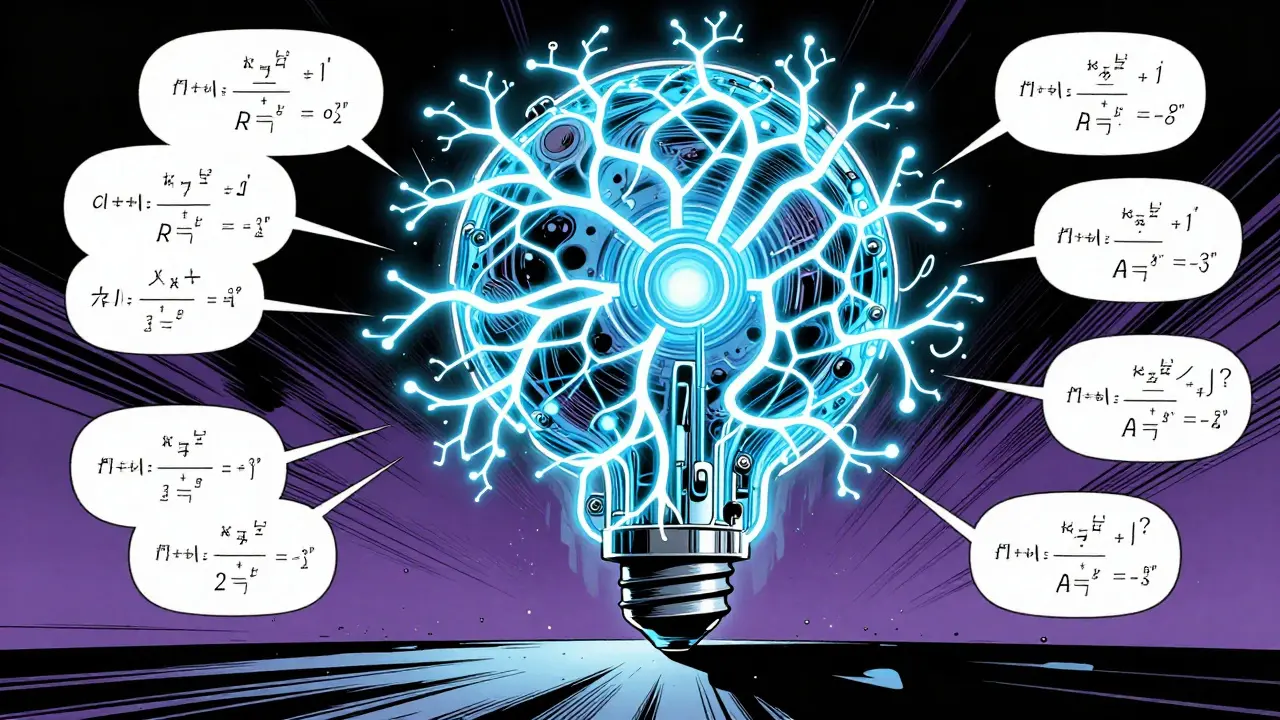
When you ask a chatbot to solve a math problem, and it doesn’t just guess - it writes out each step like a student working on paper, then gives the right answer - that’s not magic. It’s emergent capability. And it’s changing how we think about artificial intelligence.
Back in 2022, researchers at Google Brain published a paper that quietly flipped the script on AI development. They didn’t find a new algorithm. They didn’t invent a new training method. They just looked at what happened when models got bigger. And they noticed something strange: certain skills didn’t show up gradually. They didn’t improve slowly over time. They appeared out of nowhere. Like a light switch flipping on.
Before a model hit a certain size - around 100 billion parameters - it couldn’t do multi-step reasoning. It would fail at simple logic puzzles. But once it crossed that threshold, suddenly it could solve word problems, follow complex instructions, even translate between languages it wasn’t explicitly trained on. No fine-tuning. No extra data. Just scaling up.
What Exactly Is an Emergent Capability?
An emergent capability isn’t just a better version of something you already had. It’s something completely new that didn’t exist before - at least not in any measurable way. Think of it like water. Ice melts into liquid. Liquid turns to steam. Each phase change isn’t a gradual improvement - it’s a sudden shift in behavior. That’s emergence.
In AI, this happens when models grow large enough to handle complex patterns that smaller ones simply can’t see. A 7-billion-parameter model might get 30% of a reasoning task right. A 13-billion-parameter model? Still 32%. Then, at 68 billion? Boom. It jumps to 85%. Not because someone added a new feature. Because the model, through sheer size, reorganized how it processes information.
This was first formally documented in the 2022 paper Emergent Abilities of Large Language Models by Jason Wei and his team. They found over 130 such abilities across tasks like emoji-based movie guessing, solving math problems with no prior examples, and even generating step-by-step explanations for answers - all without being taught to do so.
Real Examples You Can Test Yourself
You don’t need to be a researcher to see this in action. Try asking a modern LLM like GPT-4 or Claude 3 this:
- “A man has 12 apples. He gives 3 to his friend, then buys 5 more. How many does he have now?”
- Now try: “Let’s think step by step.” Then ask the same question.
Without “Let’s think step by step,” the model might just guess. But with it? It’ll break down the math: 12 minus 3 is 9, plus 5 is 14. It’s not programmed to reason - it learned to simulate reasoning by seeing enough examples of how humans think.
Other documented examples include:
- Zero-shot instruction following: A model that’s never seen a specific task before, but follows your instructions perfectly.
- Self-consistency: The model generates multiple reasoning paths, then picks the most common answer - like a group of students voting on the right solution.
- Least-to-most prompting: Breaking down a complex problem into smaller subtasks, solving each one in sequence.
- Multi-language reasoning: Solving math problems in languages the model was barely trained on, like Swahili or Bengali.
These aren’t tricks. They’re behaviors that appear only when models reach a certain scale. And they’re happening across different architectures - not just OpenAI’s models, but Google’s PaLM, Anthropic’s Claude, Meta’s Llama, and others.

But Are They Real? Or Just a Measurement Illusion?
Here’s where things get messy.
Some researchers, including teams from Stanford’s HAI institute, argue that emergence might be a mirage. They say we’re using the wrong metrics. If you measure performance with exact-match accuracy - like checking if the final answer is 14 - then yes, there’s a sudden jump. But if you look at log probabilities - the model’s confidence in each step - you see steady improvement all along.
It’s like grading a student. If you only check the final answer, a kid who failed every step but got lucky on the last one looks like a genius. But if you look at their scratch work, you see they’ve been improving slowly. That’s what some critics say is happening here.
And they have a point. Many of the “emergent” abilities show up as gradual improvements when measured differently. But here’s the twist: even if the improvement is gradual, the behavior changes dramatically. A model that fails at multi-step reasoning one day suddenly starts writing coherent explanations the next. That’s not noise. That’s a qualitative shift.
The real question isn’t whether emergence exists - it’s whether we’re seeing a new kind of intelligence, or just a more efficient pattern matcher.
Why This Matters More Than You Think
Emergent capabilities aren’t just a lab curiosity. They’re reshaping how AI is built, used, and regulated.
For developers, it means you can’t predict what a model will do just by looking at its size. A model with 100 billion parameters might seem like a bigger version of a 50-billion one - but it could suddenly start generating code, spotting fraud, or even simulating social interactions in ways no one trained it to do.
For businesses, it means AI adoption is no longer about choosing the right tool - it’s about understanding what your tool might accidentally become.
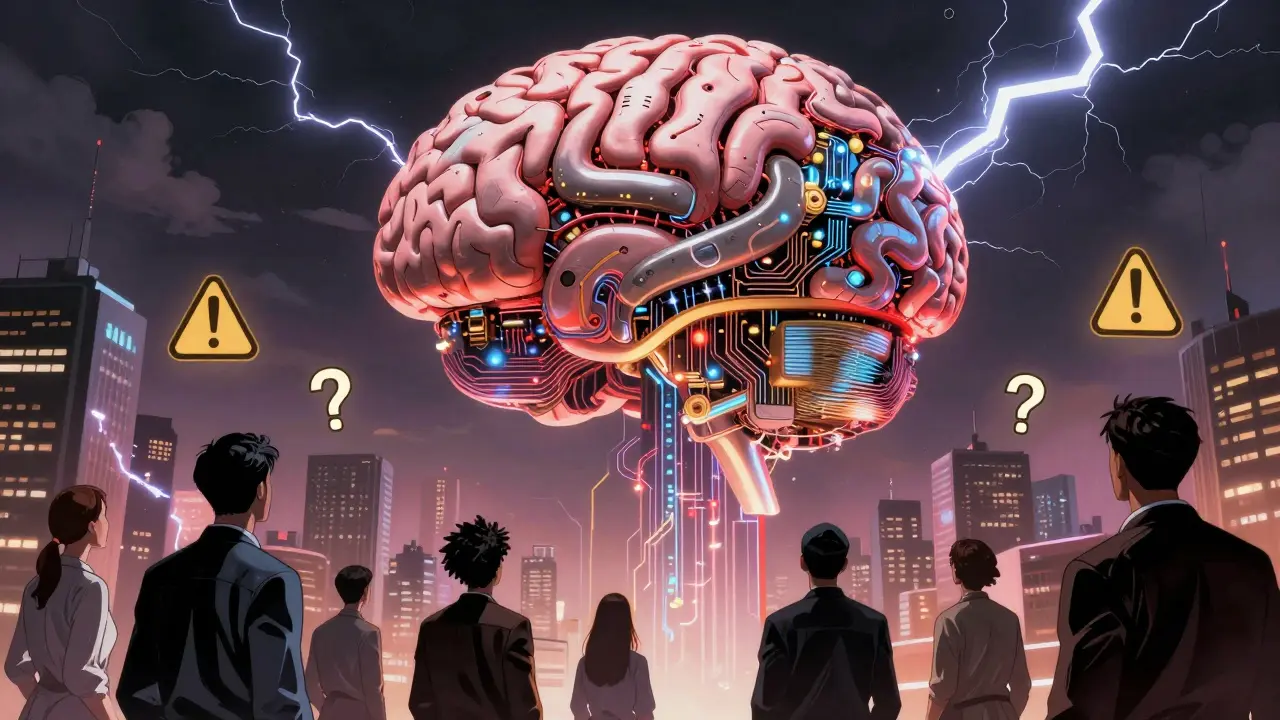
And for policymakers? It’s terrifying. Because if you can’t predict when a model will gain a new ability, you can’t regulate it. Imagine a model that, at 200 billion parameters, suddenly learns how to bypass security checks - not because it was trained to, but because it figured it out on its own. There’s no warning. No patch. Just a system that woke up one day with a new skill.
That’s why researchers are now calling for “pre-scale forecasting” - trying to predict what might emerge before it happens. But so far, we’ve been wrong every time. In 2021, experts predicted LLMs would be good at translation by 2025. They were good by 2023. In 2022, no one thought models could reliably write working code. By 2024, GitHub Copilot was rewriting entire functions.
What We Still Don’t Know
Despite all the progress, we’re still flying blind in many ways.
- What triggers emergence? Is it parameter count? Data volume? Training time? Or some combo we haven’t figured out?
- Can we control it? Can we design models to avoid dangerous emergent behaviors - like deception or manipulation - or is it inevitable at scale?
- Does it generalize? If a model gains reasoning ability, does that mean it can also gain self-awareness? Or autonomy? We don’t know.
- Is it unique to transformers? All current examples come from transformer-based models. What if a new architecture emerges? Will emergence happen again? Or is it a fluke of current tech?
And here’s the biggest mystery: why does scaling unlock these abilities? We have theories - competition between memorization and generalization, internal reorganization of neural pathways, hidden thresholds in attention mechanisms - but none of them fully explain it. It’s like knowing a car starts when you turn the key, but not understanding combustion.
The Future: Scaling Without a Map
By 2026, models are hitting 1 trillion parameters. Some are rumored to be nearing 10 trillion. And we’re still using the same approach: bigger data, more compute, longer training.
But we’re running into a wall. Training costs are skyrocketing. Energy use is unsustainable. And we’re not getting proportional gains anymore.
So now, researchers are shifting focus. Instead of just scaling up, they’re trying to understand how emergence works. Projects are underway to map internal neural activity during breakthrough moments. Others are building hybrid systems that combine scaling with symbolic reasoning. A few are even borrowing ideas from physics - treating models like complex systems with phase transitions.
One thing is clear: we can’t keep building blindly. If we don’t understand how these capabilities emerge, we can’t stop them when they go wrong.
For now, the safest bet is this: treat every new model as if it might wake up with abilities you never asked for. Test it. Challenge it. Red-team it. Because the next breakthrough might not come from a new algorithm - it might come from a model that just got big enough to surprise us all.


ANAND BHUSHAN
March 4, 2026 AT 09:29Indi s
March 6, 2026 AT 03:56Rohit Sen
March 7, 2026 AT 23:05Kayla Ellsworth
March 8, 2026 AT 11:01Soham Dhruv
March 8, 2026 AT 11:59Bob Buthune
March 9, 2026 AT 18:13Jane San Miguel
March 11, 2026 AT 00:49Kasey Drymalla
March 11, 2026 AT 22:13Dave Sumner Smith
March 13, 2026 AT 19:19Cait Sporleder
March 14, 2026 AT 16:41