
When you ask an AI to build a feature, it doesn’t just write code-it writes assumptions. And those assumptions? They don’t always match your business rules. That’s the core problem with vibe coding: speed without structure leads to fragile systems. Teams using AI to generate code are shipping features 3.7x faster, but production bugs are rising-not because the AI is broken, but because the testing hasn’t caught up.
Why Traditional Testing Fails with AI-Generated Code
You can’t test vibe-coded apps the same way you tested hand-written code. Traditional test suites were built for predictable, human-authored logic. But AI doesn’t think like a developer. It patterns from examples. If you say, "Make a payment flow," it might generate a working API call-but miss the fact that refunds need a 48-hour hold, or that fraud flags should trigger an email, not just a database flag. PropelCode.ai’s 2025 study found conventional tests caught only 41% of logic errors in AI-generated code, compared to 78% in traditional code. Why? Because AI doesn’t understand context unless you force it to. It doesn’t know what "business-critical" means unless you spell it out in the prompt. And it won’t test edge cases unless you ask for them explicitly.Unit Testing: The F.I.R.S.T. Rules You Can’t Skip
Unit tests for vibe-coded modules need to be tight, fast, and unambiguous. The F.I.R.S.T. principles aren’t optional-they’re survival tools. Fast? AI-generated tests often hit databases or call external APIs, slowing suites to a crawl. Independent? Many AI-written tests share state between cases, making failures unpredictable. Self-validating? Too many just check if the code runs, not if it returns the right result. SynapticLabs’ 2025 analysis showed 79% of AI-generated unit tests broke at least one F.I.R.S.T. rule. The fix? Prompt engineering. Don’t just say, "Write tests." Say:- "Use Test-Driven Development. Write failing tests first to define expected behavior, then implement just enough code to make tests pass."
- "Each test must assert one outcome only. No multiple assertions in a single test."
- "Mock all external services. No real API calls."
Contract Testing: The Missing Link in AI-Generated APIs
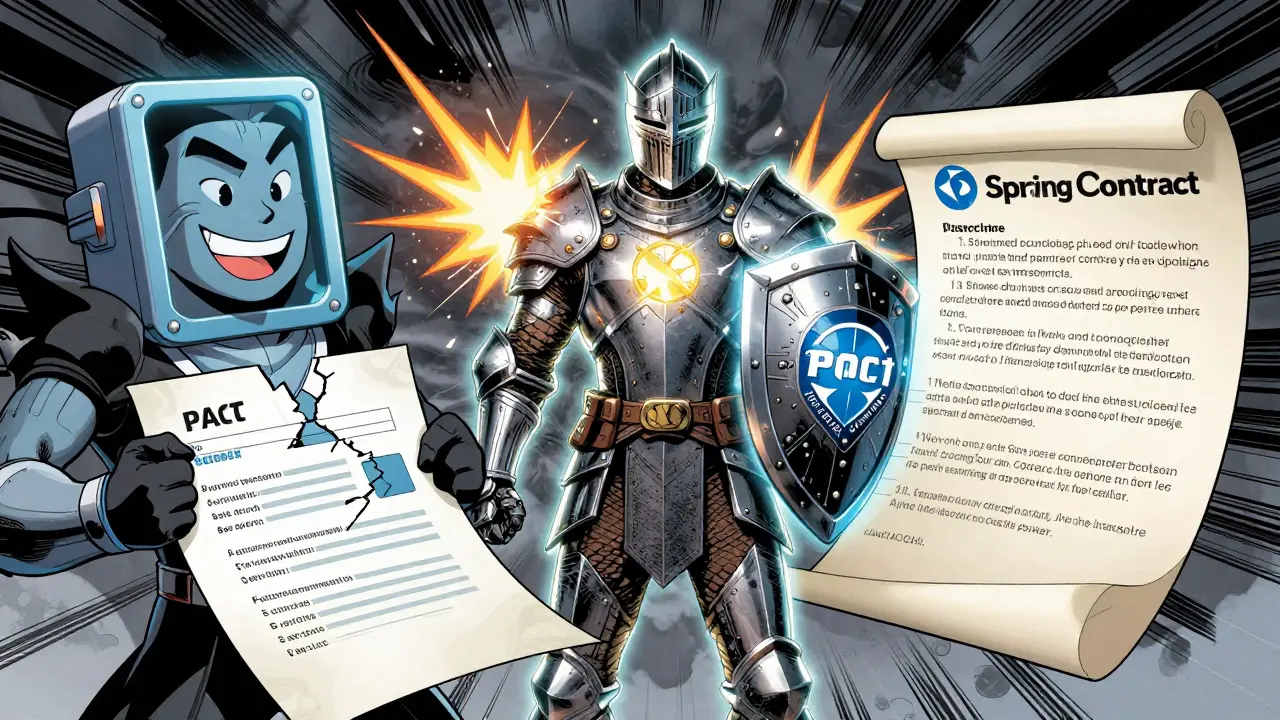
AI is great at generating API endpoints. It’s terrible at understanding what those endpoints are supposed to do in the real world. Codecentric’s 2025 field report found that AI-generated code passed 92% of database connection tests-but failed 83% of business contract tests. That means your API might accept a payment request, but it won’t know to block it if the user’s card is flagged, or to send a confirmation email, or to log the transaction for compliance. The solution? Define contracts before you generate code. Give the AI a precise schema:- "The /api/payment endpoint accepts a JSON object with: amount (decimal), currency (USD/EUR), card_token (string), and customer_id (UUID). It returns 201 Created with a payment_id and status: pending. If the card is declined, return 402 Payment Required with error_code: card_declined."
- "Generate contract tests that verify every field in the request and response. No defaults. No optional fields unless explicitly marked."
End-to-End Testing: The Pyramid That Keeps You Alive
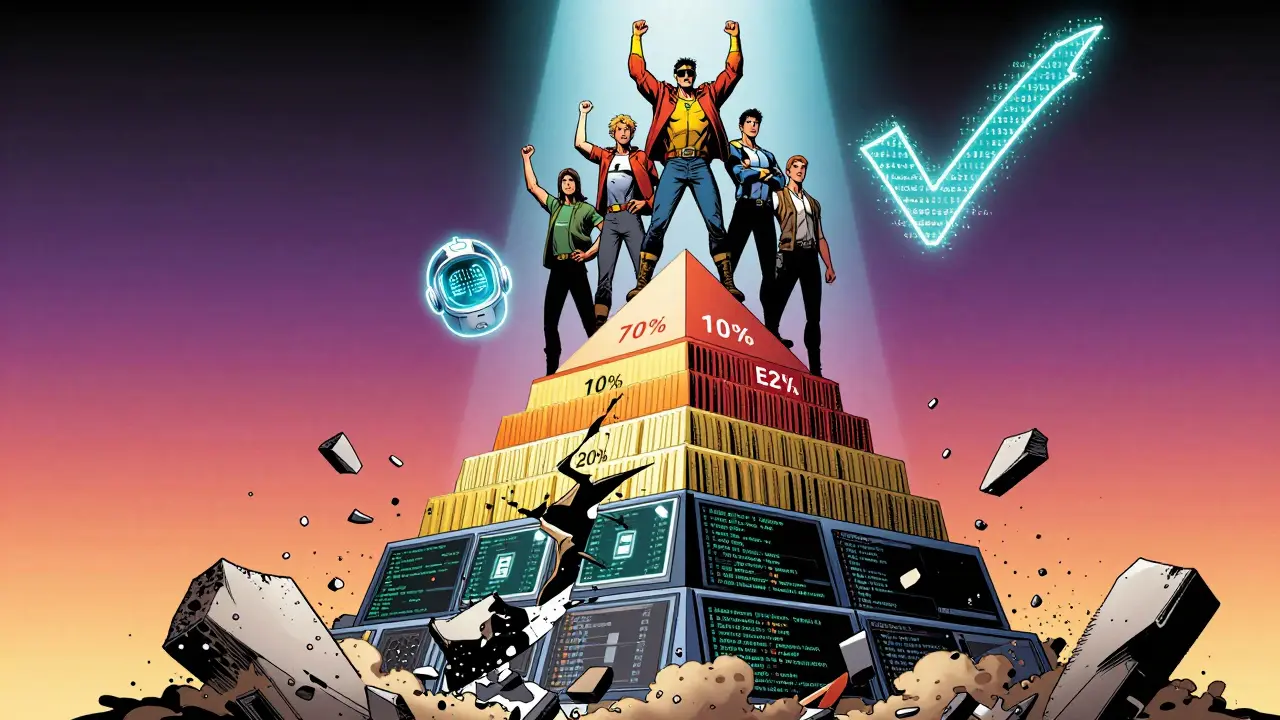
Most teams using vibe coding go straight to E2E tests. They want to see the whole thing work. But that’s like building a house by testing the front door before framing the walls. SynapticLabs tracked 142 teams over 18 months. The successful ones stuck to a 70-20-10 ratio: 70% unit tests, 20% integration, 10% E2E. Traditional teams? They were at 50-30-20. Why does it matter? E2E tests are slow. They’re flaky. They break when the UI changes color. But they’re your last line of defense for critical business flows-like checkout, user onboarding, or data export. If you skip unit and contract tests and rely only on E2E, you’ll spend 80% of your time fixing false positives. The winning pattern: Use E2E tests only for your top 3 user journeys. For example:- User signs up → receives confirmation email → logs in
- User adds payment method → makes purchase → gets receipt
- Admin exports report → file is encrypted → sent to S3
Quality Gates: Code That Tests Itself
The most advanced vibe-coded teams don’t wait for a CI pipeline to catch bugs. They bake quality into the prompt itself. PropelCode.ai’s January 2026 update introduced context-aware quality gates: AI tools now adjust testing rigor based on code criticality. If you’re generating a login page, it auto-generates 12 unit tests, 3 contract tests, and 1 E2E. If you’re generating a tax calculation engine? It demands 28 unit tests, 5 contract tests, 2 E2E, and a compliance audit log. This isn’t magic. It’s prompt chaining:- "Implement feature X with complete business logic."
- "Generate comprehensive unit tests covering all edge cases for feature X."
- "Create contract tests validating API specifications for feature X."
- "Write E2E test for the primary user journey of feature X."
- "Verify test coverage is at least 85%. Execution time under 5 seconds per module."
The Hard Truth: Vibe Coding Isn’t a Shortcut. It’s a Responsibility
Martin Fowler put it bluntly: "Teams accepting strategic shortcuts during rapid validation must schedule concrete refactoring milestones-68% fail to do this, creating technical debt that becomes unmanageable at scale." Vibe coding works only if you treat it like a partnership-not a replacement. AI gives you the draft. You provide the discipline. Dr. Sarah Chen at Google Cloud AI says: "AI rarely produces perfect code on the first attempt-the iterative approach leverages AI’s strength in making targeted improvements while ensuring quality through human oversight." That means:- Commit after every AI-generated change. Average 12.3 commits per session, not 4.7.
- Review every test generated by AI. Don’t assume it’s right.
- When a test fails, paste the error message back into the AI and ask: "What are three possible causes? Test each fix in isolation."
- Set a hard rule: No feature ships without contract tests for business logic.
What Happens When You Don’t Test Right?
The data doesn’t lie. Momentic.ai’s March 2025 study showed AI-generated tests covered technical implementation 76% of the time-but only 34% of business requirements. That’s why startups succeed and scaling companies fail. Startups use vibe coding for 0-6 month prototypes. They don’t need perfect compliance. They need speed. But when they hit 6-18 months, they hit walls: customers complain about missing features, auditors flag untested workflows, and engineers spend half their time fixing old bugs. Gartner’s 2025 survey found only 19% of Fortune 500 companies use vibe coding in production-not because the tech is bad, but because testing frameworks aren’t mature enough. The ones that do? They treat testing as a first-class citizen in every prompt.Where This Is Going
By 2028, Forrester predicts 70% of new development will use vibe coding with robust testing. But that’s only if we fix the business logic gap. The next leap? AI that learns from your test failures. Imagine an AI that, after seeing 500 payment bugs, starts auto-generating fraud checks without being asked. That’s already in experimental phases. Regulation is coming too. By 2027-2028, financial and healthcare systems will require proof that AI-generated code was validated by human-reviewed test suites. The companies that start now will lead. The ones that wait will be stuck with brittle, untrustworthy systems.Start Here: Your 5-Step Testing Checklist
If you’re using vibe coding today, here’s what to do right now:- Define your business logic in plain language before generating code.
- Require F.I.R.S.T. principles in every unit test prompt.
- Write contract tests for every API endpoint-no exceptions.
- Limit E2E tests to your top 3 user journeys.
- Set quality gates: 85% coverage, under 5 seconds per test module.
Can AI generate reliable unit tests on its own?
No. AI-generated unit tests often violate F.I.R.S.T. principles-being slow, dependent, or not self-validating. Without human refinement, they give false confidence. Always review them. Use prompts like "Write failing tests first," "Mock all external services," and "One assertion per test" to guide better output.
Why are contract tests more important in vibe coding than traditional code?
AI generates code that works technically but often misses business rules. Contract tests force clarity: they define exactly what an API should accept, return, and do under edge cases. Without them, you get working endpoints that break critical workflows-like payments that don’t trigger emails or user roles that don’t enforce permissions.
Should I use E2E tests for everything in vibe coding?
No. E2E tests are slow and flaky. They’re your safety net, not your main tool. Use them only for your top 3 critical user journeys. Let unit and contract tests handle 90% of validation. Successful teams use a 70-20-10 ratio: 70% unit, 20% integration, 10% E2E.
What’s the biggest mistake teams make with vibe coding testing?
Assuming AI-generated code is good enough without structured testing. Many teams skip contract tests, ignore F.I.R.S.T. principles, and rely on E2E alone. This leads to "working" apps that break under real conditions. The fix? Treat AI as a co-pilot, not a driver. Define requirements, validate output, and iterate.
Is vibe coding safe for production systems?
Yes-if you implement quality gates. Startups use it successfully in early stages because they prioritize speed over perfection. But scaling companies need structured testing: automated coverage checks, contract validation, and human review of business logic. Without those, vibe coding creates technical debt that’s hard to pay back. The key isn’t avoiding AI-it’s testing it rigorously.



Amit Umarani
January 31, 2026 AT 08:11AI writes tests that pass but don't catch the real bugs. I've seen it too many times - code runs, coverage is 90%, but the refund logic silently ignores weekends. Unit tests need to be mean. One assertion. No fluff. Mock everything. Otherwise you're just fooling yourself.
And stop calling it 'vibe coding.' It's lazy coding with a fancy name.
Noel Dhiraj
February 1, 2026 AT 17:44Love this breakdown. Seriously. We started using AI to draft features last quarter and our bug count went through the roof until we forced contract tests on every endpoint. Now we write the spec first, feed it to the AI, then review the output like a code review. It’s not magic, it’s discipline. And yeah, the tests run faster too.
Team morale improved once we stopped spending Fridays fixing production fires.
vidhi patel
February 1, 2026 AT 21:23The notion that AI-generated code can be shipped without rigorous testing is not merely irresponsible - it is an existential threat to software integrity. The F.I.R.S.T. principles are not suggestions; they are foundational axioms of reliable engineering. That 79% failure rate in unit tests is not a statistic - it is a warning shot fired across the bow of every organization that treats AI as a replacement for human judgment.
Furthermore, the absence of mandatory compliance audits in AI-generated financial code is a regulatory time bomb. You are not innovating - you are endangering users.
Priti Yadav
February 2, 2026 AT 04:54They’re not even trying to hide it. AI is being used to cut corners so execs can brag about ‘speed.’ But every time a contract test fails, it’s because the AI didn’t understand the business rule - because no one told it the truth.
And guess who gets blamed? The devs. The QA team. The ‘lazy’ engineers. Meanwhile, the CTO’s bonus is based on how fast they shipped. I’ve seen this movie before. It ends with a $20M outage and a LinkedIn post about ‘learning from failure.’
They’re building a house of cards and calling it a skyscraper.
Ajit Kumar
February 3, 2026 AT 19:15It is not sufficient to merely assert that AI-generated code requires structured testing; one must also recognize that the very architecture of modern AI systems is predicated upon probabilistic pattern-matching rather than deterministic logic - a fundamental epistemological divergence from human cognitive processes. Consequently, the notion that one can rely upon AI to generate unit tests that adhere to the F.I.R.S.T. principles is not only optimistic - it is logically incoherent unless human oversight is not merely present, but actively enforced through institutionalized review protocols.
Moreover, the assertion that contract testing is ‘more important’ in AI-driven development is a tautology - for in the absence of human intentionality, all code is inherently context-blind. Therefore, the burden of contextual translation falls entirely upon the engineer - and if that burden is not acknowledged, then the entire endeavor is a form of technological delusion.
Pooja Kalra
February 5, 2026 AT 06:51There’s a quiet irony here. We outsource thinking to machines, then pretend we’re being productive. But the real work - the meaning, the nuance, the responsibility - never leaves us. It just gets heavier.
AI writes the code. We write the consequences.
Jen Deschambeault
February 6, 2026 AT 14:48This is exactly what my team needed to hear. We were drowning in flaky E2E tests. Started limiting them to 3 core flows - sign-up, payment, export. Everything else? Unit + contract. Our deploy frequency doubled and our on-call alerts dropped by 60%.
Stop trying to test everything. Test what matters. The rest is noise.
Kayla Ellsworth
February 7, 2026 AT 10:48So let me get this straight - you’re telling me the solution to AI writing bad code is… to write better prompts? Wow. Groundbreaking. Next you’ll tell me that if I yell louder at my toaster, it’ll make better toast.
AI doesn’t understand business logic. It predicts words. And you’re asking it to be a QA engineer? That’s not innovation. That’s magical thinking with a GitHub token.
Soham Dhruv
February 8, 2026 AT 15:25Man I just tried the prompt chaining thing last week - 'implement feature, then generate tests, then check coverage' - and it actually worked. My team thought I was nuts. But now our CI runs in 4 seconds and we caught a bug in the tax calc before it hit prod.
Still review everything tho. AI still thinks 'user_id' is optional sometimes. Weird.
Also, why is everyone so mad? We're just trying to ship stuff without burning out.
Bob Buthune
February 9, 2026 AT 12:06I’ve been doing this for 18 years. I’ve seen every trend come and go. Agile. DevOps. Microservices. AI coding. And every time, the same thing happens - people think the tool fixes the problem instead of just moving it.
The problem isn’t the AI. The problem is that we stopped caring. We stopped asking why. We stopped teaching. We stopped reviewing. We just hit enter and walked away.
And now we’re surprised when the system collapses?
I don’t need another blog post. I need a team that remembers what ‘quality’ means. Not a prompt. Not a tool. A human who cares enough to check.
And if you’re reading this and you’re not checking your AI’s tests… you’re not a developer. You’re a glorified copy-paster with a subscription.