
Imagine asking your data warehouse, "Why did sales drop in the Northeast last Tuesday?" and getting a clear, written explanation with charts attached within seconds. No SQL queries. No waiting for an analyst to build a dashboard. This is no longer science fiction; it is the new reality for analytics teams leveraging Natural Language Business Intelligence (NLBI), which uses generative AI to translate conversational questions into actionable business insights. As we move through 2026, this shift from static dashboards to dynamic, narrative-driven conversations is redefining how organizations access and interpret their most valuable asset: data.
The Shift from Dashboards to Conversations
For years, the standard workflow involved analysts building complex reports that executives would then stare at, trying to decipher trends. It was a bottleneck. The introduction of Generative AI in analytics workflows has flipped this model on its head. Instead of hunting for answers in pre-built visualizations, users now initiate a dialogue with their data.
This technology relies on two core components. First, there is the translation layer, where Large Language Models (LLMs) convert natural language prompts into structured queries like SQL or DAX. Second, and perhaps more importantly, are Insight Narratives. These are automated textual explanations that accompany data visualizations, summarizing key findings, highlighting anomalies, and suggesting next steps in plain English.
Consider a retail manager who previously spent four hours filtering spreadsheets to identify underperforming store locations. With modern NLBI tools, they simply ask, "Which stores missed targets by more than 10%?" The system not only pulls the list but generates a narrative explaining potential causes based on correlated data points, such as local weather events or inventory shortages. According to IBM benchmarks from 2024, this capability reduces data preparation time-which traditionally consumed 50 to 70 percent of an analyst’s day-from hours to mere minutes.
How Natural Language BI Actually Works
Under the hood, these systems are sophisticated integrations of LLMs and existing data infrastructure. When you type a question, the AI doesn't just guess. It scans your organization's metadata-the definitions of your tables, columns, and business terms-to construct an accurate query.
Here is the typical flow:
- Prompt Interpretation: The LLM analyzes the user's intent, identifying entities (like "sales" or "Q3") and relationships (like "compare" or "trend").
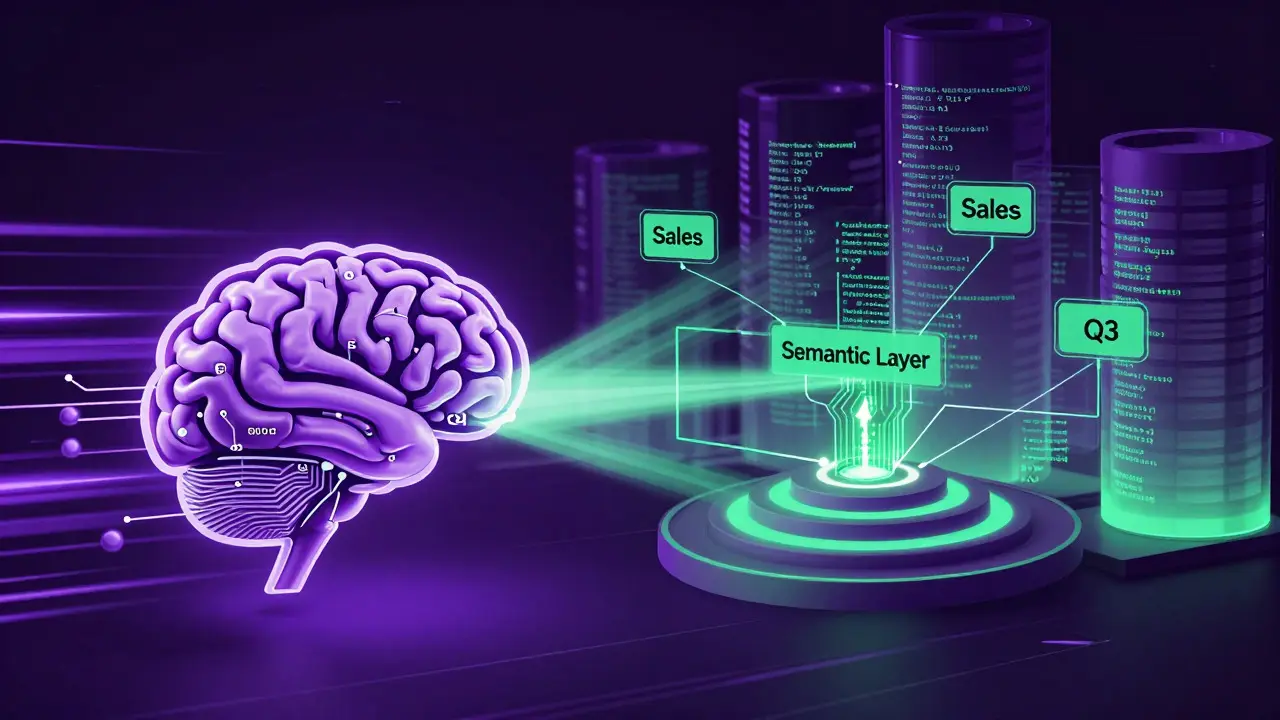
- Semantic Mapping: The system maps these concepts to specific database fields using a semantic layer. This is why clean data dictionaries are non-negotiable. If the AI doesn't know that "rev" means "revenue," it will fail.
- Query Generation: The tool generates the underlying code (SQL, MDX, etc.) and executes it against the data warehouse.
- Narrative Synthesis: Once the data is retrieved, a secondary model analyzes the results to detect patterns, outliers, and correlations, writing a concise summary of what the numbers mean.
Independent testing by TDWI in 2024 showed that natural language-to-SQL translation accuracy rates hover between 82% and 93%. While impressive, this margin of error means human oversight remains critical, especially for high-stakes decisions.
| Platform | Market Adoption (Fortune 500) | Key Strength | Primary Limitation |
|---|---|---|---|
| Microsoft Power BI Copilot | 34% | Seamless Microsoft ecosystem integration | Limited customization outside Azure |
| Tableau Einstein Copilot | 22% | Strong retail/e-commerce templates | 15% lower NL query accuracy vs. peers |
| Qlik Insight Advisor | 18% | Superior data storytelling capabilities | Requires 30% more training data |
| Arria NLG | 7% | 98% accuracy in regulatory reporting | Lacks broad BI platform integration |
The Role of Insight Narratives in Decision Making
Data visualization tells you what happened. Insight narratives explain why it matters. This distinction is crucial for democratizing data across an organization. An executive might see a red line on a chart indicating a drop in customer retention, but without context, that information is inert.
Automated narratives bridge this gap. They provide contextual analysis, such as, "Retention dropped 5% primarily due to increased churn among users aged 18-24, correlating with the price increase implemented on June 1st." This level of specificity allows non-technical stakeholders to make informed decisions without needing a data science degree.
However, this power comes with responsibility. Dr. Andrew Ng, founder of DeepLearning.AI, noted in March 2025 that while NLBI represents the greatest democratization of data since the spreadsheet, organizations must enforce strict governance to prevent "hallucination risks." A hallucinated insight-one where the AI confidently states a false correlation-can be disastrous if acted upon without verification.
Implementation Challenges and Realities
Despite the hype, rolling out Natural Language BI is not plug-and-play. Many organizations hit snags during implementation. The biggest hurdle is often data quality. If your metadata is messy, incomplete, or inconsistent, the AI will produce garbage outputs. In fact, 38% of enterprises attempting implementation faced significant challenges integrating with legacy data systems lacking proper API access, according to 451 Research.
Another common issue is ambiguity. Current systems require an average of 2.3 follow-up clarifications per complex query. If a user asks, "Show me performance," the AI needs to know: performance of what? Sales? Server uptime? Employee productivity? And over what timeframe? This back-and-forth can frustrate users if not managed well.
Furthermore, there is a cultural shift required. Traditional BI teams often fear role displacement. However, early adopters report a different reality. Analytics professionals spend less time on routine reporting and more time on validation, strategy, and complex modeling. One senior data scientist on Reddit noted that while Copilot helped non-technical team members get answers faster, they now spend 30% of their time verifying AI outputs. The role hasn't disappeared; it has evolved from builder to validator.

Future Trends: Agentic AI and Multimodal Analytics
We are currently in a transitional phase. By 2026, Gartner predicts that 50% of all analytical queries will originate from natural language, up from just 10% in 2024. But the next frontier is even more ambitious: agentic AI.
Microsoft’s Convergence 2025 announcements highlighted "agentic business applications" where AI agents don't just answer questions-they take action. Imagine an analytics agent that detects a supply chain disruption via NLBI, writes a narrative about the impact, and then automatically drafts an email to procurement recommending alternative suppliers. McKinsey’s 2025 survey indicates that 23% of organizations are already scaling these agentic systems.
Additionally, multimodal analytics are on the horizon. Future NLBI systems will incorporate image and video analysis, allowing users to ask questions about physical store footage or product images alongside traditional numerical data. Gartner estimates that 35% of enterprise analytics will include visual data interpretation by 2027.
Best Practices for Analytics Teams
To succeed with Generative AI in analytics, teams should focus on three areas:
- Clean Your Metadata: Invest heavily in defining business terms. Create a comprehensive data dictionary. The AI is only as good as the labels it understands.
- Train for Prompt Engineering: SQL skills are becoming less critical than domain knowledge and prompt crafting. 68% of organizations now require certified prompt engineering training for analytics staff. Teach your team how to ask precise, contextual questions.
- Establish Governance Frameworks: Define clear rules for when AI-generated insights can be used autonomously versus when they require human approval. Develop specific compliance frameworks, especially for regulated industries like finance and healthcare.
The return on investment is compelling. AmplifAI’s 2025 ROI Analysis shows that each dollar invested in Generative AI delivers $3.70 in return, with analytics implementations leading the pack at $4.80 per dollar. The market is projected to grow from $2.1 billion in 2024 to $8.7 billion by 2027. Organizations that hesitate risk falling into the "GenAI Divide," where performance gaps between AI-integrated and traditional teams widen significantly.
What is the difference between Natural Language BI and traditional BI?
Traditional BI requires users to navigate pre-built dashboards or write code (like SQL) to extract data. Natural Language BI (NLBI) allows users to ask questions in plain English, which the system translates into queries and responds to with both visualizations and written narrative explanations.
Are AI-generated insights always accurate?
No. While translation accuracy is high (82-93%), errors can occur, especially with ambiguous queries or poor metadata. Human validation remains essential. Studies show that 23% of executives have misinterpreted AI narratives without verification, highlighting the need for oversight.
Which platforms lead in Natural Language BI adoption?
Microsoft Power BI Copilot leads with 34% adoption among Fortune 500 companies, followed by Tableau Einstein Copilot at 22%. Qlik and specialized platforms like Arria NLG also hold significant market shares depending on specific use cases like retail analytics or regulatory reporting.
How long does it take to implement Natural Language BI?
Successful adoption typically takes 4-6 weeks for initial setup, including data governance configuration and metadata enrichment. However, achieving full proficiency for business users may require additional training, though studies show they reach 85% proficiency in just 14 hours of hands-on experience.
Will Generative AI replace data analysts?
Unlikely to replace them entirely, but it will transform the role. Analysts will spend less time on routine reporting and data preparation, shifting focus toward validating AI outputs, complex predictive modeling, and strategic decision-making. The demand for strong domain knowledge and prompt engineering skills is increasing.
What are the main risks of using Insight Narratives?
The primary risks include hallucinations (false insights), over-reliance leading to blind spots in critical thinking, and security concerns regarding data privacy. Organizations must implement robust governance frameworks to mitigate these risks, ensuring that AI-generated content is verified before influencing major business decisions.