
By 2026, the race for bigger models is over. It’s not about how many parameters a language model has anymore. What matters now is how well it understands, reasons, and acts - especially in real-world settings. The next generation of large language models (LLMs) isn’t just smarter; it’s more focused, more reliable, and more integrated into the systems we rely on every day.
Context Windows Are Now Measured in Books, Not Pages
A few years ago, a 32,000-token context window felt like a breakthrough. Today, models like GPT-5 and Claude 4 are hitting 200,000 tokens. That’s not just a number - it’s a game-changer. Imagine feeding an entire legal contract, a 500-page research paper, or a full software codebase into a single prompt. No more chopping up documents. No more losing context between chunks. The model sees it all at once.This isn’t just about handling more text. It’s about deep analysis. In finance, analysts can now feed entire quarterly reports into a model and ask for trends, risks, and comparisons across years. In engineering, a developer can upload a full repository and get feedback on architecture, bugs, and security flaws - all in one go. The old limit of short context meant models had to guess. Now, they can reason from full evidence.
Seeing, Hearing, and Understanding the World Beyond Text
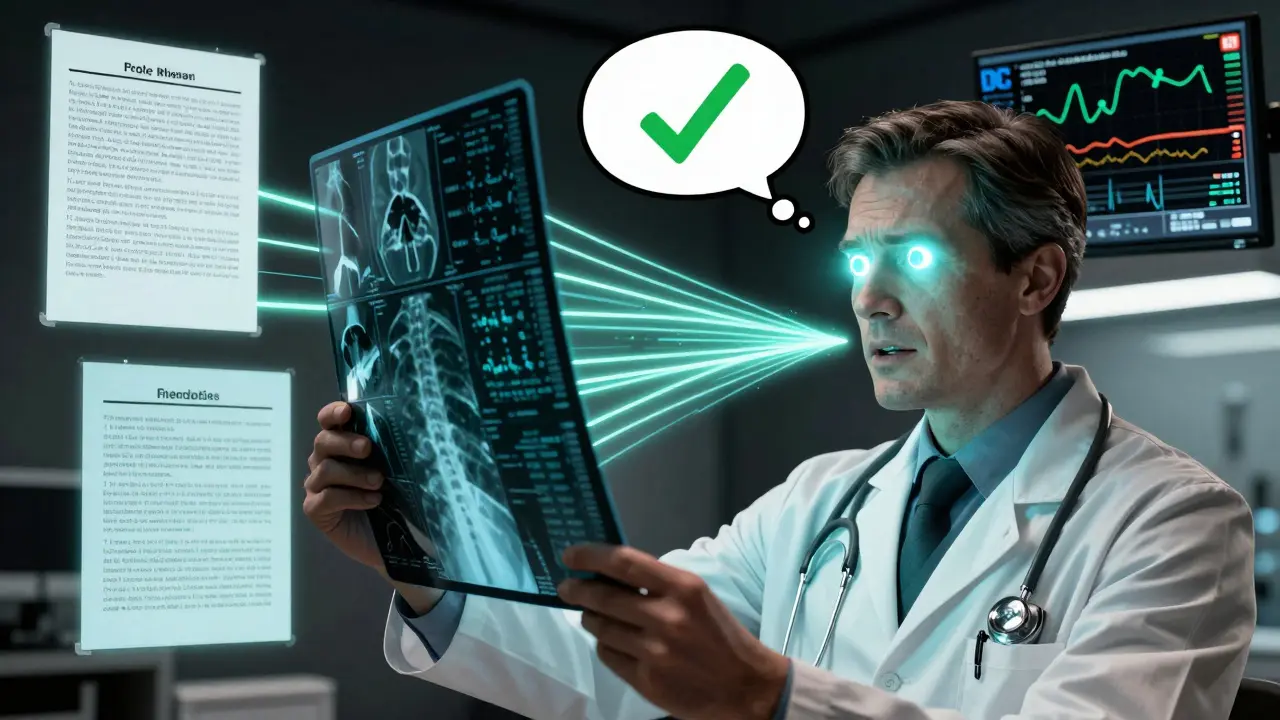
Text-only models are becoming relics. The next wave of LLMs doesn’t just read - they watch, listen, and interpret. Multimodal models now process images, audio, video, and even sensor data like temperature or motion logs. A doctor can upload an X-ray and a patient’s medical history together, and the model will cross-reference symptoms, imaging findings, and lab results to suggest possible diagnoses. A teacher can record a lecture, and the model will extract key points, identify confusing sections, and generate study guides with diagrams.This shift isn’t optional anymore. Over 70% of digital content is now visual or audio-based. If a model can’t handle it, it’s useless for real applications. Models like Gemini 2.5 and Qwen 3 now have unified encoders that treat text, images, and audio as equal inputs. The result? Fewer hallucinations, better accuracy, and deeper understanding.
How Models Think: Chain-of-Thought Reasoning
Earlier models gave answers like magic - fast, but often wrong. You’d ask, “What’s the capital of France?” and get “Paris.” Simple. But ask, “If a train leaves Paris at 8 a.m. going 120 km/h and another leaves Lyon at 9 a.m. going 100 km/h, when do they meet?” and you’d get nonsense.That’s changing. Chain-of-thought reasoning forces models to break problems into steps. Instead of guessing, they write out: “Step 1: Calculate time difference. Step 2: Distance covered by first train before second starts. Step 3: Relative speed. Step 4: Time to meet after second train starts.” This isn’t just for math. It works for legal reasoning, code debugging, and financial forecasting. OpenAI built this into GPT-5 because users demanded transparency - not just answers, but how the answer was reached.
Smarter, Cheaper, and More Efficient: Mixture-of-Experts
Running a massive model isn’t cheap. Training and deploying models with hundreds of billions of parameters eats up power, time, and money. Enter Mixture-of-Experts (MoE). Instead of activating every neuron in the model for every query, MoE routes each request to a small group of specialized “experts.” Think of it like a hospital: you don’t call every doctor for a headache. You call the right specialist.Mistral Large 2 and Mixtral use this approach. They’re faster, use less energy, and cost less to run - without losing accuracy. For small businesses and startups, this is a lifeline. You don’t need to be Google to use state-of-the-art AI anymore. You just need a smart architecture.
Stopping Hallucinations: Retrieval-Augmented Generation (RAG)
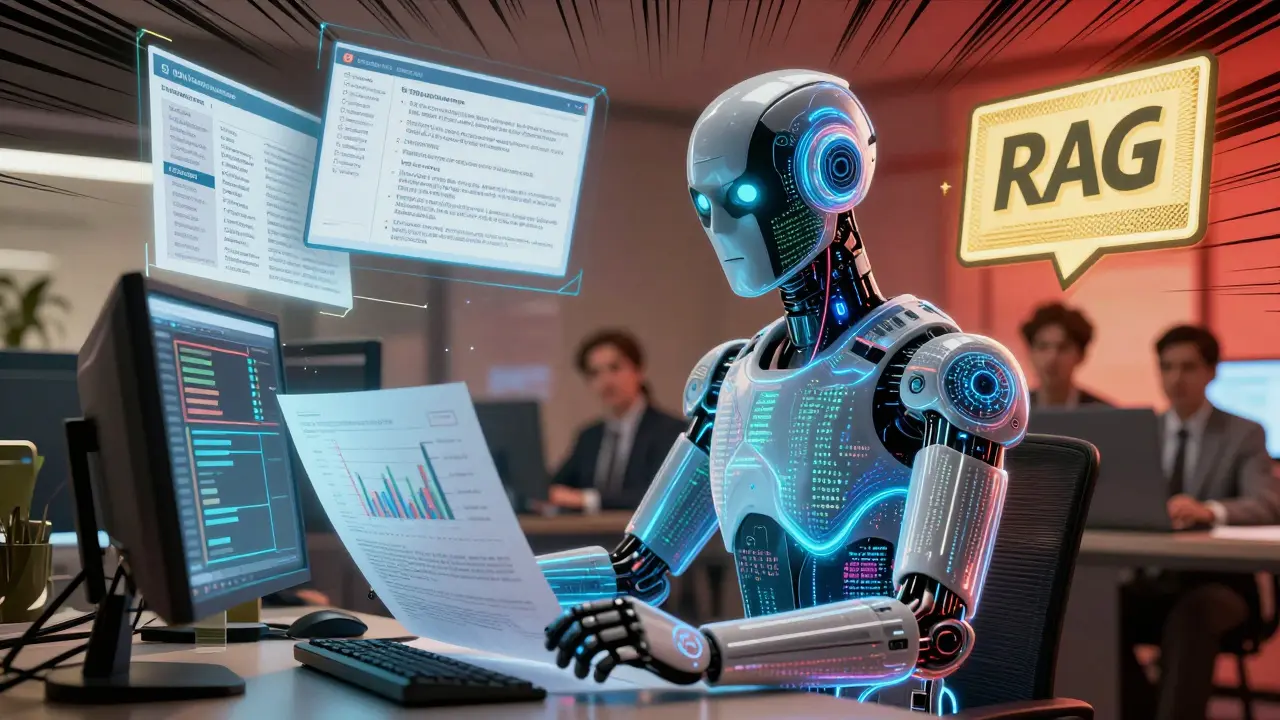
LLMs make things up. We call it hallucination. And it’s a big problem in healthcare, law, and finance. You can’t risk a model inventing a drug dosage or misquoting a law.RAG fixes this. Instead of relying only on what the model learned during training, it pulls in real-time data from trusted sources - databases, company wikis, regulatory documents. When you ask, “What’s the latest FDA guidance on insulin pricing?”, the model doesn’t guess. It checks the official FDA website, extracts the current text, and answers from there. MIT researchers found RAG reduces factual errors by up to 65% in enterprise settings. It’s not magic. It’s just good engineering.
From Chatbots to Autonomous Agents
The biggest shift in 2026? LLMs aren’t just answering questions - they’re doing work. Autonomous agents can schedule meetings, draft reports, update spreadsheets, and even debug code - all without human input. A customer service agent doesn’t just reply to emails anymore. It analyzes the customer’s history, checks inventory, proposes a refund, and sends it - all in under 30 seconds.This isn’t sci-fi. It’s happening in logistics, HR, and IT operations. Companies are building agent workflows where LLMs act as digital employees. They’re given goals, rules, and access to tools. They figure out the steps. They execute. And if something goes wrong, they learn from it.
On-Device AI: Privacy Is No Longer Optional
Cloud-based AI means sending your data to someone else’s server. For banks, hospitals, and government agencies, that’s a dealbreaker. That’s why edge deployment is exploding. Models like Llama 4 and DeepSeek V3 now run on laptops, phones, and even industrial sensors - with no internet needed.These models are smaller, optimized for low-power chips, and trained to preserve privacy. Your medical records stay on your device. Your legal documents never leave your network. And because the model runs locally, responses are near-instant - no lag, no cloud delays. This trend is being pushed by regulations like GDPR and HIPAA, but it’s also driven by user demand for control.
Specialized Models for Specialized Fields
One-size-fits-all is dead. A model trained on general internet text won’t understand medical jargon, legal contracts, or semiconductor schematics. Now, organizations are building domain-specific models. Legal firms use fine-tuned versions of Claude 4 trained on case law. Pharma companies use Llama 4 variants fine-tuned on clinical trial data. Even construction firms have models that read blueprints and flag structural risks.Techniques like LoRA and QLoRA make this affordable. You don’t need a supercomputer. You take a base model, add a few hundred million parameters tuned to your data, and you get a custom AI that outperforms general models on your tasks. This is where the real value is - not in generic chat, but in precision.
Open vs. Closed: The Great Divide
In 2024, closed models like GPT-5 and Gemini led in performance. By 2026, open-weight models like Llama 4, Mistral Large 2, and DeepSeek V3 are closing the gap - fast. The performance difference that used to be a year has shrunk to six months. And in some cases, open models already lead.Why? Because open models can be audited, customized, and deployed without vendor lock-in. Governments and defense contractors prefer them. Startups use them to avoid API costs. Researchers build on them. The ecosystem is shifting. Closed models still dominate consumer apps. But in enterprise, sovereign, and regulated environments? Open is winning.
Self-Improving Models: The New Normal
Static models are obsolete. The next generation learns on its own. Through continuous feedback loops, models adjust based on user corrections, new data, and performance metrics. If a model keeps misclassifying medical terms, it doesn’t wait for a human to retrain it - it updates its internal weights automatically.This is happening quietly, behind the scenes. In enterprise systems, models now have monitoring dashboards that flag when accuracy drops. They trigger retraining pipelines. They adapt. This isn’t a feature - it’s becoming the standard.
| Trend | Before 2024 | 2026 Standard |
|---|---|---|
| Context Window | 8K-32K tokens | 128K-200K+ tokens |
| Input Types | Text only | Text, images, audio, video |
| Reasoning | Single-step inference | Chain-of-thought step-by-step |
| Deployment | Cloud-only | Cloud + edge + on-device |
| Model Type | Dense transformers | Mixture-of-Experts (MoE) |
| Accuracy Control | None | RAG + real-time fact-checking |
| Customization | Expensive, rare | LoRA/QLoRA for any team |
What’s Next? The Autonomous Infrastructure
The future isn’t about building better chatbots. It’s about building systems that run themselves. Imagine a company where the finance team doesn’t write reports - an agent pulls data from accounting, legal, and sales systems, cross-checks it against regulations, and generates the report. The HR team doesn’t screen resumes - an agent matches candidates to job descriptions, flags bias, and schedules interviews. The IT team doesn’t troubleshoot - an agent diagnoses server errors, patches vulnerabilities, and notifies engineers only when needed.This isn’t distant. It’s happening now. And the models powering it aren’t just smarter. They’re more trustworthy, more efficient, and more deeply integrated than ever before.
What’s the biggest change in LLMs from 2024 to 2026?
The biggest change is the shift from scale to utility. In 2024, bigger models won. In 2026, smarter, more efficient, and more reliable models win. Context windows, multimodal input, chain-of-thought reasoning, and autonomous agents are now the benchmarks - not parameter count.
Are open-weight models better than closed ones now?
In performance, they’re nearly equal - and in some cases, better. For enterprise use, especially where data privacy and customization matter, open-weight models like Llama 4 and Mistral Large 2 are often preferred. Closed models still lead in consumer apps, but the gap has shrunk to under six months.
Can I run a next-gen LLM on my laptop?
Yes. Models like Llama 4 and DeepSeek V3 have been optimized to run on consumer-grade hardware. With 16GB+ RAM and a modern GPU, you can run a 7B or 13B parameter model locally. For heavier tasks, cloud APIs are still faster - but local models are good enough for many real-world uses.
Why is RAG so important?
RAG stops hallucinations. Instead of guessing answers from training data, it pulls real-time facts from trusted sources. This is critical in healthcare, law, and finance - where wrong answers have real consequences. It’s not a trick - it’s essential infrastructure now.
What’s the role of MoE in reducing costs?
MoE models activate only a small portion of their total parameters for each task - like using only the right tools for the job. This cuts inference costs by 30-50% compared to dense models with similar accuracy. For companies running LLMs at scale, that’s millions in savings.

Shivani Vaidya
March 18, 2026 AT 15:36The shift from scale to precision is long overdue. I've seen too many organizations burn millions on massive models that still hallucinate medical dosages or misquote legal statutes. What matters now isn't how big the model is, but whether it can be trusted with real-world consequences. RAG isn't just a feature-it's a necessity. And MoE? Finally, someone built something efficient that doesn't sacrifice accuracy. This isn't evolution. It's revolution.
Rubina Jadhav
March 20, 2026 AT 06:20Running Llama 4 on my old laptop changed everything. No more waiting for cloud responses. No more worrying if my documents are being stored somewhere. Just works. Quiet. Reliable. I didn't think this was possible two years ago.
sumraa hussain
March 20, 2026 AT 18:02Let me tell you something-this whole ‘context window is king’ thing? It’s hilarious. We used to brag about 32K tokens like it was a miracle. Now we’re talking 200K? That’s not progress-that’s just throwing RAM at the problem. And don’t get me started on ‘autonomous agents.’ You think a model can schedule meetings? Try explaining it to your boss when it books a meeting at 3 AM because it ‘thought’ you were in a different timezone. It’s not intelligence. It’s chaos with a UI.
Raji viji
March 22, 2026 AT 14:25Oh wow, another blog post pretending this is groundbreaking. Newsflash: RAG? We’ve had this since 2022. MoE? Mistral dropped it in 2023. Autonomous agents? I’ve been using custom LangChain pipelines since last year. And now you’re acting like this is 2026? This isn’t foresight-it’s regurgitation dressed up in fancy slides. The real story? Open models are catching up because closed ones are running out of steam. The emperor’s got no clothes, and everyone’s too polite to say it.
Rajashree Iyer
March 23, 2026 AT 10:57What if the real revolution isn't in the models at all? What if we're not seeing the shift from scale to precision-but the collapse of human authority in knowledge creation? We used to consult experts, read books, think for ourselves. Now we hand our questions to machines that don't understand context, only patterns. We don't want smarter models-we want to stop being lazy thinkers. The LLMs are mirrors. And what they reflect back is our own erosion of curiosity. The code doesn't lie. But the user? Oh, the user is lost.
Parth Haz
March 24, 2026 AT 21:45I appreciate how this article breaks down the technical shifts without hype. For teams working in regulated industries, the move toward RAG and on-device models isn't optional-it's compliance. We recently deployed a fine-tuned Mistral model with LoRA on our internal documents, and error rates dropped by over 60%. The real win? Our lawyers stopped panicking every time the AI responded. That’s not magic. That’s good design.
Vishal Bharadwaj
March 25, 2026 AT 03:41lol u think 200k context is a big deal? i ran a 500k context window on a custom llama 3.1 variant last month and it still forgot the first paragraph by the 3rd page. also rag is useless if your source data is garbage. and moe? sure, it saves money until one expert neuron gets corrupted and suddenly your model thinks the moon is made of cheese. also open models are slower and less secure. and yes i’ve read the papers. and no, i don’t believe them. also where’s the benchmark data? no one shows real-world numbers. just vibes and powerpoint charts. also i hate how everyone acts like this is new. it’s not. it’s just rebranded. also i’ve seen this before. in 2020. and 2022. and 2024. same thing. same hype. same failure. also i’m not convinced.