
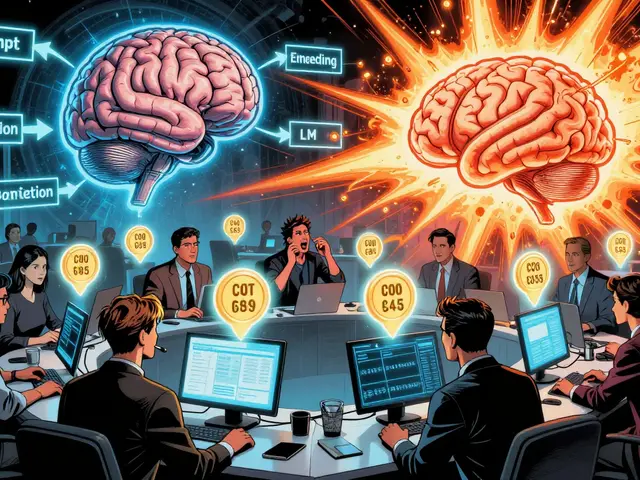
It is a bit of a tragedy in the tech world: a team spends three months building a stunning Generative AI prototype. It answers questions perfectly, summarizes documents in seconds, and wows the executives. But then, the move to production happens, and the project hits a wall. Suddenly, the Generative AI production environment is riddled with hallucinations, costs are spiraling out of control, and the security team has blocked everything. This is the "valley of death" where the majority of AI projects vanish. In fact, early data showed that as many as 86% of AI projects failed to reach production.
The problem is that most companies treat a Proof of Concept (PoC) as a science experiment. They want to see if the tech "works." But in an enterprise setting, "working" isn't just about a correct answer in a chat window; it's about security, reliability, and a clear return on investment. If you want to scale without the usual surprises, you have to stop treating the PoC as a separate phase and start treating it as the first iteration of your actual product.
The Gap Between a Demo and a Real Product
A Proof of Concept is designed to prove feasibility. It's a controlled environment where you use a few clean data samples and a handful of prompts. However, Generative AI is a type of artificial intelligence capable of creating new content, such as text or images, by learning patterns from massive datasets . Because these models are stochastic-meaning they are probabilistic, not deterministic-they don't behave the same way every time. When you move from ten users to ten thousand, the variability explodes.
You'll likely encounter a "reliability gap." A PoC might boast 90% accuracy, but without a transition plan, that often drops to 65-78% in production. Why? Because real users don't follow your script. They enter weird queries, try to trick the bot, and feed it messy data. This is why some experts, like Dr. Francesca Rossi from IBM, warn that hallucination rates can actually double once a model hits the wild.
Building a Production-Ready Foundation
To avoid the crash, you need to integrate enterprise requirements from day one. You can't just "bolt on" security and compliance at the end. For instance, consider the nightmare of a healthcare bot that works perfectly in a sandbox, only to find out it needs another year of development to meet HIPAA is the US Health Insurance Portability and Accountability Act which sets the standard for sensitive patient data protection compliance. That is a costly mistake you can avoid by involving your legal and security teams during the PoC.
From a technical standpoint, your infrastructure needs to shift. While a laptop or a small cloud instance might suffice for a demo, production usually requires GPU is a Graphics Processing Unit specifically designed to accelerate the mathematical computations required for deep learning clusters with at least 80GB of VRAM per instance for efficient fine-tuning. You also need an API gateway that can handle 500+ requests per second with latency under 500ms, or your users will simply give up on the tool.
| Feature | Proof of Concept (PoC) | Production Environment |
|---|---|---|
| Goal | Technical Feasibility | Business Value & Reliability |
| Data Volume | Small, Curated Sets | Massive, Unstructured Enterprise Data |
| Security | Basic API Keys | OAuth 2.0, RBAC, SOC 2 Compliance |
| Cost Focus | Minimal/Grant-funded | Unit Economics & OpEx Management |
| Evaluation | "Looks right" (Anecdotal) | BLEU/ROUGE Scores & Human Audits |

Solving the Cost and Performance Puzzle
One of the biggest shocks for companies scaling AI is the bill. Production costs are typically 20-30% higher than PoC costs because of the heavy lifting required for enterprise security and monitoring. If you are using AWS Bedrock is a fully managed service from Amazon that makes foundation models available via an API or Google Vertex AI is a machine learning platform that provides tools to train and deploy AI models and applications , you have some built-in tools, but you still need a strategy to keep costs down.
To keep the system performant, focus on these three areas:
- Prompt Versioning: Treat your prompts like code. Use version control so that when you tweak a prompt to fix a bug, you don't accidentally break ten other things.
- Guardrail Implementation: You will need 3-5x more training data to maintain accuracy when you add strict guardrails to prevent the AI from mentioning competitors or giving financial advice.
- Hybrid Architectures: Don't use the biggest, most expensive model for everything. Use a small, fast model for simple tasks and only route complex queries to the "heavy hitter" models.
The Path to Actual ROI
Stop asking "Can the AI do this?" and start asking "Does the AI save us money or make us money?" A huge number of failed deployments lack a clear ROI framework. If your goal is a "cool chatbot," you've already lost. Your goal should be something concrete, like "reducing customer support response time by 50%" or "increasing lead conversion by 30%."
The most successful companies use a cross-functional team from day one. This means you have a business owner, a developer, a security expert, and a compliance officer in the same room. This prevents the "throw it over the wall" mentality where developers build something that the security team refuses to deploy. When you align the business case with the technical build, your success rate jumps significantly-some studies suggest up to 47% higher than isolated experiments.

Avoiding the Human Element Pitfall
You can have the most perfect model in the world, but if your staff hates it, it's a failure. Around 73% of organizations struggle with adoption not because the AI is bad, but because they ignored change management. You can't just drop a tool into a workflow and expect people to change how they've worked for a decade.
Invest in process redesign. If an AI reduces a task from four hours to ten minutes, what does the employee do with the other three hours and fifty minutes? If you don't answer that, they will find ways to sabotage the tool or simply ignore it. The best deployments include feedback loops where real users can flag wrong answers, which then feed back into the model's fine-tuning process.
Why do GenAI projects often fail when moving to production?
Most projects fail because they treat the PoC as a technical demo rather than a business product. This leads to the "reliability gap," where model accuracy drops in the real world due to unpredictable user inputs, coupled with unforeseen security requirements and spiraling computational costs that weren't budgeted for during the experimental phase.
How can I measure the success of a Generative AI deployment?
Avoid relying on "vibes" or anecdotal evidence. Use technical metrics like BLEU and ROUGE scores for text quality, but prioritize business KPIs such as reduction in handle time, factual accuracy rates (targeting 95%+ for critical apps), and human evaluation scores where users rate coherence and relevance on a 1-5 scale.
What are the most critical security measures for AI scaling?
You should implement data encryption both at rest and in transit, role-based access controls (RBAC) that tie into your existing IAM systems, and comprehensive audit trails. Meeting SOC 2 Type II compliance is generally the gold standard for enterprise AI deployments to ensure data privacy and system integrity.
How long does the transition from PoC to production typically take?
Depending on complexity, a structured transition usually takes 4 to 8 weeks. This includes gathering stakeholder requirements (Week 1), technical setup and API configuration (Week 2), and an iterative cycle of development, testing, and refinement with real-world scenarios (Weeks 3-8).
What is the best way to handle AI hallucinations in production?
The most effective approach is a combination of structured prompt engineering and knowledge base integration (like RAG). Additionally, implementing automated hallucination detection systems and maintaining a human-in-the-loop feedback system allows you to catch and correct errors before they impact the end user.
Next Steps for Your AI Strategy
If you're currently in the PoC phase, stop and audit your roadmap. Do you have a security sign-off? Do you have a cost projection for 10,000 users? If the answer is no, you're building a demo, not a product. Shift your focus toward a "Path-to-Production" framework that emphasizes operational resilience over novelty. Start with a small, high-value use case, prove the ROI, and then scale incrementally. This is the only way to ensure that your AI journey ends with a successful deployment rather than a cautionary tale.


Jack Gifford
April 6, 2026 AT 12:04This is a spot-on breakdown of why so many projects tank. The part about the "reliability gap" really hits home because people always underestimate how chaotic real users are compared to a clean test set.
Nathan Pena
April 6, 2026 AT 21:05It is frankly exhausting to see the same fundamental misunderstandings of stochastic processes repeated ad nauseam in corporate circles. The notion that a PoC is a "science experiment" is a charitable description; in reality, it is usually just a vanity project for executives who cannot distinguish between a sophisticated autocomplete and an actual cognitive architecture. The failure rate cited is likely an underestimate, as most companies lack the intellectual rigor to even measure their failure accurately. Most of these "teams" are simply throwing tokens at a wall and hoping for a miracle without understanding the underlying latent space. True scaling requires a level of mathematical maturity that is currently absent in ninety percent of the industry. One does not simply "bolt on" SOC 2 compliance; one builds a secure architecture from the first line of code, or one accepts that they are merely playing with toys. The industry's obsession with "vibes" over BLEU or ROUGE scores is an embarrassment to engineering as a discipline.
Krzysztof Lasocki
April 8, 2026 AT 03:36Oh sure, let's just tell the security team to join the brainstorming session and I'm sure they'll be totally chill about letting a probabilistic black box touch the production database!
But seriously, the hybrid architecture approach is the only way to avoid going bankrupt paying for GPT-4 calls when a tiny model could do the job.
Bridget Kutsche
April 8, 2026 AT 23:38I really love the emphasis on the human element here! It's so easy to forget that the people using the tool need to feel supported through the change. If you've got a team struggling with adoption, try focusing on small wins first to build confidence in the AI's reliability.
Kathy Yip
April 10, 2026 AT 09:13the thoght of how we actully use these tools is kinda deep... we try to force a non-linear inteligence into a linear business process and then wonder why it doesnt fit
Mike Marciniak
April 11, 2026 AT 13:27Costs spiraling is the least of our worries. They want us to trust these "guardrails" while the models are literally designed to absorb every bit of our private data for the next training set. The real valley of death is our privacy.
Sarah Meadows
April 13, 2026 AT 06:36Total failure to prioritize domestic compute sovereignty. If we don't move the entire pipeline to US-based GPU clusters and ditch the globalized API dependencies, we're just leaking our strategic edge to foreign adversaries via latent space vulnerabilities. This is a national security issue, not just a budget problem.
Mbuyiselwa Cindi
April 13, 2026 AT 22:17I've seen this happen so many times in my own projects. The trick is definitely in the feedback loop mentioned at the end. Getting users to actually flag the wrong answers is a game changer for fine-tuning. It turns the users into part of the dev team!
VIRENDER KAUL
April 14, 2026 AT 07:40The lack of rigor in current implementation strategies is appalling the obsession with speed over stability is a hallmark of amateurism in the AI field