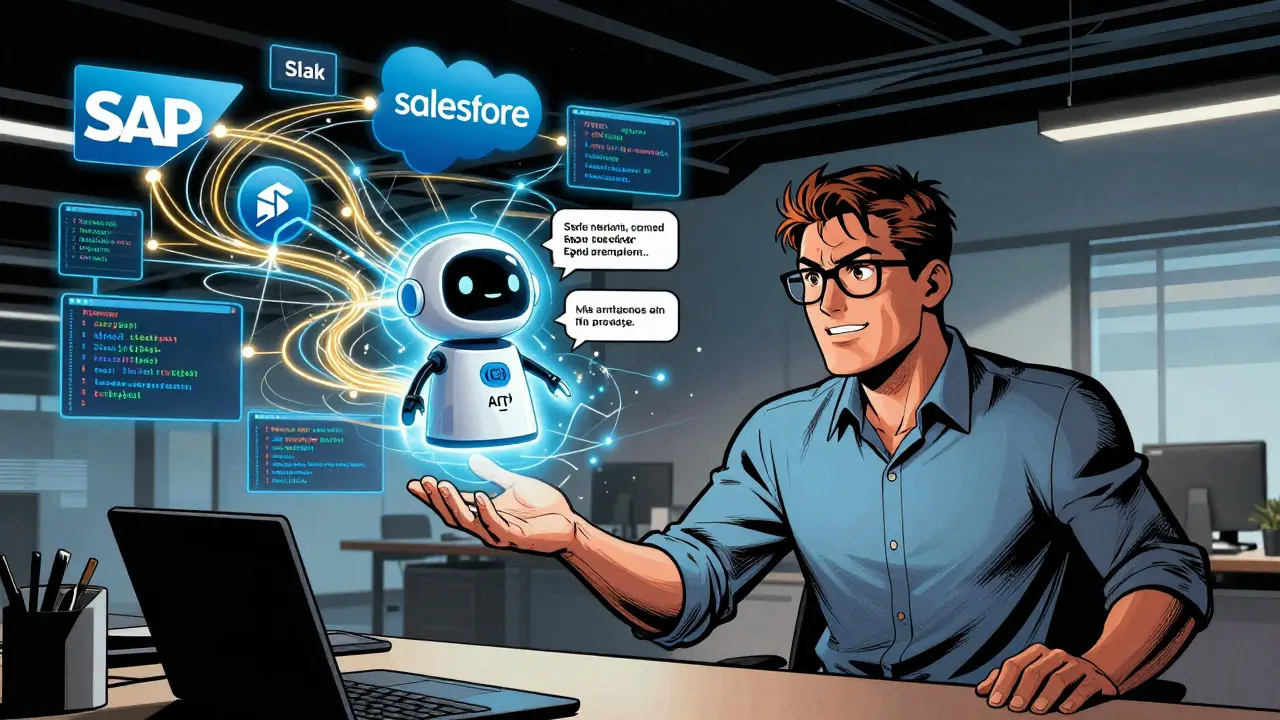
Enterprise vibe coding isn’t science fiction anymore. It’s happening right now-in finance teams automating compliance reports, logistics departments cutting delivery tracking delays, and IT departments building internal dashboards in days instead of weeks. The shift isn’t about replacing developers. It’s about changing what developers do. Instead of typing line after line of code, they’re now guiding AI agents to build, test, and deploy software using natural language prompts. And when done right, it cuts development time by 25-40%.
How Vibe Coding Actually Works in the Enterprise
Vibe coding in enterprises means using AI tools that don’t just suggest snippets-they generate entire modules, fix bugs automatically, and integrate with existing systems like SAP, Salesforce, or Oracle ERP. Unlike consumer AI coders that stop at autocomplete, enterprise-grade vibe coding platforms include guardrails: automated security scans, access controls, and compliance checks built right into the workflow. Take ServiceNow’s January 2026 update. Developers describe a workflow in plain English-"Create a form that pulls employee data from HR and triggers a Slack alert if overtime exceeds 10 hours"-and the AI generates production-ready code. It doesn’t just spit out a script. It connects to the HR database, validates permissions, adds logging, runs unit tests, and even rolls back changes if a security rule is violated. No extra glue code. No manual API connections. The system handles it. Salesforce’s Agentforce Builder works similarly. Business analysts can describe a customer onboarding flow. The AI builds the workflow, connects it to the CRM, adds validation rules, and deploys it-all without writing a single line of JavaScript or Apex. Engineers then step in to refine, audit, and optimize. This isn’t low-code. It’s high-context code, where human expertise guides AI execution.The Three-Layer Architecture Behind Successful Integration
Successful enterprises don’t just flip a switch and expect AI to run wild. They follow a layered approach:- AI-enabled IDEs: Tools like Cursor, Windsurf, or GitHub Copilot in VSCode handle individual productivity. These are the entry point. Developers use them to write, refactor, and debug code faster.
- Orchestration layer: This is where multiple AI agents coordinate. One agent writes code, another runs tests, a third checks for compliance. They communicate through structured prompts and shared context, not random guesses.
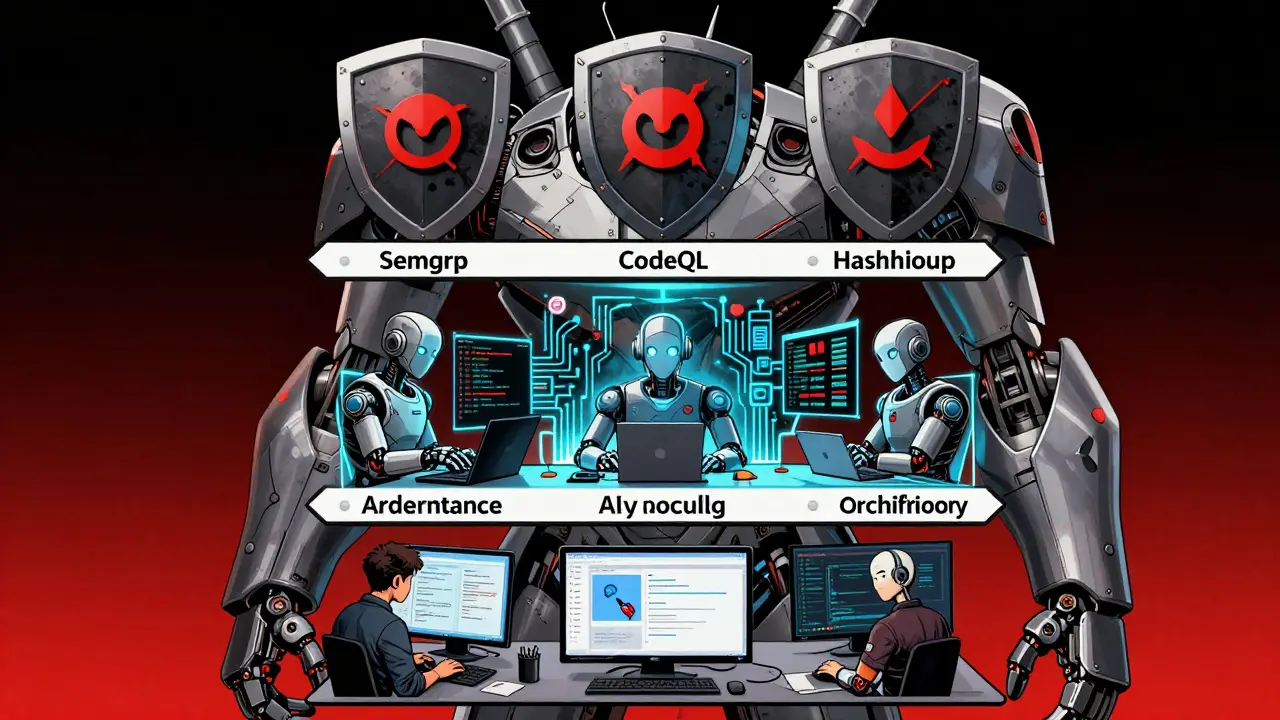
- Governance middleware: This layer enforces company policies. It blocks code that accesses sensitive data without approval, flags outdated libraries, and logs every AI-generated change. Tools like Semgrep, CodeQL, and HashiCorp Vault integrate here to scan code, manage secrets, and restrict access.
Where Vibe Coding Shines (And Where It Fails)
Not every project is a good fit. Here’s what works:- Internal tools: Dashboards, reporting systems, workflow automations. Salesforce reports these take 3 weeks traditionally-and just 3 days with vibe coding.
- Legacy modernization: Rewriting COBOL systems? Genpact found AI can cut migration timelines by 40% by auto-generating translation layers and mapping data schemas.
- Workflow automation: ServiceNow’s internal metrics show 92% fewer errors than manual coding when automating approval chains.
- Trying to automate everything at once: Teams that say, "Make our entire ERP system self-managing" end up with 41% of projects requiring full rewrites. Vibe coding needs bite-sized goals.
- Ignoring integration: 68% of custom vibe coding projects fail because they can’t talk to existing systems like SAP or Active Directory. AI doesn’t know your legacy APIs unless you teach it.
- Abandoning oversight: If engineers stop reviewing AI output, you get hallucinated code, security holes, and undocumented dependencies. The cost of maintenance jumps 35-50% when teams treat AI as a black box.
Skills You Need Now (Not Just Coding)
Forget the old skill set. Today’s enterprise developer needs:- Prompt engineering: Not just "write code"-but "Generate a secure REST endpoint that validates JWT tokens, logs access, and returns 403 if role doesn’t match." Specificity matters.
- AI testing: You can’t QA AI code like human code. You need to check for consistency, bias, edge cases, and hallucinations. Tools like Instinctools’ AI-Test Framework help automate this.
- Orchestration design: How do you chain AI agents? What happens if one fails? Who owns the output? These are new engineering problems.
- Context management: AI needs to know your company’s coding standards, naming conventions, and architecture patterns. You build that context into the system-through examples, documentation, and feedback loops.
Real-World Results and Risks
On Reddit, enterprise developers report 63% time savings on internal tool updates. But 78% struggled with SAP integrations. G2 reviews for ServiceNow’s platform give it 4.3/5-praised for automated debugging, criticized for the steep prompt learning curve. Replit’s enterprise users love Google Cloud integration but note 32% of negative reviews mention hallucinated code needing senior engineer review. The biggest risk? Skill erosion. Genpact warns that if engineers stop writing code from scratch, they lose the ability to debug deep system issues. And if AI agents start making decisions that conflict with company policy-"agentic misalignment"-you get compliance disasters. That’s why the smartest companies are using vibe coding as a supplement, not a replacement. Developers still own the code. They just have a tireless, intelligent assistant.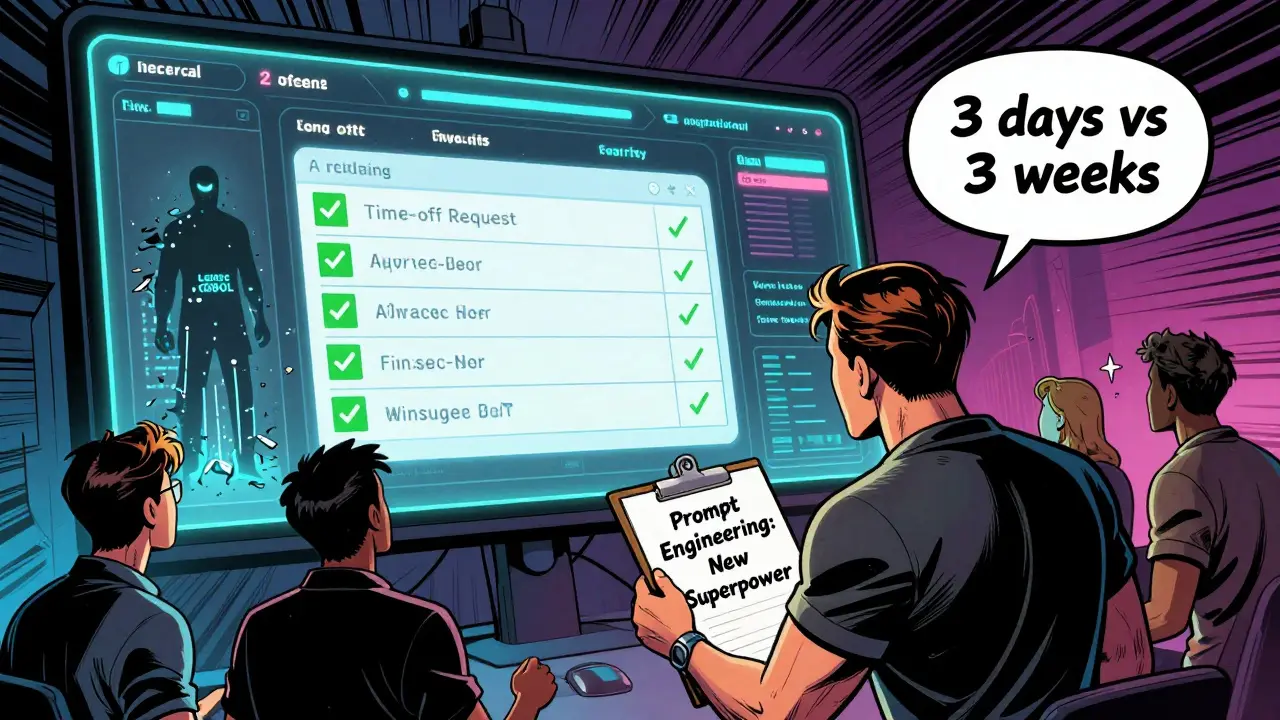
How to Start-Without the Disaster
Virtasant’s four-stage approach is the most reliable path:- Start with your IDE: Enable GitHub Copilot or Cursor for your team. Let them use it for small tasks-refactoring, writing unit tests, documenting functions.
- Build internal tools: Pick one low-risk project-like a time-off request tracker. Let AI build it from a prompt. Review the output. Fix the gaps.
- Break big tasks into steps: Don’t ask AI to "build our whole inventory system." Ask it to "generate the API for stock updates," then "add validation for low-stock alerts," then "connect it to the warehouse feed."
- Build your own patterns: Once you’ve done a few successful projects, document what worked. Create templates. Train your AI on your code style. Turn ad-hoc use into repeatable process.
The Future: Smarter Guardrails and Embedded AI
The next wave isn’t just faster coding. It’s AI that learns your company’s rules automatically. ServiceNow’s January 2026 update added "human-in-the-loop" features: AI suggests changes, but you preview, approve, or reject them-with full audit trails. Google Cloud and Replit are integrating Gemini 3 directly into design modes, letting developers sketch a UI and turn it into working code. Long-term, vibe coding will disappear as a "thing"-because it’ll just be how software is built. Like version control or agile sprints, it’ll be invisible. But only if you build the guardrails now. The companies that win won’t be the ones with the fanciest AI. They’ll be the ones who trained their teams, locked down security, and kept engineers in the driver’s seat.Is vibe coding the same as low-code or no-code platforms?
No. Low-code platforms give you drag-and-drop builders with fixed components. Vibe coding lets AI generate custom, production-ready code from natural language. It’s not limited by prebuilt blocks-it creates logic from scratch, while still following your company’s coding standards and security rules. Think of it as low-code on steroids, with full code ownership.
Can vibe coding replace software engineers?
Not even close. Engineers are more critical than ever-but their role is changing. Instead of writing every line, they now design prompts, review AI output, fix edge cases, manage security guardrails, and integrate AI agents into existing systems. The best engineers today are AI coaches and system architects, not typists.
What’s the biggest mistake companies make when adopting vibe coding?
Trying to automate everything at once. The most common failure is asking AI to build a complete enterprise system from a vague prompt like "Make our CRM better." Successful teams start with one small, well-defined task-like automating a single report-and build from there. Complexity kills vibe coding projects faster than bad code.
How do you ensure security with AI-generated code?
You need three layers: automated scanning (using tools like Semgrep and CodeQL), strict access controls (AI agents can’t access production data without approval), and local model execution (for high-security environments). Also, every AI-generated change must be logged, reviewed, and tested before deployment. No exceptions.
Which companies are leading in enterprise vibe coding right now?
ServiceNow and Salesforce lead in integrated platforms, with native ERP and CRM connections. Replit, with its Google Cloud partnership, leads in developer tooling. GitHub Copilot remains strong for IDE integration. But the real winners are companies that combine these tools with their own governance layers-not just the vendors.
What skills should teams focus on training first?
Start with prompt engineering and AI testing. Teach teams how to write clear, specific, context-rich prompts-and how to validate AI output. Then add training on orchestration, API integration, and cloud infrastructure. These are the new core competencies. Traditional coding skills still matter, but they’re no longer enough.
Enterprise vibe coding isn’t about replacing humans. It’s about removing friction. The goal isn’t to write less code-it’s to write better code, faster, with fewer errors, and without burning out your team. The tools are here. The question isn’t whether you’ll adopt them. It’s whether you’ll adopt them wisely.

Jen Kay
March 25, 2026 AT 11:59Look, I’ve seen this movie before. Remember when everyone said ‘automation will replace jobs’? Then we got Excel macros and suddenly everyone was a data wizard. Vibe coding is just the next iteration. The real win isn’t speed-it’s that junior devs can now ship real tools without waiting six months for a ‘senior’ to review their PR. That’s not magic. That’s equity.
And yes, the guardrails matter. But let’s be honest: if your org can’t enforce basic security scanning, you’ve got bigger problems than AI hallucinations.
Michael Thomas
March 27, 2026 AT 08:53USA invented the computer. We built the internet. Now we’re letting AI write our code? Pathetic. Real engineers type. Real engineers debug. Real engineers don’t ask Siri to build their API. This is what happens when you let woke HR dictate tech policy. Wake up.
Abert Canada
March 27, 2026 AT 13:21Man, I’ve been doing this for 12 years in Montreal and Toronto. We started with Copilot on small scripts. Then we built a ticketing bot that auto-closed duplicate requests. Took us two days. Used to take two weeks.
But here’s the thing: the AI doesn’t know our French-Canadian naming conventions. So we trained it on 800 of our legacy commits. Now it writes code that feels like ours. Not ‘generic tech bro’ code. Our code.
Also-yes, you need to review it. But you also need to stop acting like AI is a threat. It’s a translator. Between business and code. And we’re the ones who speak both languages.
Xavier Lévesque
March 29, 2026 AT 06:29Let me guess-you’re the guy who says ‘I don’t need AI, I type 120 WPM.’
Bro. You’re not faster. You’re just louder.
I watched a business analyst write a customer onboarding flow in plain English. AI built it. Deployed it. No Apex. No debugging hell. She didn’t even know what a ‘loop’ was. But she knew what ‘send a Slack alert if payment fails’ meant.
That’s not replacing devs. That’s unblocking humans. And honestly? It’s beautiful.
Thabo mangena
March 31, 2026 AT 03:37Allow me to express my profound appreciation for the intellectual rigor evident in this exposition. The structural integrity of the three-layer architecture, particularly the governance middleware component, represents a paradigmatic advancement in software development methodology.
It is my earnest observation that the confluence of AI-enabled IDEs with formalized compliance orchestration constitutes not merely an operational enhancement, but a civilizational inflection point in the evolution of human-machine symbiosis.
May I humbly suggest that organizations neglecting this paradigm risk not merely technical obsolescence, but epistemological irrelevance in the digital age?
Karl Fisher
March 31, 2026 AT 12:36Okay but have you SEEN the code? I mean, I saw a demo where the AI generated a ‘secure’ auth endpoint… and it used MD5. MD5. Like, 2005-era MD5.
And then the ‘guardrails’? They blocked the code for 3 days while waiting for a manager to approve a ‘security review’ that was literally just copy-pasting the same 3 rules from last quarter.
Also, I asked for a dashboard. Got a React component with 17 nested divs and a console.log that says ‘DEBUG: this is probably wrong.’
It’s not vibe coding. It’s vibe… chaos.
Buddy Faith
April 1, 2026 AT 04:40AI writes code now so the government can track everything
next thing you know they’ll make the AI write your tax return and auto-file it
they already know your password
they already know your sleep schedule
they already know you clicked that link in the email
they’re not replacing devs
they’re replacing you