
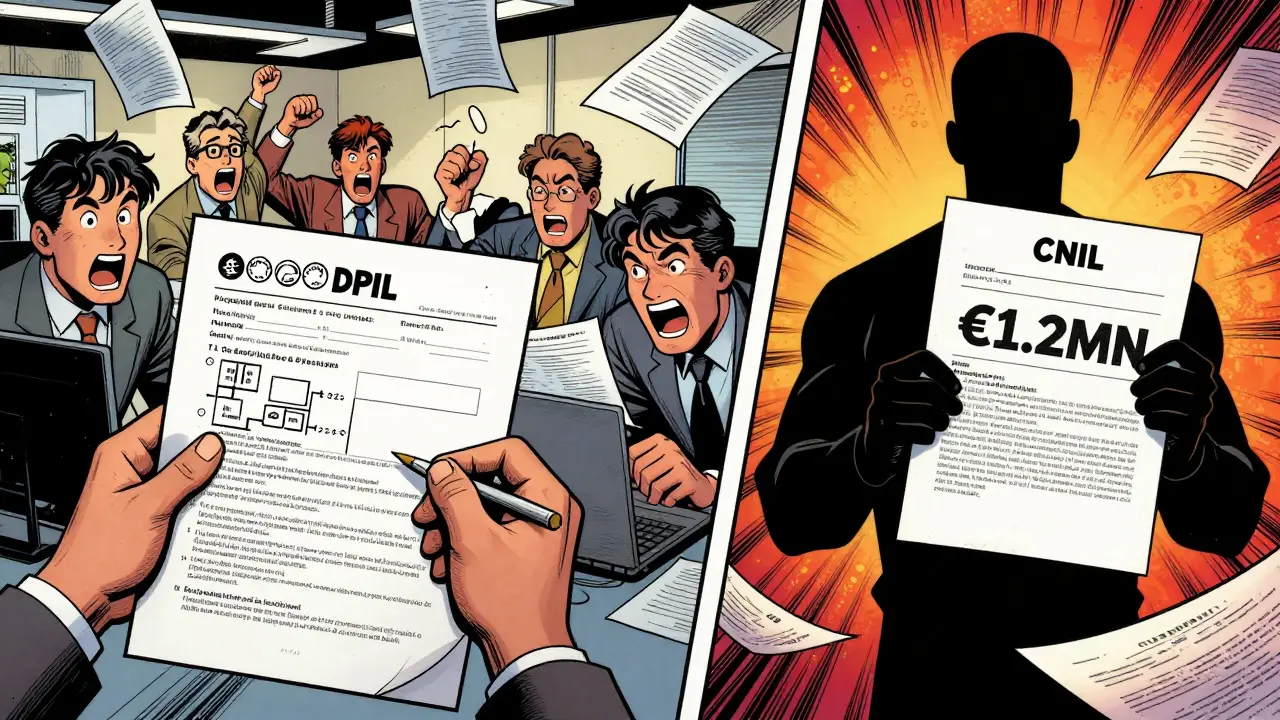
When you use generative AI to analyze employee emails, predict credit risk, or generate medical summaries, you’re not just building a tool-you’re processing personal data at scale. And under new laws, that’s not optional. If you’re deploying generative AI in the EU, UK, or anywhere subject to GDPR or the AI Act, you must do an impact assessment. Not someday. Not when you have time. Now.
Why DPIAs for Generative AI Are No Longer Optional
Data Protection Impact Assessments (DPIAs) were created under GDPR to catch risky data processing before it happens. But generative AI changed the game. These systems train on massive datasets-often scraped from the internet without clear consent-and spit out outputs that can mimic real people, reveal private details, or make decisions that affect jobs, loans, or healthcare. The European Data Protection Board (EDPB) says if your AI system does any of these, you need a DPIA:- Uses profiling to score people-like hiring decisions or insurance pricing
- Processes special category data-health, race, religion, biometrics
- Automatically monitors people at scale-think workplace surveillance via AI
DPIA vs. FRIA: Two Assessments, One Goal
The EU AI Act, which took effect in August 2024, added another layer: the Fundamental Rights Impact Assessment (FRIA). It’s not a replacement for the DPIA. It’s a companion. Think of it this way:- DPIA asks: “Are we handling personal data legally, fairly, and securely?”
- FRIA asks: “Is this AI system violating human rights-like freedom from discrimination, privacy, or fair trial?”
- Why the system is necessary and proportionate
- How you’ll handle complaints
- What internal governance structures you’ve put in place
- How data flows through the system
- What safeguards protect the data
- How users can access, correct, or delete their data
When Exactly Do You Need a DPIA for Generative AI?
Not every chatbot needs a DPIA. But these situations do:- You’re using a foundation model trained on personal data without explicit consent-like scraping LinkedIn profiles to build a resume-scoring tool
- Your LLM generates health advice based on patient records
- You’re analyzing employee communications to rate performance or predict turnover
- You’re using AI to detect emotions in video interviews
- Your system processes over 10,000 personal records per month
The Four Core Elements of a Generative AI DPIA
The ICO and EDPB agree: every good DPIA must answer four questions.- What are you doing? Describe the processing. Not in marketing language. In technical detail: which model? Where’s the data from? How is it stored? Who accesses it?
- Why is this necessary? Can you achieve your goal without AI? Could you use less data? Is there a less invasive way?
- What risks do people face? Think beyond data breaches. Could the AI hallucinate medical advice? Could it misgender someone? Could it leak private conversations? Could it reinforce stereotypes in hiring?
- How are you fixing it? What safeguards? Data minimization? Human review? Audit trails? Training for staff? Clear user controls?
Templates That Actually Work in 2026
Generic DPIA templates from 2020 are useless now. Generative AI needs specialized fields. The ICO’s updated template (v4.1, March 2023) includes sections for:- Explainability of automated decisions
- Training data sources and consent status
- Output accuracy and bias testing
- Training data composition-what percentage is personal data?
- Output risk assessment-does the AI generate fake names, addresses, or medical records?
- Percentage of personal data in training sets
- How users can request deletion of AI-generated outputs tied to them
- Data minimization effectiveness
- Percentage of synthetic data used instead of real personal data

What Happens If You Skip It?
Fines aren’t the only cost. In January 2025, the EU started enforcing DPIA requirements for high-risk AI systems. By June 30, 2025, even general-purpose models like GPT-4 or Claude need them. Enforcement begins January 1, 2026. Gartner predicts 92% of enterprise generative AI deployments will require DPIAs by 2026. Forrester says enforcement actions will rise 40% next year. Companies that delayed are now scrambling. Some are halting AI projects entirely. But there’s a silver lining. As templates become standardized and tools automate parts of the process, the average cost of a DPIA is dropping-from $18,500 in 2024 to $14,200 in 2026. The tools are getting better. The rules aren’t going away.Next Steps: What to Do Today
If you’re using generative AI:- Map your data flows. Where does input come from? Where does output go?
- Identify if you’re processing special category data or doing profiling.
- Check if you’re using a foundation model or training on personal data.
- Download the latest template from ICO or CNIL. Don’t guess-use the official one.
- Involve your Data Protection Officer. They’re not optional.
- Start the assessment now. Even if you’re not sure yet.
Do I need a DPIA if I’m using a third-party generative AI tool like ChatGPT?
Yes-if you’re inputting personal data into it. Using ChatGPT to analyze customer emails, generate personalized marketing, or screen job applicants counts as processing personal data under GDPR. The provider (OpenAI) isn’t responsible for your compliance. You are. You must still complete a DPIA to document how you’re using the tool, what risks it introduces, and how you’re mitigating them.
Can I use the same DPIA for multiple AI systems?
Only if they’re nearly identical in function, data sources, and risk profile. If you’re using one model for hiring and another for customer service, you need separate assessments. Each system introduces different risks. Regulators expect specificity-not a generic template slapped onto five different tools.
What if my AI doesn’t store data-does that mean no DPIA?
No. Even if your AI doesn’t store data, if it processes personal data during inference-like analyzing a user’s voice to detect stress or scanning a resume to rank candidates-you still need a DPIA. Processing happens at the moment of use, not just during storage. The risk is in the interaction, not the archive.
Is synthetic data a way to avoid DPIAs?
Not always. If synthetic data is generated from real personal data-like using real employee records to train a model that then creates fake ones-you still need to assess how the original data was obtained and whether the synthetic outputs could be reverse-engineered. Some regulators, like CNIL, require you to disclose the percentage of synthetic data used and prove it doesn’t leak real information. It reduces risk, but doesn’t eliminate the need for assessment.
What happens if my DPIA says the risk is too high?
You must consult your national data protection authority before proceeding. If you ignore this step and still deploy, you’re violating GDPR. In 63% of cases, regulators require changes to the system-like adding human review, limiting data scope, or improving transparency. Only 12% of cases result in outright bans. Most organizations adjust and move forward. The goal isn’t to stop innovation-it’s to make it safe.


poonam upadhyay
January 9, 2026 AT 17:24Okay but let’s be real-how many companies are actually doing this? I’ve seen DPIAs that look like they were written by a ChatGPT prompt that got drunk on compliance jargon. ‘We mitigate risk by having a committee’-cool, and what does that committee DO? Do they even know what a transformer is? Or are they just signing off because the lawyer said so? I’ve worked at three startups where the ‘DPIA’ was a Google Doc titled ‘AI Stuff - FINAL V1 - DO NOT TOUCH’ with one bullet point: ‘We didn’t break anything… probably.’
Shivam Mogha
January 10, 2026 AT 10:31Just did my first FRIA. Took 3 days. Worth it.
mani kandan
January 10, 2026 AT 10:44There’s something deeply ironic about using AI to assess AI’s risks. We build these black boxes to automate compliance, then demand they explain themselves in 47-page PDFs. The truth? Most orgs treat DPIAs like tax forms-do the bare minimum, hope nobody audits you. But when the CNIL shows up with a subpoena and a smirk? That’s when you realize: you can’t outsource ethics to a template.
I’ve seen teams spend six months tweaking output bias metrics while ignoring the fact that their training data was scraped from Reddit threads about ‘how to ghost your boss.’ The AI didn’t invent discrimination-it just mirrored it, perfectly.
Still, props to the ICO and CNIL for pushing real specificity. That ‘percentage of personal data in training sets’ field? Genius. Makes you actually think about what you’re feeding the beast.
And synthetic data? Don’t get me started. I once saw a company claim they used ‘100% synthetic data’-turns out their ‘synthetic’ resumes were just real ones with names swapped out. The regulator called it ‘fraudulent obfuscation.’ Ouch.
Bottom line: if your AI touches personal data, even once, you owe it to the people whose lives it affects to do this right. Not because it’s legal. Because it’s human.
Rahul Borole
January 11, 2026 AT 23:22As a Certified Information Privacy Professional (CIPP/E) and compliance lead for a multinational fintech firm, I can confirm with absolute certainty that the regulatory landscape for generative AI has reached a critical inflection point. The European Data Protection Board’s guidance, coupled with the binding obligations under the AI Act, mandates a rigorous, documented, and cross-functional approach to impact assessment. Failure to implement both DPIA and FRIA frameworks constitutes a material breach of Article 35 and Article 28 of the GDPR and AI Act, respectively, exposing organizations to administrative fines of up to 4% of global annual turnover. Furthermore, the requirement to document governance structures, complaint handling procedures, and proportionality justifications is not discretionary-it is a statutory obligation. We have implemented automated compliance workflows integrated with our MLOps pipeline, reducing assessment time by 40% while improving audit readiness. Organizations that delay action are not merely non-compliant-they are exposing themselves to existential legal and reputational risk. Immediate action is not optional; it is imperative.
NIKHIL TRIPATHI
January 13, 2026 AT 15:27Man, I read this whole thing and thought-this is the most boring thing I’ve ever clicked on. Then I remembered my cousin got fired because an AI flagged her ‘low engagement’ after she took a sick day. She didn’t even know it was tracking her Slack messages. So yeah, maybe this stuff isn’t boring. Maybe it’s life-changing.
I work in HR tech. We use AI to screen resumes. We thought we were being smart. Turns out we were just being lazy. We didn’t do a DPIA. Now we’re fixing it. Took us three months. We had to hire a data scientist just to map where the data went. It’s a mess. But it’s a mess we own now.
Also-synthetic data? Yeah, we tried it. Turns out the AI still leaked real names. Like, it generated fake resumes but used real company names and job titles. So we had to go back and scrub everything. Lesson learned: synthetic isn’t magic. It’s just a different kind of risk.
And yes, if you’re using ChatGPT to write performance reviews? You’re still responsible. OpenAI doesn’t care if your employee gets demoted because the bot thought ‘too many exclamation marks’ meant ‘unprofessional.’ You do.
Start now. Don’t wait for the fine.
Shivani Vaidya
January 13, 2026 AT 20:37It's fascinating how we've created systems capable of mimicking human thought, yet we still lack the institutional will to hold them accountable. The DPIA is not a bureaucratic hurdle-it is a moral contract between technologists and the public. When an AI denies someone a loan, or misdiagnoses a condition, or misgenders a user in a healthcare portal, the harm is real, irreversible, and often invisible until it's too late. The templates from ICO and CNIL are not mere documents-they are artifacts of responsibility. Every field, every risk, every mitigation strategy is a step toward ethical engineering. We must treat compliance not as a cost center, but as a design principle. Innovation without integrity is not progress-it is negligence.
Aryan Jain
January 14, 2026 AT 10:39They’re lying. All of it. DPIAs? FRIAs? Templates? Just a distraction. The real truth? The EU doesn’t want to regulate AI-they want to kill it. They’re scared. They know these models can expose corruption, leak secrets, expose billionaires’ private chats. So they make you fill out 47-page forms so you give up before you even start. That’s why they say ‘you need a DPIA for GPT-4’-because they don’t want you to use it. It’s not about safety. It’s about control. And the ‘fines’? Just a scare tactic. The real penalty is silence.
They’ll fine you for using AI to analyze emails… but not for the 1000 other things they do with your data. Double standard. Total scam.
They’re not protecting you. They’re protecting themselves.
Nalini Venugopal
January 14, 2026 AT 12:25OMG this is so important!! I just read this and cried a little 😭 I work in healthcare IT and we’re using an AI to summarize patient notes-no DPIA yet, but now I’m emailing my boss RIGHT NOW to schedule a meeting. Thank you for writing this. I’ve been so scared to speak up because everyone says ‘it’s just an AI’ but NO-it’s reading my patients’ trauma, their diagnoses, their secrets. I can’t sleep knowing we didn’t do this right. I’m printing out the CNIL template today. #AIethics #DPIAismandatory
Pramod Usdadiya
January 15, 2026 AT 19:23so i read this and i think… maybe we need more training for people who use ai? like, not just the tech team but the HR people, the doctors, the managers? i mean, i saw a guy use chatgpt to write a warning letter to an employee and it called them ‘unreliable’ and ‘emotionally unstable’-but the person had depression. no one checked the output. no one even knew it was ai. we need workshops. not just templates. people need to understand what they’re asking the machine to do.
also, typo: ‘dpias’ not ‘dpias’ 😅
Aditya Singh Bisht
January 17, 2026 AT 14:03Look, I used to think this was all overkill. Too much paperwork. Too much red tape. Then my sister got denied a mortgage because an AI flagged her as ‘high risk’-turns out it was because she’d taken time off to care for her mom. No one told her why. No one could explain it. That’s not tech. That’s cruelty dressed up as efficiency.
So yeah, I spent my weekend filling out the ICO template. It sucked. But I feel better. Like I did something right. If you’re reading this and you’re still waiting-don’t. Start today. Even if it’s just one page. Even if you don’t know all the answers. Just start. Because the people who get hurt aren’t the ones writing the code. They’re the ones whose data got scraped, whose voices got misgendered, whose lives got scored by a bot that never asked them how they felt.
You can fix this. Start now.