
By early 2026, vibe coding tools have gone from novelty to necessity. You can now describe an app in plain English-like "a dashboard that shows sales data and lets users export CSVs"-and watch an AI build it live, deploy it, and even set up user authentication. It’s fast. It’s impressive. And for most teams, it’s still not enough.
Tools like Replit’s Autonomous AI Agent 3 and Vercel’s v0 have turned prototyping into a drag-and-drop dream. Developers who used to spend days wiring up backend APIs now type a sentence and get working code in seconds. Non-technical users build internal tools without touching a line of JavaScript. But here’s the problem: vibe coding still doesn’t think like a human architect.
What Vibe Coding Gets Right
Let’s start with what’s working. These tools deliver on speed. Forrester’s Q4 2025 study of 127 enterprise teams found vibe coding cuts prototyping time by 63%. A marketing team at PixelPulse built a landing page in 4 hours that would’ve taken 3 days using traditional methods. Replit handles 27 languages, auto-deploys to the cloud, and even manages database schemas. Vercel’s v0 integrates directly with Next.js, making frontend generation feel seamless. The best platforms now offer real-time collaboration-multiple people can edit the same prompt, tweak outputs, and see changes live.
Market adoption is climbing. Replit leads with 38% of enterprise users, followed by Vercel at 22%. Together, the top three platforms-Replit, Vercel, and Betty Blocks-control 75% of revenue. The market hit $1.87 billion in 2025, growing at 63% year-over-year. That’s not hype. It’s momentum.
What Vibe Coding Still Can’t Do
But here’s where it breaks down. Ask any developer who’s used these tools beyond simple interfaces: they’re great at building pieces. Terrible at building systems.
Stack Overflow’s January 2026 survey found that 78% of developers say AI handles component-level tasks well-like a login form or a data table-but fails at system design. One user on Reddit tried building an e-commerce app with Softr. The AI generated product listings and a cart. But when he added custom payment logic, the code broke. He ended up paying $1,200 to a freelancer to fix it.
Why? Because vibe coding tools operate in a narrow context. They see one request, generate one response. They don’t remember what happened five steps ago. They don’t understand dependencies. They don’t know if the database schema you asked for last week conflicts with the API endpoint you’re building now.
MIT’s Professor Amy Chen put it bluntly: "Current vibe coding tools operate in a narrow context window-they see the forest or the trees but not the entire ecosystem."

The Missing Pieces
Three gaps are holding vibe coding back from becoming truly transformative.
- Architectural Reasoning: No tool today can design a scalable microservice structure from a single prompt. If you ask for "a CRM with roles, workflows, and audit logs," you’ll get three separate components that don’t talk to each other. You’ll need to manually connect them, fix naming conventions, and rewrite error handling. That’s not efficiency-that’s just delayed work.
- Context Awareness: Tools don’t retain project history. Change a variable name? The AI forgets it existed. Add a new dependency? It doesn’t check if it breaks an existing integration. This forces users to constantly switch between planning, coding, and debugging interfaces. Stack Overflow reports 61% of users struggle with this context switching.
- Governance and Compliance: Enterprises need more than working code-they need audit trails, access controls, and regulatory alignment. The EU’s January 2026 draft AI Act requires human oversight for critical systems. Yet no vibe coding platform today can auto-generate compliance documentation, enforce role-based permissions at scale, or track changes for SOC 2 audits. Betty Blocks, the most enterprise-focused tool, has a 2.8/5 rating from business users because of this exact gap.
Testing is another blind spot. IEEE’s January 2026 study found that AI-generated code from top platforms averages just 32-41% test coverage. That means over half the code has no safety net. You’re deploying with half your guardrails missing.
Who’s Trying to Fix It
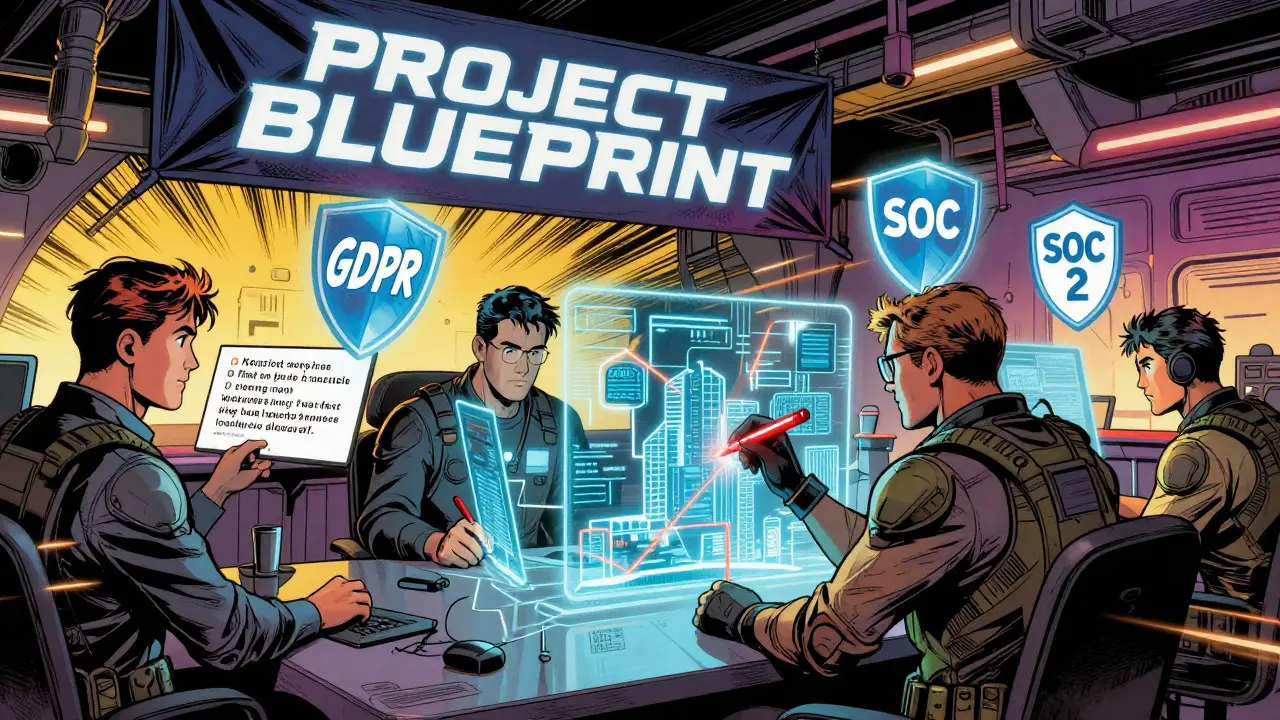
Change is coming. Replit announced "Project Blueprint" in January 2026-a feature set aimed at helping AI understand system architecture, not just components. It’s scheduled for Q3 2026. Vercel’s team is working on "enhanced context awareness," integrating with project docs and version history so the AI remembers past decisions. Betty Blocks is quietly building governance modules for GDPR and HIPAA compliance, though details remain sparse.
But these are reactive fixes. The real breakthrough won’t come from better prompts or faster rendering. It’ll come from tools that think like senior engineers: they’ll track dependencies across files, warn about scalability risks, suggest architectural patterns based on team size and traffic projections, and auto-generate test suites that match real-world usage.
What the Best Teams Are Doing Right Now
Until the next wave arrives, smart teams aren’t trying to replace developers. They’re using vibe coding as a force multiplier.
PixelPulse’s model is telling: business analysts describe requirements in natural language. Senior developers review the AI’s output, fix architecture flaws, and add tests. The result? 4-hour builds with production-grade stability. Gartner found that 82% of successful enterprise implementations follow this hybrid pattern.
It’s not about letting AI run wild. It’s about using it to remove grunt work-so humans can focus on what matters: structure, logic, security, and long-term maintainability.
The Road Ahead
By 2027, Gartner predicts 60% of enterprises will demand vibe coding tools with built-in compliance frameworks. Forrester forecasts "governance-first" platforms will capture 25% of the market. Goldman Sachs projects the market will hit $5.2 billion by then.
But IDC warns: "Tools failing to bridge the planning-execution gap will lose 40% market share by 2028."
That’s the turning point. The next wave won’t be about faster code generation. It’ll be about smarter systems. The tools that succeed won’t just write code. They’ll help you design it.
Can vibe coding replace software engineers?
No. Vibe coding tools are powerful assistants, not replacements. They handle repetitive tasks, generate components, and speed up prototyping-but they lack architectural reasoning, context retention, and governance awareness. Complex systems still require human oversight for design, scalability, security, and long-term maintenance. The best outcomes come from pairing AI with skilled engineers, not replacing them.
Which vibe coding tool is best for non-technical users?
Softr and Replit currently lead for non-technical users. Softr has the simplest interface, ideal for building basic internal tools or landing pages. Replit offers more power with its cloud hosting and multi-language support, and its collaboration features help teams work together without deep technical knowledge. However, both struggle when users need to add custom logic-like payment processing or complex data validation-where manual coding becomes necessary.
Why do vibe coding tools fail at system design?
Current tools process prompts in isolation. They generate code based on the immediate request without understanding how it connects to existing files, databases, or user flows. They don’t track dependencies, anticipate scalability issues, or enforce architectural patterns. As a result, they produce working components-but not coherent systems. This is why 78% of developers say AI handles pieces well but fails at overall design.
Are vibe coding tools secure for enterprise use?
Most aren’t ready for enterprise-grade security. Only a few platforms, like Betty Blocks, offer basic role controls-but even those lack automated audit trails, compliance documentation, or integration with SSO and IAM systems. The EU’s 2026 AI Act requires human oversight for critical systems, which current vibe coding tools don’t satisfy. Until platforms integrate governance features like access logs, change tracking, and regulatory templates, they should be limited to non-critical internal tools.
How much testing do vibe coding tools generate?
On average, AI-generated code from top vibe coding platforms produces only 32-41% test coverage, according to IEEE’s January 2026 study. That means nearly half the code has no automated tests. Teams must manually write unit and integration tests, which often takes longer than the original development. This gap makes production deployments risky without human review.
Parth Haz
February 5, 2026 AT 06:34Vibe coding is a game-changer, no doubt. But let's not confuse speed with sustainability. The real value isn't in generating a login form in 10 seconds-it's in building systems that last years, not weeks. Teams that treat this as a magic wand are setting themselves up for technical debt hell. The future belongs to those who use these tools to offload boilerplate, not to replace architecture. Human oversight isn't optional-it's the foundation.
Let’s be clear: no AI can replace the intuition of a senior engineer who’s seen 10 failed architectures. That’s why hybrid models are winning. AI does the grunt. Humans do the thinking. That’s how you build scalable, secure, maintainable software.
Vishal Bharadwaj
February 5, 2026 AT 08:39lol this whole post is just a fancy way of saying ‘ai sucks at thinking’ like we didn’t already know. you spent 2000 words to say ‘my code broke when i tried to add payments’? dude. that’s not a system design flaw, that’s a user being lazy. if you can’t tell a tool that ‘the cart needs to talk to the payment gateway’ then maybe you shouldn’t be building apps at all. also betty blocks has a 2.8 rating? yeah because it’s the only one that doesn’t let you write code in emojis. fix your expectations, not the tools.
anoushka singh
February 5, 2026 AT 22:59okay but like… why do we even need all this? i just wanted to make a simple form for my coffee shop’s waitlist and now i’m reading about SOC 2 audits and microservices? i’m not even mad, i’m just… tired. can’t we have one tool that just works without me needing a PhD in devops? also, can someone explain why i have to manually write tests again? i thought i was done with that forever 😅
Aditya Singh Bisht
February 7, 2026 AT 09:56This is the most honest take on vibe coding I’ve seen in months. Seriously. We’ve been chasing the dream of ‘type it and it’s done’-but the truth is, the best tools don’t replace engineers. They elevate them.
At my team, we use Replit to generate 80% of our UI components. Then our lead dev steps in-checks the state management, adds proper error boundaries, writes integration tests, and connects the API flows. What used to take 5 days now takes 1.5. And the code? It’s clean, maintainable, and deployable.
The magic isn’t in the AI. It’s in the collaboration. AI removes the friction. Humans add the foresight. That’s the combo that wins. Don’t fear the tool. Use it as a lever. The best engineers aren’t the ones who code the most-they’re the ones who know when to let AI do the heavy lifting and when to step in.
And yes, governance matters. If you’re building for enterprise, you need audit trails. Not because you’re bureaucratic, but because trust isn’t built on speed-it’s built on reliability. Tools that ignore that? They’ll be dead by 2027.
Agni Saucedo Medel
February 8, 2026 AT 09:36👏👏👏 YES. This. Exactly this. I’ve been saying this for months. The tools are amazing, but they’re like a super powerful hammer. If you don’t know what you’re building, you’ll just smash everything.
My team uses vibe coding for prototypes, then hand it off to our senior devs. We’ve cut dev time by 70% and our bug reports dropped by 60%. It’s not magic-it’s teamwork.
Also, I just want to say-thank you for mentioning test coverage. So many people forget that. 32% coverage is basically playing Russian roulette with production. 😬
ANAND BHUSHAN
February 8, 2026 AT 10:53ai builds pieces. humans build systems. that’s it. no need for 2000 words. just say that.