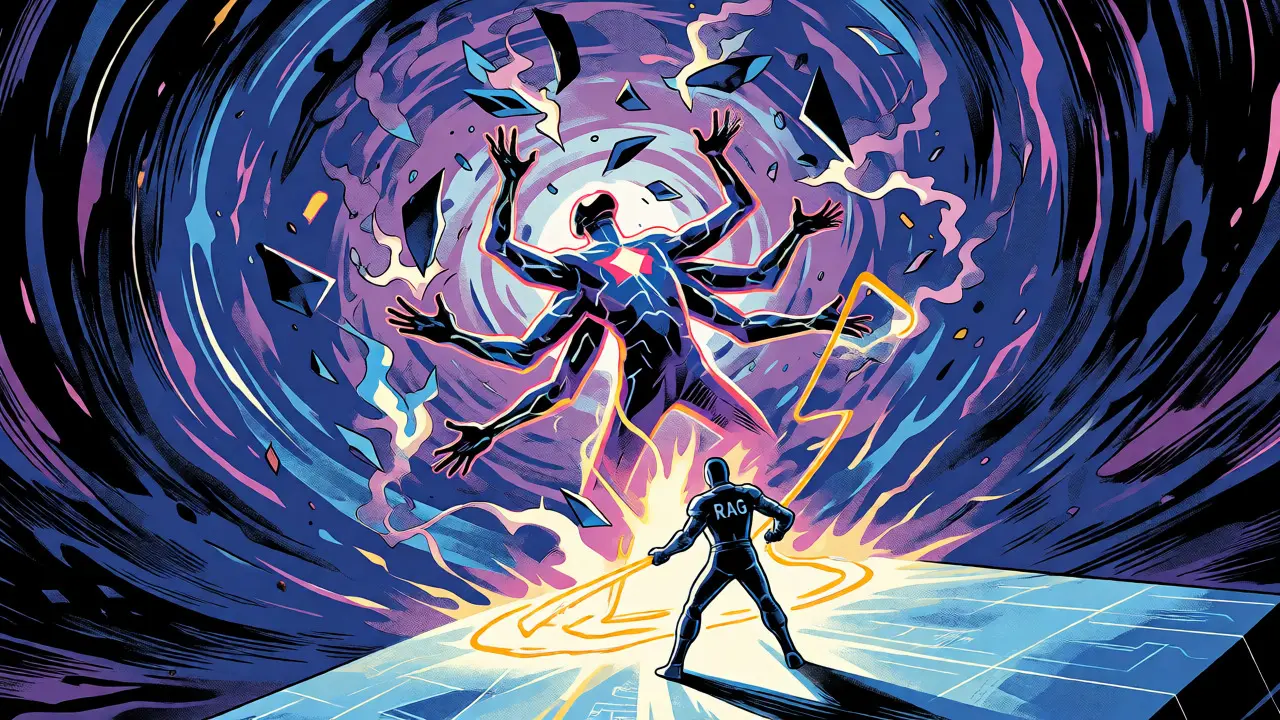
You ask a chatbot for your company’s refund policy. It gives you a confident answer. But it’s wrong. Not slightly off-completely fabricated. This is the hallucination problem that keeps executives up at night. The fix isn’t just better models; it’s grounding prompts. Grounding connects large language models (LLMs) to real, verifiable data so they cite sources instead of making things up.
Think of an LLM as a brilliant student who has read every book but can’t look anything up during an exam. They guess based on patterns. Grounding gives them an open-book test with a library card. Specifically, we use Retrieval-Augmented Generation (RAG) to fetch relevant documents before the model answers. This shifts the AI from "creative writer" to "research assistant." The result? Accuracy jumps dramatically. In one study, hallucination rates dropped from 27% in standalone models to under 3% when grounded. If you’re building or buying AI tools, understanding how grounding works is no longer optional-it’s survival.
Why Ungrounded AI Fails in Enterprise Settings
Large Language Models are probabilistic engines. They predict the next word based on training data, not current facts. If your pricing changed last week, the model doesn’t know unless you tell it. Without grounding, it might invent a price that sounds plausible but is false. This is dangerous for customer service, legal compliance, and medical advice.
The core issue is the Symbol Grounding Problem, first described by Stevan Harnad in 1990. Symbols (words) have meaning only if connected to real-world referents. An ungrounded LLM manipulates symbols without knowing what they truly mean in your specific context. It knows the word "invoice" exists, but it doesn’t know which invoice system your company uses.
Enterprises tried fine-tuning initially. You take a base model and train it further on your data. It helps, but it’s expensive and static. Training costs $15,000-$50,000 per model and takes weeks. Worse, if your data changes tomorrow, you need to retrain. RAG solves this by keeping the knowledge external. The model stays smart; the database stays fresh.
How Retrieval-Augmented Generation Works
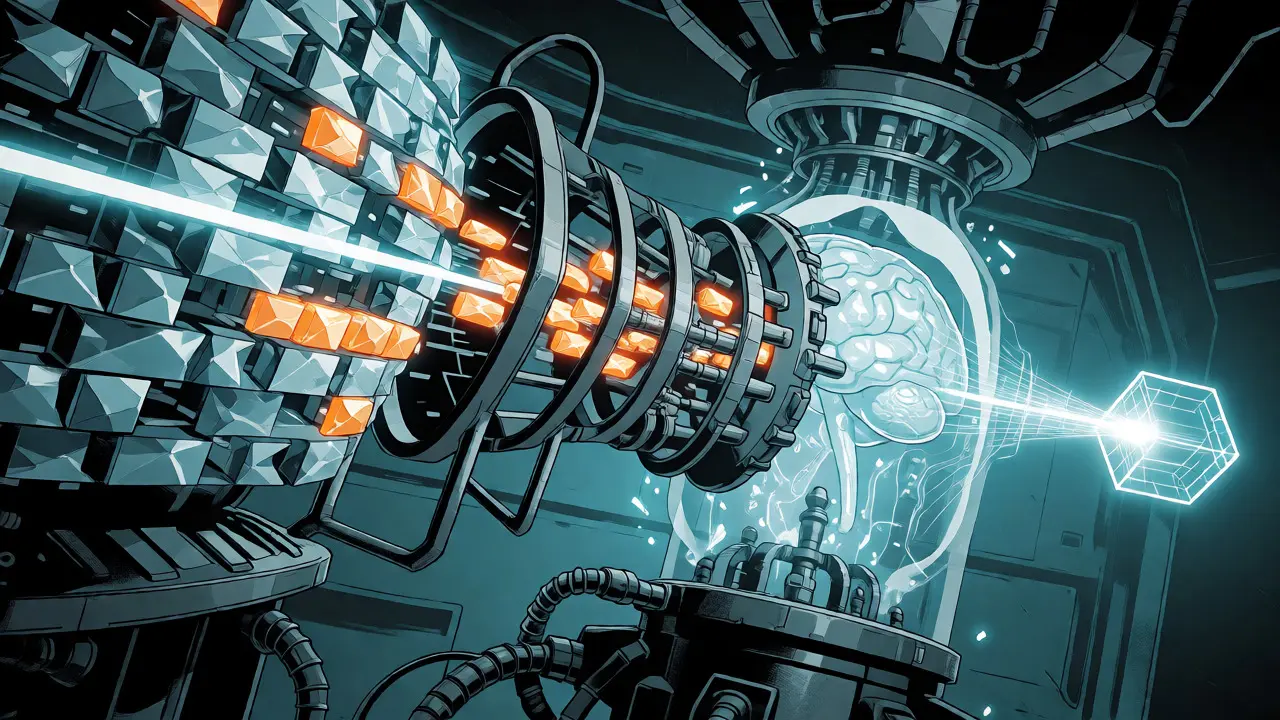
RAG isn’t magic; it’s a three-step pipeline. Understanding this architecture helps you troubleshoot when answers go wrong.
- Retrieval: When a user asks a question, the system converts the query into a vector (a list of numbers representing meaning). It searches a vector database (like Pinecone or FAISS) for chunks of text similar to the query. Typical similarity thresholds are set between 0.7 and 0.85 to ensure relevance.
- Augmentation: The retrieved text chunks are inserted into the prompt sent to the LLM. This is where constraints matter. Most enterprise systems limit this context to around 3,072 tokens to manage cost and latency.
- Generation: The LLM generates an answer using both its internal knowledge and the provided context. Crucially, good implementations force the model to cite the source document ID or URL within the response.
This process reduces hallucinations because the model is constrained by evidence. If the retrieved documents don’t contain the answer, the model should say "I don't know" rather than guessing. However, retrieval accuracy is critical. If the search engine pulls irrelevant documents, the model will confidently generate nonsense based on those bad inputs.
Technical Architecture and Tooling Choices
Building a grounded system requires more than just an API call. You need a robust stack. Here’s how major players handle it in 2026.
| Platform | Key Feature | Latency | Best For |
|---|---|---|---|
| Google Cloud Vertex AI Search | Hybrid keyword/vector search | < 500ms | General enterprise search |
| Salesforce Einstein GPT | Native CRM integration | < 800ms | Sales & Support teams |
| AWS Bedrock | Model flexibility & scalability | Variable | Custom dev workflows |
| K2View Grounded AI | Data mesh integration | < 800ms | Complex data landscapes |
Notice the emphasis on latency. Users won’t wait five seconds for an answer. K2View, for instance, achieves sub-800ms response times for 95% of queries by optimizing their retrieval layer. Salesforce wins on ease of use because it already holds your customer data. Google Cloud excels at handling messy, unstructured documents via hybrid search, which combines traditional keyword matching with semantic vector search.
Pitfalls That Break Grounding
It’s not all smooth sailing. Three common issues plague grounded systems.
- Context Truncation: If your policy document is long, the system might cut off important clauses. A financial services firm reported that 22% of responses omitted compliance details because the context window was too small. Solution: Hierarchical chunking, where summaries of sections are retrieved along with full text.
- Homonym Confusion: Vector search struggles with ambiguous terms. If you ask about "Java," do you mean the island or the programming language? Studies show a 37% error rate on ambiguous terms. Solution: Use metadata filters to narrow down the search scope before vector comparison.
- Stale Knowledge Bases: If your vector database isn’t synced with your live CRM, the AI cites old prices. Real-time synchronization is hard. Many enterprises spend 3-6 months just cleaning and structuring data before going live.
Security is another blind spot. MIT Technology Review noted that 22% of enterprises experienced data leakage during RAG implementation. Why? Because the knowledge base becomes a high-value target. Ensure field-level encryption protects sensitive data elements, as K2View does for 97% of their clients’ records.

Measuring Success: Metrics That Matter
Don’t just trust the vibes. Measure grounding effectiveness. Standard metrics include:
- Hallucination Rate: Percentage of answers containing unverifiable claims. Target < 5%.
- Relevance Score: Human-rated agreement between the answer and the source. Aim for > 90%.
- Citation Accuracy: Does the cited document actually support the claim? Test this randomly.
- Task Completion: Did the user get what they needed? Grounded systems hit 78% completion vs. 34% for traditional search.
Forrester reports a 63% reduction in inaccurate responses when grounding is implemented correctly. But remember, garbage in equals garbage out. If your documentation is messy, grounding fails. One Reddit thread highlighted a 68% success rate with clean docs versus 32% with chaotic internal wikis.
The Future: Multimodal and Regulatory Pressures
Grounding is evolving beyond text. Meta’s RAG 2.0, released late 2023, supports cross-lingual retrieval. Imagine asking in Spanish and getting answers grounded in English technical manuals. Multimodal grounding is next, integrating images and video. Perplexity Labs showed a 39% accuracy boost in product support when the AI could "see" diagrams alongside text.
Regulations are forcing adoption. The EU AI Act specifically mentions grounding techniques to minimize risks of generating false information. Compliance isn’t just nice-to-have; it’s law. With the market projected to hit $14.7 billion by 2027, ignoring grounding means falling behind competitors who offer trustworthy, auditable AI.
What is the difference between fine-tuning and RAG?
Fine-tuning updates the model's weights with new data, which is costly and static. RAG retrieves data at runtime, allowing for real-time updates and lower costs. RAG is generally preferred for frequently changing knowledge bases, while fine-tuning suits style adjustments or niche domains.
Can grounding completely eliminate hallucinations?
No, but it drastically reduces them. Studies show hallucination rates dropping from ~27% to ~3%. Residual errors often stem from poor retrieval quality or conflicting information in the source documents.
Do I need a vector database for grounding?
Yes, typically. Vector databases like Pinecone, Weaviate, or FAISS store embeddings for fast similarity search. Some platforms abstract this away, but underlyingly, vector storage is essential for efficient RAG performance.
How much does implementing grounding cost?
Costs vary widely. Fine-tuning can cost $15k-$50k upfront. RAG infrastructure involves cloud compute and storage fees, plus potential licensing for platforms like Salesforce or AWS Bedrock. Data preparation often accounts for 50% of total project time and cost.
Is grounding secure for sensitive data?
It introduces new risks. The knowledge base becomes a target. Implementations must use encryption, access controls, and audit logs. 22% of enterprises reported data leakage incidents during initial RAG rollouts, highlighting the need for rigorous security protocols.